

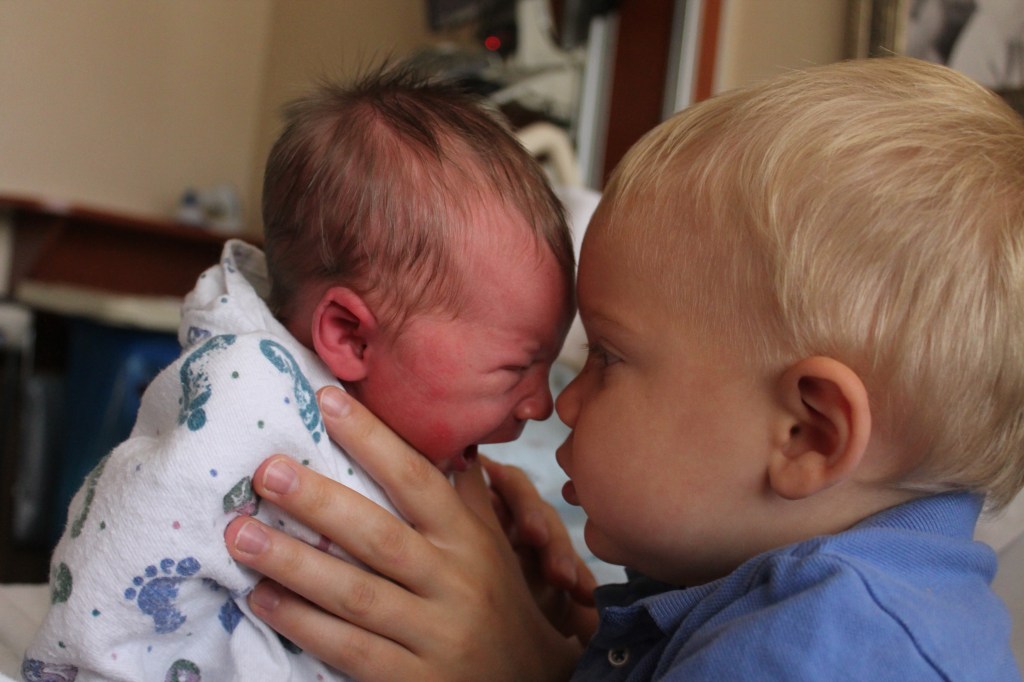
Introducing Clark David, my new little nephew. Welcome to the world, little one. In every step of life, may you find that God is bigger than the unknown. And always know that you are loved.
Introducing Clark David, my new little nephew. Welcome to the world, little one. In every step of life, may you find that God is bigger than the unknown. And always know that you are loved.
It was 2:30 a.m. and I was wide awake, when suddenly it struck me: I’m from a family of writers!
My mom, my siblings, and I all enjoy writing. Of course, we’ve had our share of mishaps. Like the time my mom sent a cheerful email to her siblings proclaiming “Hell to you all!” (she’d forgotten an “o”). Or the time when I was a child making a birthday card for my aunt. The card contained a hidden message cleverly concealed under a square of paper on which I had inscribed “Open the flab.”
Despite these unfortunate skeletons, we continued writing and continue to this day.
Mom comes from a family of unusual vocabulary, a vocabulary which still seeps into her everyday speech and writing. Before having children, she used to write poetry and keep a journal. Since children, she exchanged writing time for reading aloud: tales of Ira, Francis, Ichiro, and a little later, Narnia. Now her main writing occupation is optimistic emails to missing family members.
My older sister and I have stacks of journals. Hers go way back, to when she recorded observations from our childhood such as “Tricia eats like a horse and looks like a string bean.” Even now, she writes captivating emails recording events and people that waltz through her married life.
My older brother is the nerdy, theological writer of the family. When he asked me to help edit his Bible school thesis, I read a bit then stuck to editing grammar, not content. Instead of “This deep point of doctrine would be more indisputable if…” I was penciling in things like, “Maybe this sentence structure needs help???” Of late, most of his writing seems to be going out from the mailbox to a certain Ohio address.
My younger brother kept a journal of our family trip out West. The several pages, which gave a snapshot of the vacation in that moment, also gave some humorous insight to the workings of a 12-year-old mind. It was delightful to find his journal in my stash of papers years later… and give a copy to his wife to read! Now he gets to write sermons rather than record who is eating candy and what music we are listening to.
It was on another vacation long ago that my little sister, wrote an adorable note: “Dad, why do you let your whiskers grow?” Her thoughts have run down deeper lines since then. She maintains her own blog now and is more dedicated to her writing than any of us other family members.
At 14-months, even my nephew scripts his feelings quite clearly (see photo above).
Why do we write? Maybe it was due to those years when our parents instilled in us a love of reading. Those evenings that Mom would take us to the library and we would walk out with 40+ books that we started to read on the way home. The librarian told Mom that we were “good for circulation.”
Regardless of the reason, I’m thankful to be from a family who expresses through writing. For one, it makes living overseas more possible.
How often do I pass judgment without considering another’s perspective? And how often do I whisper that judgment to someone who is willing to listen?
These are questions I have been asking myself recently. Because even if my judgment is accurate, is it edifying? The phrase “speak life” has been rolling around in my brain. But what does it mean to “speak life”? I have a feeling that I haven’t been very good at it.
David says, “Let the words of my mouth and the meditation of my heart be acceptable in your sight, O LORD, my rock and my redeemer” (Ps. 19:14).
So words of life would be words that are acceptable in God’s sight.
Once upon a time, religious people caught a woman in the act of adultery and dragged her out to be publicly stoned. Then seeing Jesus, these people tried to trap Him by asking whether or not the woman should be stoned. Jesus didn’t pick up a stone, but neither did He deny the woman’s sin. He calmed the mob by questioning the state of their own hearts, and then He turned to the fearful sinner crouching in the dirt. “Go, and from now on sin no more.” (Jn. 8)
Those are words of life. Not words of ignorance or denial, but words that give hope.
While I was on the 15th floor of an office building in downtown Chicago, my siblings were lounging in a plaza across the street, discussing how I had been strong and calm before my appointment. “But when she comes out, she will collapse.”
They were right. Of course they were. They had watched me meticulously gathering my paperwork over the last several months. I had read everything once, twice, a dozen times. They had seen me bend over backwards to satisfy the requirements of a Spanish residence visa.
Fifteen stories up in the one-room Spanish consulate, I watched two other applicants turned away due to unsatisfactory paperwork. Would I be next? I had tried so hard, but had I missed something? They called my name.
I was so nervous that I couldn’t even read the tidy sticky notes that I had stuck to my paper-clipped and stapled stacks of paper.
“Application form?” The accented voice was muted through the glass window.
I slid the form through the slot. Why didn’t they have personal interview rooms instead of making us feel like paroled prisoners requesting our belongings?
“Letter of invitation?”
Another man approached and looked over my interviewer’s shoulder. They discussed something in great length and jotted some notes on my application form. I stood, breathless until nearly purple. Was something wrong? Didn’t I have the right papers?
The second man asked me a few questions with an alarmingly furrowed brow. I deflated. But it was okay. I would have to start over with some of it. But at least I could go home now. I could just climb in that shiny elevator and disappear.
But the man said, “Okay, I trust you. I will try to get it to you in time.”
I wasn’t sure what he was “trusting” me about. The answers to the questions he had asked were on the papers in front of him. But I didn’t ask him to explain himself. Prolonging our talk felt risky.
“Proof of insurance?”
I slid my translated insurance letter through the slot. The list went on until I had handed over every one of my documents. There were no complaints, no outbursts, no declarations that I hadn’t gathered the correct things.
The interviewer gave me a curious glance as I packed up my things. Perhaps he was analyzing how I would survive in Europe. But I didn’t care because gliding down 15 floors in a polished elevator was my red carpet.
Now the waiting would begin, and with it came the possibility of a rejected application. But for today, I could be done!
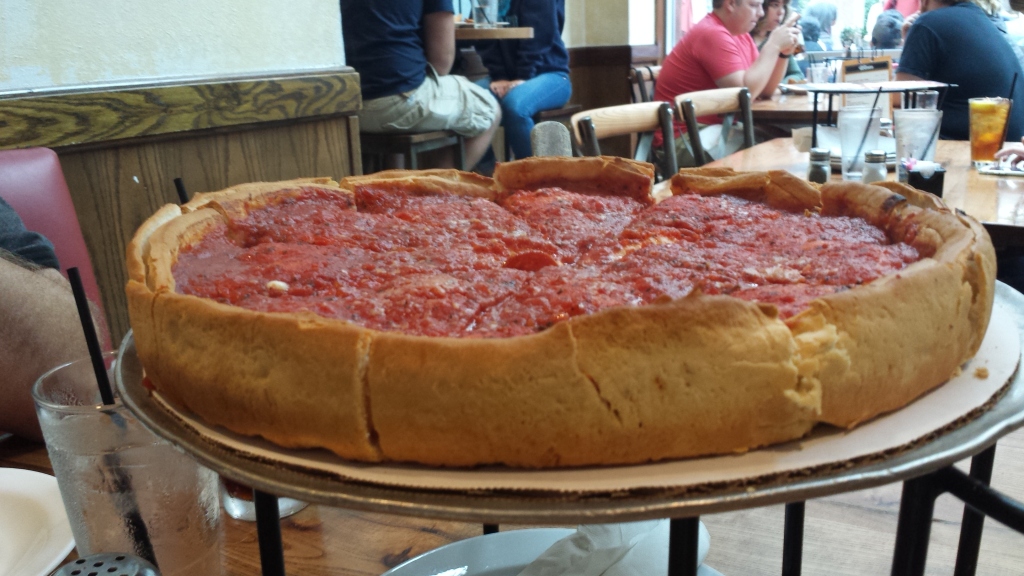
That is why I collapsed when I saw my siblings waiting for me in the plaza. And then we went to Giordano’s for celebratory deep dish pizza.
If you haven’t already, check out Part 1 and Part 2. Continuing the discussion of stereotypes other cultures have of Americans, and why I’m still glad to be one…
Freedom of speech.
Some people may abuse this, but I for one, and glad we have it. It’s wearing to be conscious of everything you write in light of a government’s definition of acceptable and unacceptable.
Our government.
Despite political corruption, it is important to realize that we still have a relatively uncorrupted government compared to much of the world.
A diverse country… in more than just scenery.
I love being in the city where I see a variety of people groups. I love trying out ethnic restaurants. I love those moments when, as a white American in American, I feel like a minority. Rather than feel threatened to be outnumbered, I am honored to be a part of America’s diversity.
Access to [almost] everything.
Sometimes it means you have to pay dearly, but it’s almost always there. Exotic Asian fruit. Aromatic African spices…
English
Do you realize that learning English as your mother tongue means that you’ve already learned one of the most useful languages in the world?
These, of course, are not exhaustive lists. What are some stereotypes you have or have heard of Americans? What are some positive aspects to being an American?
Photo by Donovan Reeves on Unsplash



 My Thoughts From Afar |