Do you want to know the apricot tree?- Part 1

Just a quick trip to the store and I would be back in a jiffy. Humming, I pranced down the flights of stairs and onto the street that baked in the warm March sun.

“Peace be upon you,” I greeted the storekeeper.

“And upon you.”

A woman was in front of me at the counter. She turned to me with an intrusive stare. “Is she English?” she addressed the storekeeper.

“No, I’m American.” I answered for myself and then looked away to avoid further questions.

Some North African women could smell evasion. They went around, rooting out people who dared to hide anything from them. Her eyebrows lifted. “You speak Arabic?”

“Yes. I live here.”

“How much do you pay for rent?”

Really? All I need is two eggs. I bit back a smart reply that would probably be effective. It would also probably be rude. So I cleared my throat and tried to dance around the question. “I live with two other girls.”

The storekeeper was smirking. I could feel it more than I saw it. But despite our months of trust-building and extraordinary civility, he refused to come to my rescue. Then again, maybe I had rescued him.

The woman hung on like an un-oiled tick. “But how much do you pay?”

Exsparated, I gave her an amount.

She gasped. “What? All of you pay that together?”

A gusty sigh escaped before I could stop it. “Noooo. Each of us pays that amount.” I had yet to acquire the linguistic ability to defend myself and my private information around women like her.

“Oh.” She glanced at the ceiling as she did some quick math. “That’s not very much.”

Glad you think so. Now, could you please finish?

When she had vanished, carrying with her the essence of satisfied control, I stepped up the counter, deflated. “Eggs.”

“How many?” The store keeper was still smirking.

“Just two.”

Enjoying the journey

“When I’m finished with school-”
“After work today-”
“When we get old, we’ll retire and be able to do the things we always wanted to do.”

Sound familiar? Those words could be snatched from the mouths of most western culture citizens.

That’s when I look at North Africans and realize that they understand the brevity of life better than we do. For many of them, it’s not about the next thing; it’s about today.

I thought about it while shopping one day. It would have been much simpler to taxi to the supermarket and buy all of my groceries in one place (and sometimes I do this). Instead, I went from little shop to shop, little vendor to vendor to find what I was looking for. I was not just another face in the checkout line; I was “my sister” to some of the shopkeepers. There was conversation and relationship.

It wasn’t about being efficient; it was about having interaction. It wasn’t about finishing the task; it was about enjoying the moment that you have while you have it.

This method of thinking has its drawbacks, but it is a rich way to live life. Maybe someday I will learn how to implement it in my western mindset. 

Picky eater

“Picky eeeeeater!”

I heard that phrase a lot as a child, mostly from older siblings. As I grew up, I learned to like more foods, as most children do. But living here in North Africa, I have come to a deeper understanding of “picky eater.” North Africans are the pickiest eaters I have encountered in my limited international experience.

Why? Well, that’s the question I have been asking myself since I arrived.

In my opinion, most of the answer can be found in the pride the people have for their own cuisine. On my last trip home from Spain, I sat beside two men on the plane–one from North Africa and another from South America. This was the conversation:

South American: Is the food here good?
North African: It is the best in the world!

They hadn’t asked my opinion, so I sat, pondering the unmasked pride of the North African. Granted, the food here is good; I love it. But I also know that there are other flavors out there besides cumin, olive, dried fruit, lemon, and garlic. And how many other cuisines had this particular North African tasted?

In fact, how many ethnic restaurants does my city have? The few scattered here and there have to be sniffed out by a detective. Unless the three fast food restaurants count as American. There is also a pasta place in the mall. Italian, I suppose?

But the other restaurants seem to have exactly the same menu. It’s like the few things they do, they do well…but they remain few. And that’s all the people have ever known. So anything foreign is unwelcome because, of course, it could never measure up anyway!

When I make food for local friends, I select recipes with care. Something North African would not suit because as a foreigner, I wouldn’t prepare it correctly. Therefore, I must try something American but with the prominent North African flavors.

But once, a friend came to visit me unexpectedly. Although hesitant, I offered her some of the stir-fry I had just made. She tasted it and has been talking about that “salad” ever since, hoping to replicate it in her own kitchen.

That gives me hope that with more globalization will come more exposure to various cuisines and hence fewer picky eaters in North Africa!

Adventure on Hardware Alley

My motive was to not look lost. I fingered the plastic washer in my pocket as I turned down “hardware alley,” a street lined almost exclusively with hardware stores. Lest you question the logic of this arrangement, note that most of the stores specialize in certain areas such as light fixtures, mirrors, tile, etc. And often, they don’t overlap merchandise. For example, only one or two stores carry little items like screws, nails, and washers.

Which was exactly my problem. I had yet to ascertain which stores I needed to visit and I felt out of place tromping from store to store on a street operated and patronized mostly by men. My task was to find metal washers to replace the plastic ones that had come with our new toilet seat. Ideally, the metal would grip the porcelain and keep the seat from sliding around.

When I whipped out my plastic washer for the first store owner, he pointed to the store next door. The store next door did indeed have washers.

“What do you want them for?” the owner asked.

I was embarrassed to admit that I was trying to fix a toilet seat. After all, this man was from a culture where Western toilets were the exception rather than the norm. So I offered a blank smile and pretended not to understand his question. Sometimes being a foreigner is helpful. Then again, being a foreigner was what got me into the situation in the first place.

The man eventually dug out two metal washers. They were small, but they were the only size he had. He suggested I keep looking for bigger ones and if I couldn’t find any, to try out the ones he had given me. When I pulled out my wallet, he said, “No problem” and ushered me out of his store.

I stopped at a third store where the man shook his head and told me to try another store.

“Where?” I realized how ridiculous the question was as I asked it. My directional comprehension still had much room for improvement. I prepared to nod and smile despite the fact that I wouldn’t understand.

And I didn’t understand everything, but I understood that the store he recommended was somewhere in relation to a nearby bank. So I meandered around, trying to look purposeful rather than lost.

Eventually, I made an educated guess and entered a store that was overcome with men. (One of my friends refers to such places as “the valley of the shadow of men.”)

I sidled up to the counter. “Do you have something like this…” I plunked the metal washer from the second store owner on the counter. “But bigger. Like this one…” Another plunk as I set the larger plastic washer beside the tiny metal one. “But not plastic.”

The owner didn’t give me any smart remarks or pick-up lines. He didn’t even give me a strange look. He just asked how many I wanted and fetched me precisely what I was looking for.

I fought the urge to cast a smug look around to see if anyone was astonished by my smooth purchase on hardware alley.

Aisha- part 3

Isolated. That was the flavor of the air as we walked down streets that were merely variations of the same. I was the only foreigner in the neighborhood, strange considering that just over the hill, tourists were thick within the shadowy walls of the old city.

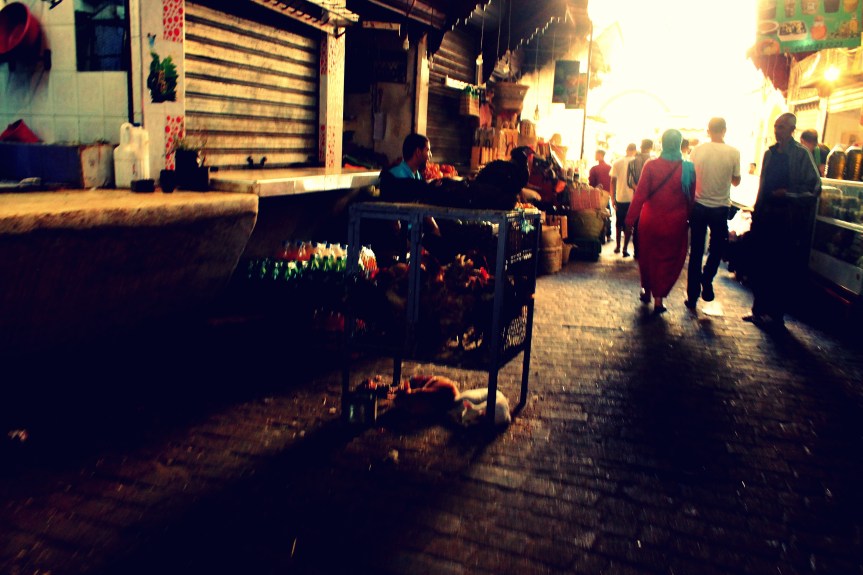
But here, crumbling buildings full of tiny apartments stretched toward the overcast sky. Cobblestone streets cupped leftover puddles and floating litter. Laundry was strung everywhere: on wires, through window grates, on rooftop clotheslines. Curious faces darkened whitewashed doorways and window ledges. Children danced along the streets in endless game.

Much of the world was happening outside. Together. As if the culture didn’t realize that people didn’t have enough room to live.

Our first stop was a relative’s home. We entered a low doorway and were enveloped in a world of chattering woman. It was a noise that trailed up several flights of uneven concrete steps. There Aisha picked up her 1 1/2 year-old son. And there, we were offered coffee so sweet it made my teeth cringe. My coffee cup smelled like the residue of someone else’s saliva. I smiled and drank the coffee anyway. Our hostess was a dainty woman. Her face was young, but her smile revealed only a few teeth scattered along her gums.

I met in-laws, nephews, sisters, and other connections I no longer remember. It didn’t help that I was struggling to remember my family vocabulary! After a few more stops, we wound our way to Aisha’s apartment. She insisted on carrying the juices I had brought with me even though she was also carrying her little boy.

The apartment building was cold and concrete. With every floor that we climbed, I would turn and ask Aisha, “Here?” She would shake her head, “Still!” She said that all of the way to the sixth floor after dozens and dozens of uneven concrete steps.

In each woman, there is a certain amount of pride for her home. Aisha was no exception, although her home consisted of a closet-sized wash room and kitchen, one salon, and one bedroom. That was all.

Aisha’s 16-year-old daughter Soukaina and I walked out on the roof to stare at the world six stories below. Heads walked by–heads without faces from my point of view. A woman dumped a bucket of water over the cobblestones in front of her home and scrubbed vigorously. Two little girls played school. A man propped himself in the doorway and watched the world. A woman two doors down did the same. But it wasn’t just the street that was alive; all throughout the apartment towers, people were moving: appearing in windows, hollering to someone below, gathering laundry on the rooftop, smoking a cigarette, or talking across the street with someone in the opposite building.

Once Aisha ascertained that I liked couscous, the lunch preparations began. I offered to help once, but only once. I was a guest. When the food was ready around 4 p.m., the family pulled down the table for my sake. (I heard the father say, “She’s American.”) There were some other random family members around the table, and I couldn’t remember exactly how they fit in the family. But it didn’t really matter.

We all dug into the center plate. Aisha kept tossing potatoes and carrots onto my side of the platter. Whenever I tried to stop eating, they demanded I eat more. No amount of “I’m full, praise God!”s could satisfy their vicious desire to watch me glut myself.

For me, mealtime was tense because in their attempt to honor me, they set my presumed needs so far above their own comforts that I felt the separation deeply. I was given two cushions to sit on at the table and the older woman present was given none. When I tried to share, I only succeeded in raising a chorus of protests. I was incapable of experiencing their everyday life because I had the prestige of a guest.

After an hour of TV and conversation over the TV, the preparation for the afternoon tea began. I offered to go with Soukaina to buy doughnuts, but the father turned down my offer on account of my being American. “This is not like the new city!” he declared. My presence would attract attention and a 16-year-old companion didn’t provide the necessary protection.

More female relatives joined us for tea and the conversation livened. We laughed, ate, and took pictures. And then it was time to go. We descended–down down down–until the precarious stairwell spewed us onto the narrow cobblestone street again.

We sloshed through the evening drizzle to the taxis. Aisha and Soukaina tried to accompany me home in the taxi, but when I put up a protest that rivaled their insistence, they relented. But Aisha gave the driver precise instructions where I needed to be deposited and made sure that I had enough money with me. I kissed them both goodbye.

For now.

Irritating?

Being immersed in a new culture reveals that some cultural customs are bad, some are neutrally different, and some are good… sometimes better than they are in our own culture.

Quite honestly, something in this culture grates on my nerves. It doesn’t happen every day, but when it does, I find it inexpressibly irritating.

As I walk along the street,  I meet passersby who look like they lead normal North African lives. Then without warning, one of these normal-looking people veers in my direction and holds out their hand for money. It’s as if seeing me, a foreigner, makes them remember they are not satisfied with their normal lives.

Irritating? Quite. I am a victim of racial profiling.

Well, today as I walked to school, I began to rethink this irritation of mine. What if, instead of looking at me and recognizing their lack of money, they looked at me and recognized their lack of something much greater, Someone much greater? What if, by seeing me (not as a foreigner, but as a friend), they realize that they are not satisfied to live a normal life?

And when that happens, will I be ready or will I be irritated to share what I have?