
Mi casa es tu casa

My neighbor’s hands were slick with oily meloui dough when the doorbell rang. “Could you get that?”

I opened the door and gave a cheerful “Salam walekum!” The young mother greeted me but backed away with popping eyes and an apology. 

“No, no, no, you came to the right door.” I grinned. “Welcome.” I had dropped by to play with my neighbor’s little boy. Soon I had three little people to play with and a mother who stood beaming over me, incredulous that I was there on the floor stringing monkeys from the doorknob and reading about 1-2-3 with Winnie the Pooh. The new little girls wanted laptime too.

Amid the chaos of the younger generation, I heard snippets of the visitor’s story, a story that didn’t match her sparkling eyes. Then we ate meloui, tiny cooling pieces at a time. I ate mine, trying not to sprinkle crumbs on the smooth little pigtail bobbing just below my chin.

“This is such a great day,” my neighbor sang as she shuffled us around the table in order to reach the fridge. “My friend came and my neighbor!” She smiled and began sorting through last week’s cilantro. 

If I hadn’t known, I would not have guessed that her son had been sick, refusing to eat and wailing day and night for several days straight. In desperation, his parents had hauled him to the ER where he got the medication he needed. 

Low on sleep on top of a distorted schedule, would I have been cheerful to have my house overflowing with people?

You could argue that hospitality is required in Islam and therefore, whether or not they feel it, North Africans are hospitable. True. But most North Africans are not just hospitable because they’re required to be; it’s less of a conscious choice and more of an integral part of life.

Another night, my neighbor, her friend, and I walked to the park. There, we joined up with several other women. Our bench seated three and squished four. We were seven.

Had we been American, we would have chatted briefly and then half of us would have moved to a nearby bench to sit. However, North Africans value relationships much more than they value comfort… and relationships require time spent together. So three of us stood or chased renegade children while four sat hip to hip. Every now and then, someone wedged themselves out of the line-up and gave another the chance to sit for a while.

I came home from that outing, over-stimulated and linguistically exhausted. The sound of my key turning in the lock was absolutely musical. I am American and I value both personal space and comfort. I will probably always value those two things. Those values and solid relationships aren’t mutually exclusive when others prioritize the same values.

But what about when they don’t?

I’m still pondering what it means to be an introvert in my line of work–What does that look like practically? (Maybe someday I’ll be brave enough to explore this on my blog.) But I will say this: even in my exhaustion, I also rejoice in the beauty of a culture that decidedly values relationships and community, even at the expense of individual preference.

Why I don’t understand white

While I was working my way through college, I cleaned a doctor’s mansion that needed this floor cleaned with vinegar and that one cleaned with mopping solution and the other one wiped dry, and well, yes. 

I hated cleaning (and still do), but I did it for the money, considering it a comfort issue rather than a class distinction. Then one day, I overheard the doctor telling her friend that she didn’t really need a cleaning lady but, “They need work.” 

They?

I’ve carried that with me for years as a reminder of the lines that people draw between “us” and “them.” The lines that I draw.

“I think I finally saw a little bit of what you see every day,” I told a Latino co-worker later that weekend. I don’t remember what he said, but I remember he acted embarrassed that I, a white middle-class American, even wanted to discuss discrimination.

How can I really understand white privilege when I’m living it? When I stepped out of my white world and moved to North Africa, I began to have an inkling of the disparity between white and other colors. North Africans love foreigners… Well, they loved me and I was white. Now, in a Spanish province chock-full of immigrants, I’m not blind to how immigration officials relax when they see my blue passport. 

“Are you looking for an apartment for you?” one realtor asked during my apartment hunt. “Because if it’s for an Arab, I have nothing.”

“It’s for me,” I assured him, startled by the blatant discrimination. What would it be like to taste rejection on account of my skin color or my nationality? I honestly had no idea.

The occasional Spaniard lumps me in with the North African crowd, and not in a good way. In those times, my blazing internal response runs along the lines of, “How dare they?! They don’t know me well enough to judge me!” 

True. They don’t. But my subconscious assumption is, “If they only knew who I was, they would treat me better than this.” If they only knew I was white because white deserves special treatment. 

How I hate that I subconsciously believe this! Yet, it’s not hard when it’s all I’ve ever known. 

I’ve been watching other immigrants and I wonder. While I am busy taking offense at any implication of discrimination, I see most Arabs and sub-Saharans accepting it as a matter of course. They’re used to being used and unwanted. 

I’m not. Has the special treatment of whites the world around made me more fragile, more threatened by opposition? I say this because I am weak, I am white, and I wonder.

We must endure

“Pero que hacemos? Hay que aguantar.” But what do we do? We must endure.

The phrase caught me off-guard. I am used to hearing North Africans talk like that, especially if they throw in a “praiseGod” or dozen and shake their heads with wry smiles that say what their words don’t. And then their words do, but they are followed so closely with more resigned “praiseGod”s that it all feels more like a question mark rather than a confirmation of faith. But I am not used to hearing Spaniards talk with the same resignation. What happened?

Meanwhile, in America we clamor for platforms that offer unfiltered voice on topics we may or may not understand when, in fact, the world would be better off if most of us suffered from stage fright. 

Are these our only options? Resignation or dogmatism?

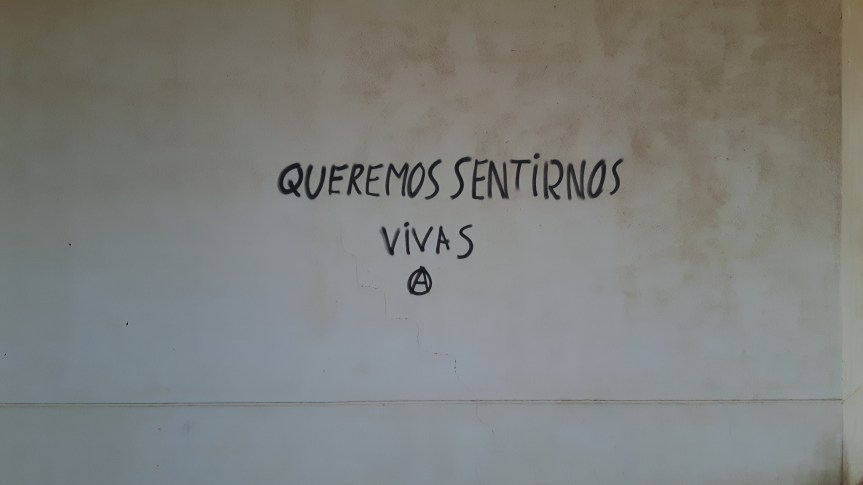
Almost every time I walk across town, some wanna-be graffiti slapped to the side of a décor shop catches my eye. “Queremos sentirnos vivas” We want to feel alive. It sounds like a cry, not to oppressors, not even to God, but just hurled into space from a spirit that wants more than resignation or dogmatism. It reminds me of another of another cry:

During those many days the king of Egypt died, and the people of Israel groaned because of their slavery and cried out for help. Their cry for rescue from slavery came up to God. And God heard their groaning, and God remembered his covenant with Abraham, with Isaac, and with Jacob. God saw the people of Israel—and God knew.

(Ex. 2:23-25)

Even though the cry was not to God, God heard and God knew. And He liberated His people. After this liberation, the following years in the desert were so hard that the ex-slaves began to daydream of life back in Egypt (Num. 11:5). God had promised a land flowing with milk and honey, but not yet.

Today as headlines continue to make history in ways we never would have chosen, we too are in that “not yet” pocket, basking in salvation (already) and looking forward to God’s promise of heaven (not yet).

What will choose in the meantime? Resignation or dogmatism?

Or life. Abundant life (Jn. 10:10). After all, we have a guarantee of our inheritance as heirs with Christ:

In him you also, when you heard the word of truth, the gospel of your salvation, and believed in him, were sealed with the promised Holy Spirit, who is the guarantee of our inheritance until we acquire possession of it, to the praise of his glory.

(Eph. 1:13)

We don’t just have to endure and parrot “praiseGod.” We don’t all have to share our opinions about every topic all the time (and resent those who disagree). We don’t even have to assign divine meaning to suffering.

Yes, hay que aguantar, but that is not all. Whatever “not yet” desert we are stumbling through today is not the end of our stories. And right here in the middle of the dry, we can sentirnos vivos because the gift of abundant life transcends our desert.

Recipe fail: mousse au chocolat

We tried. Twice. And then I tried by myself a third time. I am still determined. Every time I think of mousse I had in France, I begin stockpiling chocolate and cream.

The first failure was completely my fault. My roommate and I had even purchased precious raspberries to garnish the mousse. But then I tried to whip the egg whites in the same mixer that I had just whipped the cream… without cleaning the bowl.

Yah, so I didn’t know.

We tried again. In the meantime, we watched the cream and chocolate mixture slowly sinking. What should we do? We decided to stick the chocolate mixture in the refrigerator to preserve it. Wrong choice. When we finally folded in the egg whites, we discovered that the chocolate had chilled into ribbons.

We still ate it and it was still amazing especially with luscious raspberries, but we knew we could do better.

So we tried again about two months later. This time, it would be perfect! Instead, we over-whipped the egg whites so that they settled into little pools in the bottoms of the ramekin dishes while we ate dinner. Plus, the chocolate had sat too long and so, although it was warm, it wasn’t warm enough, and beaded as we folded it into the cream. So the mousse was grainy and watery. But somehow still amazing.

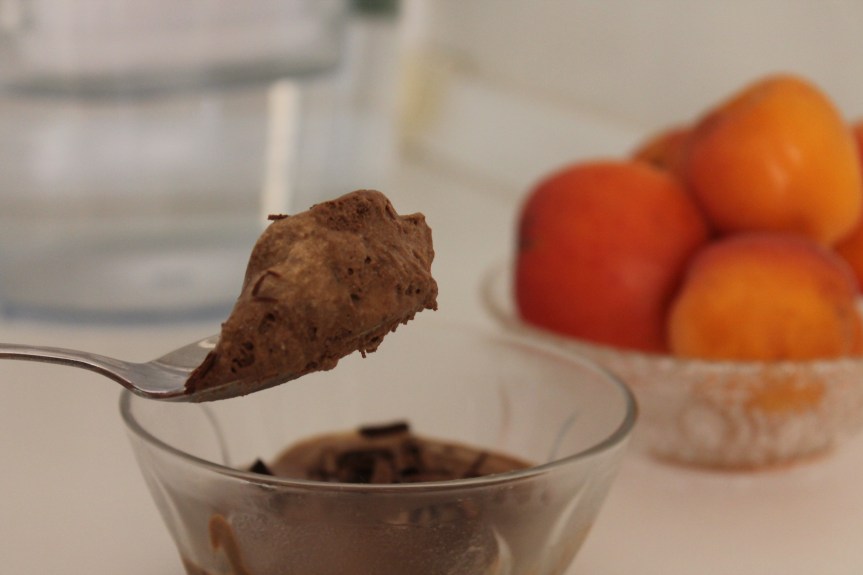
small dish of chocolate mousse with chocolate shavings

But I knew we could do better. So one afternoon, I had a guest and decided to try a third time. I felt fairly confident even though I was on my own this time. I would whip the whites into perfect elf hats and whisk the yolks into the chocolate while the chocolate was still warm enough.

Instead, the chocolate stiffened when I whisked in the egg yolks. I tried heating it again, but you probably know how that goes. In the meantime, the egg whites began to sink.

With nothing to lose because it all was a failure anyway and I would just have to serve my guest snack mix and pretend I had never tried, I whisked the globby chocolate mixture into the cream until it was 100% incorporated (forget the 10 folds limit!). Then I folded the sagging whites into the chocolate and cream, poured rather than spooned it into ramekin dishes, grated some chocolate on the top and stuck it in the fridge for time out.

I pulled it out before my guest arrived, just to sample it. Heavy instead of fluffy. A little like mousse meets fudge. Before I realized it, I had eaten the entire dish, but don’t worry, there were 3 more dishes to share with my guest. 😉

If anyone has a mousse au chocolat recipe that is easier than what I’ve tried, I would love to have it! (Note: none of the chocolate pudding and cool whip stuff. I love that too, but it will never transport my taste buds to France.)

Or maybe you have your own mousse story…

Welcome to Mytown

Nobody told me “Welcome to Mytown.” I had to interpret their welcome in other ways. 

Most don’t seem to know in which box to put me. So they gawk. Is this some weird North African-Spanish hybrid? Romanian? Russian? In small-town Immigrantville, people knew where I belonged, but in Mytown, a larger city, they don’t.

Sometimes, I enjoy shocking people. Once, I walked into a halal butcher shop and greeted the owner in Arabic. He began a lively exchange, incredulously. Arabs are varied enough that though light complexions are not common, neither are they impossible. Sometimes Arabs just assume I’m a rare breed of themselves. “Syrian? Palestinian?”

But other times, people can be downright rude. While I was waiting at the bus station with an Asian friend, a man sauntered over. He deliberately stopped in front of us but said nothing, just eavesdropped. After my friend left, he and two of his buddies approached me.

“Where are you going?”

“Where are you from?”

“Where is your friend from?”

And then, “What you don’t find in Mytown!” as if I, apparently a freak of geography, weren’t standing right in front of them.

Once, I stopped by the café next door to drop off something for the owner. My unanticipated entrance startled the old men circling tables of dominoes. As I walked out only seconds later, the rowdy conversation had ceased. The only sound was the clink, clink of dominoes.

Although I still don’t know them well, my neighbors have been fabulous (except one), offering to help me with things, greeting me on the streets, holding doors open for me, and so on. One gave me a watermelon when I happened upon him rolling watermelons to the front door. 

“You want watermelon? You have a family? Children? Take some!”

I imagined myself rolling little watermelons through the front door to the elevator like he was doing. “Thank you. Just one.”

“Just put it over there,” he suggested, probably because he didn’t want me squeezing into the elevator with him and the watermelons that wobbled around his feet. “No one will take it,” he assured me. 

I balanced my watermelon on top of the apartment mailboxes, confident that he was right. We were both wrong and I never saw my watermelon again. But that same night, a neighbor asked me to drop by and pick up some sweets she had made me. Those fried balls of dough dripping with honey were sweeter than the watermelon in more ways than one. 

My acclimation to Mytown is taking longer than I had anticipated. When I mentioned this to a woman at the bus station, she peered at me over her glasses and explained that I shouldn’t just be friendly to everyone I meet because there is no reason to trust them. You have to grow your friend base slowly and carefully, she said.

If this is how people think, no wonder they greet my persistent friendliness with suspicious stares!

Then, still watching me over her glasses, the woman said, “I’ve been living in Murcia for 16 years and I still haven’t grown used to it.” Well then, I guess 3 months isn’t so bad.

Telemarketers and tempers

I lost my temper. Telemarketers had been calling at least twice a day for weeks, making me jump, startling me from whatever I was doing to dig my phone out of my bag in the middle of the store or turn off my bluetooth speaker. They called from various numbers but they always played the same music when I answered. Because of my pending residency, I didn’t have the luxury of not answering calls from unknown numbers. Initially, I told them I wasn’t interested in their internet offer, and then mostly just ignored them. But one day I lost my temper.

“Look, who are you with? Stop calling me! I’m tired of you calling me! Do you understand me?” My rush of emotion garbled my Spanish.

“No, I don’t understand.”

“Who are you with?” I demanded again.

She hesitated split second, thrown off-script. “I’m calling for María…” Liar.

“I’m not María and I have had this number for three years!”

“I’m sorry for bothering you.”

After I cooled down, I began to wonder if this poor lady had received the brunt of my anger at a Spanish demographic. Not at Spanish culture as a whole–more often than not, I view the culture as a welcome Western break from North African culture–but at a certain bossy attitude I bump into. In America, the current lingo has something to do with the name “Karen” (which I believe is an injustice to the name since no Karens I know act like the memes). It’s the women who believe it is their duty to uphold every law they can get their hands on. And they enforce invisible laws too. 

“You can’t sit there! We’re supposed to keep a distance of 2 meters!” The bossy voice at my ear caused me to jump.

And the familiar dread rose. “No?” The last I had heard was that we were allowed to sit side by side on the bus. Had regulations changed again?

The man behind the sharp voice piped up: “Yes, we’re allowed to sit with a partner.” His tone was just as blessedly bossy.

“No, we’re supposed to keep a distance of 2 meters!” she bugled. 

I closed my eyes. As if anyone on the bus could sit 2 meters apart. Then again, I sure wouldn’t mind having more than 2 meters separating me from that voice. They fought it out, those two equally matched enemies while I sat, staring forward, trying to talk myself out of venomous irritation.

Sometimes I deserve a reprimand as I cut a corner here or there. Most of us probably do. After a sharp comment at the post office after I violated a hyper-enforced regulation (Note: no getting a number to wait outside while “Karen” is on duty), I obediently returned outside and pondered what in the world made me so angry about that attitude. Spanish culture is abrasive, yes, especially for thin-skinned Americans, but this went deeper than hurt feelings.

Then I found it: shame. It was shame. Every time someone barked at me, whether or not it was to enforce a covid regulation (or an imagined one!), they reinforced my sense of incompetence in their culture. And deeper still, they contributed to a deep-seated fear that I did not nor would I ever belong. 

That fear is what bubbled to the angry surface with the unsuspecting telemarketer. The solution? Probably a cocktail of growing a few more layers of skin as long as I am a “stranger and pilgrim” while simultaneously rooting myself deeper in the One I belong to.

I’m still working on that, but in the meantime, I’m learning that shouting at telemarketers probably doesn’t solve anything. Although, they haven’t called me since that day…

Good

It’s not that we don’t believe You’re good because we know You are.
It’s not that we don’t believe You can heal because we know You can.
It’s just that we ask ourselves if You have her best in mind, 
And by association, our best.
Not doubt exactly, but frozen waiting for Your next move
Even while begging You to take this cup from her.
Can we yield to the nevertheless-not-our-will
And trust Your goodness without knowing Your plan?
Because it’s not our understanding of her good, 
But Yours, O Restorer, Redeemer, that’s tucked into Your promise.

Photo by Patrick Fore on Unsplash

The “little” of what’s happening

Today you get bullets because that’s how my thoughts are arriving. After most of a day buried in a textbook, my brain is sore. There are big things happening in life right now, probably for both of us. But today, I’m bulleting the little things, the things that fall between the cracks of the bigger things because they don’t announce themselves but wait to be noticed.

  • There is a plant store nearby with inexpensive little green things. My pots and plants were a little like chips and salsa– too many pots, oops! too many plants, oops! and so on– until the day I walked past the plant store and the shopkeeper greeted me like an old friend. That was my wake up call.
  • The first tray of cookies I put in my convection oven, I grilled. I couldn’t find the user’s manual in my landlord’s things until the first singed round emerged.
  • I passed out cookies to my neighbors, my heart pounding all of the way to my toes. It was thrilling in the sense that I had no idea who would open the door– man, woman, child and what nationality– what their response would be, or if they would have a frothing rottweiler at their side.
  • A shopkeeper glowed when I asked him a question in Arabic and rattled off something that started with, “You understand Arabic!. I thought…” He rattled on for another paragraph before noting my blank expression.
  • Two long-time friends visited me in my new apartment, and reclined on those couches that were meant for dear friends to recline upon. 
  • I found cookie butter at my local Día!!! (I just found it. I haven’t bought it… yet).
  • Meanwhile, I discovered that the post office no longer carries stamps to the U.S. of A. How does this happen, Spain?
  • My old roommate and I accidentally spent some time wandering the beautiful old streets of Almería while trying to find a shortcut.
  • I have found local places to charge my bus card, charge my phone, send letters, withdraw money, buy quality light bulbs, and make photocopies and print. It’s small, but so much new takes time.
  • I have spent a lot of time trying to track down why my bathroom smells like drain all of the time. Either it’s going away, or I have a head cold coming on, or I’ve stopped noticing because I’ve started smelling like it too.
  • This week, I bought too much fabric at the market. I knew it was too much when the vendor threw in another piece just because. “Un regalo,” he said. Now, to find time to pull out my sewing machine…
  • On my way home one afternoon, a young man stepped into my path. He wore a towering chef’s hat like he had stepped right out of Ratatouille.  “Excuse me!” he said and I paused to look into his wide-eyed, breathless face. “Do you know where I can find a Chinese store that sells white wine vinegar?” After I apologized that I didn’t, he went on his way, even more panicked than before. And I can’t help but wonder if I misunderstood him…

I’m unfashionably lounging in gray socks and flip-flops (as if I didn’t have fuzzy slippers in the next room). The next door neighbors are thick in their nightly shouting match and I’m using Yiruma to drown them out (not working). And my bullety brain is ready to shut down for the evening. Buenas noches a todos. 🙂

War and journey

Someone was telling me about his 100-year-old grandmother who has lived through myriad wars, including the Spanish Civil War when neighbors became traitors. This grandmother was identified as republican and the family was sent away. When they returned, neighbors were using the family possessions. She could hear their heirloom steel mortar and pestle next door and see their sheets waving on the neighbor’s lines. 

“If you’re not for me, you’re against me.” It’s no wonder they hid in their houses and trusted no one. And these were the lucky ones: the ones that survived.

Can this nation ever heal? An acquaintance thinks it will take only a few more generations, when those who lived through the Civil War and the Franco era are no longer around.

But sometimes, I look at the elderly and wonder: What were their lives like? What have they seen and experienced? And in what ways have these dear people passed the searing baton of their pain to the next generation? 

How can we expect a country to recover in only one or two generations? Healing takes time. When we try to rush it, it doesn’t happen at all. That’s true for my country where we still see the effects of slavery, if no longer in laws, then in hearts. Pain like that doesn’t heal just because we tell it to or because we ignore it. 

That’s true for me, someone who would like to be a perfect Christian, but finds herself wallowing in pain and besetting sins year after year. 

Although our Savior is the one who “knew no sin,” don’t forget that He became sin for our sake (2 Cor. 5:21). Yes, and He is delighted to travel the healing road with us, shaping us into His likeness and loving us even in the moments we least resemble Him.

Our lives will never be painless nor will we ever be perfect no matter how many years we live… that is, until years no longer count. So keep journeying, but have patience with yourself today, because He does.


Photo by Museums Victoria on Unsplash