God is good

I’m stuck in Madrid.

Same nightmare, just backwards this time… with even less time in between. I could have wept when I arrived at my gate, panting from the weight of my carry-ons (and my out-of-shapedness) only to find the gate completely deserted.

But God works in mysterious ways, you know. Just because that phrase is cliché doesn’t make it untrue.

While I was stressing that my London-Madrid flight was running late and I would have even less than the allotted 50 minutes to get through border patrol and change terminals, I pretty sure God was making my flight late on purpose. “I got this,” I think I heard Him say while I was in at least 4 lines deep at passport control.

“Okay, God. You got this.”

But even if I had heard His voice, I wasn’t really sure what He “got.” So I still ran and I almost let myself plop down and sob at that empty gate at the tippy-tip of that long terminal.

God’s sovereignty is like that. We don’t know what He’s up to, but we can trust that He knows and that what He does is good.

Not that I was thinking lofty thoughts when I walked up to Iberia’s information desk, alone and sad between that rock and hard place.

God was good to me. Because my London flight had arrived late, I was offered 3 meals and a hotel, something that may end up being more needed than rushing home and diving into life. If my flight hadn’t been late (because I almost assuredly would have missed the connecting flight anyway), it would have been another ticket purchase and nighty-night on the grimy airport floor.

But God would have been good there too. Just as good as He is after a real shower and a real pillow.

Why is that so hard to remember?

Do you ever wonder if Jesus was tempted to forget His Father’s goodness in light of His personal pain? He was born fragile into a hostile society. He had to learn about a world He had created, grow up among people He had formed, and probably even misspell words He gave us breath to pronounce. And He dedicated His ministry to many who eventually turned their backs on Him.

Just before His crucifixion, didn’t He cry, “Let this cup pass from me”?

Last summer, as we watched a friend suffer from cancer, we prayed with her that the cup would pass. It didn’t.

Her cry for relief wasn’t a cry of doubt. Like Jesus, she was able to say, “Nevertheless, Your will be done.” Like Jesus, she submitted to the Father’s sovereignty.

“Sovereignty” and “submission” don’t sound like such big words after a hot shower and a clean bed, but what about right there in the middle of chemo? In the agony of dying for a world that hates you? Or just feeling weepy at a deserted airport gate?

Is my concept of God’s goodness too fragile, too willing to be broken? Is it just a churchy façade for a secular ideology?

This is getting too heavy for my tired brain. So I’ll wrap this up by saying that I was challenged by my own circumstances today: Do I really believe God is good all of the time?

Okay, that’s all. Next time, I’ll try to write about Christmas or my time in the States instead of just the dreadful little airport bookends of my trip!

Have a wonderful weekend, everyone!

Mi casa es tu casa

My neighbor’s hands were slick with oily meloui dough when the doorbell rang. “Could you get that?”

I opened the door and gave a cheerful “Salam walekum!” The young mother greeted me but backed away with popping eyes and an apology. 

“No, no, no, you came to the right door.” I grinned. “Welcome.” I had dropped by to play with my neighbor’s little boy. Soon I had three little people to play with and a mother who stood beaming over me, incredulous that I was there on the floor stringing monkeys from the doorknob and reading about 1-2-3 with Winnie the Pooh. The new little girls wanted laptime too.

Amid the chaos of the younger generation, I heard snippets of the visitor’s story, a story that didn’t match her sparkling eyes. Then we ate meloui, tiny cooling pieces at a time. I ate mine, trying not to sprinkle crumbs on the smooth little pigtail bobbing just below my chin.

“This is such a great day,” my neighbor sang as she shuffled us around the table in order to reach the fridge. “My friend came and my neighbor!” She smiled and began sorting through last week’s cilantro. 

If I hadn’t known, I would not have guessed that her son had been sick, refusing to eat and wailing day and night for several days straight. In desperation, his parents had hauled him to the ER where he got the medication he needed. 

Low on sleep on top of a distorted schedule, would I have been cheerful to have my house overflowing with people?

You could argue that hospitality is required in Islam and therefore, whether or not they feel it, North Africans are hospitable. True. But most North Africans are not just hospitable because they’re required to be; it’s less of a conscious choice and more of an integral part of life.

Another night, my neighbor, her friend, and I walked to the park. There, we joined up with several other women. Our bench seated three and squished four. We were seven.

Had we been American, we would have chatted briefly and then half of us would have moved to a nearby bench to sit. However, North Africans value relationships much more than they value comfort… and relationships require time spent together. So three of us stood or chased renegade children while four sat hip to hip. Every now and then, someone wedged themselves out of the line-up and gave another the chance to sit for a while.

I came home from that outing, over-stimulated and linguistically exhausted. The sound of my key turning in the lock was absolutely musical. I am American and I value both personal space and comfort. I will probably always value those two things. Those values and solid relationships aren’t mutually exclusive when others prioritize the same values.

But what about when they don’t?

I’m still pondering what it means to be an introvert in my line of work–What does that look like practically? (Maybe someday I’ll be brave enough to explore this on my blog.) But I will say this: even in my exhaustion, I also rejoice in the beauty of a culture that decidedly values relationships and community, even at the expense of individual preference.

The Hunchback of Mytown

I’ve always had bad posture. For the first decade and a half of my life, it probably had to do with the fact that my peers came up to my belly-button. A severe introvert can pack themselves full of shame and self-loathing when they are literally forced to stand out from the crowd. Think giraffe in a world full of adorable penguins.

Ironically, now that I am living in the stubbiest part of Spain where I tower head and shoulders over most Andalusians, I am no longer ashamed of my height. I know people look at me in awe or call me “the long one” when they talk about me or add me to their marriageable women list simply because I’m hard not to notice. But, I’ve grown used to it, and like I said, it doesn’t bother me (well, except for the last point).

So, where does today’s bad posture come from? The curvature of my spine is still not curvaturing the right way. I lower my aching back into bed at night with a feeble, geriatric groan, “Whyyyyy?”

Why indeed? 

You can try to blame my back pain on FHP (Forward Head Posture) and count the hours I spend on my laptop. You can put a book on my head and tell me to walk across the room. Or you can tell me it’s an attitude problem and blather about the advantages of reaching that top shelf. But, folks, my legs are taller than my kitchen counters. Yep. I can almost sit on my counters without even getting up on tiptoes. So talk about reaching shelves all you want, but how often do I reach for the extra spices on that top shelf and how often do I wash my dishes? 

The real culprit to most tall people’s back pain is that the world was not made for tall people.

I’ve been known to pull up a chair to wash the dishes. Sometimes as I work in the kitchen, I spread my legs apart so my cupboards and I can work together comfortably. Tables are too low for us long-necked diners who dribble most of our soup before it reaches our mouths. Clothing is too short in one place or another. Beds with footboards are nightmare-inducing. When we bend, we have to bend further than normal people. When we fall, we’re more likely to be injured since the ground is farther away. And please don’t recline your airplane seat on a tall person’s knees. 

What is a tall person’s response to this? At least for some of us, it’s bad posture that becomes a habit. It’s sort of a peace treaty in a war that has too many battles. 

The next time you see a hunched tall person, have a little sympathy. Their posture probably has less to do with shame and more to do with acceptance of a world not made tall enough for them.

For the record, I enjoy being tall. But I do sometimes wish I could prop my counters up on concrete blocks.

Are you short? Tell me what it’s like to be short, because I honestly have no idea. 😉

For another perspective on “tall” (and some fabulously creative illustrations) visit: What Is It Like to Be a Tall Girl?


Photo by Nicole Smith on Unsplash

Why I don’t understand white

While I was working my way through college, I cleaned a doctor’s mansion that needed this floor cleaned with vinegar and that one cleaned with mopping solution and the other one wiped dry, and well, yes. 

I hated cleaning (and still do), but I did it for the money, considering it a comfort issue rather than a class distinction. Then one day, I overheard the doctor telling her friend that she didn’t really need a cleaning lady but, “They need work.” 

They?

I’ve carried that with me for years as a reminder of the lines that people draw between “us” and “them.” The lines that I draw.

“I think I finally saw a little bit of what you see every day,” I told a Latino co-worker later that weekend. I don’t remember what he said, but I remember he acted embarrassed that I, a white middle-class American, even wanted to discuss discrimination.

How can I really understand white privilege when I’m living it? When I stepped out of my white world and moved to North Africa, I began to have an inkling of the disparity between white and other colors. North Africans love foreigners… Well, they loved me and I was white. Now, in a Spanish province chock-full of immigrants, I’m not blind to how immigration officials relax when they see my blue passport. 

“Are you looking for an apartment for you?” one realtor asked during my apartment hunt. “Because if it’s for an Arab, I have nothing.”

“It’s for me,” I assured him, startled by the blatant discrimination. What would it be like to taste rejection on account of my skin color or my nationality? I honestly had no idea.

The occasional Spaniard lumps me in with the North African crowd, and not in a good way. In those times, my blazing internal response runs along the lines of, “How dare they?! They don’t know me well enough to judge me!” 

True. They don’t. But my subconscious assumption is, “If they only knew who I was, they would treat me better than this.” If they only knew I was white because white deserves special treatment. 

How I hate that I subconsciously believe this! Yet, it’s not hard when it’s all I’ve ever known. 

I’ve been watching other immigrants and I wonder. While I am busy taking offense at any implication of discrimination, I see most Arabs and sub-Saharans accepting it as a matter of course. They’re used to being used and unwanted. 

I’m not. Has the special treatment of whites the world around made me more fragile, more threatened by opposition? I say this because I am weak, I am white, and I wonder.

Lord of the shadows

Something about the book begs tears. I don’t know what it is exactly; there’s no paragraph or even chapter that particularly resonates. Perhaps it’s the undertone of sorrow mingled with hope in everyday sacred moments.

“God, where are you?” And I set aside the book and turn off the reading light to stare into the shadows of the 9:30 world. “Please meet me here.”

He does. And I have my own mingling of sorrow and hope. Of homesickness and gratitude. Of reluctance and awe. 

And, refusing to turn on the light, I stumble in the shadows to make a cup of tea, fumbling for the tea kettle and spilling leaves from the tea ball. Strawberry cream. I found it at the market today. It leaves a thick aftertaste of comfort although it’s new to my palate. I sip it from the robin’s egg mug I found while shopping with a new friend. The mug makes me think of her, this new friend full of intense questions ever since our first encounter.  She is working hard to please Allah. “Please meet her too.”

Down below, are voices. Arabic. I peek over the balcony to see two men and one woman leaving the nightclub next door. But no, only the men are leaving, caressing the woman’s hand in parting. “See you on Saturday,” they say. She tugs up her blouse neckline as she returns to that dark doorway that heaves its sweet and sick breath. “Oh God, please meet her there!”

With the light on, now I can see God was in the cooling rain this morning. In the huge, toothless smile from a friend’s husband who pretended to steal my market bag. In the husky greeting from a melancholy neighbor puffing a cigarette on the front stoop. In a phone call from a chatty acquaintance-turning-friend. In the final save of a document that took countless hours and headaches to create.

As I finish my cup of strawberry cream tea in the lamplight, the shadows have faded. But they lurk. There will always be shadows, I think. But even in the glow of the light, there is comfort knowing that He is Lord of the shadows too.

It’s hard

It’s hard not to look at cancer as a monster. Sometimes, it’s even hard to remember that God is sovereign.

A while back, my niece memorized Psalm 23. It was delightful to hear her cement the words that have challenged and comforted for millennia. “He leadeth me in the paths of risheshness for his name’s sake… Mommy, why’s his name ‘Sake’?… Yea, though I walk through the valley of the shadow of deaf…” They made a video of memory verses to send to Mommy’s friend who was sick with cancer.

It’s hard to watch someone we love walk through the valley of the shadow of death. “Hard” is simplistic; it doesn’t really touch that helpless gnawing. But she feared no evil, not because it wasn’t hard but because she bravely clung to God’s goodness and mercy. He was with her, comforting her with His rod and His staff.

It’s hard to believe that death hasn’t won after all. But what is death for her except an opportunity to dwell in the house of the Lord for ever?

We must endure

“Pero que hacemos? Hay que aguantar.” But what do we do? We must endure.

The phrase caught me off-guard. I am used to hearing North Africans talk like that, especially if they throw in a “praiseGod” or dozen and shake their heads with wry smiles that say what their words don’t. And then their words do, but they are followed so closely with more resigned “praiseGod”s that it all feels more like a question mark rather than a confirmation of faith. But I am not used to hearing Spaniards talk with the same resignation. What happened?

Meanwhile, in America we clamor for platforms that offer unfiltered voice on topics we may or may not understand when, in fact, the world would be better off if most of us suffered from stage fright. 

Are these our only options? Resignation or dogmatism?

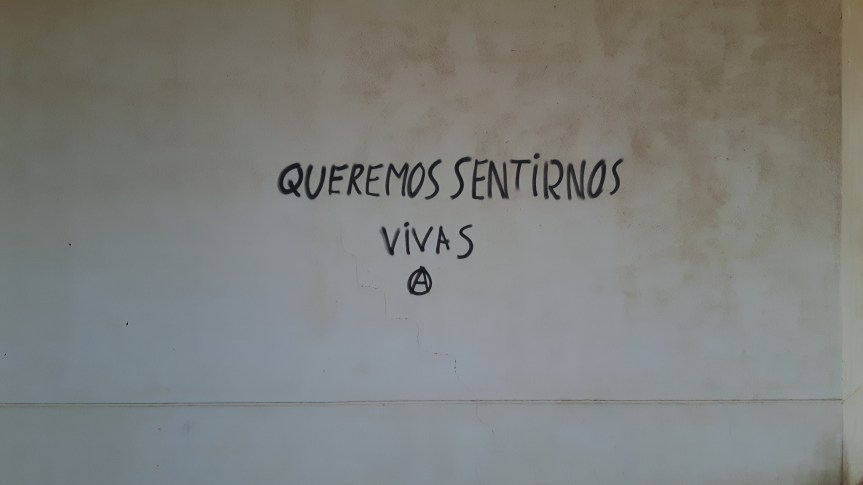
Almost every time I walk across town, some wanna-be graffiti slapped to the side of a décor shop catches my eye. “Queremos sentirnos vivas” We want to feel alive. It sounds like a cry, not to oppressors, not even to God, but just hurled into space from a spirit that wants more than resignation or dogmatism. It reminds me of another of another cry:

During those many days the king of Egypt died, and the people of Israel groaned because of their slavery and cried out for help. Their cry for rescue from slavery came up to God. And God heard their groaning, and God remembered his covenant with Abraham, with Isaac, and with Jacob. God saw the people of Israel—and God knew.

(Ex. 2:23-25)

Even though the cry was not to God, God heard and God knew. And He liberated His people. After this liberation, the following years in the desert were so hard that the ex-slaves began to daydream of life back in Egypt (Num. 11:5). God had promised a land flowing with milk and honey, but not yet.

Today as headlines continue to make history in ways we never would have chosen, we too are in that “not yet” pocket, basking in salvation (already) and looking forward to God’s promise of heaven (not yet).

What will choose in the meantime? Resignation or dogmatism?

Or life. Abundant life (Jn. 10:10). After all, we have a guarantee of our inheritance as heirs with Christ:

In him you also, when you heard the word of truth, the gospel of your salvation, and believed in him, were sealed with the promised Holy Spirit, who is the guarantee of our inheritance until we acquire possession of it, to the praise of his glory.

(Eph. 1:13)

We don’t just have to endure and parrot “praiseGod.” We don’t all have to share our opinions about every topic all the time (and resent those who disagree). We don’t even have to assign divine meaning to suffering.

Yes, hay que aguantar, but that is not all. Whatever “not yet” desert we are stumbling through today is not the end of our stories. And right here in the middle of the dry, we can sentirnos vivos because the gift of abundant life transcends our desert.

Telemarketers and tempers

I lost my temper. Telemarketers had been calling at least twice a day for weeks, making me jump, startling me from whatever I was doing to dig my phone out of my bag in the middle of the store or turn off my bluetooth speaker. They called from various numbers but they always played the same music when I answered. Because of my pending residency, I didn’t have the luxury of not answering calls from unknown numbers. Initially, I told them I wasn’t interested in their internet offer, and then mostly just ignored them. But one day I lost my temper.

“Look, who are you with? Stop calling me! I’m tired of you calling me! Do you understand me?” My rush of emotion garbled my Spanish.

“No, I don’t understand.”

“Who are you with?” I demanded again.

She hesitated split second, thrown off-script. “I’m calling for María…” Liar.

“I’m not María and I have had this number for three years!”

“I’m sorry for bothering you.”

After I cooled down, I began to wonder if this poor lady had received the brunt of my anger at a Spanish demographic. Not at Spanish culture as a whole–more often than not, I view the culture as a welcome Western break from North African culture–but at a certain bossy attitude I bump into. In America, the current lingo has something to do with the name “Karen” (which I believe is an injustice to the name since no Karens I know act like the memes). It’s the women who believe it is their duty to uphold every law they can get their hands on. And they enforce invisible laws too. 

“You can’t sit there! We’re supposed to keep a distance of 2 meters!” The bossy voice at my ear caused me to jump.

And the familiar dread rose. “No?” The last I had heard was that we were allowed to sit side by side on the bus. Had regulations changed again?

The man behind the sharp voice piped up: “Yes, we’re allowed to sit with a partner.” His tone was just as blessedly bossy.

“No, we’re supposed to keep a distance of 2 meters!” she bugled. 

I closed my eyes. As if anyone on the bus could sit 2 meters apart. Then again, I sure wouldn’t mind having more than 2 meters separating me from that voice. They fought it out, those two equally matched enemies while I sat, staring forward, trying to talk myself out of venomous irritation.

Sometimes I deserve a reprimand as I cut a corner here or there. Most of us probably do. After a sharp comment at the post office after I violated a hyper-enforced regulation (Note: no getting a number to wait outside while “Karen” is on duty), I obediently returned outside and pondered what in the world made me so angry about that attitude. Spanish culture is abrasive, yes, especially for thin-skinned Americans, but this went deeper than hurt feelings.

Then I found it: shame. It was shame. Every time someone barked at me, whether or not it was to enforce a covid regulation (or an imagined one!), they reinforced my sense of incompetence in their culture. And deeper still, they contributed to a deep-seated fear that I did not nor would I ever belong. 

That fear is what bubbled to the angry surface with the unsuspecting telemarketer. The solution? Probably a cocktail of growing a few more layers of skin as long as I am a “stranger and pilgrim” while simultaneously rooting myself deeper in the One I belong to.

I’m still working on that, but in the meantime, I’m learning that shouting at telemarketers probably doesn’t solve anything. Although, they haven’t called me since that day…

Trying dieting

I’ve never been the person watching what she ate, until I came to Spain. Then it was simple: overdose on protein and stay away from sugar and caffeine. Until I got back from the States this fall and my blood test revealed shocking cholesterol numbers. 

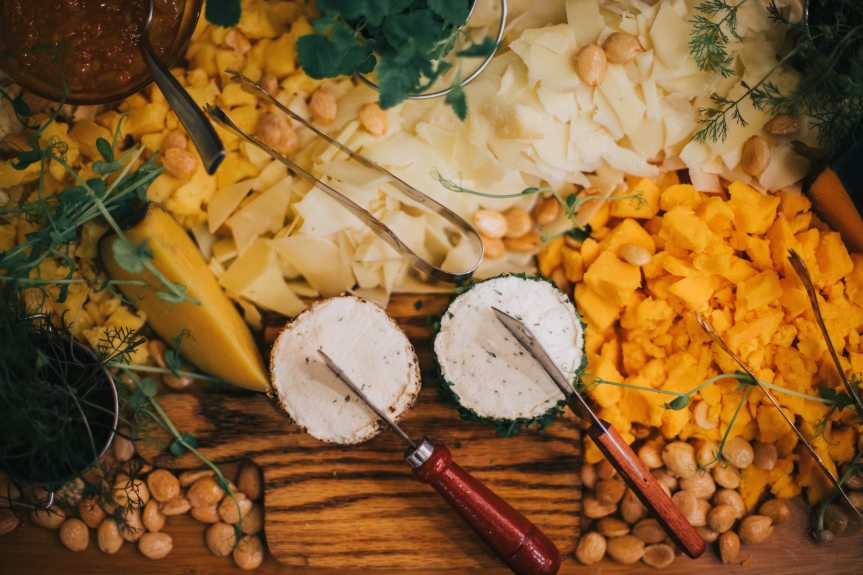
Genetics? Yes. Well, partly. Also, my love affair with cheese. After visiting France a couple of years ago, I thought it would be nice for God to call me to a country where one can eat a different kind of cheese every day of the year. Now I’m thankful I’m in Spain, where cheeses are outstanding, but numbered. 

The doctor gave me a “to eat and not to eat” list. I did my own research, plugged a basic menu into a nutrition calculator and stuck to it for the most part. I’ve been eating well, make no mistake, but food prep takes longer than it used to. Plus, I spent a couple of months enduring my roommates snickers when I weighed almost everything I ate. I also had to endure my sister’s judgment when I feasted on a rosy salmon fillet, roasted brussel sprouts, rye crackers with homemade hummus, with a mango and 85% chocolate for dessert. 

I love baking. I would probably bake every day if it weren’t for the piles of dishes. Or the piles of sweets. When I had a roommate, it was easier to dispose of my leftover baked goods. Granted, she was not always pleased to see another plateful of a sugary something with an attached note: “EAT!” 

Honestly, I am a healthy eater by discipline, not naturally. If you’re going to trip me up, set out a cracker variety and a luscious cheeseball, chips and salsa, or just mounds of greasy potato chips. I don’t even like bread, but once and a while, I pig out on bread, especially if it’s loaded with heart-stopping slabs of cold butter.  It hasn’t been all that long ago since I ate an entire bag of chips in one day. Or one day, I was walking down the street and smelled hot dogs. Hot dogs! And I could taste them, roasted over a fire, overloaded with tangy mustard and a heap of shredded cheddar. I admitted this craving to my roommate who, after watching me carefully blend kale smoothies, was amused. Rightfully so. 

For us first-worlders, food, like so many other things in life, is a choice. What we choose today may affect our tomorrow. 

Do you have a food plan? What do you do? Do you make allowances or take days off? Wedge in a bit of space for that mousse au chocolat? Speaking of which…


Photo by Cody Pulliam on Unsplash

The Hammer Holds

May you have a blessed Good Friday and Resurrection Sunday.

Even though we live on the Spanish coast, this year we don’t plan to watch the sunrise on the beach… perhaps because we have approximately one morning person on our team (and it’s not me). We still plan to celebrate Christ’s resurrection for most of the day through worship, fellowship, and food. What are your plans?

This week, I have been buried in research and I’m not taking time to write anything original. Still, I wanted to share a piece of the song “The Hammer Holds” from Bebo Norman, a deep, poetic work that tells the story of a piece of steel as it is shaped into a nail to be driven into the Savior’s hand. You can listen to the full song here.

The hammer pounds again, but flames I do not feel. 
This force that drives me, helplessly, through flesh, and wood reveals 
A burn that burns much deeper, it's more than I can stand: 
The reason for my life was to take the life of a guiltless man. 
So dream a little, dream for me in hopes that I'll remain, 
And cry a little, cry for me so I can bear the pain. 
And hurt a little, hurt for me, my future is so bold, 
But my dreams are not the issue here, for they, the hammer holds. 
This task before me may seem unclear 
But it, my Maker holds

from Ten Thousand Days 1999, Watershed Records.


Photo by Glen Carrie on Unsplash