
All we get are windows

“All we get are windows,” he had said.

And this after my week of cancelled plans, disappointed tears, and familiar feelings of uselessness. But his words rang in my head all weekend so that now in the middle of a lively West African church service, my mind was still stuck.

The dissonant keyboard chords, the steady drums and tambourine and my mind was thousands of miles away in last summer.

I could still hear those testimonies of broken men and women who were crying out to God for the meaning of their years of overseas service—men and women who felt they had little to report except failure.

“All we get are windows of time in people’s lives. We walk with them while we can.”

Sometimes those windows feel pointless. Like walking with someone on their journey is a waste of time and couldn’t God please bring someone else into our lives? Sometimes the windows feel so nice that we frantically try to prop them open when they begin to close. But they close anyway and we label them as aborted opportunities.

In the snippets of time we have with people—these “windows”—sometimes we lose sight of the bigger picture and think that the windows are all that matter. That’s when we feel useless, like failures.

The keyboard, drums, and tambourine faded as a new song leader took the microphone. Pacing back and forth, she started an African version of “Alleluia.”

“Alleluia. Alleluia. For the Lord God Almighty reigns.

“Holy, holy are you, Lord God Almighty!”

Behind the song leader was a pillar that supported the center of the little church building. There on the pillar, neat rows of pink and white silk rose buds formed a cross.

“Worthy is the Lamb! Worthy is the Lamb! Amen!”

Amen. So where will I place my focus? On my interpretation of efficiency or on the bigger picture: the glory of the Lamb? On the brevity of the windows of time or the fact that the Lamb is worthy of a life spent in faithful service?

Thank you for the homesickness

When I think of my family, friends, and church at home, the word that comes to mind right now is “thank you.”

Thank you for the strength I feel behind me. When I struggle, you gently carry me along with your prayers, encouragement, and advice. When I am happy, you rejoice with me. And you tell me about life at home like I’m still one of you. I am still one of you.

You give me a reason to be homesick. Not every day. But some days it rushes over me and I feel lost, pretty sure that I will drown. And I do for a little, overwhelmed with the sorrow of what has been and probably would have continued being had I not moved here. But then I lift my hands in surrender (literally sometimes), let my tears dry, and blow my nose. Life goes on.

“God, I’m not questioning my calling; I’m just feeling the hurt right now.”

I’m thankful for technology– emails, phone calls, video chats and such– but it’s not the same.

I wonder if Jesus ever felt homesick. He had sweet and constant communion with His Father. And then He left heaven to come to earth. Sure, He could pray to His Father. But it wasn’t the same. Sorta like a phone call.

But without that sweet communion, without something that emotionally ties us to “our” place, there would be no homesickness.

That’s why I say, “Thank you for the homesickness.” You have given me many reasons to miss you.

A dog and a man

It was a quiet Sunday morning. Very little traffic. Very few people out except the dedicated who had rolled out of bed for 10 o’clock mass.

The evangelical service didn’t start until 11. And a crisp morning stroll was a good remedy for lethargy during church. Obviously, I was fairly alone in my opinion, or at least alone in the motivation for its practice.

I jammed my fists into my coat pockets to keep them warm. I was headed nowhere in particular and anyone looking at me could tell. Who cared? The hushed activity was restful and I talked with God as I walked.

Along the boulevard, there was a big piece of cardboard spread out on a bench. Had a homeless person slept there? Where was he now? Had the police chased him away? Why was he homeless?

As I continued strolling, I prayed for the needy of our quiet little town. Up a block or two along the boulevard, I noticed a dog shying away from a man on a bench. The skinny beast had belonged to somebody at some point in time—I knew because of the collar—but now his ribs were jutting through his thin white coat.

Again, the dog approached the man with great skepticism and was rewarded with a chunk of bread. He shied away again, but watched for the next morsel.

And the man. As I got closer, I noticed him. He had that look. Like someone who had spent more than one night on a park bench. Next to him was a childless stroller piled high with things, earthly treasures that may have come from a nightly raid of the neighborhood trash bins.

I passed the scene, wondering why the man was throwing away his bread to a dog. Wasn’t that proof of his bad stewardship that had probably put him out on the street in the first place?

Or could it be that he knew need—true, desperate need—and he had compassion on another needy creature?

On my return loop, my view was from the back of the scene. The dog was still there, darting in and shying away, but not quite so shyly anymore. He and the man understood each other.

I was the outsider, passing by the scene without really understanding.

10% thankful

At church on Sunday, we had a sermon about the ten lepers in Luke 17. After Jesus healed them, only 10% came back to thank Him. What about the other 90%? All we really know is that they were healed on their way to the priest. Undoubtedly, they were grateful, but what did they do about it?

Ten percent versus ninety percent. I’m thinking in percentages because the story brings to mind tithes and offerings. I like to think that 10% is God’s and 90% is mine. I go my way with the 90%.

What would change if I started to live like the 100% belonged to God?

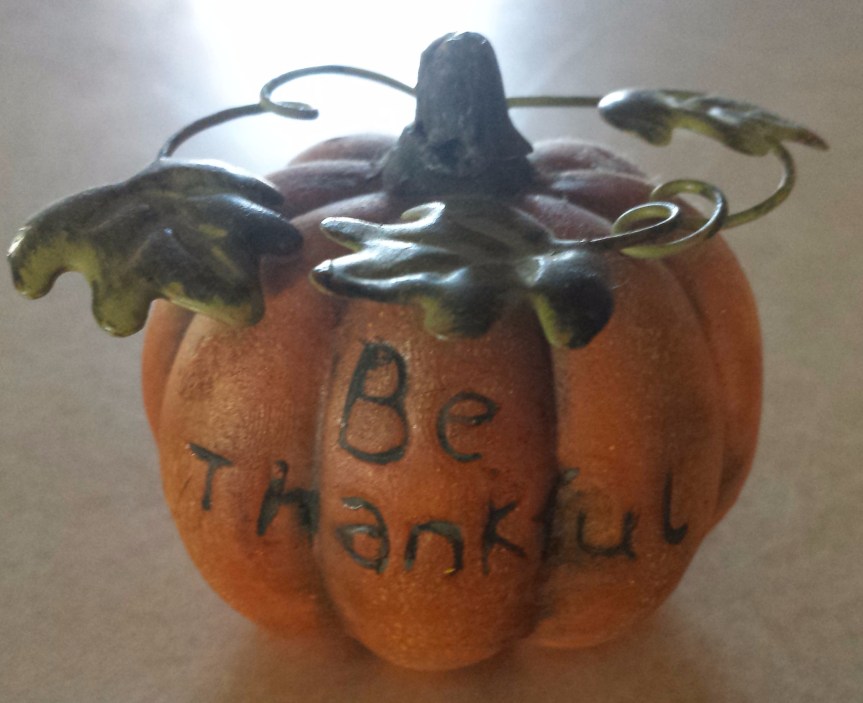
Just a thought as I consider how thankful or unthankful I am this Thanksgiving Day 2017.

From a family of writers

It was 2:30 a.m. and I was wide awake, when suddenly it struck me: I’m from a family of writers!

My mom, my siblings, and I all enjoy writing. Of course, we’ve had our share of mishaps. Like the time my mom sent a cheerful email to her siblings proclaiming “Hell to you all!” (she’d forgotten an “o”). Or the time when I was a child making a birthday card for my aunt. The card contained a hidden message cleverly concealed under a square of paper on which I had inscribed “Open the flab.”

Despite these unfortunate skeletons, we continued writing and continue to this day.

Mom comes from a family of unusual vocabulary, a vocabulary which still seeps into her everyday speech and writing. Before having children, she used to write poetry and keep a journal. Since children, she exchanged writing time for reading aloud: tales of Ira, Francis, Ichiro, and a little later, Narnia. Now her main writing occupation is optimistic emails to missing family members.

My older sister and I have stacks of journals. Hers go way back, to when she recorded observations from our childhood such as “Tricia eats like a horse and looks like a string bean.” Even now, she writes captivating emails recording events and people that waltz through her married life.

My older brother is the nerdy, theological writer of the family. When he asked me to help edit his Bible school thesis, I read a bit then stuck to editing grammar, not content. Instead of “This deep point of doctrine would be more indisputable if…” I was penciling in things like, “Maybe this sentence structure needs help???” Of late, most of his writing seems to be going out from the mailbox to a certain Ohio address.

My younger brother kept a journal of our family trip out West. The several pages, which gave a snapshot of the vacation in that moment, also gave some humorous insight to the workings of a 12-year-old mind. It was delightful to find his journal in my stash of papers years later… and give a copy to his wife to read! Now he gets to write sermons rather than record who is eating candy and what music we are listening to.

It was on another vacation long ago that my little sister, wrote an adorable note: “Dad, why do you let your whiskers grow?” Her thoughts have run down deeper lines since then. She maintains her own blog now and is more dedicated to her writing than any of us other family members.

At 14-months, even my nephew scripts his feelings quite clearly (see photo above).

Why do we write? Maybe it was due to those years when our parents instilled in us a love of reading. Those evenings that Mom would take us to the library and we would walk out with 40+ books that we started to read on the way home. The librarian told Mom that we were “good for circulation.”

Regardless of the reason, I’m thankful to be from a family who expresses through writing. For one, it makes living overseas more possible.

Happy birthday, Albert

The way he oohs and aahs over simple pleasures. The way he slobbers out motor sounds while he drives his cars and tractors across the carpet. The way he points at things with an excited gasp, expecting you to look in wonder. The way he giggles with Eskimo hugs. The way he “dances” when he hears bouncy music. And the way he sings in church– “Aaaaaaaaaaaaaaaaaaaaaaaaaa.”

We met only a few months ago, but he has already managed to steal my heart.

Happy first birthday, Albert Harris.

Not so glamorous

I asked my roommate for ideas for my blog. She suggested that I write about how life abroad isn’t necessarily glamorous. The common misconception is that life at home is mundane, but those who live abroad are enveloped in a never-ending adventure. Yet, those who have live out of the country soon realize that there is a difference between traveling abroad and living abroad.

I dug around in my old emails to find my initial impressions of my “exotic” life. It turns out that despite the initial culture shock, I soon settled into a routine, much like life at home.

From February 2016: “It was hard to decide what to write about this month. If I only mention the highlights, you assume that my life is one big, adrenaline-laden adventure. It’s not. Each day is unique, but I have developed a pattern and am beginning to plod down the same cowpath day after day. Even the grass is wearing out beneath my hooves. Moo… In spite of these very normal circumstances, occasionally I do experience variation from normal life. It’s like happening on an untasted meadow (to continue the bovine analogy). Sometimes the meadow is sweet grass, other times it’s mostly thistles.”

From April 2016: “Perhaps my life sounds glamorous to you. I suppose it is in theory, but it’s been hard to give up close interaction with family, church, and friends while what used to be my everyday life changes without me. And looking like an ignorant tourist isn’t particularly glamorous or comfortable..”

What’s new quickly becomes normal when you experience it enough. Flagging down taxis, crossing the street amidst moving traffic, watching things shatter when dropped on hard tile, eating piles of bread and drinking liters of syrupy tea is all commonplace.

See, the glamorous part happens in the initial stages. A North African immigrant in America might be startled at the wealth of personal space, how difficult it is to make friends, traffic that is relatively decent and in order, prices that are non-negotiable, and everything running on time. That is something to write home about…initially. Until the glamour of the foreign adventure becomes everyday life.

Also from an email from April 2016: “A recent sermon has given me a few thoughts to ponder. Using John 21, the speaker proclaimed that our duty is to follow Him, not to compare ourselves to others and decide that our personal callings are unjust. No matter where we are, whether glamorous or not glamorous at all, our duty is to follow, day by day and hour by hour.”

To the land that I will show you

When Abram was called by God in Genesis 12, he wasn’t called to a specific country. God didn’t say, “Abram, go to China.” Neither did God say, “There you will use your gifts of teaching and discipling by starting a language center and a church.”

Abram went with no country in mind and no idea of how to plug into his new world. He didn’t even know what linguistic and cultural barriers he would face. Plus, he was 75-years-old.

But he went in obedience because that was really all he had. He didn’t update his facebook or keep a blog to tell the world what a great job he was doing. He probably never even communicated with home again.

And then, to top it all off, within a short time of his being on the field, the land was hit with famine. The Bible doesn’t record the thoughts that would have gone through my mind: “Am I sure that God led me here? These people and this place were never really on my heart before I got here. Maybe I heard God wrong. Maybe He meant I should move down the street, not leave my home country.”

Perhaps the Bible doesn’t record those thoughts because Abram didn’t really have them. He struggled with faith in other areas at other times, but this whole “going” thing seems to be one thing he was really good at. Going and not looking back. Not doubting his calling or God’s promises even when the hard times came.

30

Turning thirty is means that I have a fair amount of life under my belt. Instead of being sad that I am leaving the 20s behind, I’m pondering the things I would like to do during my 31st year. You might call it a bucket list. You might not.

  • See more parts of this North African country
  • Finish language and culture study (well, the official stage anyway)
  • Learn how to cook North African food
  • Spend lots of time with family
  • Meet my nephew and make him fall as in love with me as I am with him
  • Renew friendships and relationships at home
  • Gather the required paperwork for my Spanish residence visa
  • Daily recognize my reliance upon One who loves me completely

Aisha- part 2

Aisha was waiting for me on my way to school the next day. And the next. And every morning that I had the early hour of class. Because of her, I began to recognize the network of house workers who met regularly to chat on the way to their respective jobs.

Although I was glad for the chance to practice conversational Arabic, I still was unsure of what she wanted from me.

The day she had invited me to stay at her house grew closer. Because of my apprehension, I managed to whittle the overnight adventure down to a day trip. On the Friday before, we rehearsed what would take place on Sunday: I would meet her at the same place under the berry tree across from the bus stop at 11:00 a.m.

I don’t think she believed I would follow through with the plan. She tried calling me five times while I was in church. And when I finally answered, I was on my way to the meeting place.

“I’m coming!”

She spewed a string of sentences I couldn’t understand, but what I assumed to be a reason that she was behind schedule.

“Okay. Okay. No problem. Okay.”

And I waited under the berry tree until a taxi pulled up and honked. Aisha was in the backseat, bouncing in her excitement. She grabbed me in a warm embrace before I had the chance to close the door behind me. And she talked, one rapid sentence after another, often missing the fact that I didn’t understand.

The taxi wound through the new city, behind the old city, and up up up on a hill. There was no containing Aisha’s joy as she led me out of the taxi and into her world.

It was the first bite of a day full of exquisite North African hospitality.