Lost in the system- Part 2

Continued from Part 1

F-7. That was my number. There again in the place I would love to bid goodbye forever.

We were all scanned in, checked in, and trapped. Waiting for that computerized voice to say “H-65” or “F-7.” Not that we heard the voice against the background of a hundred other voices; it was just a reminder to check the screen.

The room was heavy with anxiety and stale cigarette smoke on winter clothes. We were different colors. Different nationalities. But all in the dilemma of surviving the system.

An hour passed. Another hour buried in a legal system. This time to get permission to leave and re-enter the country while Spain ate up months processing my application. My paperwork, started in October, was now complete until they mailed me a list of more documents to wring out of someone somewhere. But if I left the country without special permission, I would have trouble re-entering.

“You need to fill out a form, give me copies of your card, your passport, and this other form, and pay a tax.”
“Is this completely necessary?”
“Where are you going?”
“Africa.”
“Absolutely.”
“And I can’t get this done today?”
She looked at her clock. “Not today. Come back tomorrow!”

I couldn’t decide if I wanted to reach across the desk and grab her by the neck or simply burst into tears. Lost in indecision, I did neither until I was dismissed.

Out on the street, I fumed, determined to leave Spain forever. I was tired of these daily trips to immigration offices. Tired of being an immigrant! Eventually, I calmed down and rearranged my schedule to fit in two more trips to the immigration office, gritting my teeth as I crossed off the rest of life to make room.

But something happened when I stopped fighting for my schedule and opened my heart to joy. Something happened when I stopped wishing I could be somewhere other than where I was and embraced the present, bumps and all.

The world began to brighten. Not much. But a shade enough to make a difference.

Even more discouraging than being lost in the immigration system was being lost in the system of discouragement. After all, when we reject the gift of joy, we reject the strength we need for daily life. Check out Nehemiah 8:10 if you doubt it.

On the way home from my final trip to the immigration office, I met up with an acquaintance. I squeezed her little girl close as we bounced home together on the bus, letting uninhibited, contagious giggles complete the joy of the present.

Lost in the system- Part 1

I have been lost in a system I can never hope to understand. Once, an immigration official told me, “Immigration is the part of government that changes the most.”

No kidding.

The letter in the mail. The journey to the immigration office in Almería to request information.

“You need a new invitation to work.”
“And a new empadronamiento?”
“No, you don’t need that unless you’ve moved. But you have to turn your paperwork in to Immigrantville, not here in Almería.”
“Where in Immigrantville?”
He gave a vague answer that told me he had no idea.

So I put in a request for a new invitation to work and waited and waited. Weeks later, it came. We signed and sent it off. The same papers came a second time, requesting signatures again.

“What happened?”
“I don’t know. My guess is some little old lady working in the office lost your papers.”

So we started again. And waited again.

I wasn’t sure where this elusive Immigrantville immigration office was, but one morning I started out across town with a vague notion, a handful of papers, and a trembling aloneness.

“You need an appointment.”
I stood, almost panting after my 45 minute walk. “When?”
“Right now we’re scheduling in December…”
“My card expires in November.”
“Oh, well you should have come sooner.”

But she squeezed me in just after the weekend. Another 1½ hour round trip on Monday. This time I was at least 50% sure I was in the right place. If I wasn’t, I would have to start all over somewhere else.

I waited an hour with a cluster of Senegalese men, listening to Wolof and crocheting. Round after round of crochet as my hope dwindled.

“Could I borrow a scissors?”
The receptionist gawked at my amateur square of yarn. “Of course.”

Finally, I was across the desk from a lady who was late for her lunch break. But she was the one who actually knew something.

“You need a new empadronamiento.”
“But the man in Almería told me…”
“It expires after 3 months.”
“I know. But the man told me…”
She shook her head. “Sorry. You need a new one.”

She offered to keep my paperwork until I made my next trip.

In the morning, I was the first client at town hall, one half hour before opening. Within 2 minutes, I had a new empadronamiento. Within 20 minutes, I was presenting it at the immigration office.

A friend stopped by and sat with me while I waited for the process to be finalized: another 45 minutes for that tiny stamp in the corner of my form that said I was still a legal immigrant.

“Lost in the system” to be continued in part 2…

No loaves but plenty of fish

I left for Almería after work. The morning had been long, but my errands were more important than my lunch. The errands went so smoothly that an hour after arriving in Almería, I was on board the bus again.

But so was someone else.

Due to our prior acquaintance, David and I greeted each other, he with an excited “God bless you!” and me with a polite, please-don’t-try-to-talk-to-me smile. Fortunately, the seat beside me was occupied, as was the seat across the aisle.

But we hadn’t even made it out of the city when suddenly a dripping bag of fresh fish came from an arm reaching over my shoulder. I was astonished. My seatmate was astonished. The two passengers across the aisle were astonished. One seat ahead, a teenager looked at me and rolled her eyes.

“This is a gift from God!” David told me gleefully. He opened the bag wider so I could have a look at just how good God was.

Fat fish decorated with twigs of rosemary stared up at me.

“Thank you.” I tied up the leaky plastic bag and continued to smile even as fishy juices dribbled over my groceries.

At home, I messaged my friend, asking her to teach me how to prepare fresh fish. She willingly adjusted her schedule and came to the rescue. We prepared the sardines together: she taught and I absorbed her instructions with naive horror.

Then I prepared American snacks and we sat to eat, study, and talk about our unique immigrant experiences.

David was right after all; the fish were a gift from God.

Small town librarying

After a couple of months of life in Spain, I gathered up courage to visit the local library. Through the park that hosts elderly men in the morning and rebellious teenagers in the afternoon. Down a long hallway lined with local photography. Until I stood in a room full of books.

Unruffled by my presence, the librarian looked at me over a piece of cardboard she was painting. A prop for a children’s program? “Can I help you?” she asked.

There would be no subtle spying out of the library grounds. I was an outsider and expected to state the purpose for my unheralded intrusion. “Uh, I live here now and-and I would like to read m-more books in Spanish.”

“You need proof of residency from city hall and a copy of your residency card.”

I retrieved the documents and filled out the paperwork. Then I selected a book.

The librarian scrawled the due date on a slip of paper inside the front cover of my selection. I admit that even in that small town, one-room library, I was startled by the lack of technology.

The book I had chosen was boring, so I returned it the next week.

“Did you finish it?” the unruffleable librarian asked without glancing up from her new craft project.

Why this sudden sense of guilt? “No.” I cleared my throat.

“Okay. Just leave it there on the desk.” And she continued unruffledly crafting.

A week later I slipped in again, determined to select a more interesting book. This time, the unruffled librarian was in the middle of a sewing class. She barely looked up while I selected Las Memorias de Sherlock Holmes.

She pulled out my file without confirming my name, made a phone call to the main branch—the internet was down, she said—and then picked up a pencil.

I’m sure my eyes widened when she penciled the due date in the corner inside the front cover.

Sherlock Holmes was a better choice, but I still didn’t finish it by the due date. So I attempted my first renewal.

The librarian’s hands were covered in black paint as she was undertaking yet another craft project. “Did you finish it?”

“No. I would like to renew it.”

“No problem. Just bring it back when you finish.”

Assuming she was referring to the due date, I pointed out that the date inside the front cover said tomorrow.

“No, not when it is due. When you finish,” she clarified. She held up a black hand while the other still clutched a dripping paintbrush. “My hands are covered in paint right now. When you finish, bring the book back and I will erase your fine.”

This week, I returned the overdue book. There was a painting project spread across the entire library floor. The librarian’s pre-teen volunteers cleared a skinny path for me between the massive sheets of damp paper. The unruffled librarian continued hot-gluing safety pins to name tags as I selected another book and brought it to her.

Inside the cover of the old book, she jotted down the number of the new book, handed the new book to me, and returned to her gluing. Apparently, she didn’t feel like traversing the skinny path to her desk.

But this time, she was not the only one unruffled. I had grown accustomed to small town library dynamics and was quite unruffled myself.

BOOM!

I was home alone the day that a man came to inspect the hose on our gas tank. Apparently ours had expired in 2008. Not good, I guess.

“It might explode,” he said.

“What?” I was still trying to figure out exactly who this guy was, how he had burst past me in the doorway, and how in the world I was going to get him out.

“It might explode,” he said again, more slowly this time as if he realized that I was a foreigner.

I was silent, my mind racing in all directions.

He lifted his eyebrows. “BOOM!”

I explained that my roommate wasn’t there and she was the one in charge of the household, so he couldn’t do anything. Surely there was some sort of a law that said a serviceman couldn’t barge into an apartment and do a job against the wishes of the occupants. Right? This was ridiculous.

He gave a long and rapid speech about how it was obligatory and since he was from thirty minutes away, he had to do it now. He probably said more too, but that was what I caught.

“Now all I need is your card or your passport.” His head was in our cupboard and he was fiddling with our tank.

“Wait. Don’t do anything. Wait!” The situation was spiraling out of control. I dashed into my room to grab my phone and call my roommate. Twice. She was in the middle of an English class and didn’t answer.

When I returned to the kitchen, I saw that the man had parked himself on a kitchen stool. The oddity of the situation struck me as I looked at him there. “Do you want a glass of water?”

The question caught him by surprise. “No thank you,” he said.

“Look, I can’t do anything until I talk with my roommate.”

“What time will she be home?”

“Eight.”

“That’s too late. I leave work at six. You have to change the hose. It’s obligatory. Look, if you don’t change it, you might have an explosion. BOOM!”

There he was, booming again, as if a hose expired ten years couldn’t wait a few more days. I heaved a sigh. “If there’s an explosion, I will go to heaven. It doesn’t matter to me.”

Again, he was taken off-guard. Perhaps not every client has said that.

He insisted. I insisted. Finally, he was on the verge of a concession, “You don’t want to pay that price?”

He was going to drop it. I was pretty sure. But it didn’t matter. Obligatory or not, he would not change our hose today. “I don’t want you to do anything.”

We finally agreed that he would leave his information so I could call him after I had talked with my roommate because, I pointed out, if expired hoses have to be changed now, what does he do if someone doesn’t answer their door?

He asked for my number and scribbled it on a piece of paper. I took his business card and took a picture of the contract.

I smiled. I had won. At least for now.

But he was smiling too. “I will message you on whatsapp, okay? Not for the business. For me, like friends.”

Or had he won? I wondered as he walked out of the apartment with my number in his pocket.

Side note: As far as we can figure out, this was a scam. Gas hoses do expire, but the government does not send out servicemen to inspect and change them for 42€ cash. A friend kindly changed ours for 8.50€ to keep us from going “BOOM.” And, no, I am not in contact with the scammer via whatsapp.

Tarjetas and tourists: what’s been happening recently

“What has been happening recently?” you ask. I’ll tell you, even if you didn’t ask. 

One of my favorite big events was getting my residency card, my tarjeta. FINALLY. All of the paperwork, the trip to the Chicago consulate, the phone calls that drove me close to insanity, the corrections, the visa, the move to Spain, the various trips to the extranjería (and the wonderful roommate who accompanied me on all of those!), and finally… finally… on the last trip, the man across the counter handed me my tarjeta. “Perfect.”

We celebrated with a trip to the mall, coffee and tostadas, and getting lost (as is our custom while on foot in Almería).

Last week, my roommate and I took a trip to Berja, a small town in the province of Almería. Away from our immigrant town, we noticed a more defined Spanish flavor, especially in the thicker Andalusian Spanish.

At a bus stop in the middle of nowhere, a man (one who would fit nicely into one of those “anti-smoking” commercials) climbed on board our bus. He sat in front of us but hollered over our heads to the man sitting directly behind us. After several minutes of thick and raspy Andalusian exchange, he turned to face forward and lean back in his seat. The seat was broken and little by little, it voluntarily reclined so far that soon there were three of us in our seat. I giggled. I couldn’t help it! The day was going to be an adventure…

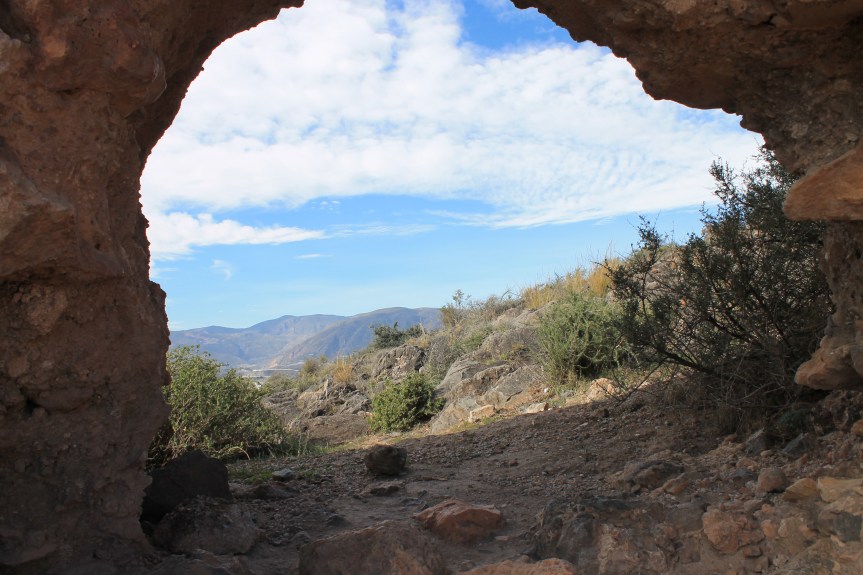
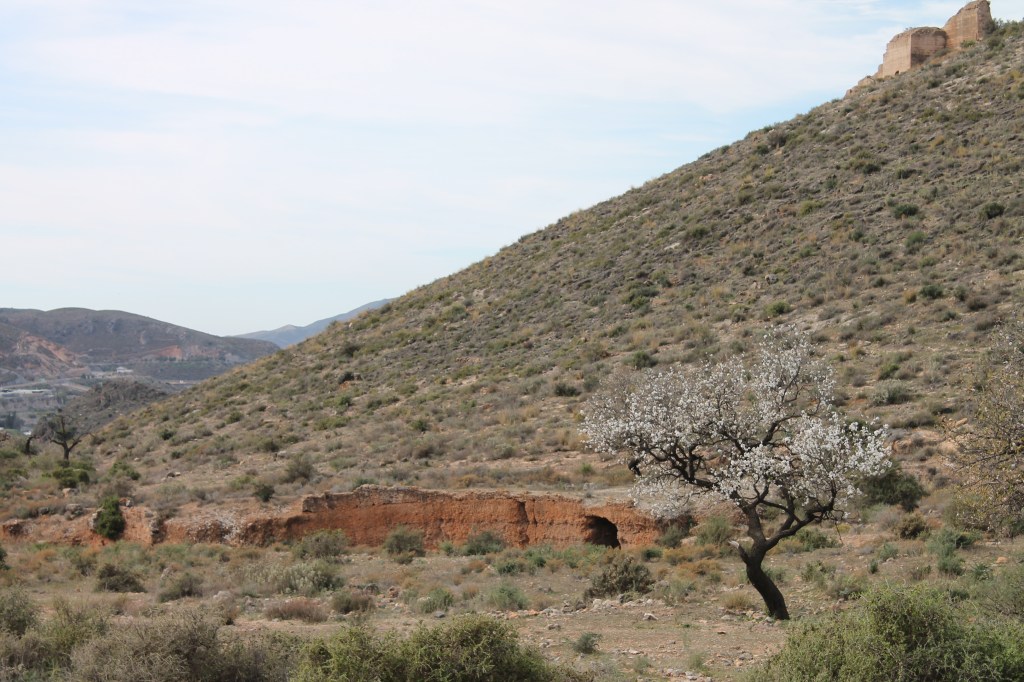
In la villa vieja, we freely roamed the Roman and Arab ruins and enjoyed the silence of the forsaken countryside.

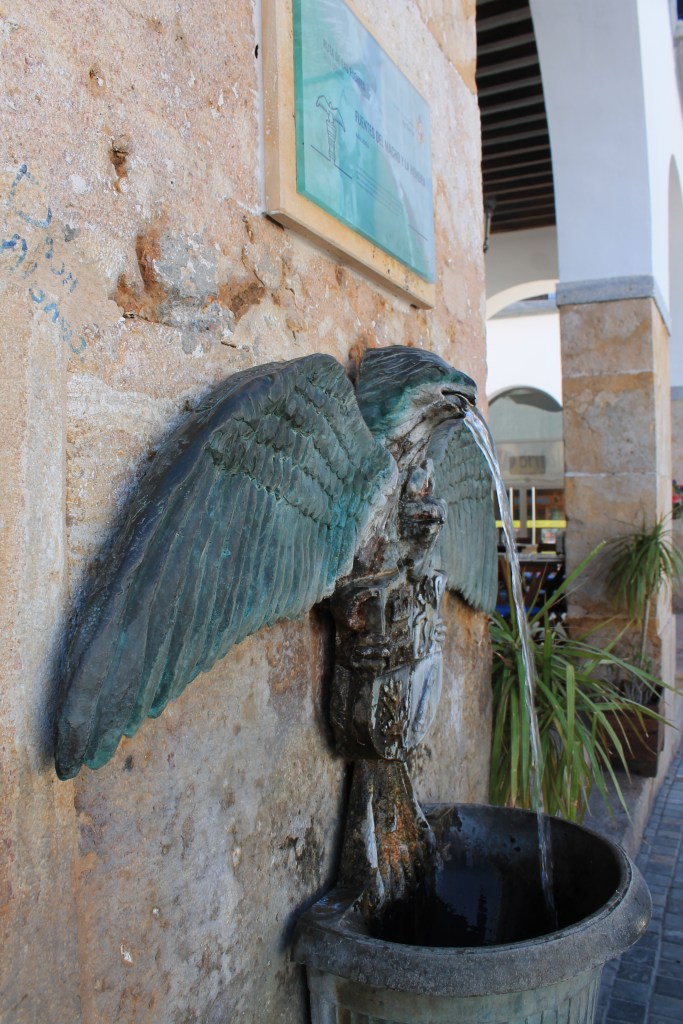
We walked part of “the route of fountains” to find the oodles of little fountains throughout the town. But more fun than finding the fountains was seeing pretty pieces of the town I wouldn’t have noticed otherwise.

We topped off the afternoon with a sumptuous “choto al ajillo” (goat in garlic sauce) which we bravely tried… and liked!

Of course, lots of other things have been happening too that I haven’t described in detail here (at least not yet), such as:

  • setting up a library corner at the store
  • watching a bus driver threaten to call the police to remove a disruptive and cussing passenger
  • walking with a friend in time to a spiritual discussion
  • seeing God working miracles through brothers and sisters in Christ who are willing to be a channel of God’s power and love
  • multiple trips to the bank to set up an account… to no avail until the fifth time I tried and the bank teller threw up his hands and hollered, “IT’S THE END OF THE WORLD AS WE KNOW IT!”

And more. Much more. But that’s enough for now, because I’m off to have another adventure. After all, there is an adventure in every day if we remember to look for it.

A day of Midwestern culture

One day last week, I started out the day with a friend and dusty chaff in a soybean field. It was a lovely way to celebrate my favorite season: the dry plains that stretch into the horizon, the banter of voices over the radios, the roar of machinery, the swirling haze of dust every time the combine approaches. There is something about growing up on a farm that makes the joy of the countryside stick in your blood.

But in the afternoon, I drove to the city to shop. Within minutes, I had exchanged the hazy corn and bean fields for the asphalt and concrete of the glaring city. And I loved it, as I always do. Right down to the traffic (as long as I’m not in a hurry).

After inhaling the exotic spices in the Asian Market, I had fun browsing up and down the aisles of Wal-Mart with a short list and a lot of time. Of course, I did this in a Wal-Mart that is sometimes referred to as “ghetto-mart.” But it’s my favorite Wal-Mart because one can escape the SUV, soccer-mom rush that usually accompanies Wal-Mart trips closer to home.

After crossing a few things off of my list, I paid and exited the store. The cart man met me in the doorway, gave me a bright look, and said cheerily, “Goodbye, Saint! Have a nice day. Praise the Lord!” And I smiled all of the way out to my car.

In fact, my heart was still warm even after 30 minutes of wandering around on obscure backstreets that inevitably turned into dead ends. (I had left the directions to my friend’s orchestra concert on my nightstand.) I told myself not to despair of ever hearing her play the violin and stopped at Arby’s for directions (and roast beef and curly fries, if you must know). I chatted with the helpful cashier and then tried not to spill the oozing Arby’s sauce on my shirt as I embarked on the remainder of my journey.

The free concert was lovely, but there was a catch: it was in an assisted living facility and I was the only person in the audience under 50 (or maybe 70). But I didn’t care because I had a great view. Plus, I didn’t feel out of place tapping my feet or humming my way along through “The Sound of Music”, “Chicago”, and “Phantom of the Opera.”

Unexpected heroes

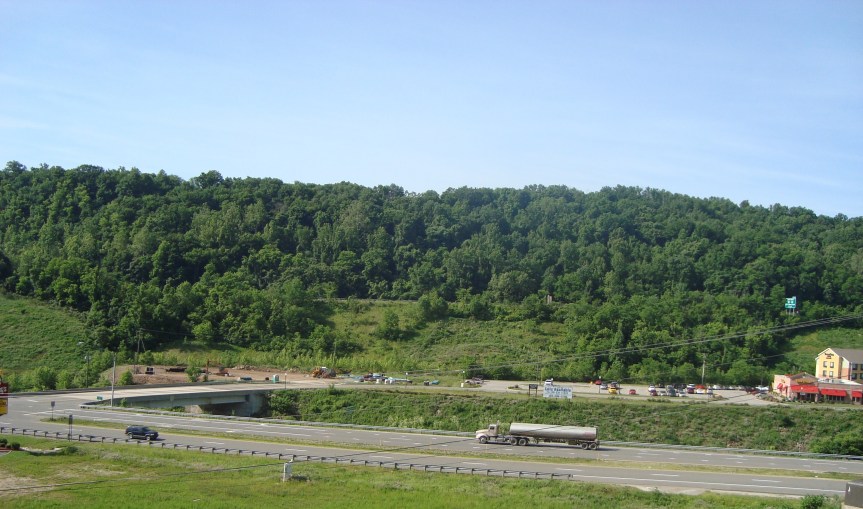
When my car broke down in West Virginia, I had visions of myself hunting down a toothless backwoods mechanic. As I stood at a gas station counter, buying every quart of 5W-30 synthetic oil the station had, I told the lady, “My car hates West Virginia!”

“We all do,” she remarked dryly.

A man stood behind me, 12-pack of Coors Light in hand. He looked a bit like Gimli, the dwarf of The Lord of the Rings—a bit pudgier and balder, but not much taller. He caught my glance. “You’re looking pretty today,” he graveled.

Apparently, I was being appraised just as I had been appraising. Apparently, he hadn’t noticed my frumpy traveling clothes. “Thank you.” I turned away from him and slipped outside as soon as I had my change.

I ducked under the hood of the car, carefully re-checking the oil and wondering how I would ever make it to my destination. My dad was helplessly 10 hours away while my car reeked of hot oil.

A man walked past. “Problems?” He studied the car. “This is a new car! It should still be under warranty.” And then he walked away shaking his head.

Thanks. Even if it had been under warranty—which it wasn’t—how would that solve my immediate problems? I was stuck in the middle of the West Virginia mountains. He may as well have said, “Be warmed and filled” before going on his way.

But suddenly Gimli and his equally rough-looking companion were standing under the hood with me. “Problems?” Gimli set down the Coors Light. The men listened to my description of the symptoms, filled the engine with fresh oil, and looked around under the car. Last, they started the car and listened to the heartbeat of the engine. And just as dusk was approaching, they sent me on my way.

No, my car wasn’t miraculously healed, but I limped along with the mighty reassurance that God was looking out for me, even if it was through unexpected heroes.

Proud to be an American?- Part 3

If you haven’t already, check out Part 1 and Part 2. Continuing the discussion of stereotypes other cultures have of Americans, and why I’m still glad to be one…

Freedom of speech.
Some people may abuse this, but I for one, and glad we have it. It’s wearing to be conscious of everything you write in light of a government’s definition of acceptable and unacceptable.

Our government.
Despite political corruption, it is important to realize that we still have a relatively uncorrupted government compared to much of the world.

A diverse country… in more than just scenery.
I love being in the city where I see a variety of people groups. I love trying out ethnic restaurants. I love those moments when, as a white American in American, I feel like a minority. Rather than feel threatened to be outnumbered, I am honored to be a part of America’s diversity.

Access to [almost] everything.
Sometimes it means you have to pay dearly, but it’s almost always there. Exotic Asian fruit. Aromatic African spices…

English
Do you realize that learning English as your mother tongue means that you’ve already learned one of the most useful languages in the world?

These, of course, are not exhaustive lists. What are some stereotypes you have or have heard of Americans? What are some positive aspects to being an American?


Photo by Donovan Reeves on Unsplash

Proud to be an American?- Part 2

If you haven’t already, check out Part 1. Continuing the discussion of stereotypes other cultures have of Americans…

We are self-centered.
We are used to being a world power. We’re used to having our voice heard. We’re used to having a massive portion of the world’s wealth. So it seems reasonable that people should get on board with our ideas. It even seems reasonable that we should be able to talk to anyone anywhere in our own language. Which leads to the next stereotype…

We are monolingual.
Again, the stereotype is only a stereotype, but perhaps it’s based on a grain of truth. If an American is not growing up in a multi-cultural home, or didn’t grow up overseas, there’s a good chance that they made it through their high school Spanish and haven’t looked back. Why? Well, English is one of the most useful languages to know. Therefore, many people know it all over the world. So we begin to expect that others know it, and use it when they’re around us, not considering how much more challenging it is to operate in a 2nd, 3rd, 4th, or 5th (etc.) language. In our defense, it’s hardly fair to compare Americans to Europeans for example. America was colonized by the British and we kept a version (albeit an altered version) of that language. And in this mass of land, most everyone speaks English. In the Midwest, we can drive hours and hours in any direction and be surrounded by English speakers. In Europe, on the other hand, one might drive an hour or two and find a country or region that operates in another language. In short, the worlds are much closer and therefore the necessity of learning more than one language is greater than in America.

We are fat.
Restaurants serve massive portions. We eat too much. Maybe because we’re used to having so much.

We are rich. (Mostly from third world cultures)
Many this there is no poverty in America. Being an American automatically speaks of great wealth which you should be willing to share with those who have less than you.

It is hard to stereotype a monstrous country of diverse people. And I’ve only listed a handful of the stereotypes that are out there. Do any of these define me? You?

Most of these stereotypes are pretty negative. What are some positive points of being an American? Because, despite all of these negative stereotypes, I’m still glad to be an American…

Stay tuned for Part 3!


Photo by Donovan Reeves on Unsplash