Today I will see beauty- Part 2

In my blog post last week, I told you that I wanted to see beauty in the daily grind of life. I wanted to intentionally notice.

I managed to get a photo from each day and multiple photos from several days. My self-induced challenge made me look for beauty, even when I wasn’t snapping pictures. I liked that.

There were a lot of photos I would have liked to have had and one I accidentally deleted… but instead of telling you about those, I’ll show you these:

(Most of the photos below were taken on my phone, so I won’t vouch for their quality.)

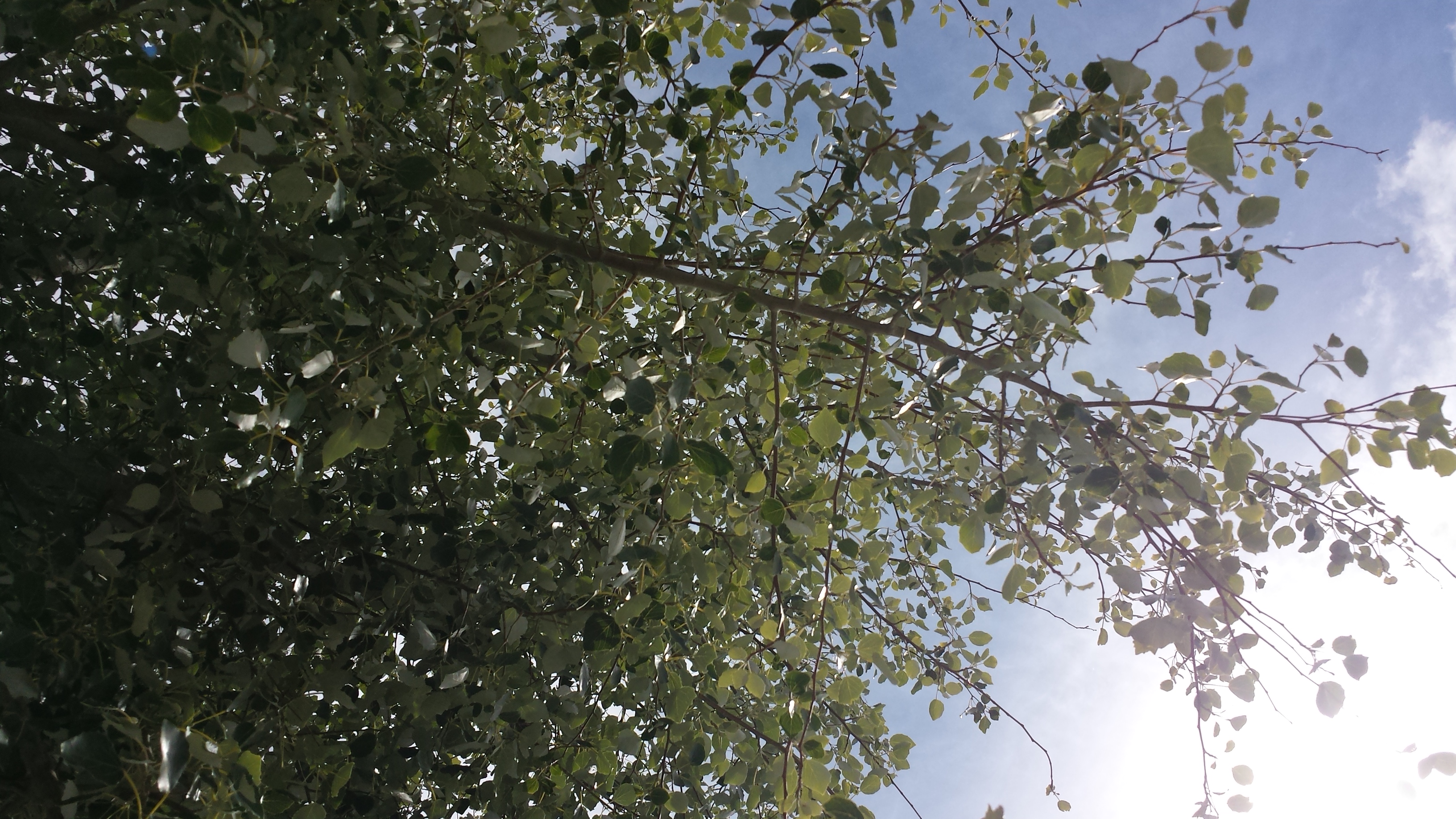
silvery underside of tree
Thursday: My favorite tree. When I pass under it, I love to look up at the silverly undersides of the leaves.
sun shining through clouds over city
Friday: After an early morning rain
trees and roses lining boulevard
Saturday: The roses are still blooming
silhouettes of two women
Sunday: Friendship
family of three with sombrilla and market bag walking along tree-lined boulevard
Sunday (again): A family walking home from the market
elderly couple seated on bench along tree-lined boulevard
Monday: An elderly couple enjoying the tranquil boulevard
open cupboard
Tuesday: Organized cupboards!
water bottle in case made out of aluminum bottle tabs
Wednesday: The water bottle holder itself is not very beautiful, but two things make it beautiful to me: 1) it was a gift and 2) it’s made from recycled aluminum can pull tabs.

Today I will see beauty- Part 1

Sometimes beauty gets lost in the daily grind of life until I hardly notice it anymore. Noticing the beautiful things in life generally doesn’t happen unless it’s intentional… at least for me.

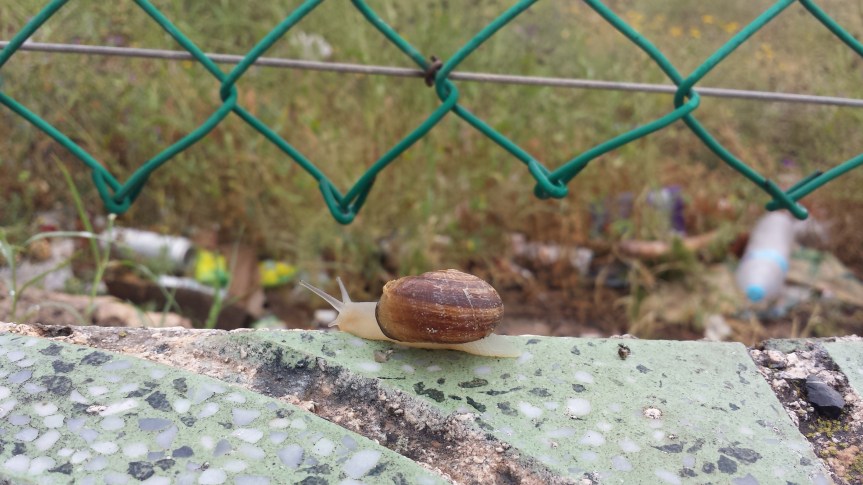
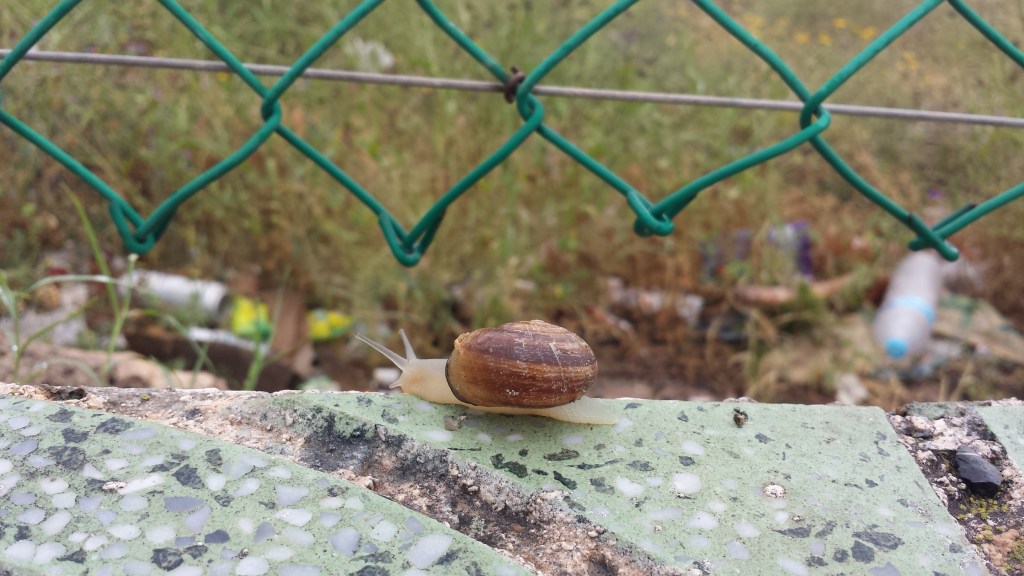
snail gliding along tile sidewalk

Many days, I would notice the trash, but not the snail.

This week, I want to be intentional about noticing beauty.  I propose one photo or descriptive scene each day.

I’m making the “descriptive scene” an option because sometimes the best photos lodge themselves in my mind and never make it to my camera. Sometimes because pulling out my camera would detract from the beauty. Sometimes because the moments happen too fast. Sometimes I am trying to be culturally sensitive.

(Pictures speak a thousand words, but sometimes words can speak a thousand pictures because words come from human perception rather than a camera lens.)

So for one week, I will look for beauty in every day… and give you an update next Thursday.

Join me?

I once was young, but now…

I found my first gray hair after more than a year in North Africa. I wailed as I looked at its reflection in the mirror. Was it really gray or just blond? I yanked it out and gingerly carried it to my roommate. She inspected it too, pulling out her flashlight for better lighting.

There, in the glaring battery-powered light, we knew the truth. Grimacing, my roommate (only one year younger than I) looked up at me, “I’m sorry!”

I could have wallowed in despair. But I didn’t. For some reason it didn’t bother me as much as I was expecting.

Long, long ago—and I’m pretty sure I’m qualified to use this phrase now that I’m over 30—long, loooong ago, my older sister told me that she didn’t think there was any point in feeling old. “We’re never going to be any younger than we are right now.”

I’ve remembered that.

Why are we so afraid of age? Is it the aches and pains? The slowing metabolism? The realization that our bodies are “past their prime”? The imminence of the grave (even though “to die is gain”? Why do we focus on the negative aspects?

Long, long ago, an English professor told me that the best part about getting older is the accumulation of knowledge. I’m not sure I would agree that knowledge is the best part, but it’s a pretty hefty perk.

As we get older, we get to embrace adulthood, make our own decisions, continue maturing, grow in wisdom, and teach the younger generation.

In Arabic (at least in this North African dialect), the verbs “to grow old” and “to honor” are almost identical. In the culture, gray-haired people are respected because of their life experience and wisdom. For some reason, my one gray hair—or maybe five or six by now—doesn’t hold a lot of weight yet. Maybe in another ten years I will be ten years wiser, and ten years more worthy of respect.

All we get are windows

“All we get are windows,” he had said.

And this after my week of cancelled plans, disappointed tears, and familiar feelings of uselessness. But his words rang in my head all weekend so that now in the middle of a lively West African church service, my mind was still stuck.

The dissonant keyboard chords, the steady drums and tambourine and my mind was thousands of miles away in last summer.

I could still hear those testimonies of broken men and women who were crying out to God for the meaning of their years of overseas service—men and women who felt they had little to report except failure.

“All we get are windows of time in people’s lives. We walk with them while we can.”

Sometimes those windows feel pointless. Like walking with someone on their journey is a waste of time and couldn’t God please bring someone else into our lives? Sometimes the windows feel so nice that we frantically try to prop them open when they begin to close. But they close anyway and we label them as aborted opportunities.

In the snippets of time we have with people—these “windows”—sometimes we lose sight of the bigger picture and think that the windows are all that matter. That’s when we feel useless, like failures.

The keyboard, drums, and tambourine faded as a new song leader took the microphone. Pacing back and forth, she started an African version of “Alleluia.”

“Alleluia. Alleluia. For the Lord God Almighty reigns.

“Holy, holy are you, Lord God Almighty!”

Behind the song leader was a pillar that supported the center of the little church building. There on the pillar, neat rows of pink and white silk rose buds formed a cross.

“Worthy is the Lamb! Worthy is the Lamb! Amen!”

Amen. So where will I place my focus? On my interpretation of efficiency or on the bigger picture: the glory of the Lamb? On the brevity of the windows of time or the fact that the Lamb is worthy of a life spent in faithful service?

A dog and a man

It was a quiet Sunday morning. Very little traffic. Very few people out except the dedicated who had rolled out of bed for 10 o’clock mass.

The evangelical service didn’t start until 11. And a crisp morning stroll was a good remedy for lethargy during church. Obviously, I was fairly alone in my opinion, or at least alone in the motivation for its practice.

I jammed my fists into my coat pockets to keep them warm. I was headed nowhere in particular and anyone looking at me could tell. Who cared? The hushed activity was restful and I talked with God as I walked.

Along the boulevard, there was a big piece of cardboard spread out on a bench. Had a homeless person slept there? Where was he now? Had the police chased him away? Why was he homeless?

As I continued strolling, I prayed for the needy of our quiet little town. Up a block or two along the boulevard, I noticed a dog shying away from a man on a bench. The skinny beast had belonged to somebody at some point in time—I knew because of the collar—but now his ribs were jutting through his thin white coat.

Again, the dog approached the man with great skepticism and was rewarded with a chunk of bread. He shied away again, but watched for the next morsel.

And the man. As I got closer, I noticed him. He had that look. Like someone who had spent more than one night on a park bench. Next to him was a childless stroller piled high with things, earthly treasures that may have come from a nightly raid of the neighborhood trash bins.

I passed the scene, wondering why the man was throwing away his bread to a dog. Wasn’t that proof of his bad stewardship that had probably put him out on the street in the first place?

Or could it be that he knew need—true, desperate need—and he had compassion on another needy creature?

On my return loop, my view was from the back of the scene. The dog was still there, darting in and shying away, but not quite so shyly anymore. He and the man understood each other.

I was the outsider, passing by the scene without really understanding.

I was thirsty and you gave me coffee

When I saw this mural of a homeless man and his hot coffee, I thought of the countless cups of coffee that we serve to immigrant women each week. Some mornings, we scramble to warm milk, fill sugar containers, and pour coffee, remembering that this lady likes her coffee heated especially hot and this one doesn’t take milk so fill it to the brim and that one wants her special cup and saucer.

“I was thirsty and you gave me drink.”

Some of the women are easy to serve. They smile. They are grateful. They ask you to sit with them and don’t mind your faltering Arabic. But others gossip or demand things from you while appraising you with hardened eyes. Sometimes it’s hard to remember that serving these women, “the least of these,” is serving the Lord.

But aren’t we all from the lineage of “the least of these”? At one time, weren’t we all watching the world with hardened eyes, cup out-stretched, thirsty? But did we know for what we were thirsting?

“The water that I will give him will become in him a spring of water welling up to eternal life.”

Today we serve, we pray, we speak, we love. But we never want those we serve to find fulfillment in a cup of coffee. We want them to walk away thirstier until they find that spring of water that wells up to eternal life.


(Matt. 25:35 and Jn. 4:14)

Two steep ditches I dig for myself

“If you don’t take your sorrows to God, they turn into bitterness. And if you don’t take your joys to God with thanksgiving and praise, they turn into idolatry.”

My brother learned this in one of his classes at Bible school.

But how one is supposed to balance on the narrow path between the ditches of bitterness and idolatry?

Late one night in the thick of my visa process, I was angry with life’s injustices. I curled up in my bed and started thanking God for His blessings. Thanking God seemed to be the spiritual thing to do.

But I didn’t feel thankful. I felt worried and scared and alone.

God saw through my flimsy façade. “Tell me about it,” He said.

“But, God, You have brought me so far already. I should be thanking You. I don’t want to be ungrateful!” Couldn’t He just accept my hollow thanks and be done with it?

Instead, He beckoned me to approach Him with my sorrow, no matter how frivolous or temporary it was. So I did. Would my silly little sorrow have turned to bitterness had I not given it to God?

See, I’m not sure that the path between these two ditches is so narrow after all. I don’t have to balance on a fine line between bitterness and idolatry. It’s not about balancing; it’s about surrendering.

God wants to be the One to hold our joys and our sorrows. The only two ditches are the ones I dig for myself when I don’t allow my Creator into my confidence and determine to face life alone.

Skeletons in the Savior’s closet

If anyone would have a perfect family tree, it would be sweet baby Jesus, right? No one who wants to rule the earth can hide skeletons in their closet. Any politician can tell you that.

In the end of the Old Testament book of Ruth, the writer gives a summary of Jesus’ lineage up to King David. First mentioned is Perez, son of Judah. Instead of a squeaky clean Old Testament saint, we find that Perez was the result of Judah mistaking his daughter-in-law for a prostitute (Gen. 38). Any good journalist would have sniffed out that scandal in a heartbeat and plastered unflattering pictures on the front page of every newspaper.

But that’s not all. This genealogy also mentions Boaz’s father, Salmon. But who was Boaz’s mother? None other than the heathen prostitute, Rahab (Josh. 6). Shocking.

Boaz marries Ruth, a Moabitess. Where did the Moabites come from? Well, when Lot is told to flee the city of Sodom, he and his daughters escape to a cave. There, the daughters conspire to preserve their father’s line and the eldest gives birth to her father’s child, Moab (Gen. 19). A sensational story that only God had the guts to write.

The family tree leaves more scars as generations march into history. Why didn’t God hide these skeletons in His Son’s closet instead of recording them for all people for all time? He had set up His Son for political failure.

But Jesus wasn’t a politician. His goal was not to erase the past, but to redeem it. God could have chosen a purer heritage for His Son; instead, He painted a stunning picture of redemption. These broken relationships in Jesus’ lineage wounded the heart of God, but out of them came Jesus, Healer of broken relationships, Hope of the hurting world.

Merry Christmas!

Dare to give away your dream

“Twelve dirham.”

I picked eight dirham out of my coin purse. “Here you are.”

The produce vendor looked down at the coins in his palm and waited.

I stared at the eight dirham and felt the heat creep up my face as my mind replayed the Arabic word he had used. He had said, “tnash” and I had given him “tminia.” I had been in North Africa for six months and still didn’t know my numbers? Good grief.

Despite the countless hours of study, I was, in fact, the worst language student in all of history.

The sting of my disappointment worsened when I saw others fulfilling my dream. While I plodded through language school, feeling like a daily failure, I was forced to watch other students blossom. It wasn’t fair.

Seeing others fulfill my dreams made me insecure and envious.

During my time in North Africa, I heard of a man and his wife who had a vision similar to mine. But because of circumstances outside of their control, they could not move overseas. Instead of being jealous and closing up their heart to this dream, they sent me a donation to carry on with my work. Several hundred dollars to someone who was living out their dream. Their heart was for the dream rather than who was fulfilling the dream.

Thousands of years ago, King David realized that he was living in a palace while God dwelt in a tent. He decided to honor God by building a gorgeous temple. It was his dream, and a worthy dream at that. But God said “no.”

Instead of pouting, King David helped to plan and gather building materials. He even blessed his successor to complete the God-given privilege of building the temple.

So when you see other people being or doing what you would like to be or do, don’t soothe your pride with the camaraderie of other envious people around you. Share your dream with others, even if they are better at it than you are. But beware: it’s much harder to give away your dream than it is to give it up! Trust me; I know because it’s a lesson I’m still learning.

Permanence

Barf bag? Check. Peppermint oil? Check. Ginger? Check. I wasn’t going to jeopardize the rest of the trip by getting sick on the first of my three flights.

Now for the distraction. I plugged in earbuds and cranked up Handel’s Messiah.

The plane taxied. The engines roared. And we were up, up, and away. “Prepare ye the way of the Lord!” boomed the bass soloist.

Forty-five minutes later, the wheels touched the runway. “Glory to God! Glory to God! Glory to God in the hiiiiiigh-eeeest!” the choir shrieked.

Amen. Flight #1 was done. But flight #2 was the doozy: Chicago to Madrid. I glazed over after hours of my seatmate’s flickering screen through my closed eyelids. When flight #3 came around, I couldn’t keep my eyes open during the safety demonstration but drifted to sleep on my seatmate’s arm.

Traveling to my new home took less than 24 hours, but it’s going to take me longer than that to adjust. As I walk the familiar streets, I’m continually surprised when I realize that I’m a Spanish resident, not just a visitor.

For years, I have been longing for a sense of permanence. Now I have it and I’m not quite sure what to do with it. Not yet.

But Someone in my life understands permanence better than I do. In fact, He has never changed. And He is the best part of the permanence in my life right now. “The eternal God is your refuge and underneath are the everlasting arms.” (Deut. 33:27a)