Tips for surviving Spain- Part 1

Thinking of moving to southern Spain? Or even just visiting? Here are some helpful tips that my roommate helped me compile:

  1. Learn Spanish (I might as well start with the obvious).
  2. Carry your own shopping bags with you, recycle, conserve water, etc. Europe tends to be greener than America.
  3. Weigh your produce when you go shopping… or you’ll get to the counter without prices and the cashier might roll her eyes.
  4. Bring cash. Not every store accepts credit and/or debit cards. And many stores want small change, not large bills.
  5. Don’t read dates backwards. Dates are written by day/month/year rather than month/day/year. Don’t show up for an appointment on January 2 that was set for February 1.
  6. Read schedules by the 24-hour clock. Otherwise, you might expect a train at 6 p.m. that actually went at 6 a.m.
  7. Allow more time to complete tasks. The Spanish are fairly efficient… most of the time. But don’t treat the shopping world like a Wal-Mart. Shops tend to be more specialized and it takes longer to get everything you need (but it’s more fun!). And don’t expect buses to arrive on time… or arrive at all if it’s a holiday.
  8. Relax a bit. The average schedule runs about two hours later than the American schedule: shops open at 9 or 10. Lunch is at 2 or 3 p.m.
  9. Don’t try to shop between 2 and 5 p.m. In fact, don’t even bother going outside unless you’re looking for some quality solitude. And in the summer, you might burn to a crisp if you’re out in the hot sun between 1-6 p.m.
  10. Watch your step. At least in southern Spain, many people have little yippy dogs that leave behind deposits on the sidewalk.
  11. Realize that when it’s dark outside, it is NOT time to go to bed; the party is just beginning.
  12. Eat meat. Most Spaniards are unapologetically carnivorous. They especially love pork. (Be prepared to see the jamón serrano everywhere.) Some restaurant billboards would send animal rights activists into a tizzy.
  13. Don’t expect to find chicken in restaurants unless the restaurant name specifies chicken. Most menus are laden with pork and seafood options.
  14. Get used to eating bread, bread, bread. Fortunately, the Spaniards are excellent bread makers.
  15. And learn to love olives while you’re at it. Don’t worry; Spanish olives are amazing.

To be continued as we continue learning…

Confessions of Betty Croaker

Have I ever told you I’m a terrible cook? Well, I am, and now you know.

My roommate, makes ratatouille. I make things like red curry and other spicy foods that people can’t actually taste because their mouths are on fire.

I suppose that my biggest problem is that I don’t often analyze what makes good flavors blend in the food I’m eating. Therefore, I can’t replicate such caution while I’m cooking.

One day, I suggested putting fresh salsa on a pesto pasta dish I had made. Tomatoes and pasta sounded close enough to Italian for me. My sister wrinkled her nose. “You would be mixing cuisines.” I think she was probably right. Basil and cilantro might not be a good mix after all.

I’m a thrifty cook like my grandma used to be. Before you commend me for such skill, please note that “thrifty” is a nice adjective to describe a lot of things, but not a cook. Especially if that is the only positive adjective one can conjure.

I’m the kind of cook that looks at a dying entity in my refrigerator and googles a recipe to use it up. Consequently with this spur-of-the-moment cooking, I rarely have the other ingredients the recipe calls for. Simple. I improvise! … and end up with something barely tolerable but edible as long as I’m not having guests.

The other option I sometimes employ is to keep searching for recipes that only have the ingredients I have on hand (or say “optional” behind them). The result is a bare bones dish that I don’t even want to sample.

When I moved to Spain, my roommate and I agreed to cook for each other once a week. Then I panicked. “What am I thinking?!” But it was a brave sort of panic, because I was pretty sure I could do it. My sister (maybe more concerned than I) shot me some menu ideas.

So once a week, I’ve been ignoring my budget and plunging into the exciting new world of meals with all of the ingredients, even the optional ones. (I eat the dying entities in the back of the fridge the other days of the week.)

After careful planning and zealous shopping, I was rewarded. At my first meal, my roommate took a second helping. Imagine! And at my second meal she said, “This one is worth repeating!”

It’s beginning to look a lot like Christmas… in Almería

My roommate, a friend, and I spent a chilly afternoon on the beach before checking out what Christmas looks like in Almería. We sampled roasted chestnuts, feasted on chicken and potatoes, tried to find an elusive tea shop, browsed through a Christmas market, and walked and walked and walked until I was sure we had worn holes in the soles of our shoes.

giant bethlehem manger scene
An entire room of a Bethlehem scene
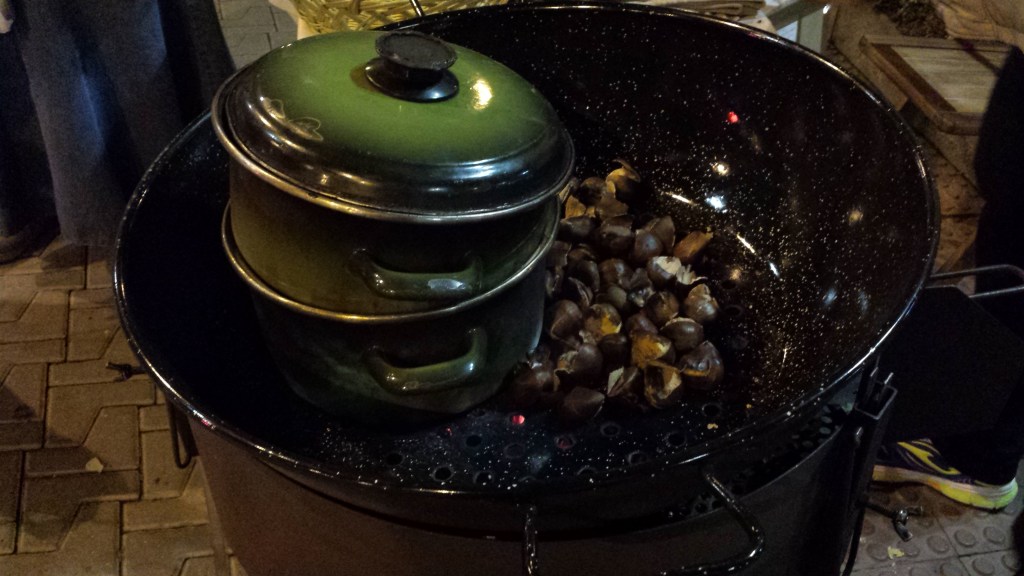
chestnuts roasting in a pan over a fire
“Chestnuuuuuts rooooasting on an open fiiiiiire.”
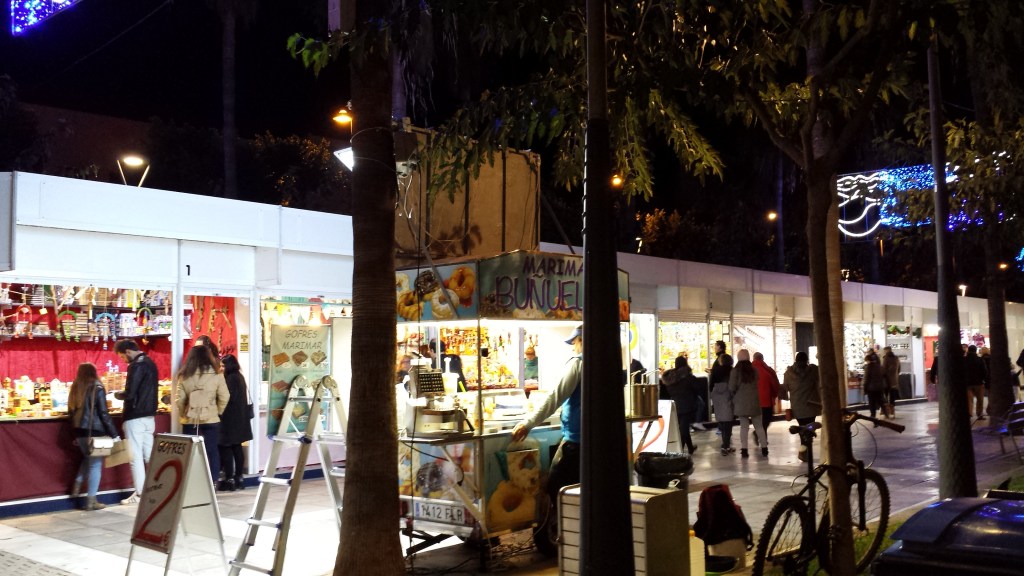
brightly lit row of market stalls
A Christmas market

Permanence

Barf bag? Check. Peppermint oil? Check. Ginger? Check. I wasn’t going to jeopardize the rest of the trip by getting sick on the first of my three flights.

Now for the distraction. I plugged in earbuds and cranked up Handel’s Messiah.

The plane taxied. The engines roared. And we were up, up, and away. “Prepare ye the way of the Lord!” boomed the bass soloist.

Forty-five minutes later, the wheels touched the runway. “Glory to God! Glory to God! Glory to God in the hiiiiiigh-eeeest!” the choir shrieked.

Amen. Flight #1 was done. But flight #2 was the doozy: Chicago to Madrid. I glazed over after hours of my seatmate’s flickering screen through my closed eyelids. When flight #3 came around, I couldn’t keep my eyes open during the safety demonstration but drifted to sleep on my seatmate’s arm.

Traveling to my new home took less than 24 hours, but it’s going to take me longer than that to adjust. As I walk the familiar streets, I’m continually surprised when I realize that I’m a Spanish resident, not just a visitor.

For years, I have been longing for a sense of permanence. Now I have it and I’m not quite sure what to do with it. Not yet.

But Someone in my life understands permanence better than I do. In fact, He has never changed. And He is the best part of the permanence in my life right now. “The eternal God is your refuge and underneath are the everlasting arms.” (Deut. 33:27a)

What leaving feels like

I leave tomorrow. I’m excited and almost ready. But right now, Spain seems far away. Maybe life as it is now will go on forever: me almost leaving, a surgery here, a new job there, a new baby a state or two or three away.

To not be part of this ever-changing cycle at home is unfathomable. And when I do fathom, I burst into tears. My nostalgia remembers the days, weeks, and maybe even months that used to pass dry-eyed.

The other evening, I stretched out on the carpet with my head next to Clark’s. I stared into his bright face and could not cherish the moment. Neither could I reject the moment to protect my heart. The moment just was and I watched it pass.

Later as my nephews were leaving, Albert got zipped up in his too-big, puffy coat. Soon he will fill up that coat and I will not be here to see him do it.

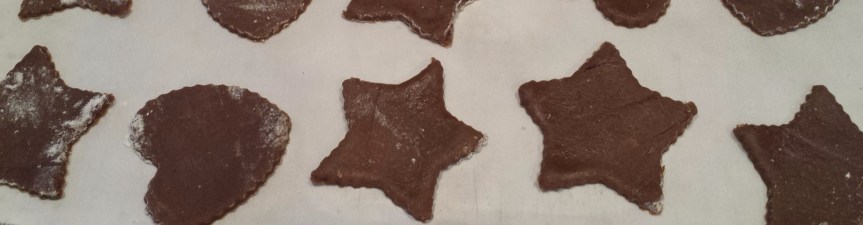
I made gingerbread cookies. My sister made coffee. We hung out with Christmas music. And at night when I crawled into my own little bed, all I could do was cling to the ghosts of those memories and cry my tears of regret that I hadn’t experienced them more fully. Or sealed off my heart from loving.

And I cried out, “Oh God, why do I have to follow You?” There was no answer. I knew, and He knew that I knew. There was no warm, fuzzy peace either. Just a calm that felt more like resignation as I braced myself for more goodbyes.

I hope tomorrow things will look different. But this is what leaving looks like today.

Let the tears begin

It came while I was meeting my niece 12½ hours away from home. There it was! My Spanish residence visa. Dad WhatsApped me a picture. I broadcasted the news near and far and even took the first steps to get my plane ticket.

The ecstasy lasted approximately one hour; because when I pulled out my pocket calendar, excitement vanished with a puff of reality. I was looking at today’s date and my departure date on the same page. I had between three and four weeks.

I should have been ready; all along I had known of this possibility. But now it was real. That night, instead of drifting off into agreeable dreams, I cried myself to sleep.

That was a week ago. Now I have less than three weeks left. I’m still tossed to and fro between the delight of moving to Spain and the sorrow of leaving behind my world.

  • My nephews and niece will grow up, knowing me as the aunt who lives far away and brings them olives and cheap souvenirs with Spanish logos.
  • My family will try to keep me in the loop, even as we age and grow apart.
  • My church family will change dynamics as people come and people go.
  • Friends will move away, marry, and have children.
  • Older friends will have health complications and pass away.
  • The community will change as businesses start up and shut down, land is cleared, and landmarks disappear.

The list goes on.

I’ll change too. It’s just that this part of my life and I will not change together. It’s hard to give that up. But how can I cling to a vapor? My reality on earth is temporary. As important as life is to me right now, I don’t want it to weaken the anticipation of the life to come, the everlasting life.

Learning trust, one call at a time

The first time I got the call, I was woefully unprepared. “Your paperwork isn’t right. You have 10 days to straighten it out.”

“I will look into it. If I have questions, can I call you?”

“No, everything you need is on our website.”

I messaged my team in Spain with my sob story. Within a day, they had straightened out my paperwork on the Spanish side of things. Several agonizing days later, the documents had the proper signatures on them. All was well. Disaster averted.

A few days later, after a day of work, I noticed a missed call on my phone… from the consulate. The chances of this being a “we received your paperwork” phone call were not good. But I still prayed that way until they called again 2 days later.

This time the voice was female. “One of the documents is still not right. You have 10 days to straighten this out.”

Within a day, the team in Spain had amended yet another document and it was on its way to the consulate. But as soon as the document arrived, my phone rang and my heart sank.

“This is not right. How can you live and work in one province when your organization is in another province?”

“That’s how it is.” I tried to explain, but the man remained unconvinced.

“I need a correction on this document or an official letter of explanation or we will reject your application and you will need to start again. This has gone on too long.”

“I know.” I didn’t even try to keep the whine out of my voice. “Too long” was right. My application would be either accepted or denied and we might as well get on with it. This middle ground had stripped my nerves completely raw.

In short, each phone call presented a new opportunity to trust. After each call, I gave the entire ordeal to God… but it was never long before I stole it back from Him. When would I learn?

Just this week, I sent off the latest document. I am waiting to hear whether or not it arrived in time. Re-application is a looming possibility. But I suppose that if I apply enough times, I might actually learn complete trust in the One who is in control of every government and their consulates.

Transitioning with olives

All I wanted to do was buy olives. It was the perfect idea to reward myself with a short walk to the store between secretarial tasks. The weather was full of gentle Mediterranean breezes and I loved walking. Then why was I suddenly anxious?

What should I wear? Some of my clothes were stored in boxes. Others were stashed in suitcases, ready to make the final leg of the journey to the States. Somehow the outfit I had on no longer matched. The shades of blue were all wrong.

“Trish,” I reasoned with myself. “This outfit was perfectly fine before.” But not now. Not in Europe. Not in public. I changed and then changed back when the second option felt even worse.

How do I say olive in Spanish? Olive? No, that’s French. Zitun? That’s Arabic. Why can’t I remember my Spanish anymore? Should I take my own bag or do stores give out plastic bags? I can’t remember. What were they doing the last time I was here? Where did I even put my shopping bags?

Why is this so hard?

I didn’t want to take that short walk anymore. Every decision looked big. Nothing was familiar. I battled my anxiety all the way to the store. I felt everyone’s eyes on me. Am I even walking down the right street? Why is that car stopping for me? Thank you, sir! No, don’t wave at him; you’ll look even more like a stupid foreigner. You’re in Europe now.

Transition. Have I exaggerated my trip to the store? Yes. But the exaggeration was in reality, not in what I just wrote. It sounds ridiculous to say that I almost panicked at the thought of buying olives. But transition is hard because nothing is familiar. Everything requires extra thought and effort. No matter how insignificant, every decision feels big.

I am not the only one who feels the pressure of transition. Maybe everyone else I know can confidently buy olives, but there are different responses to transition. And there are different types of transition. Do you know of someone whose spouse has passed away? Someone who has lost a dear friendship? Someone who has moved to a different community?

Maybe it’s you. Maybe you’re feeling a bit like me right now, or worse. Whether it is you or someone else, give that person time to grieve and transition. Remember that we are not alone. There are others who understand… especially the “man of sorrows” who was “acquainted with grief” (Is. 53:3).

Celebrating life

Sitting down to write a blog post is the last thing I want to do right now. Today I cannot pretend to have the formula to solve life’s problems. I have just said goodbye to a life where I had started to belong and I’m feeling rather homeless.

But there is Someone who experienced a transition much more challenging than I will ever have to face. Imagine leaving the presence of God to become a needy child, a hormonal teenager, and then a radical adult first pursued and then rejected by a group of wishy-washy followers.

Jesus Messiah understands the struggle and the heartache that come with transition. But instead of hiding from life, He still chose to live intentionally. He chose to invest in the lives of others, sometimes despite a low return on His investment. And what happened at the end of this intentional life? Jesus was killed for living unashamed. That sounds like a noble end, doesn’t it? But noble as it is, that isn’t the end of the story. Death didn’t stop Him.

This year, I am celebrating Resurrection Sunday in Spain before I move back to the States to apply for residency. Transition has really only just begun. But despite my heartache and perceived homelessness, today I want to celebrate life: Jesus’ life on earth and my own life because of Him.