Hindsight is not 20/20

Hindsight is not 20/20. At least mine isn’t, especially my hindsight of past conversations. My hindsight compiles a list of things I should have said and didn’t or shouldn’t have said and did.

“I should have invited her up for tea when she asked if this was my street.”

“I should have complimented her on how nice she looked; I noticed she made an effort.”

“I shouldn’t have made that comment about Islam.”

That’s what I focus on. How I should have made better use of the conversation. As I turn with a finger poised to shake at the past me, my hindsight narrows to tunnel vision. 

Because, more often than not, I’m forgetting the other factors involved. 

It could be that I already had plans with a neighbor and only when the other plans were canceled did I remember the interaction on the street.

It could be that our interaction at the noisy gathering was so brief that I only had time to ask her about the exams she had been studying for when I last saw her.

It could be that after my friends spent twenty minutes complaining about Muslim men, they ganged up on me to marry me off. And I made that split second decision to speak directly rather than lose the moment in the rush of conversation by taking the time to formulate an indirect response.

I want to learn from my mistakes. However, when I get analytical about what was said or not said, I need to pause long enough to remember the other factors involved: the distractions, the mind noise, the body language of the other person, etc. 

Then slowly, a shameful, paralyzing memory is seasoned with grace. Only then can I step forward because remembering truthfully is the best way to learn from mistakes.


Photo by Laura Fuhrman on Unsplash

“The svelte brunette vs. her pimply cousin” or “Coffee vs. tea”

Last time I was Stateside, I confessed to two dear friends that I really liked tea. They smiled but disagreed. “Watery” was one of the agreed-upon adjectives. We sipped our coffee together, because at least we agreed on that. 

Long ago, back when we all still had Facebook, a friend’s sister posted that coffee was a svelte, rich brunette and tea was her pimply cousin, or something to that effect. “What a perfect description!” I thought and stashed it away in a mental file (not a verbatim mental file, apparently). I 100% agreed. 

Until now. 

I still love coffee but my intolerance to large doses of caffeine has curbed my zeal. That and the less-than-desirable church potluck coffee of my past which carried the distinct flavor of what a friend called “burnt Folgers.” In the meantime, I’ve grown fonder of tea. In fact, I like tea even more than I did when my friends called it “watery.”

Nearly every week, I visit a tea vendor at the local market. I ask for a bit of this and a bit of that until I drive her crazy filling tiny baggies. Then I go home with my loot and put the kettle on. 

I’ve never been one to branch out with coffee flavors. Yah, I’m the one who gets a plain latte practically every time she goes to a coffee shop. Now decaf, oh, and no sugar, please. But tea is different. With my little samples, I’m working my way through the tea vendor’s options. 

Rooibos is an acquired taste, I’ve decided, and I’m still working on acquiring it. I thought it was okay until my student said the vanilla blend tasted like a medicine from her childhood. The infusions also leave something to be desired. Flavor, to be exact. After my first cup of some sort of pomegranate blend I had to side with my friends on the whole “watery” thing. Apparently, infusions require a surprising quantity to achieve flavor. Blah. I picked out the now-soggy pieces of fruit and ate them to console myself. The piña colada infusion had to go too. Too coconuty, even for someone who loves coconut. 

Some of the teas that are planning to stay on my shelf are: Japanese cherry (green), black tea with rose, caramelized almond (black), green with pomegranate, and one called 1,001 nights, a green blend that is exotic, romantic, and not at all watery. 

What about you? Are you a tea drinker? If so, which flavors do you like? Any suggestions for non-caffeinated, non-watery-infusion, non-rooibos varieties?

Leaving behind our fish

My writing prompt this week is about letting something go. What have I let go? 

A couple of years ago on another blog, I wrote a lament about living far away from family. I understand the sacrifice of “letting go” theoretically and even theologically but not always emotionally. Now and then, especially when I’m homesick, I renew my lament. Yes, I love the life God has given me and the deep and beautiful blessings that come along with it, but it doesn’t mean it’s always easy. 

Sometimes even the wonderful, valuable gifts in this life are things we must let go, things God asks us to miss out on. So we watch from afar with palms pressed against the window pane that divides something we long for from our reality.

We all have laments, don’t we? Things we miss out on because we have counted the cost and decided to follow Jesus.

I won’t elaborate on this particular lament. I’ve done it in pieces on my blog: here, here, here, here, here, and here (oops, I didn’t realize there would be so many “here”s). The writing prompt reminded me of a passage I recently read, a passage I still need time to think through. Below, I have retold the story from Luke 5:1-11. I hope the story touches a dark corner of your heart like it touched mine. What do I need to let go? Really let go? Can I believe that Jesus is worth it?

May the victory of Jesus’ death and resurrection fill your life to overflowing.

The Lord is risen!


They were tired when Jesus came. It had been a long night with no fish. No fish meant no market. No market meant no income. No income meant, well, not much of anything.

He was a bit strange, this Jesus, climbing on board Peter’s boat to talk to the crowd. A few people began to splash into the lake to be close to him, and it was then that Jesus quietly asked Peter to push out just a little from the land. Peter gladly gave up his task of washing the fishing nets to hear for himself why so many people were following this Teacher around.

Jesus taught in language that was both simple and profound. The crowd pressed against the shoreline, engaged, spell-bound even. When Jesus was done teaching, he turned to Peter and said, “Put out into the deep and let down your nets for a catch.”

They had already tried that. All night, actually. So Peter said, “Master, we worked all night and caught nothing! But if you say so, I will let down the nets.” 

The nets slipped in the water with the familiar creaking of ropes. A creaking of familiar hopelessness.

And then their nets were breaking, splitting with the load of fish! It took a moment to understand what was happening, so astonished were they. “Help!” they cried to a nearby boat. Soon both boats were overflowing. They began to take on water.

Excitement and wonder were thick in the air. Peter and his companions, James and John, stared at this Teacher, this Master, who seemed to have power over creation. Overcome, Peter fell down at Jesus’ knees. “Depart from me, for I am a sinful man, O Lord.”

“Do not be afraid,” said Jesus. “From now on you will be catching men.”

They rowed to the shore as their boats sank lower and lower in the sea. Those from the crowd who had not yet dispersed stood on the shore, gawking as the water lapped at their ankles. 

Fish meant market. Market meant income. Income meant, well, anything.

But they left their boats, their nets, their fish and followed Jesus because He was everything.


Photo by Cassiano Psomas on Unsplash

Worship in routine

Last week, a friend told me that she wants her appearance to reflect who she is on the inside, to reflect her inner value and worth as the Holy Spirit’s dwelling place (1 Cor. 6:19). Hmm. That’s good, I think as I lounge in my sweatpants and dirty socks and, oh, oatmeal still between my teeth from breakfast.

I’ve been struggling with the elbow grease of my friend’s realization before she even sent that message. See, I hate getting out of bed in the morning. No, it’s not depression; it’s because my morning routine takes too long, a chunk of seemingly misused time. The world is going up in flames and I’m making my bed and starting the tea kettle and washing my face. And, goodness, what should I wear?

These small tasks don’t feel useless, per se, but of such triviality that it’s irritating how they eat up my morning. They are necessary and I do them, but they feel to me like wood, hay, and stubble. Bedtime is even worse because I have to undo what took me so long to do in the morning plus I’m sleepy and *gasps* grumpy.

WHEN WE GET TO ETERNITY, IS GOD GOING TO CALL US TO ACCOUNT FOR WEARING DIRTY SOCKS? That’s what I want to shout sometimes.

In 2020, I read and recommended Liturgy of the Ordinary: Sacred Practices in Everyday Life by Tish Harrison Warren. “[M]y theology was too big to touch a typical day in my life,” she writes (p. 55). Trim my fingernails? God’s not going to call me to account for that either. I want to do the big things, the kingdom work.

Warren challenged me to view my routines as sacred and meaningful, part of the abundant life that Jesus has for me (p. 22) “How I spend this ordinary day in Christ is how I will spend my Christian life” (p. 24). And that includes my attitude. “The crucible of our formation is in the monotony of our daily routines” (p. 34) because, according to Warren, that is where we can truly start the revolution we’re dreaming of (see Lk. 16:10).

So, God might not call me to account for my dirty socks or overflowing dish drainer, yet, that doesn’t make me unaccountable for how I treat God’s temple (my body) and the gifts He has freely given me. 

As I type out these thoughts, I interrupt myself for a shower, to heat a bowl of soup, and yes, to empty that overflowing dish drainer. It doesn’t feel worshipful, especially when I find a spoon that still has dried bean broth on it. 

But maybe I’m looking at it backwards. Like my friend, I think I should start by reclaiming my motivation and letting my life–even those mundane fingernail clippings and bed makings–come out of that motivation in something like a sweet-smelling savor of worship.


Photo by Nick Page on Unsplash

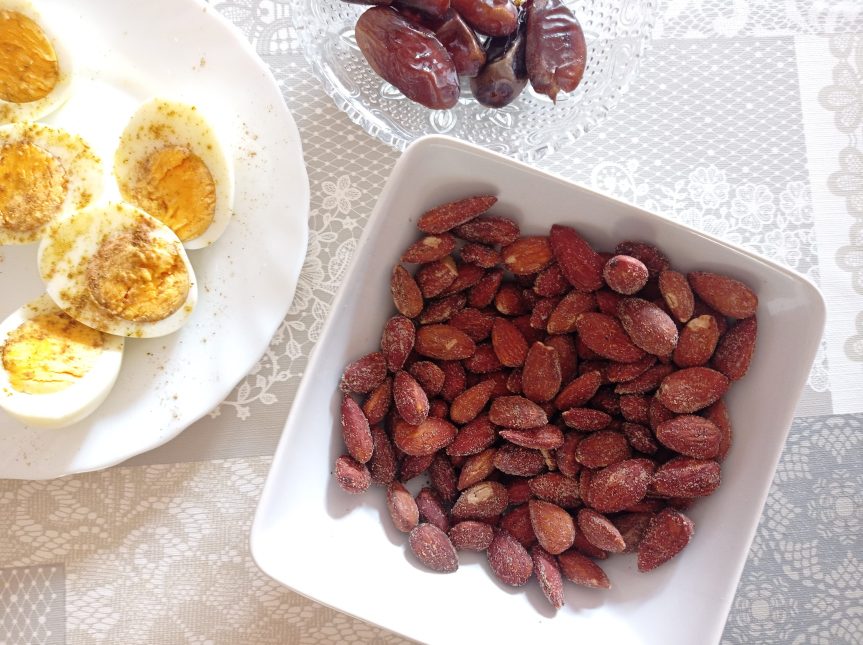
Recipe: roasted almonds

Roasting almonds is one of the easiest things in the world to do. You might buy your almonds already roasted, but roasting them at home is more fun. I’ve been roasting my own for a few years and finally decided I needed to write down a recipe since they never turned out the same. Note that these measurements are approximate; feel free to skip the measuring or branch out with your seasonings.

  • 4 c. raw almonds
  • 1 Tbsp. extra virgen olive oil
  • 1/2 tsp. garlic powder
  • 1/4-1/2 tsp. black pepper, finely ground
  • 1 tsp. salt, finely ground (I found that regular salt didn’t stick to the almonds, so I tried popcorn salt. If you have an electric grinder, grinding your preferred salt should work too.)

Stir almonds and olive oil until the almonds are uniformly coated. Add the seasonings and stir until spread evenly.

Spread on a baking sheet and bake at 300° F. (150° C) for about 15 minutes, stirring halfway through. Cool before serving.