I have found a cause

A personality test told me that I am an advocate. That means I need a cause to fight for, but which one? There are so many causes. I could collect labels that define me as pro-choice, pro-life, Republican, Democrat, Libertarian, etc. I could fight for women’s rights, for the environment, or against human trafficking…

But who am I really? That’s a question I have been asking myself since returning to my passport country. I could become an advocate for any of these causes, but will I let these causes define who I am?

In a heroic declaration of national allegiance, Nathan Hale once said, “I only regret that I have but one life to lose for my country.” As an independence fighter, he clearly had a cause.

But what if those words of beautiful loyalty were assigned to a cause greater than any of the causes listed above? I want to be able to say from depth of my soul: “I only regret that I have but one life to lose for my Savior.”

The Bible talks about losing our lives for the cause of Christ. And when we lose it for His cause, then we are truly living. That sounds like a cause worth advocating.

For whoever would save his life will lose it, but whoever loses his life for my sake will find it.

Matt. 16:25

Casting all your anxieties on him

When she told me goodbye, my roommate gave me a stack of envelopes- one per month until my birthday. There were two photos in the May envelope. One was a peaceful mountain landscape… with an ominous quote:

“You will never be completely at home again. Because part of your heart will always be elsewhere. That is the price you pay for the richness of loving and knowing people in more than one place.”

The other photo was of an overloaded North African donkey. On the back of the photo, my roommate had written “Casting ALL your anxieties on him, because he cares for you. (1 Peter 5:7)”

I immediately posted both on my refrigerator. They belonged together.

My life is strange right now- the sensation of not quite belonging anywhere. The struggle of trying to remember exactly where you are and why you are there. Sometimes the struggle even includes trying to remember who you are. Re-entry is somewhat like waking up from a vivid dream. Initially, there is such a lostness.

But He is capable and willing to carry my anxieties. And more than that, He cares for me.

Grace and migrating tissues

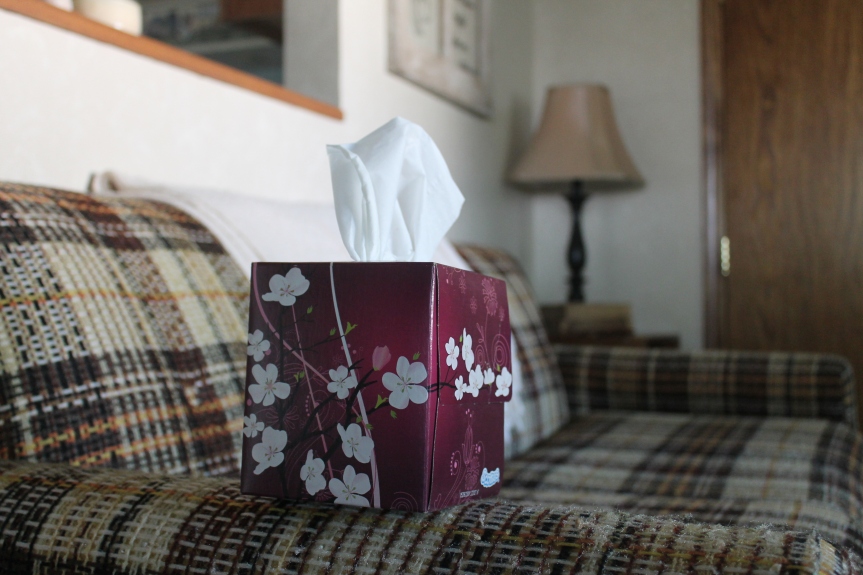
I had spent a significant part of my evening in the living room chair with a box of tissues close at hand. It was my very own pity party. No one else was invited. The piles of bank statements, resident visa forms, tax papers, and junk mail were the life of my party.

I felt like I had been making lists all day. Lists of things that had to be done. Lists of phone numbers to call. Lists of people I should visit. Grocery lists. Arabic verb lists. And this list goes on…

Not only that, but the thoughts rolling around in my head hadn’t yet been categorized on any list. Is this what “normal” looked like in America? Had I simply forgotten? Or had I completely lost my ability to handle stress? Or was it just the paperwork I couldn’t handle?

That’s why I merited a pity party. So I moped and felt considerably worse afterwards. A pity party hangover. Finally, I was able to motivate myself to go to bed. And guess what? I had a wonderful night of sleep!

Not that I deserved it. Nope. If I would have been God, I would have made me toss and turn restlessly all night to learn my lesson for worrying about all of the “tomorrows” of my future. Instead, He showed me grace and I woke up ready to face the new day instead of cowering under the covers.

I chipped away at one of my lists, accomplishing what I could and leaving the rest unwept, unhonored, and unsung. And that afternoon, I was ready when a friend arrived in unexpected tears. She didn’t need to explain. We simply moved the tissues from beside my chair to where she was seated on the couch. And I made some tea.

God knows that we don’t always learn lessons best through justice. Sometimes what we need is grace.

Some things I miss/ Things I don’t (so far)

Things I miss:

  • Friends
  • Making friends quickly
  • A respect for morals rather than a disdain of them
  • Bringing God into everyday conversation without people thinking you are overly pious
  • Easy and cheap transportation
  • Inexpensive produce
  • Going out to eat on a whim because of inexpensive menu prices
  • Bargaining for prices
  • Warm and constant hospitality
  • Crossing the street without a crosswalk… and not feeling guilty
  • People looking excited when you speak to them in their language
  • People watching out for you

Things I don’t miss:

  • The class system and discrimination
  • Being addressed in French
  • Being treated as a trophy friend
  • Being treated as better than others
  • The façade of open-mindedness
  • A monotonous cuisine
  • Bread
  • Catcalls
  • Being targeted by people asking for things because you are a foreigner
  • People budging
  • People asking invasive questions

Be still and know

“Be still, and know that I am God.” Those words beckon inner peace. For most of my life, I have enjoyed that thought in isolation. But recently, someone suggested I look at the context of the Psalm. These are a few of the phrases from the preceding verses:

  • the earth gives way
  • waters roar and foam
  • mountains tremble
  • nations rage
  • kingdoms totter
  • the earth melts

Psalm 46 is not only about finding inner peace, but about finding inner peace despite external circumstances. How? God is our refuge and strength.

God is our refuge and strength, a very present help in trouble.
Therefore we will not fear though the earth gives way, though the mountains be moved into the heart of the sea,
though its waters roar and foam, though the mountains tremble at its swelling. Selah

There is a river whose streams make glad the city of God, the holy habitation of the Most High.
God is in the midst of her; she shall not be moved; God will help her when morning dawns.
The nations rage, the kingdoms totter; he utters his voice, the earth melts.
The Lord of hosts is with us; the God of Jacob is our fortress. Selah

Come, behold the works of the Lord, how he has brought desolations on the earth.
He makes wars cease to the end of the earth; he breaks the bow and shatters the spear; he burns the chariots with fire.
“Be still, and know that I am God. I will be exalted among the nations, I will be exalted in the earth!”
The Lord of hosts is with us; the God of Jacob is our fortress. Selah

Psalm 46

Photo by Duncan Kidd on Unsplash

Transitioning with olives

All I wanted to do was buy olives. It was the perfect idea to reward myself with a short walk to the store between secretarial tasks. The weather was full of gentle Mediterranean breezes and I loved walking. Then why was I suddenly anxious?

What should I wear? Some of my clothes were stored in boxes. Others were stashed in suitcases, ready to make the final leg of the journey to the States. Somehow the outfit I had on no longer matched. The shades of blue were all wrong.

“Trish,” I reasoned with myself. “This outfit was perfectly fine before.” But not now. Not in Europe. Not in public. I changed and then changed back when the second option felt even worse.

How do I say olive in Spanish? Olive? No, that’s French. Zitun? That’s Arabic. Why can’t I remember my Spanish anymore? Should I take my own bag or do stores give out plastic bags? I can’t remember. What were they doing the last time I was here? Where did I even put my shopping bags?

Why is this so hard?

I didn’t want to take that short walk anymore. Every decision looked big. Nothing was familiar. I battled my anxiety all the way to the store. I felt everyone’s eyes on me. Am I even walking down the right street? Why is that car stopping for me? Thank you, sir! No, don’t wave at him; you’ll look even more like a stupid foreigner. You’re in Europe now.

Transition. Have I exaggerated my trip to the store? Yes. But the exaggeration was in reality, not in what I just wrote. It sounds ridiculous to say that I almost panicked at the thought of buying olives. But transition is hard because nothing is familiar. Everything requires extra thought and effort. No matter how insignificant, every decision feels big.

I am not the only one who feels the pressure of transition. Maybe everyone else I know can confidently buy olives, but there are different responses to transition. And there are different types of transition. Do you know of someone whose spouse has passed away? Someone who has lost a dear friendship? Someone who has moved to a different community?

Maybe it’s you. Maybe you’re feeling a bit like me right now, or worse. Whether it is you or someone else, give that person time to grieve and transition. Remember that we are not alone. There are others who understand… especially the “man of sorrows” who was “acquainted with grief” (Is. 53:3).

Celebrating life

Sitting down to write a blog post is the last thing I want to do right now. Today I cannot pretend to have the formula to solve life’s problems. I have just said goodbye to a life where I had started to belong and I’m feeling rather homeless.

But there is Someone who experienced a transition much more challenging than I will ever have to face. Imagine leaving the presence of God to become a needy child, a hormonal teenager, and then a radical adult first pursued and then rejected by a group of wishy-washy followers.

Jesus Messiah understands the struggle and the heartache that come with transition. But instead of hiding from life, He still chose to live intentionally. He chose to invest in the lives of others, sometimes despite a low return on His investment. And what happened at the end of this intentional life? Jesus was killed for living unashamed. That sounds like a noble end, doesn’t it? But noble as it is, that isn’t the end of the story. Death didn’t stop Him.

This year, I am celebrating Resurrection Sunday in Spain before I move back to the States to apply for residency. Transition has really only just begun. But despite my heartache and perceived homelessness, today I want to celebrate life: Jesus’ life on earth and my own life because of Him.

Djellaba shopping

We were supposed to be going djellaba shopping. Aisha had volunteered to help me when she found out I wanted to buy a traditional dress. I had agreed to meet her at her house, knowing well what would happen.

I was right. After an hour or so, when lunch was cleaned up and everyone was dressed, we moseyed out to a shop that happened to be closed. So we spent another half hour sitting on her mother’s couch and chatting over cups of thick coffee as someone dozed under a wool blanket across the room.

We entered a tiny shop that sold mostly pajamas. They did have a few djellabas, however. The tailor made me try them on and was disheartened when they all ended before my wrists and above my ankles.

So he took my measurements and told me to pick out a fabric. Aisha negotiated the price alone. When we walked away, she squealed. “That is the local price. You would not get a price like that. If I wasn’t with you, people would take advantage of you.” I didn’t doubt it.

She still had my money in her pocket and waving the scrap of fabric the tailor had snipped off for us, she insisted that we find a headscarf and traditional shoes to match my new outfit.

In that neighborhood there was such a camaraderie of poverty- a people that hovered just above the grime of life, but hovered together. Still, admonitions came to “hold your sack in front of you, not behind you!” Indeed, a lady in front of us paused when she realized that she no longer had her wallet.

But I was so watched that I couldn’t imagine how anyone could have stolen anything from me without someone else noticing. People swarmed around us, bumped into us, gawked at us.

A shopkeeper motioned to me while addressing Aisha. “Is she a Muslim?”
“No.”
“Not yet.” He eyed me. “Why aren’t you a Muslim?”
Taken off-guard, I straightened. “Why do I need to be?”
“She prays!” Aisha inserted, intent on protecting my religious freedom.
“Who is she?”
“My sister.”
“You’re short and she’s tall. How can you be sisters?”
I cleared my throat. “She is like our mother and I am like our father.”
Then Aisha and I giggled together, and the shopkeeper gave an irritated but irrepressible grin.

Another lady stopped us and Aisha proudly told her that I was getting a djellaba made by a local tailor.
“Is she a Muslim?”
“No.”
“Does she pray?”
“Yes.”
“Does she fast?”
“Yes, she fasts.”
“Well then, what does it matter what she is?”

I spoke up then, but the lady was more interested in the fact that I was speaking her dialect than in what I had to say. And she walked away, still convinced that my good deeds gave me a good shot at paradise.

The sundown prayer call sounded. Aisha kissed me goodbye and tucked me into a taxi, even while insisting that I stay for tea.

I stared out the window at the sunset on the way home, pensive and full. It was one of those days that I would like to store in my pocket and pull out when I get lonesome for these people.

Living memories

People
Are living memories of all you’ve
Seen, heard, smelled, tasted, and felt
With them.
You wake up one morning
And find you married
The reality you love.
And before you go
You must have that
Last walk to school
Last taxi ride
Last cup of tea.
Then you close the door behind you,
Taking only lifeless photos
And stale words in worn journals.