We miracles that don’t look like miracles

Not long ago, someone told me, “Every story is beautiful.” “Of course!” I probably responded. All stories were beautiful, but some stories were fascinating: dreams and visions, persecution, bold statements of faith, etc. Those were the stories that captivated me. They still do.

But that someone was right by putting all stories on the same level. Because, as he went on to say, “God loves you just as much as He loves anyone else.” Right. Of course, but–

But it’s true. My redemption story is just as miraculous and beautiful even though I haven’t “stopped the mouths of lions, quenched the power of fire, escaped the edge of the sword” (Heb. 11:33-34). In fact, many of the people who are in the Hebrews “Hall of Faith” lived lives of simple obedience rather than lives of excitement.

Those exciting stories are still fascinating. However, my challenge this week is to thank God for the redemption stories of the “normal” people around me.

Whether exciting or not, our stories are miraculous.

Adventure on Hardware Alley

My motive was to not look lost. I fingered the plastic washer in my pocket as I turned down “hardware alley,” a street lined almost exclusively with hardware stores. Lest you question the logic of this arrangement, note that most of the stores specialize in certain areas such as light fixtures, mirrors, tile, etc. And often, they don’t overlap merchandise. For example, only one or two stores carry little items like screws, nails, and washers.

Which was exactly my problem. I had yet to ascertain which stores I needed to visit and I felt out of place tromping from store to store on a street operated and patronized mostly by men. My task was to find metal washers to replace the plastic ones that had come with our new toilet seat. Ideally, the metal would grip the porcelain and keep the seat from sliding around.

When I whipped out my plastic washer for the first store owner, he pointed to the store next door. The store next door did indeed have washers.

“What do you want them for?” the owner asked.

I was embarrassed to admit that I was trying to fix a toilet seat. After all, this man was from a culture where Western toilets were the exception rather than the norm. So I offered a blank smile and pretended not to understand his question. Sometimes being a foreigner is helpful. Then again, being a foreigner was what got me into the situation in the first place.

The man eventually dug out two metal washers. They were small, but they were the only size he had. He suggested I keep looking for bigger ones and if I couldn’t find any, to try out the ones he had given me. When I pulled out my wallet, he said, “No problem” and ushered me out of his store.

I stopped at a third store where the man shook his head and told me to try another store.

“Where?” I realized how ridiculous the question was as I asked it. My directional comprehension still had much room for improvement. I prepared to nod and smile despite the fact that I wouldn’t understand.

And I didn’t understand everything, but I understood that the store he recommended was somewhere in relation to a nearby bank. So I meandered around, trying to look purposeful rather than lost.

Eventually, I made an educated guess and entered a store that was overcome with men. (One of my friends refers to such places as “the valley of the shadow of men.”)

I sidled up to the counter. “Do you have something like this…” I plunked the metal washer from the second store owner on the counter. “But bigger. Like this one…” Another plunk as I set the larger plastic washer beside the tiny metal one. “But not plastic.”

The owner didn’t give me any smart remarks or pick-up lines. He didn’t even give me a strange look. He just asked how many I wanted and fetched me precisely what I was looking for.

I fought the urge to cast a smug look around to see if anyone was astonished by my smooth purchase on hardware alley.

Life is too much

This morning I woke up early but chose not to get out of bed. The fan’s consistent hum soothed me as my mind wandered over the past week… and then the coming week.

As I lay there, suddenly I was terrified by the sensation that life was too much for me. I couldn’t face it. I couldn’t overcome the obstacles in my course.

The panicky taste lingered as all of my challenges and problems heaped up in front of me and dared me to climb. I only wanted to run away. Until I remembered that greater is He that is in me than he that is in the world (1 Jn. 4:4).

The lighter side of language learning

I have no history with the other foreigners I have met here in North Africa: no previous inside jokes, no awkward memories of growing up together, etc.

Yet, because we are here together, we have begun to share something that I cannot share with people from home: the joy of mixing our common languages. And the beautiful thing is that we understand each other.

My class is known as the class that laughs a lot. My classmates and I are often drawing parallels from Arabic to English. There are verbs that in their conjugated forms sound like “guilty” and “dirty”, and nouns that sounds like “slave” and “smelly.” So we utilize them as their false English cognate, so much that our teachers have begun to do the same.

We also like directly translating from Arabic. In Arabic, many verbs are a slight variation of their nouns. “Do you want to coffee with me and have coffee at the coffee?”or “The chicken eggs eggs.”

And then there are times when we make up our own words completely such as tacking an English ending onto an Arabic verb or even using both Arabic and English constructions on the same root word.

For example, in Arabic the passive voice is typically the normal verb preceded by a “t” sound. And, as you know, the regular past tense verb in English ends in “ed”.

One day, as a friend and I were walking down the street, a guy from a passing vehicle hollered, “Bonjour!”

We giggled. “We’ve just been tbonjoured.”

Of bargaining

“It’s camel leather!”

“Really?”

I probably wasn’t the first ignorant foreigner to fall for that trick. But unlike most foreigners, I had a friend beside me who revealed the claim as rubbish. Camels are too valuable to be able to sell cheap street merchandise made of their hides.

I narrowed my eyes at the shopkeeper. “You lied to me! Shame on you!”

He sheepishly tried to make amends, but his customer was no longer interested.

Living in North Africa requires me to be functional at bartering with shopkeepers and street vendors. If no price is listed on an item, I must accept an exorbitant price or hone my bargaining skills.

Often, a shopkeeper will take me aside and lower his voice: “For everyone else, it is 150, but for you it is 130.”  As if he doesn’t tell every customer the same thing. At times, shopkeepers add phrases like: “…because you have North African friends” or “because you live here.” If the price still seems unreasonably high, I add, “And I’m a student. Do I get a student discount?”

Once, as I was bartering in Arabic, a shopkeeper told me “You are not a tourist. You are a North African!” Given the context, I took that as a compliment.

Using Arabic helps those selling realize that I am intentional about what I am buying. It also clues them in that I might know reasonable prices. After speaking to a restaurant owner in Arabic, he listed a fair price for a meal and I accepted. But when I asked to see a menu, he had none to give me; the only menus were “tourist” menus!

I may bargain for a while, but when I know my last price and I say my last price, it is my last price. It is what the item is worth to me and if I can’t buy it for that, I don’t want it. Sometimes the shopkeepers drop their prices to meet mine, sometimes they don’t. Sometimes, I am walking away when they call me back. Perhaps it’s the threat that others will get my business when I say, “No thank you. I will keep looking at other shops.”

Bargaining used to terrify me. Now, after seven months, I have accepted this piece of the culture. Until I finish language study in another seven months, I might be enjoying myself.

Hot

I have spent most of my summers in humid Illinois, a few in Mexico, and last summer in Phoenix, Arizona. Yet, every time spring yields to an overpowering summer, the heat catches me off guard.

Sure there are ways to survive even without air conditioning. Here in North Africa, spray bottles, fans, popsicles,  and cold water bottles come to mind.

The sun hovers directly above the city and beats its rays into the vast stretches of concrete and tile. Don’t picture me lounging on lush green grass under a generous shade tree. If I reclined on the ground, I would probably fry like an egg. And most of the shade comes when the sun dips behind the concrete buildings.

I have little energy. Staying hydrated is a chore. Headaches are routine. Sometimes I’m even sick to my stomach.

Yet, this miserable heat brings out the camaraderie that wouldn’t be here if the weather were perfect. After the sun goes down, people unite on the streets, visiting, shopping, or just watching the world go by. The carefree atmosphere comes from the underlying sensation of “Whew! We survived another day together!”

WhatamIdoinghere

WhatamIdoinghere
And whatwasIthinking
To expose myself to rejection
And the stinging unknown.
WhatamIdoinghere
And whatwasIthinking
To make myself vulnerable
To a broken world,
Tasting its pain and distress
Hearing the cry of the oppressed.
WhatamIdoinghere
And whatwasIthinking
To let my soul experience
The piercing emotion that comes
From living a full life,
Allowing my will to battle strife,
Petitioning for souls at heaven’s door,
And understanding love more than before
WhatamIdoinghere?

Judging the radical

There is someone I regularly pass judgment upon. I try not to. But he has a way of deflating my perceived piety because whenever I am around him, I feel myself judging him. He just doesn’t fit into my spiritual box.

Nearly every time I see him, God teaches me the same lesson: “Stop judging, my child.” And I am convicted once again.

Spirituality isn’t confined to what I think it should look like. And when I’m not so busy being full of myself and how I am doing spirituality perfectly, then I see how God displays His attributes differently in different people. So how can I put His personality in a box?

And I think of the people in the Bible who more focused on God than on themselves. They had to do some pretty radical things: leading an entire people group out of slavery, taking messages of judgment to God’s people, marrying a prostitute, living a wild desert life, and giving up normality to have a child out of wedlock…a child conceived by the Holy Spirit.

So how can I say that I know what a relationship with God looks like for every person? He doesn’t give us all of the same callings or the same gifts. And I am thankful that not everyone is as closed-minded as I am about following God radically.

Quiet corner=buried treasure

Have you ever stumbled across a place that you were subconsciously looking for? It takes a bit for you to catch your breath as your heart smiles: “Yes!”

It might be as trivial as a little café, buried in a North African old city where few tourists trod. Except us. A friend and I were wandering down one narrow cobblestone street after another. We walked right past the café the first time, not because we didn’t notice it, but because the owner spotted us and began to holler that we were welcome. We darted down another street to avoid him. But that street was a dead end and eventually we had to turn around.

Hot and tired, we were easy victims when we passed by the café the second time and the owner called out his menu just in case we changed our minds. Then he said the magic words: “We have orange juice!”

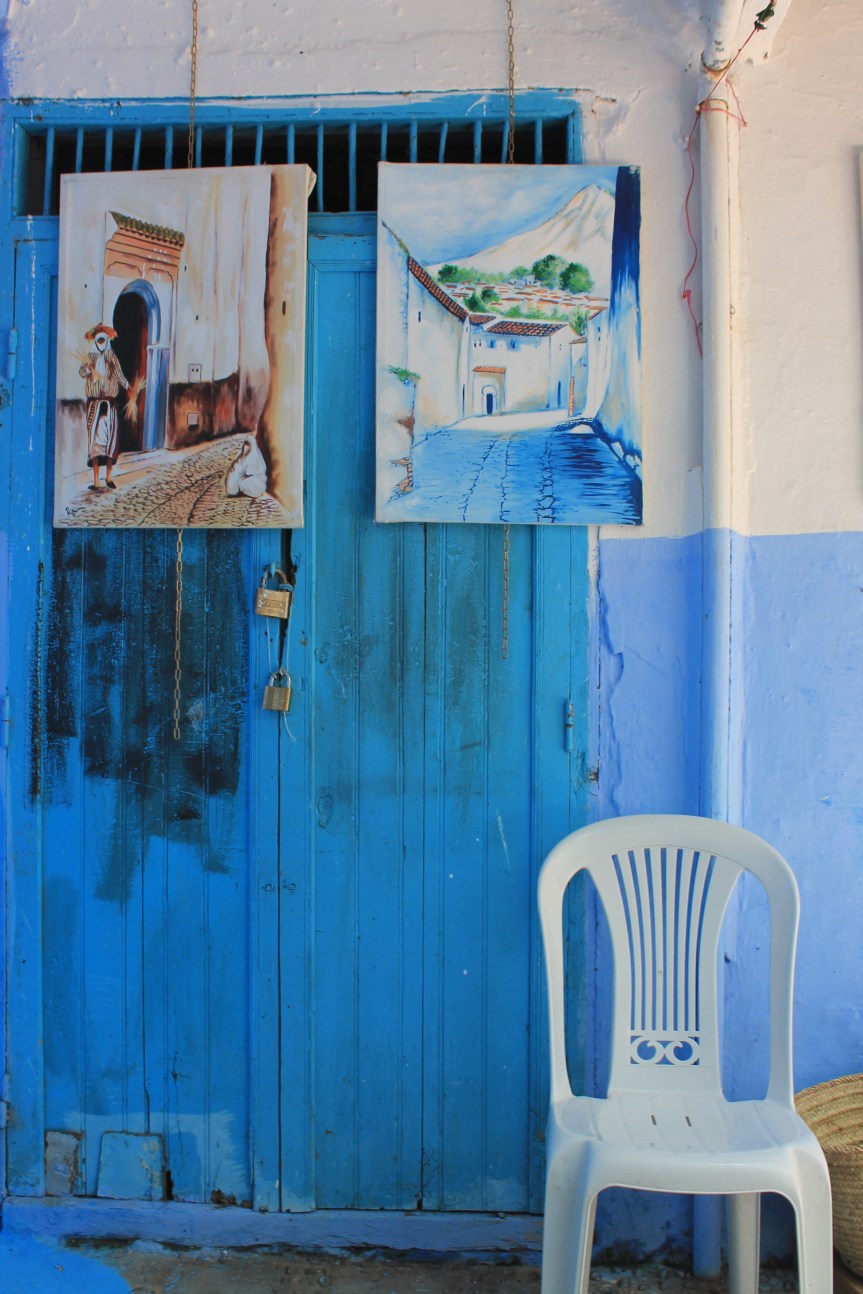
We sat on white plastic chairs and admired the blue art hanging from metal chains on the blue walls. The reed table runner covered the rusty metal table and smelled like fresh hay. Sitting felt wonderful. The shade felt wonderful. We pulled off our sunglasses and mopped the sweat from our foreheads.

The juicer was whirring inside a makeshift hut, the café’s kitchen. A moment later, we heard slurping and a satisfied, “Ahhh!” Apparently our juice had met the café owner’s approval.

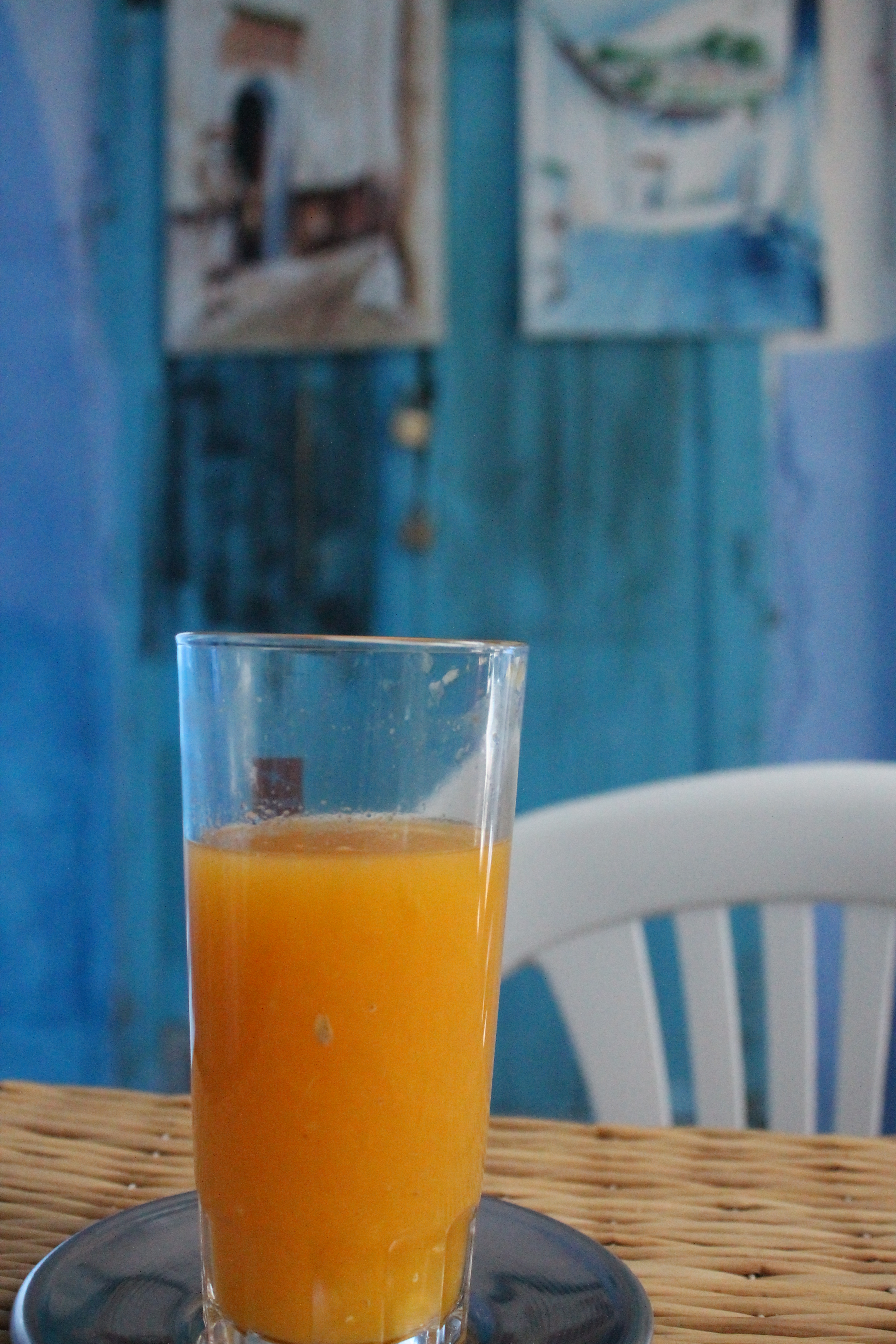
He brought out tall glasses on little metal plates. “My name is Rashid.”His sunny smile brightened when we tried to speak Arabic. But he left us alone until we were finished enjoying the shade and every last drop of our fresh orange juice.

glass of orange juice on wicker table next to blue wall