The belt slinger

Sitting in the shade of a damp sheet strung across two clotheslines hadn’t been too bad. But now out on the street, I had to stop pretending it wasn’t hot. The concrete tossed the day’s heat into my face as we walked down narrow streets of the tall apartment buildings in Aisha’s neighborhood.

It was the day of Eid, the celebration at the end of Ramadan. As the sun considered setting, people started to appear on the streets, freshly scrubbed and in new clothes. Time for the party!

Aisha had explained that all of the children would be out on the streets in their new clothes, playing, dancing, and laughing. We were on our way to witness this delightful street party now.

But we were only approaching Aisha’s mother’s apartment when we encountered a slight glitch in our plans: apparently, Aisha’s nephew had whacked a neighbor girl with his belt. The girl’s mother approached the few family members lingering outside of Aisha’s mother’s apartment. She was furious as she displayed the belt’s point of contact with her daughter’s face.

Along with the others, I peered at the unbruised, unbroken skin, trying to ascertain the validity of the crime. Her inflammatory remarks didn’t set well with the boy’s family. An instant wall of excuses met her accusations: this wasn’t the boy’s problem, but her daughter’s problem, the family told her.

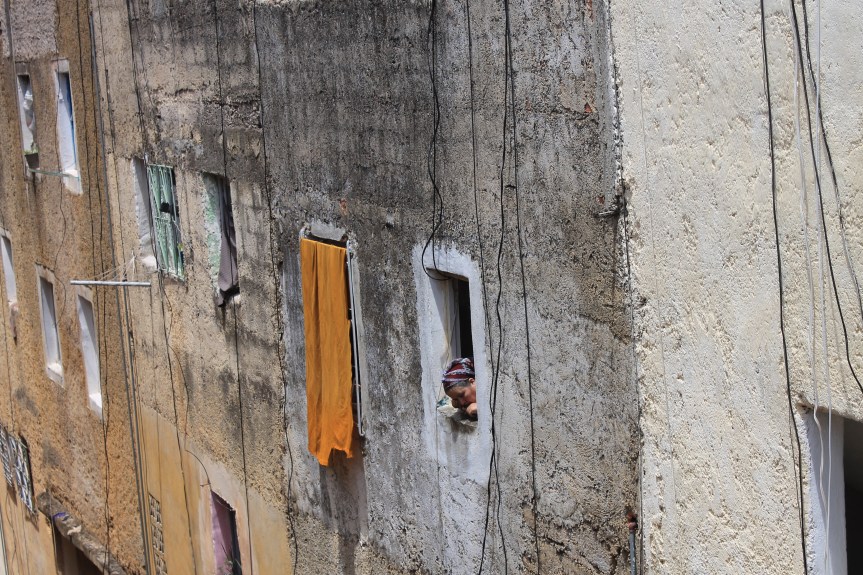
The little girl’s shaky sobs were lost as the confrontation exploded. Hollering escalated, echoing up and down the street. Neighbors rushed to the scene to offer unwanted advice and intercession. Others stood in the background to observe. Above us, others leaned out of windows to watch the drama unfold on the street below. A bit of pushing began, but tapered off quickly as friends dragged the more aggressive ones away. There was little effort to control any display of temper.

I was the only foreigner, the only one who didn’t quite culturally grasp what was happening. I leaned awkwardly against the doors of a closed shop to watch, fighting my own instincts to intervene.

The original crime had been so trivial. Why the big fight in the middle of the street?

Meanwhile, the little belt slinging offender was running around slaying other children with his belt, unhindered and unnoticed altogether… except by me!

Good windows make good neighbors

Robert Frost once wrote a poem about good fences making good neighbors. But what if there are no fences, only windows that overlook walls of windows from neighboring apartments? Do good windows make good neighbors too?

Through the windows, I can sample the lives of my neighbors. Without really knowing them or even really knowing exactly what apartment they live in, I know certain things.

For example, a man sneezes about 9:00 every evening. It’s not just a sneeze, but a SNEEZE. Actually, it is a series of sneezes that gives me an estimate of the time not unlike the call to prayer. And since the Ramadan time change, the sneezes have been coming at 8 p.m.

There is an unpleasant child in a lower level apartment, whose screams are punctuated by the parents’ roars of disapproval.

I can smell what neighbors are cooking, at times even identifying individual spices. And there is often the clattering of women washing dishes or the hissing of a pressure cooker.

In a tiny courtyard below, some neighbors play soccer with friends. When there are five or six of them, I don’t know how they manage to fit, let alone play a game. Their shouting in African French echoes all over our mini community.

Parties on the roof until the wee hours of the morning mean that talking and laughter float through our windows with the cool night breeze.

One evening, a little boy appeared in his window wearing only a T-shirt and his underwear. Silently, he climbed up in the window sill and measured the window with a tape measure. Then he climbed back down.

See, good windows must make good neighbors… or at least provide daily entertainment.

Hungry or not, here I come

How exactly does a one hour tutoring lesson turn into eight hours? Simple: I agreed to stay for lunch.

It was my first day of tutoring. I was nervous because I wasn’t sure how the protective father would view my method of teaching his 5-year-old son.

Exactly ½ hour before we had agreed to meet, the father came to pick me up.

He took me to his house where I met his family, extended family, the maid, and of course, his son. After a long conversation–some of it typed in google translate–we had breakfast (their first; my second). Then I spent exactly one hour teaching and reviewing with the little boy.

“Will you stay for lunch?”

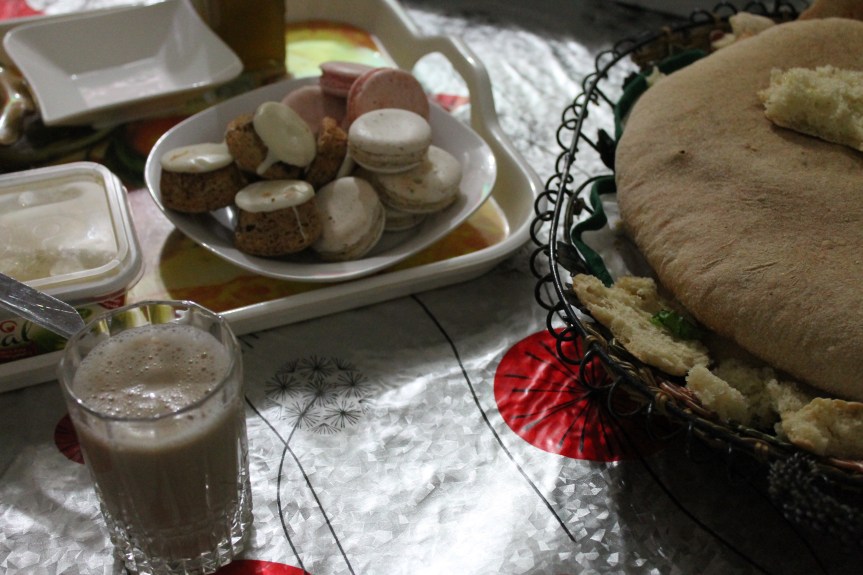
Noting the family sitting around the salon table, I agreed. But I soon realized that I wasn’t sitting down to lunch; this was pre-lunch! After two breakfasts, I was expected to fill up on bread, cookies, and tea and then eat lunch a little while thereafter.

When we finally did get lunch around 3:00 p.m., it was several courses: a salad followed by a beef and plum dish with another salad on the side, and then a huge chicken stuffed with vermicelli noodles and resting on a bed of rice. Everything was eaten with bread.

And all of the while, if I wasn’t reaching my hand into the platter, I was being told to do so. “Eat! Eat! Please eat!” The extended family kept a calculation of how much I ate while persistently informing me that it was not enough. We finished with luscious fruits for dessert, of which I was too full to enjoy.

This story has no moral, except not to take a tutoring job if you’re on a diet!

Day with the plumber

Just below our bathroom, in the storage closet of the apartment of the second floor, there was a gentle tick, tick, ticking of water dripping into a plastic tub. The neighbor had already visited our apartment to make it clear that this was our problem, not his. (His apartment is owned by a different landlord.)

We were not convinced, especially after talking with a friend with plenty of renovation experience. However, he forewarned us that the plumber would blame the problem on whoever would pay the bill: the foreigners.

My roommate called our landlord who sent us down the street to talk to his friend who came over and buzzed our neighbor. They had a long conversation in high decibels without resolving anything.

We waited for the plumber to arrive at 2:30 as scheduled. At 3:30, we visited the neighbors to tell them that the plumber wasn’t coming today. At 4:00, the plumber arrived, unconcerned that he had largely missed his appointment.

He checked our bathroom, the neighbor’s storage closet, and then predictably told us it was our problem.

“Fine,” we said. “Tell our landlord.” And we handed him the phone.

Several hours later, the neighbor was happy because the problem was fixed, at least temporarily. And the plumber was happy because he walked away with a pocketful of money.

Only my roommate and I were not so pleased because our European and American perspectives groaned at the inefficiency of a warm culture workforce. The gentle tick, tick, ticking had cost us an entire afternoon and evening!


Photo by Jouni Rajala on Unsplash

Aisha- part 3

Isolated. That was the flavor of the air as we walked down streets that were merely variations of the same. I was the only foreigner in the neighborhood, strange considering that just over the hill, tourists were thick within the shadowy walls of the old city.

But here, crumbling buildings full of tiny apartments stretched toward the overcast sky. Cobblestone streets cupped leftover puddles and floating litter. Laundry was strung everywhere: on wires, through window grates, on rooftop clotheslines. Curious faces darkened whitewashed doorways and window ledges. Children danced along the streets in endless game.

Much of the world was happening outside. Together. As if the culture didn’t realize that people didn’t have enough room to live.

Our first stop was a relative’s home. We entered a low doorway and were enveloped in a world of chattering woman. It was a noise that trailed up several flights of uneven concrete steps. There Aisha picked up her 1 1/2 year-old son. And there, we were offered coffee so sweet it made my teeth cringe. My coffee cup smelled like the residue of someone else’s saliva. I smiled and drank the coffee anyway. Our hostess was a dainty woman. Her face was young, but her smile revealed only a few teeth scattered along her gums.

I met in-laws, nephews, sisters, and other connections I no longer remember. It didn’t help that I was struggling to remember my family vocabulary! After a few more stops, we wound our way to Aisha’s apartment. She insisted on carrying the juices I had brought with me even though she was also carrying her little boy.

The apartment building was cold and concrete. With every floor that we climbed, I would turn and ask Aisha, “Here?” She would shake her head, “Still!” She said that all of the way to the sixth floor after dozens and dozens of uneven concrete steps.

In each woman, there is a certain amount of pride for her home. Aisha was no exception, although her home consisted of a closet-sized wash room and kitchen, one salon, and one bedroom. That was all.

Aisha’s 16-year-old daughter Soukaina and I walked out on the roof to stare at the world six stories below. Heads walked by–heads without faces from my point of view. A woman dumped a bucket of water over the cobblestones in front of her home and scrubbed vigorously. Two little girls played school. A man propped himself in the doorway and watched the world. A woman two doors down did the same. But it wasn’t just the street that was alive; all throughout the apartment towers, people were moving: appearing in windows, hollering to someone below, gathering laundry on the rooftop, smoking a cigarette, or talking across the street with someone in the opposite building.

Once Aisha ascertained that I liked couscous, the lunch preparations began. I offered to help once, but only once. I was a guest. When the food was ready around 4 p.m., the family pulled down the table for my sake. (I heard the father say, “She’s American.”) There were some other random family members around the table, and I couldn’t remember exactly how they fit in the family. But it didn’t really matter.

We all dug into the center plate. Aisha kept tossing potatoes and carrots onto my side of the platter. Whenever I tried to stop eating, they demanded I eat more. No amount of “I’m full, praise God!”s could satisfy their vicious desire to watch me glut myself.

For me, mealtime was tense because in their attempt to honor me, they set my presumed needs so far above their own comforts that I felt the separation deeply. I was given two cushions to sit on at the table and the older woman present was given none. When I tried to share, I only succeeded in raising a chorus of protests. I was incapable of experiencing their everyday life because I had the prestige of a guest.

After an hour of TV and conversation over the TV, the preparation for the afternoon tea began. I offered to go with Soukaina to buy doughnuts, but the father turned down my offer on account of my being American. “This is not like the new city!” he declared. My presence would attract attention and a 16-year-old companion didn’t provide the necessary protection.

More female relatives joined us for tea and the conversation livened. We laughed, ate, and took pictures. And then it was time to go. We descended–down down down–until the precarious stairwell spewed us onto the narrow cobblestone street again.

We sloshed through the evening drizzle to the taxis. Aisha and Soukaina tried to accompany me home in the taxi, but when I put up a protest that rivaled their insistence, they relented. But Aisha gave the driver precise instructions where I needed to be deposited and made sure that I had enough money with me. I kissed them both goodbye.

For now.

Aisha- part 1

We had seen each other before. Most mornings I passed her by on my way to school. She and a friend would sit on a concrete bench under a tree. Noting the consistency of our timing and location, I greeted the women regularly. But I never slowed enough to make conversation.

Until the day I needed help with my homework. Both ladies were startled when I plopped down beside them and asked them to help me. With no context for this encounter, they were full of questions: Was I a student? Where was I studying? What kind of Arabic was I studying? What was my name?

The conversation was labored, but I finished the assignment and arrived at class, breathless and only a few minutes late.

A few days later, I was striding to school with my normal stoic street face when a lady in my peripheral became animated and shouted to get my attention.

Another beggar, I surmised, and turned to greet her without reaching for my change purse. But then I recognized her face, although she wasn’t in her usual place under the tree.

As we greeted each other in somewhat reserved familiarity, I studied her for the first time. She wore old clothes and the kind of shoes that most women only wore to the public bath house. Her face was enveloped in the odor of her breath, which I smelled as I embraced her. She was a tiny woman, not built for the hard work that life required of her.

Who was this woman? And what did she want from me? She insisted on walking with me on my way to school; she said she worked as a maid at a house nearby.

Her speech was complimented with gestures. “You—come—my house—to sleep.” She isolated her words with the intention of helping me understand. “Do you understand?”

I did understand, but said only, “God willing” which was neither a commitment nor a refusal.

Before we parted ways, she asked for my phone number. That evening she called me and together we weathered my first phone call in Arabic. We exchanged greetings and a few other bits of information among the numerous confessions of “I’m sorry; I don’t understand.”

She told me she would wait for me the next day on my way to school.

Irritating?

Being immersed in a new culture reveals that some cultural customs are bad, some are neutrally different, and some are good… sometimes better than they are in our own culture.

Quite honestly, something in this culture grates on my nerves. It doesn’t happen every day, but when it does, I find it inexpressibly irritating.

As I walk along the street,  I meet passersby who look like they lead normal North African lives. Then without warning, one of these normal-looking people veers in my direction and holds out their hand for money. It’s as if seeing me, a foreigner, makes them remember they are not satisfied with their normal lives.

Irritating? Quite. I am a victim of racial profiling.

Well, today as I walked to school, I began to rethink this irritation of mine. What if, instead of looking at me and recognizing their lack of money, they looked at me and recognized their lack of something much greater, Someone much greater? What if, by seeing me (not as a foreigner, but as a friend), they realize that they are not satisfied to live a normal life?

And when that happens, will I be ready or will I be irritated to share what I have?

Bread and soap operas

What do bread and soap operas have in common? Perhaps nothing. Yet recently, I’ve been beginning to wonder if there indeed is some sort of correlation.

Imagine bread for every meal—breakfast, lunch, afternoon coffee time, and dinner—and soap operas, not between those meals, mind you, but before during and after those meals.

Lest you become concerned that I have just wasted a week of my life by living with a local family, rest assured that not all of my energy was spent in anticipating the next show.

More than spicing my limited vocabulary, the week marinated me in the flavor of the culture. What do their homes look like? What do they eat? What do they do during the day? How do they use a bathroom without an American toilet? How does a typical family function (or dysfunction)?

Overall, the week was culturally awakening. Now the North Africans I pass on the street aren’t just people–they belong to a home and a family…and maybe I’ve just sampled a slice of their typical day.

Having said that, I still might be able to tell you the time of day according to what soap opera is on.

The tourist attempt

Today I got my first taste of the unique flavor of tourist and local culture…alone. That taste has shaken me. Upon returning home, I brewed myself a pot of coffee and put in the remainder of a carton of cream. Just try to convince me that I don’t deserve every calorie.

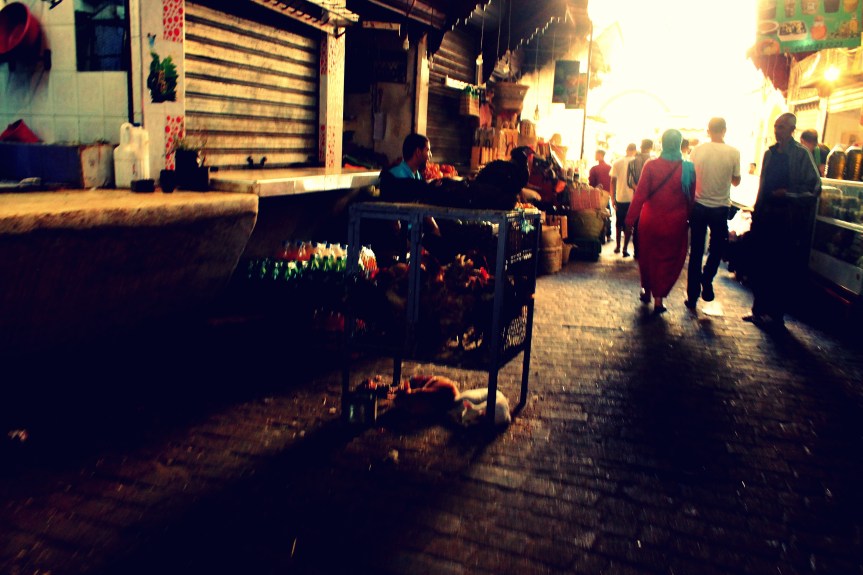
My intention was to get home from school and join some friends at the leather tanneries in the old city. They left before I got home. So I grabbed my camera, a little cash, and my phone and started after them. The brisk walk took me down familiar streets full of familiar vendors. The colors, activity, and smells are why I like the old city.

The tanneries are located at the bottom of a very long street. Although I had never been there, it was simple. I would keep walking until I met up with a group of white foreigners with cameras around their necks.

After shaking a few persistent vendors who believed that they were selling what I was looking for, I put it in high gear for the downward trek, dodging children as well as the elderly, carts, donkeys, and cats.

No, I didn’t recognize the area, but of course I wouldn’t since I’d never taken the street down so far. I was encouraged by the faint stench of the nearby tanneries. But then I came to a T. And then another T. I paled and stood up against a jewelry vendor to let the crowd press by me. The streets had disappeared into tunnels. At the call to prayer, vendors began closing up their shops with thick wooden doors.

I pulled out my phone. “Um… where are you guys?” As long as I was on my phone, passersby were less likely to approach me, right?

Fat chance. “Hiiii. How are you? What’s your name?”

The jewelry vendor tried to help me when talking with friends unveiled no solutions. Before I left, he told me to come back to his shop if I ever wanted earrings. I’ll keep that in mind, thanks.

I started back the way I had come, but the closing doors of the shops threw off my sense of direction. The landmarks were disappearing. I started down one side street, only to realize that it looked more like a public bath entrance than a street. I spun around and kept walking…and walking.

Look confident!

I turned down a promising street and marched onward. The overhead daylight was a good sign.

“Where are you going, madame? That street goes nowhere.” A schoolboy approached and promised to take me to find my friends. “It goes to the tanneries.”

I explained that I wanted to meet my friends at the tanneries, and the boy insisted on being my guide. I tried to shake him, but he refused to go…and I was beginning to realize just how lost I was. When I came face to face with a few haughty men who wanted to take me through deserted buildings to the tannery, I told the boy to take me back to the main street. I was going home.

He led me to the back streets, narrow alleyways between towering concrete walls. Something was dripping ominously. A few men wandered in and out of partially hidden doorways.

Look confident! Don’t act afraid! But if I would scream right now, who would hear me? I had no concept of how close I was to the public. This school boy was relatively harmless, but was he leading me into a trap?

It took many more little streets and uphill climbs for him to point me to the correct street that would take me home.

“Thank you!” I talked to him as I paid him and found out that he spoke several languages; what a perfect little tour guide.

I turned down his offer to go to coffee (perhaps he didn’t realize I could almost be his mother?) and scuttled toward the street. I wanted to kiss the familiar vendors and buy everything in their shops, but I charged uphill toward home.

I nearly collapsed when I stepped inside the front door. That’s why I made myself a pot of coffee. I guess I’m not cut out to be a tourist. No tanneries for me today. Maybe ever! At least without people I know chained to my wrist.

Update on taxis

In my last post, I mentioned how I liked to imagine myself as a taxi savvy. Well, ladies and gentlemen, the day has not arrived.

My first day of catching my very own taxi was yesterday. Perhaps the only reason any driver stopped at all was because I was a foreign target with light hair and trembling knees.

As the first taxi pulled up, I forgot to greet the driver. Instead, I stumbled over the two words that I needed to say. As we zipped down the road, I fretted that the driver would overcharge me. But I had prepared for this. I pulled out my orange sticky note and reviewed the transliterated Arabic phrases that, if correctly delivered, could save my pocketbook.

I was blessed, however. The driver began to chat with me in English and just before he deposited me on the side of the road, he tried to undercharge me. Imagine! The phrases I had reviewed were all for naught!

I was confident on my way home from school. So confident, in fact, that I when no “petit” taxi stopped for me, I decided to crawl in a “grand” one. The driver misunderstood my butchered pronunciation of my neighborhood and drove me in the opposite direction.

“Wait! No! This is wrong!” He slowed to a stop and had me repeat my neighborhood name several more times before realization dawned. “Aaaaaah!” And then he said the name with the emphasis on the second syllable instead of the first.

We cruised along in the “grand” taxi, the driver overeager to make conversation and the passenger overeager to remain in deflated silence. The driver pointed to random things along the street as we zoomed past them and projected loud words toward my side of the car, as if I was supposed to know what he had pointed at in the first place. I stared out my window.

When we arrived safely in my neighborhood, I looked at him and shrugged to indicate that I didn’t know what he would charge. He pulled out a bill from his stash as a suggestion. I laughed out loud. It was the equivalent of $10 for a ride that normally cost $1.10. Not encouraged by my response, he shrugged and pulled out a hopeful $5. I shook my head and rattled my coins then handed him $2 to compensate for riding in a “grand” taxi and getting lost. He shrugged again and then rushed to introduce himself.

So far, not one taxi driver has known of the school where I teach English. My afternoon driver was no exception. He made a phone call and tried to look at the map I gave him…upside down. I tried to direct him in Spanish while he interpreted through his French filter. He finally believed the school existed when we screeched to a halt in front of it.

The adventures in taxis are probably just beginning.


Photo credit: W.K.