What if you were Soukaina?

Have you ever stepped into someone else’s shoes and tried walking around in them?

Soukaina is sixteen years old. She lives with her parents and two year old brother in a poor neighborhood of a bustling North African city. In that tiny, sixth floor apartment, personal property and space are out of the question. She doesn’t have her own bedroom. In fact, there is only one bedroom for the entire family.

She usually attends school but spends her free time on the streets. She gets in trouble for bullying neighborhood kids. Her parents send her out of their way, but paradoxically rebuke her for spending too much time on the streets.

Her father is diabetic and doesn’t have a job. Her mother works herself to the bone six days a week. Her little brother follows her around and gets into everything.

To get anyone to listen to her, she has to yell. Sometimes, it’s just easier to hide. Once, she said, “I don’t like to live here. There are many bad people.”

Yet, she is loved. Despite the abstract and irregular displays of affection, her parents love her.

So what if you were Soukaina? Well, what if you were? What would your life look like? What choices would you make?

I’m not asking these questions so you can recognize your privileges or count your blessings. I’m asking you because looking at the world from someone else’s perspective makes you better capable of loving them.

The wedding I didn’t attend

I didn’t attend a wedding. That statement, of course, depends on one’s definition of “wedding”, I suppose. I did attend one or two ceremonies during the six day celebration, but the ceremonies were so low-key that I didn’t even see the bride. That’s why I say I didn’t attend because how can one attend a wedding without seeing who the wedding was for?

What I did experience, however, was enough to send my cultural senses spinning. Colorful clothing, drums and horns, dancing, green and rolling countryside, bread baking in an outside oven, a restless night curled up foot-to-foot with a stranger who kept stealing my blanket, mint tea and sweets to accompany the luscious wedding feast…

But I wasn’t only observing; I was being observed. My status as the only foreigner at this countryside wedding earned me plenty of stares, questions, and giggling girls developing heroine crushes on the uncomfortable-looking foreigner in the green dress.

After only 29 hours away from home, I returned feeling both culturally enriched and overwhelmed.

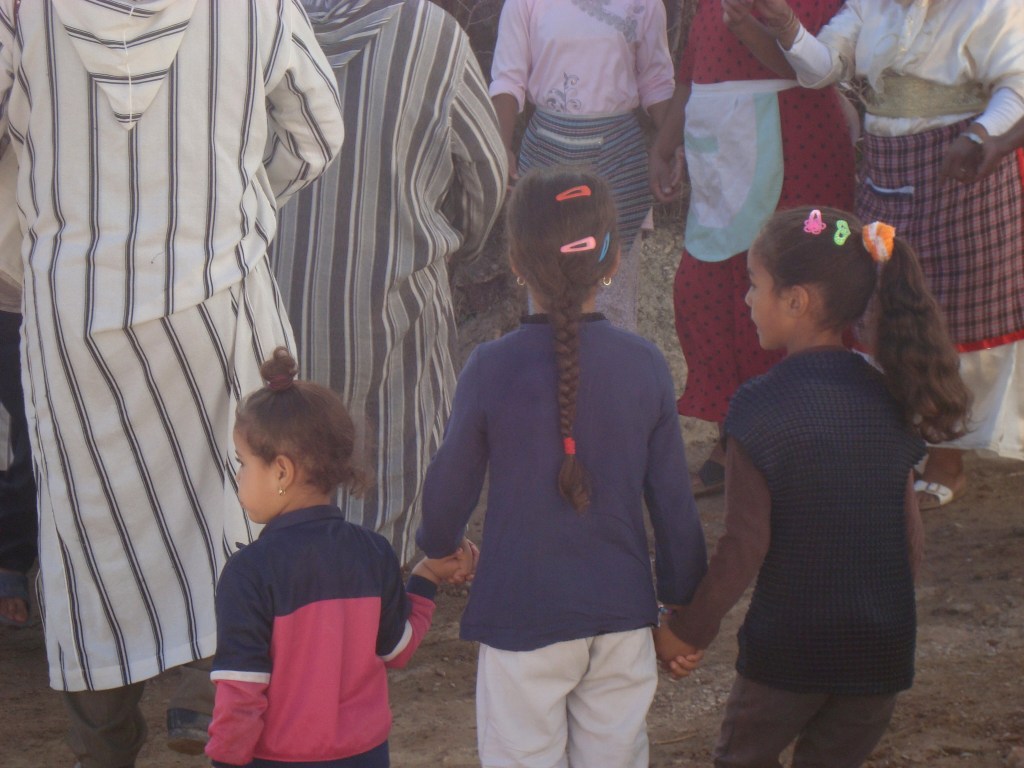
little girls holding hands next to adults in robes
people dancing
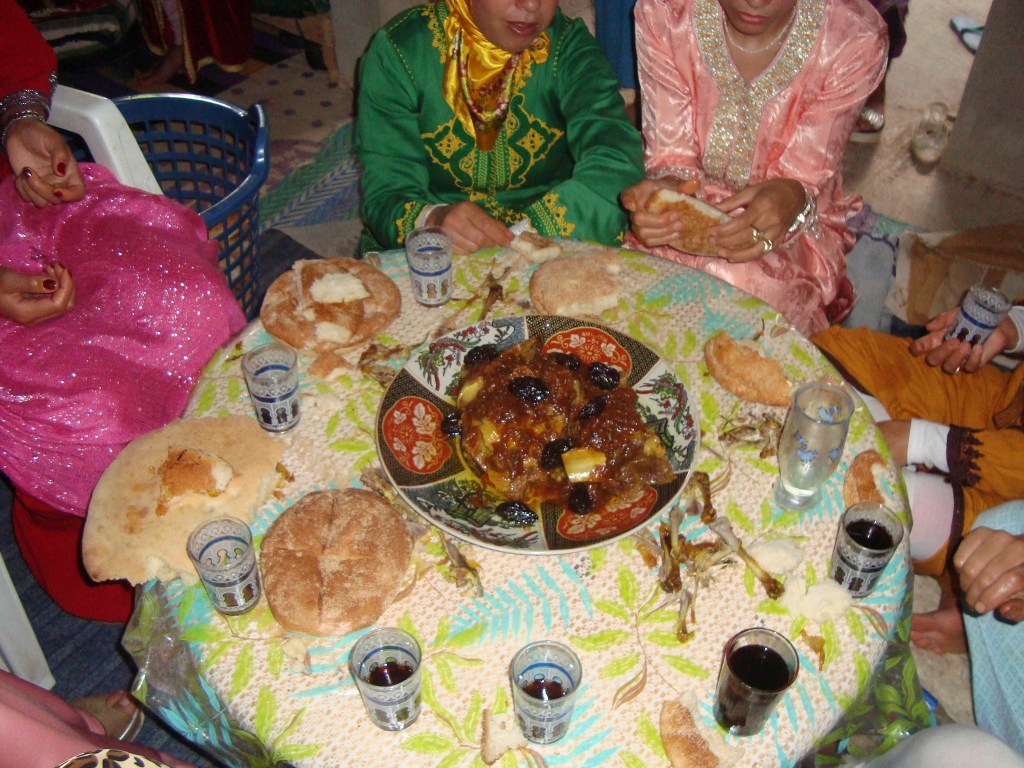
beef and prune tagine in center of table

Blessed are they that budge

Blessed are they that budge for they shall be first in line.

If that’s not a North African proverb, it should be. Some days instead of the one being budged, I want to be the one budging. Let them see how it feels for once.

But I know that’s a selfish attitude. So the question lingers: How exactly do I cope in such a pushy culture?

For example, standing in line at a shop today, the owner served the 5 pushy people behind me before he fetched what I asked for. Then I stood with my money on the counter while he served the next 10 pushy people behind me.

It wasn’t until I said, “Take this, sir!” that he turned to me and apologized. I wasn’t even tempted to give him the customary, “No problem.” My inflamed temper wanted to clear the crowd at the counter with a giant push and then hurl my unpurchased items at the shop owner. I could even envision myself stomping out, bellowing that I would never return.

How should I have acted? Really, the question is: How should I act? This isn’t a one time occurrence but a constant cultural barrier for me. In my 9 months here, I have met few truly courteous strangers; most courtesy turns out to be greediness in disguise.

This is one of the only things in this culture of which I cannot even glimpse a bright side. So, practically speaking, what should I do? Hang around a shop until the owner notices and takes pity on me? Disobey God’s command to love others as myself and begin pushing like everyone else?

Well, maybe my first step is to stop gritting my teeth when people infringe on my right to be served before them.

We are dust

Do you ever get tired of living by the expectations of the culture around you? I do. Expectations can be healthy, a type of accountability. In a way, expectations are what people give you when they can’t or chose not to give you rules.

Living in a different culture gives me two sets of cultural expectations to abide by. Suddenly, besides the way that I have been raised to behave, I am given a new set of standards from a very different culture. Sometimes I am stranded when the cultures clash: Is it better to be evasive and deceptive or offend someone by being truthful? Either way, someone is unhappy.

In short, I forget to focus on God’s expectations, which might mean disappointing both cultures. 

But are God’s expectations attainable? He was the one who placed me in this cultural conflict in the first place, so wouldn’t His expectations be the hardest to meet of all? And He does expect a lot:

“And we all, with unveiled face, beholding the glory of the Lord, are being transformed into the same image from one degree of glory to another.”

2 Cor. 3:18

His expectation is that we become more like the Son, more challenging than any cultural demand!

But He also remembers something that cultures forget: we are dust. Living to please cultural expectations would drain every drop of our resources, and like Solomon’s leech (Prov. 30:15), the culture(s) would still cry for more.

But God sees our limitations and coordinates them with His great expectation:

“As a father shows compassion to his children,
so the Lord shows compassion to those who fear him.
For he knows our frame; he remembers that we are dust.”

Ps. 103:13-14

He doesn’t forget our frailty; he knows what it is like to be a human. His expectation for us doesn’t change, but as we learn, His grace abounds.

Picky eater

“Picky eeeeeater!”

I heard that phrase a lot as a child, mostly from older siblings. As I grew up, I learned to like more foods, as most children do. But living here in North Africa, I have come to a deeper understanding of “picky eater.” North Africans are the pickiest eaters I have encountered in my limited international experience.

Why? Well, that’s the question I have been asking myself since I arrived.

In my opinion, most of the answer can be found in the pride the people have for their own cuisine. On my last trip home from Spain, I sat beside two men on the plane–one from North Africa and another from South America. This was the conversation:

South American: Is the food here good?
North African: It is the best in the world!

They hadn’t asked my opinion, so I sat, pondering the unmasked pride of the North African. Granted, the food here is good; I love it. But I also know that there are other flavors out there besides cumin, olive, dried fruit, lemon, and garlic. And how many other cuisines had this particular North African tasted?

In fact, how many ethnic restaurants does my city have? The few scattered here and there have to be sniffed out by a detective. Unless the three fast food restaurants count as American. There is also a pasta place in the mall. Italian, I suppose?

But the other restaurants seem to have exactly the same menu. It’s like the few things they do, they do well…but they remain few. And that’s all the people have ever known. So anything foreign is unwelcome because, of course, it could never measure up anyway!

When I make food for local friends, I select recipes with care. Something North African would not suit because as a foreigner, I wouldn’t prepare it correctly. Therefore, I must try something American but with the prominent North African flavors.

But once, a friend came to visit me unexpectedly. Although hesitant, I offered her some of the stir-fry I had just made. She tasted it and has been talking about that “salad” ever since, hoping to replicate it in her own kitchen.

That gives me hope that with more globalization will come more exposure to various cuisines and hence fewer picky eaters in North Africa!

Experiencing Eid Kbir

I could write a lot of things about this important holiday, but this post isn’t meant to be informational or theological. It’s is simply a snapshot of what my last couple of days have looked like. Granted, I decided not to display gruesome images of animal slaughter (thus limiting my photo options).

The first couple of photos are from the days before Eid. The city began to fill with the bleating of sheep and shops sold the necessities for the special day. Some shops even closed as their owners traveled. This is the country’s biggest holiday of the year.

Then, I had the chance to experience the celebration firsthand. I guess the first sign that Eid was upon us was when the neighbors moved a cow and then a sheep into their courtyard below my window. Soon the sheep’s bleating was only one of many others ricocheting off the concrete walls.

On Sunday evening, I joined my friend and her family for the Monday celebration. My head is spinning with the lifetime I feel like I lived in those two days. To my credit, I tasted a bit of everything that was served. The first meal of liver and heart kebabs with a side of spleen wasn’t too bad. But by evening, I admit that my mind refused to go over matter with the stomach and lungs dish. And what was worse was getting up in the morning to a breakfast of the head and feet. At least, now that I’m on the other side of it, I can look back and smile. I think my sampling of meat dishes until this point has been too tame!

bags and piles of charcoal in marketplace
Many little stands and shops sold charcoal to fill the thousands of grills around the city.
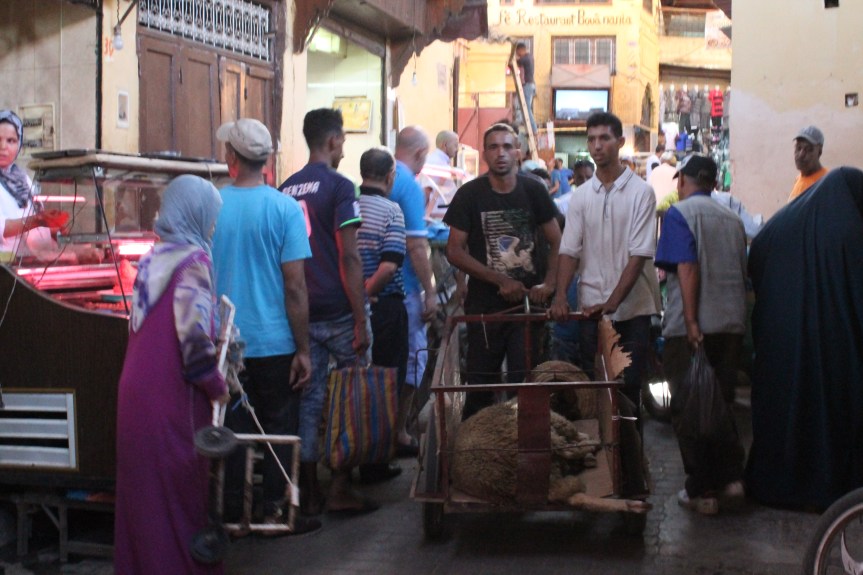
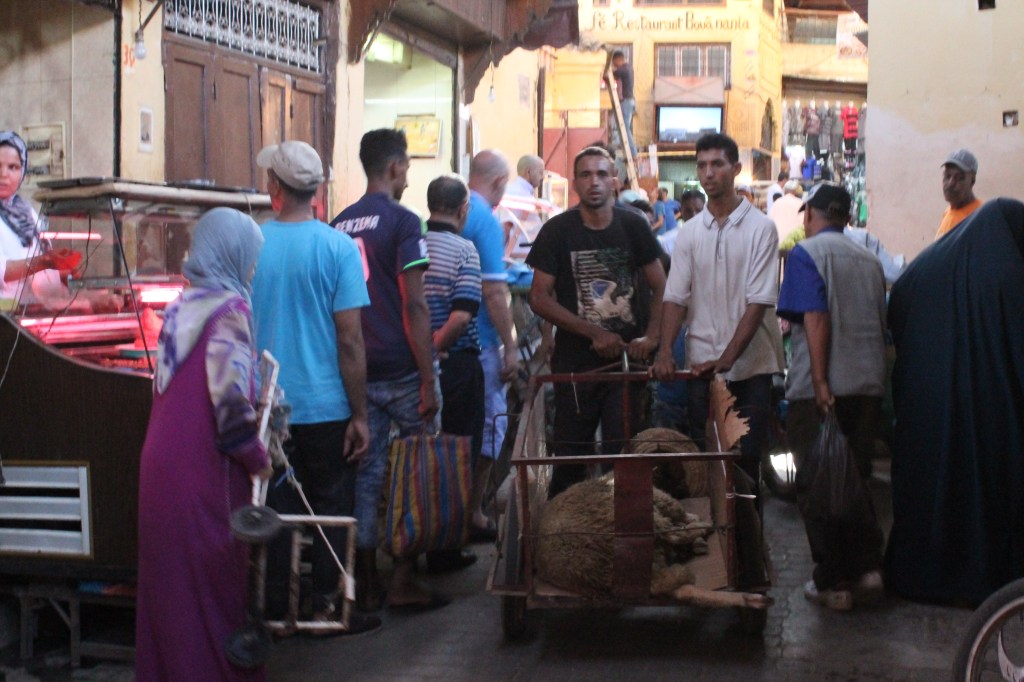
busy old city street and man hauling sheep in cart
One way of carrying your sheep home
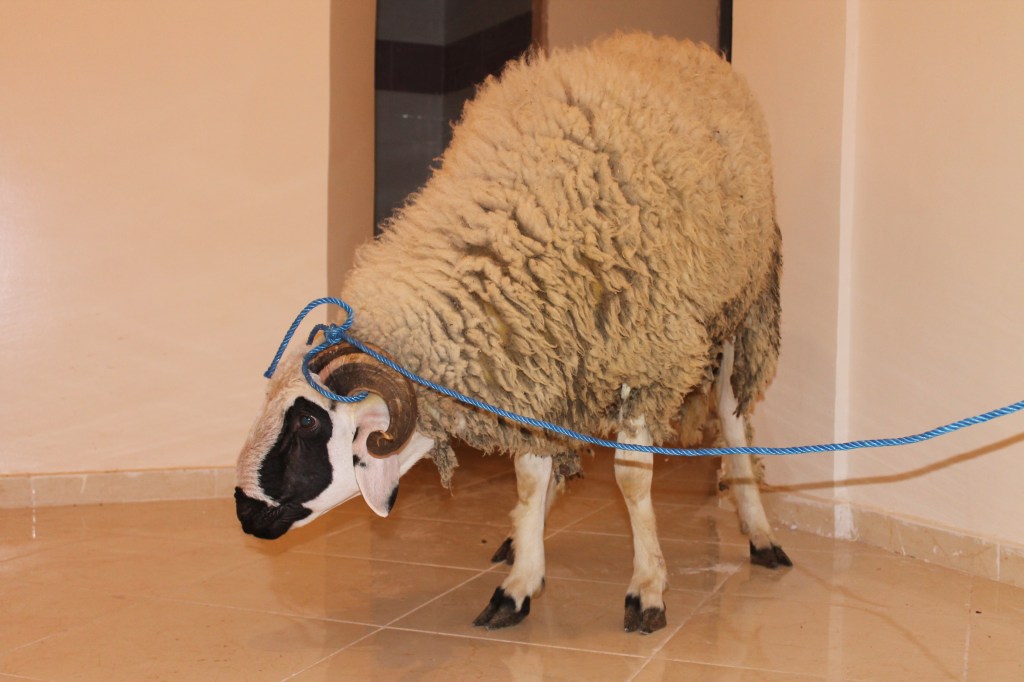
sheep tied with blue rope
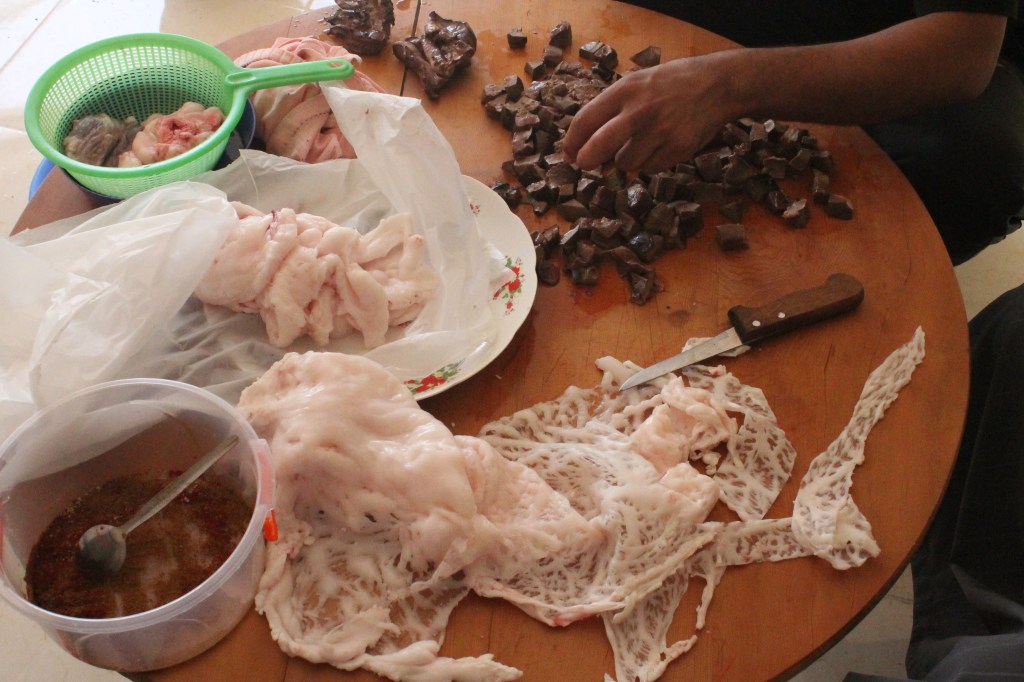
chopped liver and strips of fat on wooden table
Preparing for grilled liver and heart kebabs, also known as بولفاف
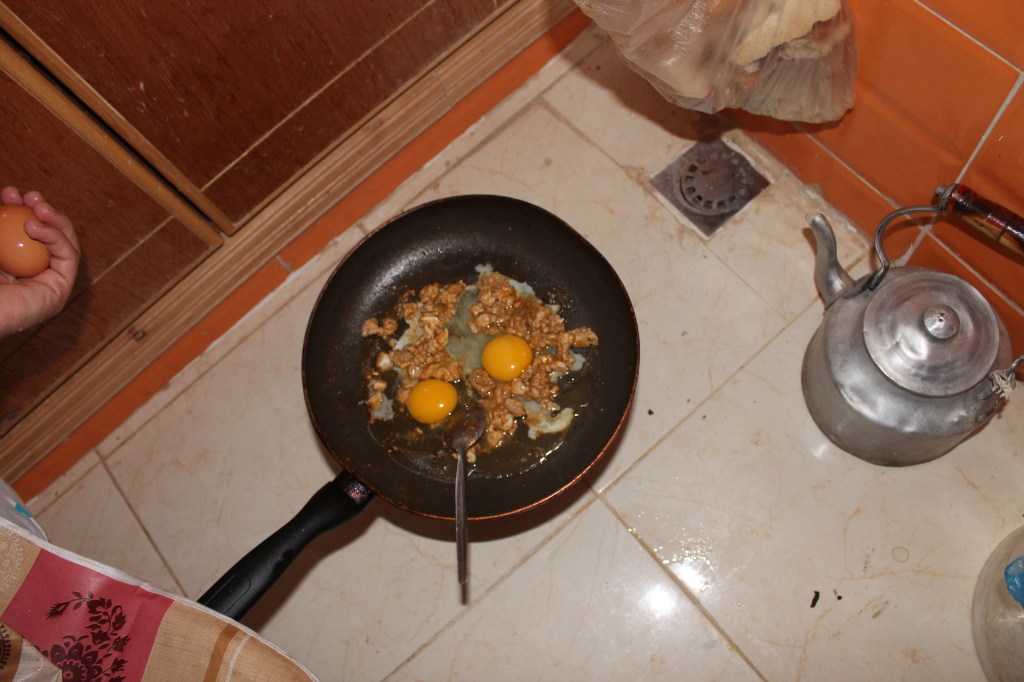
chopped brain and eggs in frying pan
Brain and eggs for breakfast, anyone?
loaves of fresh round bread
And of course, fresh bread with all of this!

Adventure on Hardware Alley

My motive was to not look lost. I fingered the plastic washer in my pocket as I turned down “hardware alley,” a street lined almost exclusively with hardware stores. Lest you question the logic of this arrangement, note that most of the stores specialize in certain areas such as light fixtures, mirrors, tile, etc. And often, they don’t overlap merchandise. For example, only one or two stores carry little items like screws, nails, and washers.

Which was exactly my problem. I had yet to ascertain which stores I needed to visit and I felt out of place tromping from store to store on a street operated and patronized mostly by men. My task was to find metal washers to replace the plastic ones that had come with our new toilet seat. Ideally, the metal would grip the porcelain and keep the seat from sliding around.

When I whipped out my plastic washer for the first store owner, he pointed to the store next door. The store next door did indeed have washers.

“What do you want them for?” the owner asked.

I was embarrassed to admit that I was trying to fix a toilet seat. After all, this man was from a culture where Western toilets were the exception rather than the norm. So I offered a blank smile and pretended not to understand his question. Sometimes being a foreigner is helpful. Then again, being a foreigner was what got me into the situation in the first place.

The man eventually dug out two metal washers. They were small, but they were the only size he had. He suggested I keep looking for bigger ones and if I couldn’t find any, to try out the ones he had given me. When I pulled out my wallet, he said, “No problem” and ushered me out of his store.

I stopped at a third store where the man shook his head and told me to try another store.

“Where?” I realized how ridiculous the question was as I asked it. My directional comprehension still had much room for improvement. I prepared to nod and smile despite the fact that I wouldn’t understand.

And I didn’t understand everything, but I understood that the store he recommended was somewhere in relation to a nearby bank. So I meandered around, trying to look purposeful rather than lost.

Eventually, I made an educated guess and entered a store that was overcome with men. (One of my friends refers to such places as “the valley of the shadow of men.”)

I sidled up to the counter. “Do you have something like this…” I plunked the metal washer from the second store owner on the counter. “But bigger. Like this one…” Another plunk as I set the larger plastic washer beside the tiny metal one. “But not plastic.”

The owner didn’t give me any smart remarks or pick-up lines. He didn’t even give me a strange look. He just asked how many I wanted and fetched me precisely what I was looking for.

I fought the urge to cast a smug look around to see if anyone was astonished by my smooth purchase on hardware alley.

Of bargaining

“It’s camel leather!”

“Really?”

I probably wasn’t the first ignorant foreigner to fall for that trick. But unlike most foreigners, I had a friend beside me who revealed the claim as rubbish. Camels are too valuable to be able to sell cheap street merchandise made of their hides.

I narrowed my eyes at the shopkeeper. “You lied to me! Shame on you!”

He sheepishly tried to make amends, but his customer was no longer interested.

Living in North Africa requires me to be functional at bartering with shopkeepers and street vendors. If no price is listed on an item, I must accept an exorbitant price or hone my bargaining skills.

Often, a shopkeeper will take me aside and lower his voice: “For everyone else, it is 150, but for you it is 130.”  As if he doesn’t tell every customer the same thing. At times, shopkeepers add phrases like: “…because you have North African friends” or “because you live here.” If the price still seems unreasonably high, I add, “And I’m a student. Do I get a student discount?”

Once, as I was bartering in Arabic, a shopkeeper told me “You are not a tourist. You are a North African!” Given the context, I took that as a compliment.

Using Arabic helps those selling realize that I am intentional about what I am buying. It also clues them in that I might know reasonable prices. After speaking to a restaurant owner in Arabic, he listed a fair price for a meal and I accepted. But when I asked to see a menu, he had none to give me; the only menus were “tourist” menus!

I may bargain for a while, but when I know my last price and I say my last price, it is my last price. It is what the item is worth to me and if I can’t buy it for that, I don’t want it. Sometimes the shopkeepers drop their prices to meet mine, sometimes they don’t. Sometimes, I am walking away when they call me back. Perhaps it’s the threat that others will get my business when I say, “No thank you. I will keep looking at other shops.”

Bargaining used to terrify me. Now, after seven months, I have accepted this piece of the culture. Until I finish language study in another seven months, I might be enjoying myself.

Quiet corner=buried treasure

Have you ever stumbled across a place that you were subconsciously looking for? It takes a bit for you to catch your breath as your heart smiles: “Yes!”

It might be as trivial as a little café, buried in a North African old city where few tourists trod. Except us. A friend and I were wandering down one narrow cobblestone street after another. We walked right past the café the first time, not because we didn’t notice it, but because the owner spotted us and began to holler that we were welcome. We darted down another street to avoid him. But that street was a dead end and eventually we had to turn around.

Hot and tired, we were easy victims when we passed by the café the second time and the owner called out his menu just in case we changed our minds. Then he said the magic words: “We have orange juice!”

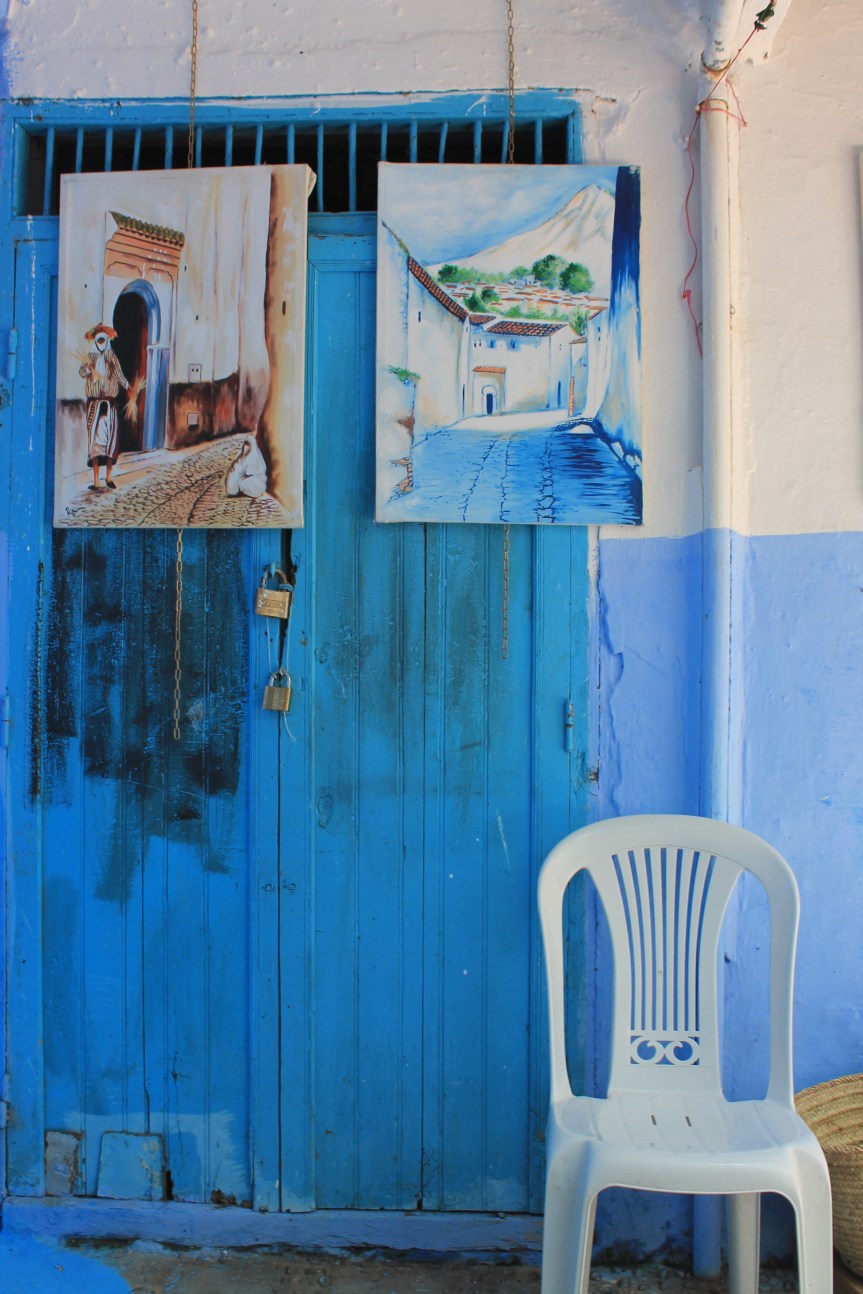
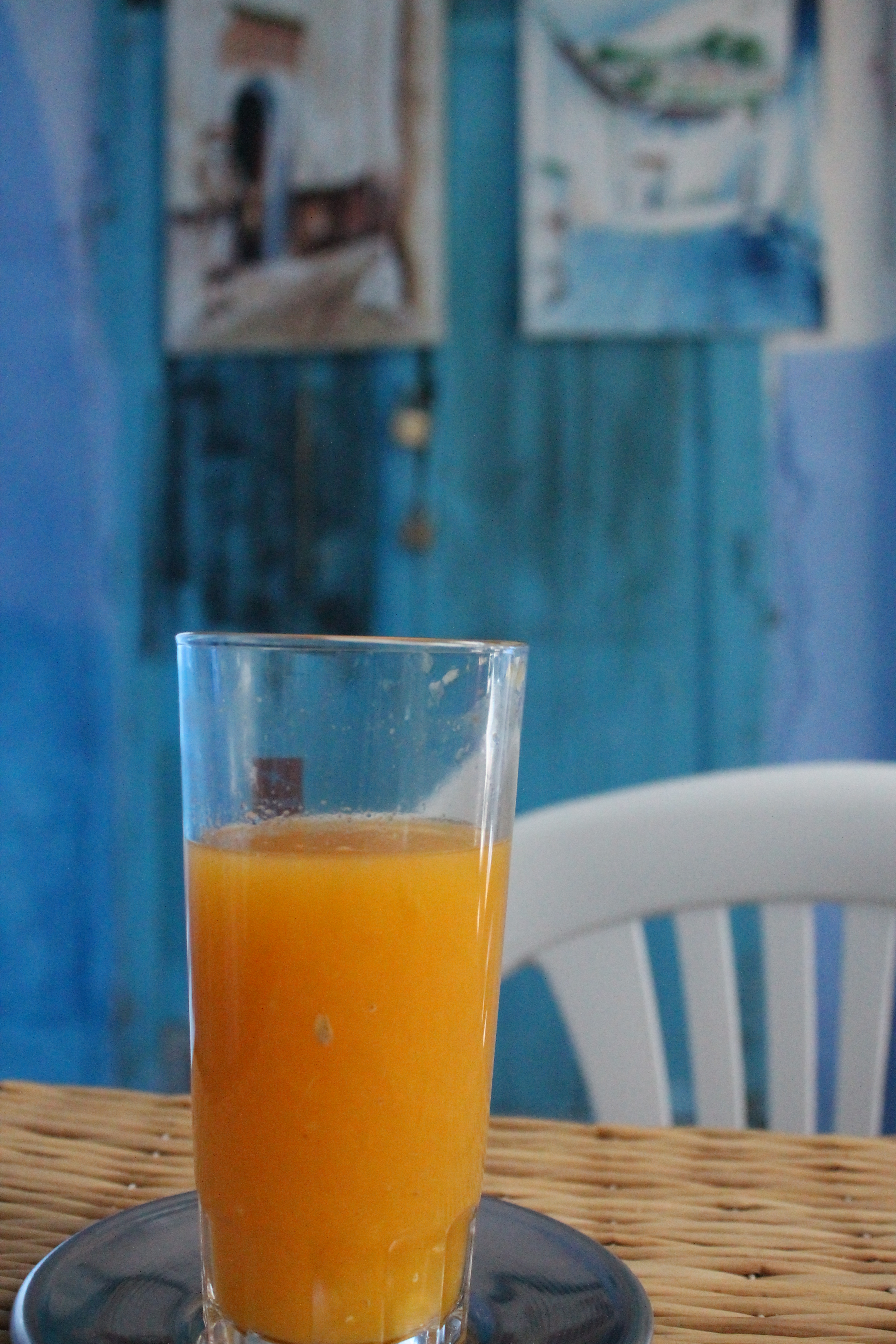
We sat on white plastic chairs and admired the blue art hanging from metal chains on the blue walls. The reed table runner covered the rusty metal table and smelled like fresh hay. Sitting felt wonderful. The shade felt wonderful. We pulled off our sunglasses and mopped the sweat from our foreheads.

The juicer was whirring inside a makeshift hut, the café’s kitchen. A moment later, we heard slurping and a satisfied, “Ahhh!” Apparently our juice had met the café owner’s approval.

He brought out tall glasses on little metal plates. “My name is Rashid.”His sunny smile brightened when we tried to speak Arabic. But he left us alone until we were finished enjoying the shade and every last drop of our fresh orange juice.

glass of orange juice on wicker table next to blue wall