Was it worth it?

“Was my time in Spain worth it?” This question has crossed my mind a hundred times since I started winding down my life here. Was all of the time, energy, and finances invested worth the results I see? Or rather, the lack of results? Were they worth the years of being far from the people I love best in the world? Far from my own culture and community?

Lord willing, I plan to move back to the States in just over 2 weeks. My emotions are everywhere, leaking out in goodbye tears with a friend or bouncing in sheer giddiness as I remember that I don’t have to face upcoming life transitions alone anymore.

But was my time worth it?

I came across a quote from Elisabeth Elliott that I had jotted down long ago: “[People] cannot be hustled into the kingdom of God. And it is well to remember Christ’s own descriptions of that kingdom–leaven and seed, things that work slowly and out of sight. We long for visible evidence of our effectiveness and when it is not forthcoming, we are tempted to conclude that our efforts never had anything to do with the kingdom.” (From Made for the Journey by Elisabeth Elliott)

Exactly. I have coached myself not to dwell on the question of whether or not my time in Spain was worthwhile. After all, God works in ways we can’t see and I don’t have to understand the whys of His calling. Like Elisabeth Elliott said, God’s work is often slow and hidden.

When I shared my thoughts with J,  he suggested a new perspective, one he had gleaned from an article he had read. In his unimposing way of communicating truth, he suggested that rather than asking myself, “Was the sacrifice worth it?” it’s better to remind myself: “He is worth it.”

My personal fulfillment takes a backseat to God’s glory. 

This doesn’t mean I can’t evaluate my work and make adjustments. Neither does it mean I cannot grieve my losses or my lack of perceived success. But staying stuck in my questioning grief reveals a lack of divine perspective because neither sacrifice nor success can define the worth of a kingdom endeavor. 

A life spent for God is worth it, no matter what.

A life of perpetual humiliation

I just finished reading Anthony Doerr’s Four Seasons in Rome. Someone discarded it, and I picked it up, curious. This isn’t a book recommendation unless you happen to know that you like Anthony Doerr, but Doerr’s descriptions of life on the outside of a culture cut me wide open. I didn’t know there were words for these “in but not of” feelings.

Apartness and perpetual humiliation are part of daily life for those living overseas. Sometimes we talk about it too much. Often we don’t even acknowledge it but let our frustration become part of the existing barrier, like a thick moss growing over a wall we’re trying to ignore.

We are outsiders, always outsiders, chipping at the barrier that stands between us. And there are successes! Moments when a chunk of the wall falls away and we glimpse the other side…only to find razor wire. 

“To be a nonfluent foreigner is to pass through one gate only to find yourself outside two more,” writes Doerr (p. 46). “We are humbled over and over–humility hangs over our heads like a sledgehammer… Oh, you think you’ve been here long enough to barter at the street markets? Guess what, you just spent €8 on three plastic clothes hangers” (p. 76).

After nine months in Rome, Doerr walks into a grocery store and makes an order without messing up a single syllable. “What happens?” he writes. “I get my groceries. No streamers drop from the ceiling, no strobe lights start flashing. The grocer doesn’t reach across the counter and take my face in her hands and kiss me on the forehead.” Instead, the grocer asks about his boys and speaks so quickly he can’t keep up. “…I miss 80 percent of it and sheepishly, stepping down from my throne of fluency, have to ask, ‘I’m sorry, more slowly, please?’” (p. 168)

For some, eventually the barriers do not loom so large or feel so insurmountable. But for many? “I know nothing… I never made it through the gates between myself and the Italians. I cannot claim to have become, in even the smallest manner, Roman” (p. 201).

True. Despite my efforts to integrate into the culture around me, my North American worldview remains mostly intact, placing me decidedly on the outside. 

But if we let it, doesn’t living on the outside help us accept who we are? After all, like it or not, we cannot cease being a part of something. Not being a part of the culture we’re living in is because we’re part of another, or even several. Being on the outside can help us identify our own “inside.”

Apartness and perpetual humiliation are hard, but they are also opportunities to learn and grow.* And we need these opportunities to understand ourselves.

So I will try to be grateful. Even as my neighbor gives me a list of what is wrong with my couscous. Next time, it will be better. I can promise.


Doerr, Anthony. Four Seasons in Rome. Scribner, 2007. 

*Thank you, J, for your positive spin on life to remind me to keep on growing!

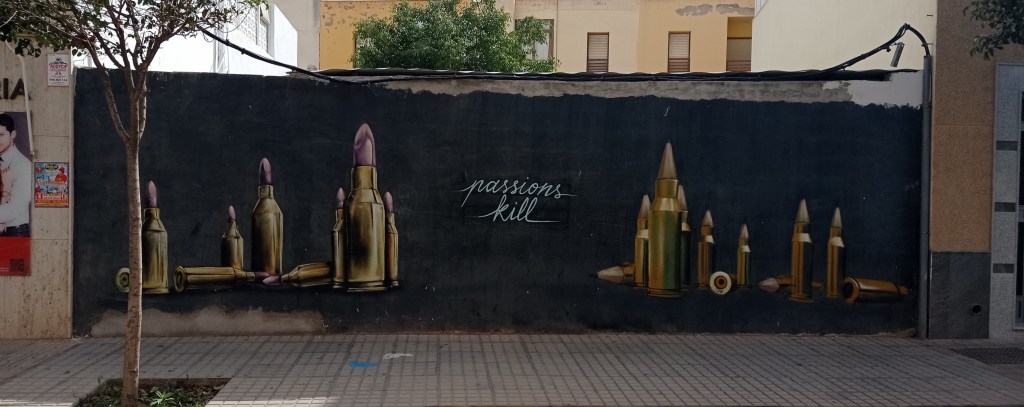
Mural: Passions Kill

As I prayer walked the streets of my city, I came across many murals, on the sides of businesses, on crumbling block walls, around the corner of an apartment building where there was no street and no one to see it.

Some of the murals were funny. Some were really odd. But then there were those that made me stop and wonder: What was the artist trying to say?

Over the next couple of months, I’ll share some of the murals with you. You can wonder with me or leave an interpretation in the comments below.

Mural of lipstick and pencils in bullet shapes with words Passions Kill

God is good

I’m stuck in Madrid.

Same nightmare, just backwards this time… with even less time in between. I could have wept when I arrived at my gate, panting from the weight of my carry-ons (and my out-of-shapedness) only to find the gate completely deserted.

But God works in mysterious ways, you know. Just because that phrase is cliché doesn’t make it untrue.

While I was stressing that my London-Madrid flight was running late and I would have even less than the allotted 50 minutes to get through border patrol and change terminals, I pretty sure God was making my flight late on purpose. “I got this,” I think I heard Him say while I was in at least 4 lines deep at passport control.

“Okay, God. You got this.”

But even if I had heard His voice, I wasn’t really sure what He “got.” So I still ran and I almost let myself plop down and sob at that empty gate at the tippy-tip of that long terminal.

God’s sovereignty is like that. We don’t know what He’s up to, but we can trust that He knows and that what He does is good.

Not that I was thinking lofty thoughts when I walked up to Iberia’s information desk, alone and sad between that rock and hard place.

God was good to me. Because my London flight had arrived late, I was offered 3 meals and a hotel, something that may end up being more needed than rushing home and diving into life. If my flight hadn’t been late (because I almost assuredly would have missed the connecting flight anyway), it would have been another ticket purchase and nighty-night on the grimy airport floor.

But God would have been good there too. Just as good as He is after a real shower and a real pillow.

Why is that so hard to remember?

Do you ever wonder if Jesus was tempted to forget His Father’s goodness in light of His personal pain? He was born fragile into a hostile society. He had to learn about a world He had created, grow up among people He had formed, and probably even misspell words He gave us breath to pronounce. And He dedicated His ministry to many who eventually turned their backs on Him.

Just before His crucifixion, didn’t He cry, “Let this cup pass from me”?

Last summer, as we watched a friend suffer from cancer, we prayed with her that the cup would pass. It didn’t.

Her cry for relief wasn’t a cry of doubt. Like Jesus, she was able to say, “Nevertheless, Your will be done.” Like Jesus, she submitted to the Father’s sovereignty.

“Sovereignty” and “submission” don’t sound like such big words after a hot shower and a clean bed, but what about right there in the middle of chemo? In the agony of dying for a world that hates you? Or just feeling weepy at a deserted airport gate?

Is my concept of God’s goodness too fragile, too willing to be broken? Is it just a churchy façade for a secular ideology?

This is getting too heavy for my tired brain. So I’ll wrap this up by saying that I was challenged by my own circumstances today: Do I really believe God is good all of the time?

Okay, that’s all. Next time, I’ll try to write about Christmas or my time in the States instead of just the dreadful little airport bookends of my trip!

Have a wonderful weekend, everyone!