Some things I miss/ Things I don’t (so far)

Things I miss:

  • Friends
  • Making friends quickly
  • A respect for morals rather than a disdain of them
  • Bringing God into everyday conversation without people thinking you are overly pious
  • Easy and cheap transportation
  • Inexpensive produce
  • Going out to eat on a whim because of inexpensive menu prices
  • Bargaining for prices
  • Warm and constant hospitality
  • Crossing the street without a crosswalk… and not feeling guilty
  • People looking excited when you speak to them in their language
  • People watching out for you

Things I don’t miss:

  • The class system and discrimination
  • Being addressed in French
  • Being treated as a trophy friend
  • Being treated as better than others
  • The façade of open-mindedness
  • A monotonous cuisine
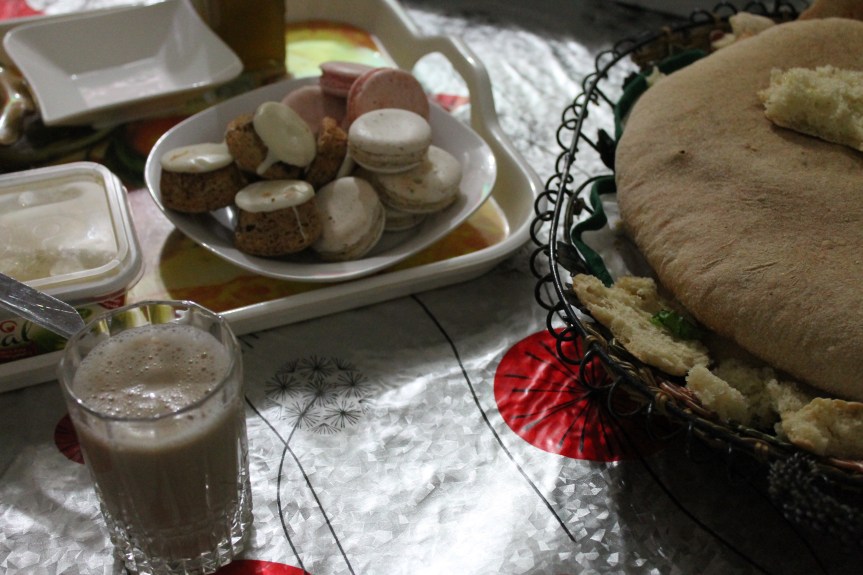
  • Bread
  • Catcalls
  • Being targeted by people asking for things because you are a foreigner
  • People budging
  • People asking invasive questions

Transitioning with olives

All I wanted to do was buy olives. It was the perfect idea to reward myself with a short walk to the store between secretarial tasks. The weather was full of gentle Mediterranean breezes and I loved walking. Then why was I suddenly anxious?

What should I wear? Some of my clothes were stored in boxes. Others were stashed in suitcases, ready to make the final leg of the journey to the States. Somehow the outfit I had on no longer matched. The shades of blue were all wrong.

“Trish,” I reasoned with myself. “This outfit was perfectly fine before.” But not now. Not in Europe. Not in public. I changed and then changed back when the second option felt even worse.

How do I say olive in Spanish? Olive? No, that’s French. Zitun? That’s Arabic. Why can’t I remember my Spanish anymore? Should I take my own bag or do stores give out plastic bags? I can’t remember. What were they doing the last time I was here? Where did I even put my shopping bags?

Why is this so hard?

I didn’t want to take that short walk anymore. Every decision looked big. Nothing was familiar. I battled my anxiety all the way to the store. I felt everyone’s eyes on me. Am I even walking down the right street? Why is that car stopping for me? Thank you, sir! No, don’t wave at him; you’ll look even more like a stupid foreigner. You’re in Europe now.

Transition. Have I exaggerated my trip to the store? Yes. But the exaggeration was in reality, not in what I just wrote. It sounds ridiculous to say that I almost panicked at the thought of buying olives. But transition is hard because nothing is familiar. Everything requires extra thought and effort. No matter how insignificant, every decision feels big.

I am not the only one who feels the pressure of transition. Maybe everyone else I know can confidently buy olives, but there are different responses to transition. And there are different types of transition. Do you know of someone whose spouse has passed away? Someone who has lost a dear friendship? Someone who has moved to a different community?

Maybe it’s you. Maybe you’re feeling a bit like me right now, or worse. Whether it is you or someone else, give that person time to grieve and transition. Remember that we are not alone. There are others who understand… especially the “man of sorrows” who was “acquainted with grief” (Is. 53:3).

The lighter side of language learning

I have no history with the other foreigners I have met here in North Africa: no previous inside jokes, no awkward memories of growing up together, etc.

Yet, because we are here together, we have begun to share something that I cannot share with people from home: the joy of mixing our common languages. And the beautiful thing is that we understand each other.

My class is known as the class that laughs a lot. My classmates and I are often drawing parallels from Arabic to English. There are verbs that in their conjugated forms sound like “guilty” and “dirty”, and nouns that sounds like “slave” and “smelly.” So we utilize them as their false English cognate, so much that our teachers have begun to do the same.

We also like directly translating from Arabic. In Arabic, many verbs are a slight variation of their nouns. “Do you want to coffee with me and have coffee at the coffee?”or “The chicken eggs eggs.”

And then there are times when we make up our own words completely such as tacking an English ending onto an Arabic verb or even using both Arabic and English constructions on the same root word.

For example, in Arabic the passive voice is typically the normal verb preceded by a “t” sound. And, as you know, the regular past tense verb in English ends in “ed”.

One day, as a friend and I were walking down the street, a guy from a passing vehicle hollered, “Bonjour!”

We giggled. “We’ve just been tbonjoured.”

Relaxed inside

A North African friend was searching for the English word “peace.” The word eluded her. Instead of asking for a translation, she created my new favorite collocation: “relaxed inside.”

Isn’t “relaxed inside” a beautiful description of peace? That inner knowledge that one’s slate is erased of error. That gentle cleansing after destruction of guilt. And the confidence that at the end of our life struggle is heaven.

Peace

This peace tonight
Surpasses understanding.
Fresh. Gentle.
A cool summer sunset
That settles in naked nothingness
Around my shoulders
Like slippery sheets.
A completed dream
That leaves me thirsty,
Arising in the blackness
To pray.
And when sleep comes again
There is only God.

A morning of sounds

What does my typical North African morning sound like?

  • Mourning doves cooing outside of my window and a lonely rooster penned in someone’s courtyard
  • Slated shades being pulled up from various apartments
  • Water running, the electric kettle steaming, my own munching and slurping
  • A few mumbled “Good morning”s and “Have a good day”s
  • The bang of the door as I pull it shut behind me
  • Clomp, clomp, clomping down two stories of steps and the banging the apartment building door
  • The murmur of passing cars from a perpendicular street
  • A few snatches of conversation between school children and university students
  • A cat meowing as it digs through leftover garbage
  • “Bonjour!… Bonjour! Hola! Hello?”
  • Horns honking around a busy intersection as other cars and pedestrians assume the right-of-way
  • Motorcycles, buses, trucks, cars, bicycles weaving in and out of each other—the screech of brakes and more horns and perhaps some yelling
  • A jackhammer of busy men working on the street
  • “سلام”
  • The scratching of a stalk broom on a sidewalk
  • The buzz of the Arabic school’s call button and consequently the opening of three heavy doors
  • “صباح الخير. لا باس؟”  “لا باس الحمد لله.”
  • The sharp sound of chairs on a bare floor and the rumble of moving wooden tables as we all pile in and settle down for a long Arabic session

I’m a failure

Recently, a friend prayed for me: “God, let her learn what you’re teaching her through what she considers failure.”

“Failure” is a word I bump up against often. Too often for my poor, wounded pride. Although I’ve learned this lesson dozens of times, it still hasn’t traversed the head-to-heart channel.

I want to be the best. The best foreign Arabic speaker in North Africa. The English teacher that inspires others to change the world. In short, I want people to reflect on my life and call me accomplished.

That’s one of the reasons I’m here. Not because I’m excelling but because I’m not excelling. God set me up for what I consider failure. He sees that deep down in the dank crevices of my heart, I believe the lie that it’s about me and what I accomplish. So when I’m struggling to survive instead of excelling, I label it “failure” and try to soothe my pride in other ways.

But at the end of the day:

“It is good for me that I was afflicted, that I might learn your statutes.”

Ps. 119:71

Maybe this time the lesson will reach my heart.

Bread and soap operas

What do bread and soap operas have in common? Perhaps nothing. Yet recently, I’ve been beginning to wonder if there indeed is some sort of correlation.

Imagine bread for every meal—breakfast, lunch, afternoon coffee time, and dinner—and soap operas, not between those meals, mind you, but before during and after those meals.

Lest you become concerned that I have just wasted a week of my life by living with a local family, rest assured that not all of my energy was spent in anticipating the next show.

More than spicing my limited vocabulary, the week marinated me in the flavor of the culture. What do their homes look like? What do they eat? What do they do during the day? How do they use a bathroom without an American toilet? How does a typical family function (or dysfunction)?

Overall, the week was culturally awakening. Now the North Africans I pass on the street aren’t just people–they belong to a home and a family…and maybe I’ve just sampled a slice of their typical day.

Having said that, I still might be able to tell you the time of day according to what soap opera is on.

Making sentences

After 9 days of studying Arabic, we learned formulaic sentences today. I discovered I was capable of following a pattern… and making mistakes.

I plodded through the Arabic script, plugging in my information at the end of each sentence: “My last name is…”, “My country is…” The sentences ticked by, miraculously without authoritative interruption to correct my pronunciation. I gathered speed. “My city is…” And like a sentence-making machine, I burst out: “My wife is…” and then paused. I really didn’t know who my wife was. Hmm.

I wasn’t the only one making mistakes. My classmate smilingly informed us that she was a “teacher” of Arabic instead of a “student.”

We giggled at ourselves. But the fact we were making mistakes meant that we were producing the language (or at least some form thereof).

Language learning is tedious. I confess I think it unfair for an adult to struggle for speech and still be patronized by teachers. There must be a better way. But meanwhile, I’ll keep working.

The Arabic school director told me, “This will give you more sympathy for your English students.”

He’s right. I didn’t even laugh when a 15-year-old boy stood up and told the class that he was a “housewife.”