The belt slinger

Sitting in the shade of a damp sheet strung across two clotheslines hadn’t been too bad. But now out on the street, I had to stop pretending it wasn’t hot. The concrete tossed the day’s heat into my face as we walked down narrow streets of the tall apartment buildings in Aisha’s neighborhood.

It was the day of Eid, the celebration at the end of Ramadan. As the sun considered setting, people started to appear on the streets, freshly scrubbed and in new clothes. Time for the party!

Aisha had explained that all of the children would be out on the streets in their new clothes, playing, dancing, and laughing. We were on our way to witness this delightful street party now.

But we were only approaching Aisha’s mother’s apartment when we encountered a slight glitch in our plans: apparently, Aisha’s nephew had whacked a neighbor girl with his belt. The girl’s mother approached the few family members lingering outside of Aisha’s mother’s apartment. She was furious as she displayed the belt’s point of contact with her daughter’s face.

Along with the others, I peered at the unbruised, unbroken skin, trying to ascertain the validity of the crime. Her inflammatory remarks didn’t set well with the boy’s family. An instant wall of excuses met her accusations: this wasn’t the boy’s problem, but her daughter’s problem, the family told her.

The little girl’s shaky sobs were lost as the confrontation exploded. Hollering escalated, echoing up and down the street. Neighbors rushed to the scene to offer unwanted advice and intercession. Others stood in the background to observe. Above us, others leaned out of windows to watch the drama unfold on the street below. A bit of pushing began, but tapered off quickly as friends dragged the more aggressive ones away. There was little effort to control any display of temper.

I was the only foreigner, the only one who didn’t quite culturally grasp what was happening. I leaned awkwardly against the doors of a closed shop to watch, fighting my own instincts to intervene.

The original crime had been so trivial. Why the big fight in the middle of the street?

Meanwhile, the little belt slinging offender was running around slaying other children with his belt, unhindered and unnoticed altogether… except by me!

We interrupt programming…

…to bring you some special news. Yesterday, on the other side of the Atlantic, a little boy was born.

Long before he was born, he had staked his claim on our hearts. We interceded for his life and his future as we prepared for him to counterbalance our adult world with the innocent perspective of a child. In anticipating a fresh, unsoiled life, it was easy to see how jaded we had let the world make us.

I started to look for baby things as soon as I heard he was coming. I could picture him snuggled in sleeper pants, sucking his thumb and hugging his stuffed Pooh bear. I could see him flipping through books, absorbing pictures and words in his brilliant little brain.

Now he is here and he has made me an aunt. Welcome to our world, Albert Harris!

Good windows make good neighbors

Robert Frost once wrote a poem about good fences making good neighbors. But what if there are no fences, only windows that overlook walls of windows from neighboring apartments? Do good windows make good neighbors too?

Through the windows, I can sample the lives of my neighbors. Without really knowing them or even really knowing exactly what apartment they live in, I know certain things.

For example, a man sneezes about 9:00 every evening. It’s not just a sneeze, but a SNEEZE. Actually, it is a series of sneezes that gives me an estimate of the time not unlike the call to prayer. And since the Ramadan time change, the sneezes have been coming at 8 p.m.

There is an unpleasant child in a lower level apartment, whose screams are punctuated by the parents’ roars of disapproval.

I can smell what neighbors are cooking, at times even identifying individual spices. And there is often the clattering of women washing dishes or the hissing of a pressure cooker.

In a tiny courtyard below, some neighbors play soccer with friends. When there are five or six of them, I don’t know how they manage to fit, let alone play a game. Their shouting in African French echoes all over our mini community.

Parties on the roof until the wee hours of the morning mean that talking and laughter float through our windows with the cool night breeze.

One evening, a little boy appeared in his window wearing only a T-shirt and his underwear. Silently, he climbed up in the window sill and measured the window with a tape measure. Then he climbed back down.

See, good windows must make good neighbors… or at least provide daily entertainment.

Tricked by hope

As North Africa heats up, people are disappearing from the streets to hide in their houses with drawn shades and fans.

But there are some who cannot hide.

Like the homeless sub-Saharan African man reclining in the shadow of a doorway. The despair in his eyes tore my heart.

Even worse is seeing that same despair in the face of a child. Like today, when I passed a family: a disabled father and a young mother with a toddler strapped to her back. The boy’s face was stricken with hopelessness.

I have so much. And I’m not talking about money. I’m talking about hope. Even in the valley, I can still see the mountain.

But what about them? What do they see beyond the next moment? What would cause them to lift their heads?

Tricked by hope

The child is weeping
because there is nothing,
not even a horizon.

His mother's heart will not hear
because it won't
be tricked by hope.

And every man's disrobed dream
sinks
in the mire of the present.

Life is nothing
and beyond nothing is the dark
that dogs every moment.

Do we hear them?
They're clawing at the gates of hell,
believing there's nothing better.

Hungry or not, here I come

How exactly does a one hour tutoring lesson turn into eight hours? Simple: I agreed to stay for lunch.

It was my first day of tutoring. I was nervous because I wasn’t sure how the protective father would view my method of teaching his 5-year-old son.

Exactly ½ hour before we had agreed to meet, the father came to pick me up.

He took me to his house where I met his family, extended family, the maid, and of course, his son. After a long conversation–some of it typed in google translate–we had breakfast (their first; my second). Then I spent exactly one hour teaching and reviewing with the little boy.

“Will you stay for lunch?”

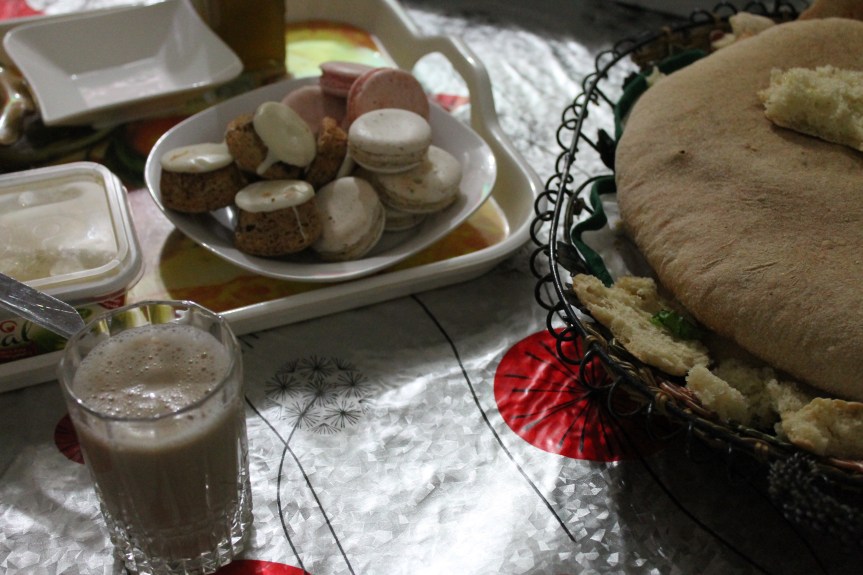
Noting the family sitting around the salon table, I agreed. But I soon realized that I wasn’t sitting down to lunch; this was pre-lunch! After two breakfasts, I was expected to fill up on bread, cookies, and tea and then eat lunch a little while thereafter.

When we finally did get lunch around 3:00 p.m., it was several courses: a salad followed by a beef and plum dish with another salad on the side, and then a huge chicken stuffed with vermicelli noodles and resting on a bed of rice. Everything was eaten with bread.

And all of the while, if I wasn’t reaching my hand into the platter, I was being told to do so. “Eat! Eat! Please eat!” The extended family kept a calculation of how much I ate while persistently informing me that it was not enough. We finished with luscious fruits for dessert, of which I was too full to enjoy.

This story has no moral, except not to take a tutoring job if you’re on a diet!

Aisha- part 3

Isolated. That was the flavor of the air as we walked down streets that were merely variations of the same. I was the only foreigner in the neighborhood, strange considering that just over the hill, tourists were thick within the shadowy walls of the old city.

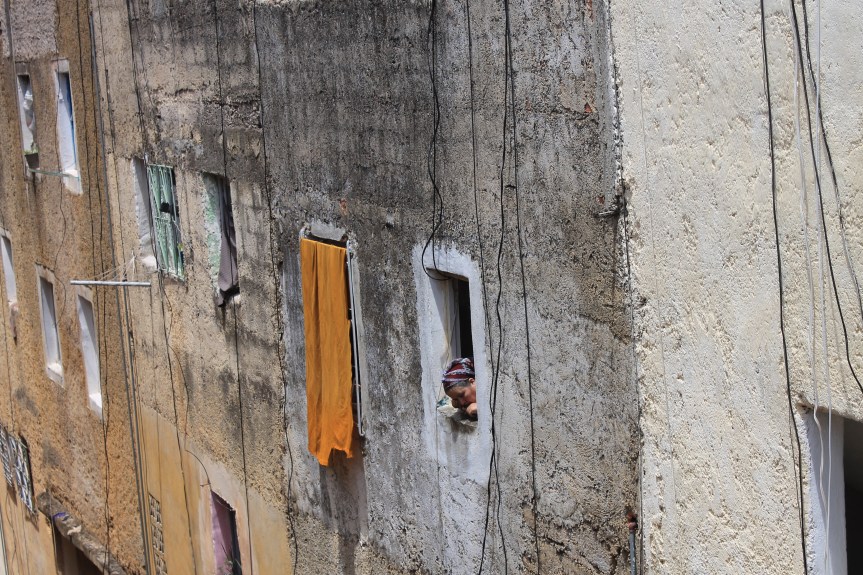
But here, crumbling buildings full of tiny apartments stretched toward the overcast sky. Cobblestone streets cupped leftover puddles and floating litter. Laundry was strung everywhere: on wires, through window grates, on rooftop clotheslines. Curious faces darkened whitewashed doorways and window ledges. Children danced along the streets in endless game.

Much of the world was happening outside. Together. As if the culture didn’t realize that people didn’t have enough room to live.

Our first stop was a relative’s home. We entered a low doorway and were enveloped in a world of chattering woman. It was a noise that trailed up several flights of uneven concrete steps. There Aisha picked up her 1 1/2 year-old son. And there, we were offered coffee so sweet it made my teeth cringe. My coffee cup smelled like the residue of someone else’s saliva. I smiled and drank the coffee anyway. Our hostess was a dainty woman. Her face was young, but her smile revealed only a few teeth scattered along her gums.

I met in-laws, nephews, sisters, and other connections I no longer remember. It didn’t help that I was struggling to remember my family vocabulary! After a few more stops, we wound our way to Aisha’s apartment. She insisted on carrying the juices I had brought with me even though she was also carrying her little boy.

The apartment building was cold and concrete. With every floor that we climbed, I would turn and ask Aisha, “Here?” She would shake her head, “Still!” She said that all of the way to the sixth floor after dozens and dozens of uneven concrete steps.

In each woman, there is a certain amount of pride for her home. Aisha was no exception, although her home consisted of a closet-sized wash room and kitchen, one salon, and one bedroom. That was all.

Aisha’s 16-year-old daughter Soukaina and I walked out on the roof to stare at the world six stories below. Heads walked by–heads without faces from my point of view. A woman dumped a bucket of water over the cobblestones in front of her home and scrubbed vigorously. Two little girls played school. A man propped himself in the doorway and watched the world. A woman two doors down did the same. But it wasn’t just the street that was alive; all throughout the apartment towers, people were moving: appearing in windows, hollering to someone below, gathering laundry on the rooftop, smoking a cigarette, or talking across the street with someone in the opposite building.

Once Aisha ascertained that I liked couscous, the lunch preparations began. I offered to help once, but only once. I was a guest. When the food was ready around 4 p.m., the family pulled down the table for my sake. (I heard the father say, “She’s American.”) There were some other random family members around the table, and I couldn’t remember exactly how they fit in the family. But it didn’t really matter.

We all dug into the center plate. Aisha kept tossing potatoes and carrots onto my side of the platter. Whenever I tried to stop eating, they demanded I eat more. No amount of “I’m full, praise God!”s could satisfy their vicious desire to watch me glut myself.

For me, mealtime was tense because in their attempt to honor me, they set my presumed needs so far above their own comforts that I felt the separation deeply. I was given two cushions to sit on at the table and the older woman present was given none. When I tried to share, I only succeeded in raising a chorus of protests. I was incapable of experiencing their everyday life because I had the prestige of a guest.

After an hour of TV and conversation over the TV, the preparation for the afternoon tea began. I offered to go with Soukaina to buy doughnuts, but the father turned down my offer on account of my being American. “This is not like the new city!” he declared. My presence would attract attention and a 16-year-old companion didn’t provide the necessary protection.

More female relatives joined us for tea and the conversation livened. We laughed, ate, and took pictures. And then it was time to go. We descended–down down down–until the precarious stairwell spewed us onto the narrow cobblestone street again.

We sloshed through the evening drizzle to the taxis. Aisha and Soukaina tried to accompany me home in the taxi, but when I put up a protest that rivaled their insistence, they relented. But Aisha gave the driver precise instructions where I needed to be deposited and made sure that I had enough money with me. I kissed them both goodbye.

For now.

A morning of sounds

What does my typical North African morning sound like?

  • Mourning doves cooing outside of my window and a lonely rooster penned in someone’s courtyard
  • Slated shades being pulled up from various apartments
  • Water running, the electric kettle steaming, my own munching and slurping
  • A few mumbled “Good morning”s and “Have a good day”s
  • The bang of the door as I pull it shut behind me
  • Clomp, clomp, clomping down two stories of steps and the banging the apartment building door
  • The murmur of passing cars from a perpendicular street
  • A few snatches of conversation between school children and university students
  • A cat meowing as it digs through leftover garbage
  • “Bonjour!… Bonjour! Hola! Hello?”
  • Horns honking around a busy intersection as other cars and pedestrians assume the right-of-way
  • Motorcycles, buses, trucks, cars, bicycles weaving in and out of each other—the screech of brakes and more horns and perhaps some yelling
  • A jackhammer of busy men working on the street
  • “سلام”
  • The scratching of a stalk broom on a sidewalk
  • The buzz of the Arabic school’s call button and consequently the opening of three heavy doors
  • “صباح الخير. لا باس؟”  “لا باس الحمد لله.”
  • The sharp sound of chairs on a bare floor and the rumble of moving wooden tables as we all pile in and settle down for a long Arabic session

Bread and soap operas

What do bread and soap operas have in common? Perhaps nothing. Yet recently, I’ve been beginning to wonder if there indeed is some sort of correlation.

Imagine bread for every meal—breakfast, lunch, afternoon coffee time, and dinner—and soap operas, not between those meals, mind you, but before during and after those meals.

Lest you become concerned that I have just wasted a week of my life by living with a local family, rest assured that not all of my energy was spent in anticipating the next show.

More than spicing my limited vocabulary, the week marinated me in the flavor of the culture. What do their homes look like? What do they eat? What do they do during the day? How do they use a bathroom without an American toilet? How does a typical family function (or dysfunction)?

Overall, the week was culturally awakening. Now the North Africans I pass on the street aren’t just people–they belong to a home and a family…and maybe I’ve just sampled a slice of their typical day.

Having said that, I still might be able to tell you the time of day according to what soap opera is on.

Sand castles

Last weekend I was in Ohio for a seminar. It was incredible. One of the most applicable things I learned all weekend was an analogy that exemplified a principle.

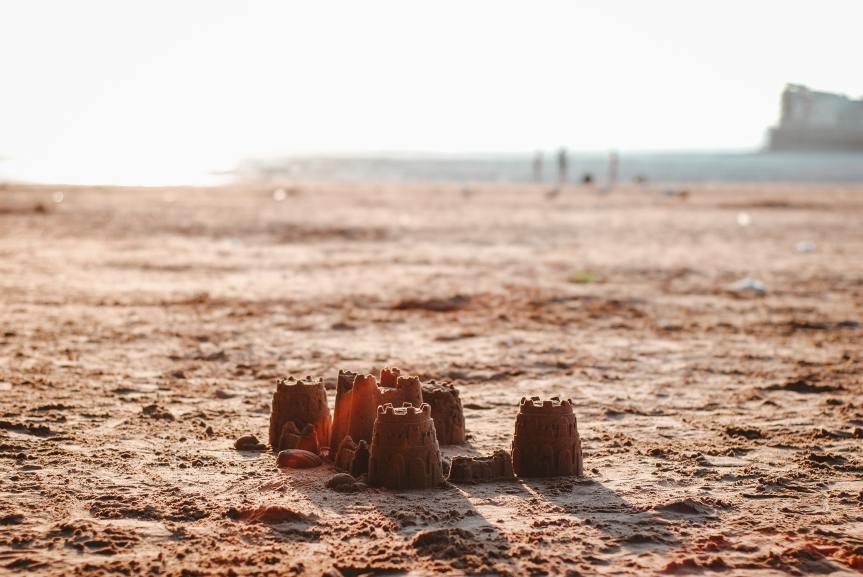
Picture yourself and your siblings as children playing in the sand. Each of you is building your own sand castle. But building a sand castle is more effective with more than one builder. You begin to strategize how you can get your siblings to help you build your castle:

You could approach their castles, mocking them: “You’re building it all wrong! How silly! It doesn’t even look like a castle!” Maybe you’d even kick over a tower.

Or you could focus on your castle, building it up with your words as well as with your hands. You could talk about your plans for your castle. “Look at this! Isn’t it great?! I want a double moat around it here… and don’t you think it would look nice to extend it out this way?”

“Religion”=Sand castle

Which method would be more likely to attract people to what you believe? Think about it.


Photo by Hello I’m Nik on Unsplash