
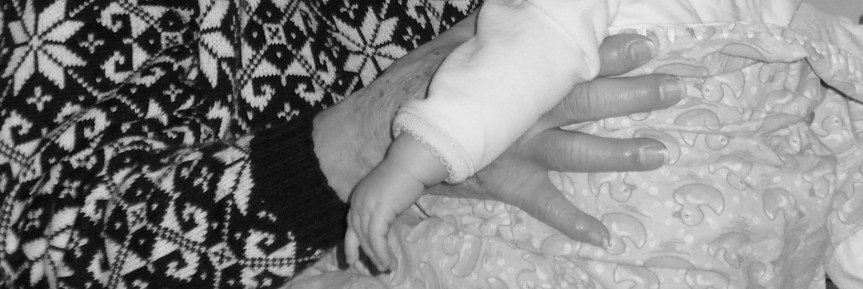
Grandma

Grandma imagined a pump of cold, running water in heaven. She told me so as we sat side by side on the couch just before I left for Spain.

“What do you imagine?” she asked.

Heavenly mansions were on our minds, not the frailty of human life.

When I said goodbye, I hugged Grandma and then Grandpa. My voice was still cheerful as I said, “If I don’t see you again here, I’ll see you in a much better place!”

They both smiled.

But I couldn’t control that rush of grief. The memories, joys, sorrows, and love just landed in a heavy heap on my heart. I started to cry.

Like I am now.

Today is Grandma’s funeral and I’m an ocean away.

Grandma spent her whole life quietly serving others. She inspired almost subconscious admiration and love; she was the rock that we all leaned on but sometimes forgot was there. She always had time for her children, grandchildren, and great-grandchildren (and even our pets too!).

And yet, she loved to be alone, content to be still while the world marched by. She enjoyed life without needing to partake of all its luxuries, and contentment made her life richer. Her faith in God, her love for others, and her hobbies—collecting, organizing, couponing, gardening, reading— strengthened her for the hard things life threw at her.

On Friday, the hard thing was emergency surgery with very little chance of success. The family was stunned. We knew she was ready to meet her Maker, but we weren’t ready for her to meet her Maker.

And then she was gone. Before most of us had the chance to say goodbye.

It’s as if the book of some of my best memories has closed. No more melting plastic game chips on the threadbare carpet. No more sleepovers on crinkly pillow covers. No more poring over stacks of Berenstain Bear books. No more Keebler cookie snacks. No more tiptoeing around in the forbidden basement with cousins. No more strict “with soap!” hand washings. No more maneuvering the golf cart between the fragile fir trees at the risk of Grandma spotting us from the living room window. No more Grandma stories from when Dad was a little boy. No more of her French silk pie or other outstanding desserts and dishes. No more talks on the couch. No more phone calls or quirky, Grandma-style emails.

Her last email came the middle of October:

“Think I swept my time under the rug and now need to reverse that. All kind of things collect there under that cover up. That’s why some people insist on hardwood floors. Do you have hardwood floors or rugs with secrets?”

Her emails always put a smile on my face, no matter what kind of day I was having. Especially when they ended like this one:

“We don’t sweep love under the rug so you’re safe! Grandpa and Grandma”

On Saturday, I sat on the lonely beach, staring at the sea and trying to swallow the suddenness of her death. There’s just no easy way to say goodbye. No easy way to hurt. Friends from here and there and everywhere have decided to hurt with me and my family. Thank you.

Today we are grieving the loss of a beloved grandmother. And we’re also celebrating Grandma’s gain as she welcomes eternity.

I hope there’s a pump of cold, running water.

Summer in Immigrantville

Summer in Immigrantville, Spain is not an easy thing to endure.

Why not? For one reason, it’s hot. As I write, a breeze billows the curtain, bringing dust and the sensation of standing within range of a hairdryer. They say it has been a relatively cool summer so far. Fine. But I’m still turning on the fan.

With heat comes lethargy. Trying to think of something to ingest other than iced coffee. Trying to drag myself off of the couch to get out and talk to people. Of course, this whole “getting out” thing is over-rated anyway; very few people brave the heat of the day, so why should I? On the other hand, staying “in” should produce deliberate choices to study language rather than Dickens.

But heat and lethargy are not all that is wrong with the summer here. The worst part of summer is summer vacation. In Immigrantville, this means that families scrape together the means to travel back to their countries for months at a time. Slowly, the town empties and the streets grow quieter. There are fewer people to bump into. Fewer people to talk with.

But that’s the pessimistic view of summer life in Immigrantville. Fortunately for all of us, I can only think of 3 negative aspects. And I can think of a few more positive aspects from my experience so far. Like…

  • Volunteering to help a local thrift store employee reorganize her store. Mostly, I just put clothes on hangers and affirmed her ideas to rearrange clothing displays.
  • Washing my clothes by hand because splashing around in cool water helps beat the heat.
  • Preparing new recipes for foods that can be eaten cold.
  • Taking a grocery trip to a nearby city. Of course, the trip required a date with my Kindle at an air-conditioned café in order to fortify me to haul heavy groceries from store to bus station and bus stop to home.
  • Learning it’s okay to rest in the afternoon while the town is hiding in their respective homes under their respective fans.
  • Strolling down the boulevard after sunset when the remnants of the population emerge from their homes. In fact, one time I even walked home with an invitation to couscous and another to an afternoon tea.
  • And last and least but not least, studying. The quieter days provide a chance to brush up on my languages and pertinent topics. (Note: As much as I love the idea of this opportunity, I am still learning the art of self-discipline.)

See? Rather than wallow in sweat and loneliness, I might be able to enjoy my summer in Immigrantville after all!

Djellaba shopping

We were supposed to be going djellaba shopping. Aisha had volunteered to help me when she found out I wanted to buy a traditional dress. I had agreed to meet her at her house, knowing well what would happen.

I was right. After an hour or so, when lunch was cleaned up and everyone was dressed, we moseyed out to a shop that happened to be closed. So we spent another half hour sitting on her mother’s couch and chatting over cups of thick coffee as someone dozed under a wool blanket across the room.

We entered a tiny shop that sold mostly pajamas. They did have a few djellabas, however. The tailor made me try them on and was disheartened when they all ended before my wrists and above my ankles.

So he took my measurements and told me to pick out a fabric. Aisha negotiated the price alone. When we walked away, she squealed. “That is the local price. You would not get a price like that. If I wasn’t with you, people would take advantage of you.” I didn’t doubt it.

She still had my money in her pocket and waving the scrap of fabric the tailor had snipped off for us, she insisted that we find a headscarf and traditional shoes to match my new outfit.

In that neighborhood there was such a camaraderie of poverty- a people that hovered just above the grime of life, but hovered together. Still, admonitions came to “hold your sack in front of you, not behind you!” Indeed, a lady in front of us paused when she realized that she no longer had her wallet.

But I was so watched that I couldn’t imagine how anyone could have stolen anything from me without someone else noticing. People swarmed around us, bumped into us, gawked at us.

A shopkeeper motioned to me while addressing Aisha. “Is she a Muslim?”
“No.”
“Not yet.” He eyed me. “Why aren’t you a Muslim?”
Taken off-guard, I straightened. “Why do I need to be?”
“She prays!” Aisha inserted, intent on protecting my religious freedom.
“Who is she?”
“My sister.”
“You’re short and she’s tall. How can you be sisters?”
I cleared my throat. “She is like our mother and I am like our father.”
Then Aisha and I giggled together, and the shopkeeper gave an irritated but irrepressible grin.

Another lady stopped us and Aisha proudly told her that I was getting a djellaba made by a local tailor.
“Is she a Muslim?”
“No.”
“Does she pray?”
“Yes.”
“Does she fast?”
“Yes, she fasts.”
“Well then, what does it matter what she is?”

I spoke up then, but the lady was more interested in the fact that I was speaking her dialect than in what I had to say. And she walked away, still convinced that my good deeds gave me a good shot at paradise.

The sundown prayer call sounded. Aisha kissed me goodbye and tucked me into a taxi, even while insisting that I stay for tea.

I stared out the window at the sunset on the way home, pensive and full. It was one of those days that I would like to store in my pocket and pull out when I get lonesome for these people.

The quiet road

It’s been a quiet road. Not a lot of mountains, valleys, or even speed bumps. But sometimes the quiet is the hardest part of the journey. I feel alone sometimes. Well, a lot of times. The world at home continues without me… like it should and like I knew it would. But it hurts when I can’t be a part of it.

This week at the international church, the speaker brought a very real struggle into the open: it doesn’t seem fair that we have to be the ones leaving behind what we know.

But His call is personal. He instructs Peter to “Feed my sheep” and “Follow me” (John 21). When Peter questions him about another disciple, He pulls Peter’s focus back to the personal calling: “What is that to you? You follow me!”

See, it’s not a matter of what we have or what we leave behind; it’s a matter of following.

So, although the quiet road is lonely, I don’t have to feel something supernatural and emotional to be able to claim God’s promise that He is with me.

Ode to Marriage

The rain is banging against the tarp, filling the concrete house with a dull roar. Just the sound of it causes my bones to shiver. I promised myself a cup of coffee as long as I diligently planned the week’s English lessons. Then I opened a blank document and forgot my promise.

There is something about having a sheet of white on my screen that makes my fingers want fill it up with random thoughts. This time my random thoughts are about marriage.

What do I know about marriage? Very little since I’ve been single for nearly 30 years. Yet, being in a culture that points to marriage as necessary for one’s spiritual journey makes me contemplate this more than I would were I still in the States.

In one perspective, life begins at marriage. The unspoken idea is that one cannot be happy unless they have a significant other.

Then there is the perspective that life ends at marriage. Think about how countless movies and books end with a couple finally realizing that they are right for each other. Why do the books and movies end there?

And then, even more real to me in this culture is the perspective that once a woman is married, she becomes her husband’s servant and is bound to her home. Her only joy after marriage is having children.

At times, I’m envious of married couples who step into this new world together and get to experience things as a unit rather as individuals.

To me, that’s one of the most beautiful things of marriage: companionship. I told my classmate my thoughts and she looked at her husband and smiled: “Yes, that’s true. But once you’re married, you don’t DO as much!”

I suppose there’s a flip-side to everything. That’s why I won’t stress out about my marital status. The preparation for anything is in seeking God’s face.

These are my disconnected, rainy day thoughts.