Was it worth it?

“Was my time in Spain worth it?” This question has crossed my mind a hundred times since I started winding down my life here. Was all of the time, energy, and finances invested worth the results I see? Or rather, the lack of results? Were they worth the years of being far from the people I love best in the world? Far from my own culture and community?

Lord willing, I plan to move back to the States in just over 2 weeks. My emotions are everywhere, leaking out in goodbye tears with a friend or bouncing in sheer giddiness as I remember that I don’t have to face upcoming life transitions alone anymore.

But was my time worth it?

I came across a quote from Elisabeth Elliott that I had jotted down long ago: “[People] cannot be hustled into the kingdom of God. And it is well to remember Christ’s own descriptions of that kingdom–leaven and seed, things that work slowly and out of sight. We long for visible evidence of our effectiveness and when it is not forthcoming, we are tempted to conclude that our efforts never had anything to do with the kingdom.” (From Made for the Journey by Elisabeth Elliott)

Exactly. I have coached myself not to dwell on the question of whether or not my time in Spain was worthwhile. After all, God works in ways we can’t see and I don’t have to understand the whys of His calling. Like Elisabeth Elliott said, God’s work is often slow and hidden.

When I shared my thoughts with J,  he suggested a new perspective, one he had gleaned from an article he had read. In his unimposing way of communicating truth, he suggested that rather than asking myself, “Was the sacrifice worth it?” it’s better to remind myself: “He is worth it.”

My personal fulfillment takes a backseat to God’s glory. 

This doesn’t mean I can’t evaluate my work and make adjustments. Neither does it mean I cannot grieve my losses or my lack of perceived success. But staying stuck in my questioning grief reveals a lack of divine perspective because neither sacrifice nor success can define the worth of a kingdom endeavor. 

A life spent for God is worth it, no matter what.

J&T: A piece of our story

Besides a detailed account of our few weeks together, I haven’t written much about my relationship with J. It’s not because he has been pushed to the periphery of my life–he has been invading every nook and cranny! But I guess those were the nooks and crannies I once used to write on my blog.

Months ago, a reader asked me to tell our story. So here it is from my perspective…

We met at a wedding, our siblings’ wedding, to be exact. My older brother and J’s younger sister married each other in the summer of 2018. 

You’d think that we both would have had romance on the brain in such a setting. Yet, he was based in China and I had just moved to Spain. Our minds were on our respective work, not romance. When I think hard enough, I remember things about him from that weekend–like when I tripped on my too-long skirt and he tried to blame my clumsiness on himself–but I can’t remember what he was wearing the first time I saw him or anything of the sort. He remembers even less than I do.

At the Sunday potluck, we chatted with each other. Our conversation was enthusiastic because, as overseas workers, we could connect in ways that we couldn’t connect with just anybody. He asked to be added to my newsletter mailing list. 

I went back to Spain. He finished school and returned to China. I contacted him once about an article I was writing and he sent me some information. That was our only personal contact for five years.

His church became one of my supporting churches for two years. I was delighted because I already knew some of the congregation. I also knew his family. (When our siblings were dating back in 2017, I had made a point to travel to Ohio. Twice. And J was in China both of those times.)

In 2019, he returned to Ohio to finish his Master of Science with the intention of moving back to China. And then the pandemic happened, and he found himself planted Stateside indefinitely. Over the next several years, he made trips to Illinois to visit his sister, my brother, and our mutual nephews. I returned to Illinois as well, for a vacation or a home assignment, but our paths didn’t cross, and neither of us considered that they didn’t.

Then while I was on home assignment summer of 2023, I gave a talk at his church. J and I chatted a little that Wednesday evening, but I did a little chatting with a lot of people and nothing felt unusual. I was at the beginning of a long trip and was dealing with ongoing health symptoms I had become an expert at suppressing. Had I been a little more in tune with my surroundings that evening, perhaps I would have seen that quiet question mark above J’s head. But I continued my trip, clueless.

Still, he said nothing. Not that I was expecting him to have anything to say. In retrospect, it was as if, in my mind, he was married to China and therefore ineligible. 

Toward the end of my time in the States that summer, he and his parents came to Illinois to visit his sister… the same day I left for Indiana. 

It seemed that God was keeping us apart. And I think, in a sense, He was.

While in Indiana, I found a name for the symptoms I’d had for more than a dozen years, the symptoms that were getting progressively harder to suppress.

I started treatment after returning to Spain. Within a month, I recorded in my journal that I was beginning to feel better. I knew I wasn’t completely healed, but I was on my way. I had lots to be thankful for that Thanksgiving.

Thanksgiving was also the time that J, who had been praying for me in the meantime, sensed that the time was right. He emailed me that weekend.

I woke up at 5 a.m. to take the day’s first dose of treatment. As I crawled back into bed that Sunday morning, I saw I had an email from J. I immediately assumed that he was writing to say he was moving back to China and could I please take him off my newsletter list?

Or.

I didn’t stop to ponder; I just tapped the notification and opened the email that would change my life. Stunned, I lay in bed, lost in thought until my alarm went off. 

He didn’t get an answer right away; I had a lot to think through. The truth is, as older singles, we both valued our respective single lives. Could this really be God’s next step for us? I knew I would need to mourn that first layer of loss before I responded to his email. Finally, with both trepidation and excitement, I wrote back, mostly with questions he had given me permission to ask: What about China? How did he feel about singleness?

Our initial emails were full of questions as we tried to sort out if forward were the best direction for us.

Deep down, I had a sense our relationship would work out, which was based on what I knew about him, his family, and his church. At its core, that inner sense was: “Of course. Why didn’t we think of this before?”

We wrote back and forth for a bit and then were ready to make our relationship more official around Christmas. Our families were shocked and excited. Our friends were shocked and excited. At last, these two “permanent singles” were dating!

Starting a relationship while 4,000 miles apart wasn’t for the faint of heart, but I’ll skip over those layers for now. One month after our first official phone date and just when I was admitting to myself how much I liked him, J was nominated to become a pastor in his home church. The next Sunday, one man would be chosen by lot and ordained. 

He wrote to me on Monday morning, and all I could do was fall on my knees. 

We both had lots of feelings that week. We tried phone calls but found we didn’t have a lot of words. Tears came at unexpected moments. I wasn’t mourning; I was overwhelmed. How could I support him when I was feeling so weak myself? What exactly was the new girlfriend’s role? 

The events of that week drew us together in ways neither of us could have anticipated. Our relationship deepened to a level we would have said we weren’t ready for. We learned to trust each other. 

I watched the ordination over WhatsApp, tears flowing as J was chosen to serve as a pastor in his home church.

Then we picked up and kept going, in both praise and uncertainty.

He came to visit Spain in May. We had 19 whole days on the same continent. During that time, we finished falling in love and seriously talked about a future together.

Three months later, I spent three weeks Stateside, in my home community and his. Right in the middle of our time together, J asked me to marry him. Even though I had known it was coming soon, he managed to surprise me. (Well, he surprised both of us, but that’s another story. 😉 )

Then came the whirlwind of excited decision-making in the week before I returned to Spain. Spain is where I am now. The whirlwind hasn’t stopped and likely won’t as I close down my life here, move back to the States, and plan a wedding.

But I’m surprised to find how much joy is in the whirlwind too.


This message has been approved by J. 😉

Notes from Hospitality 101

I had promised I would summarize a few of the things I learned (and am currently learning!) while researching for an essay on hospitality. If you’re interested in reading the entire essay, send me a message. 🙂

  • We think of hospitality as taking place in our homes. But hospitality is broader than that; we can take hospitality with us wherever we go by honoring those around us.
  • Hospitality is not about bowing to the expectations of others. It’s not that we ignore expectations, but neither obligation nor martyrdom is true hospitality. Why? Because our work, our hospitality will never validate us; only God can do that.
  • Christ followers are commanded to show hospitality. (Check out Titus 1:8, 1 Timothy 5:10, Romans 12:13, Hebrews 13:2, and 1 Peter 4:9.) However, the truth is that we love our comforts. And the other truth is that hospitality isn’t always comfortable. So while it would be easier never to invite anyone into our homes and lives, as Christians, we no longer worship the god of comfort.
  • If you’re an introvert like me, hospitality may feel like it requires more than you can give. But it doesn’t. Everyone needs boundaries and everyone has limits. If you’re introverted, it doesn’t exempt you from hospitality; it just means that you prepare for hospitality differently than those who have different limits.
  • True hospitality starts with worship. God is the One who empowers hospitality because He shows us both our imago dei and our depravity, reminding us that we are on the same level as everyone who walks through our door.
  • Hospitality can be grand and life-changing, but day-to-day hospitality is usually quiet, small, and insignificant.
  • We cannot wait until we know how to do it “right” or have the “right” circumstances before we show hospitality. If so, we will never start. Perfectionism can stand in the way of God working through us. In fact, hospitality goes hand in hand with humility, creating a space for our own vulnerability.
  • Speaking of creating spaces, hospitality creates a safe space for relationship regardless of life’s circumstances. Not only that, but we need to be fully present, committed to the privilege of walking with someone on their journey, even as they walk with us on ours. In other words, we should be invested for the long haul.
  • Hospitality is both living and speaking love and truth, all the while acknowledging that our story is only a part of a bigger story, God’s story.
  • Yes, hospitality requires much but it also blesses much. We connect with people we may have never known otherwise. We learn to enjoy them instead of use them. We are enriched when we enrich the lives of others, sharing our gifts and partaking of their gifts. We also bless God when we live in obedience to His Word.

Photo by Priscilla Du Preez on Unsplash

Leaving behind our fish

My writing prompt this week is about letting something go. What have I let go? 

A couple of years ago on another blog, I wrote a lament about living far away from family. I understand the sacrifice of “letting go” theoretically and even theologically but not always emotionally. Now and then, especially when I’m homesick, I renew my lament. Yes, I love the life God has given me and the deep and beautiful blessings that come along with it, but it doesn’t mean it’s always easy. 

Sometimes even the wonderful, valuable gifts in this life are things we must let go, things God asks us to miss out on. So we watch from afar with palms pressed against the window pane that divides something we long for from our reality.

We all have laments, don’t we? Things we miss out on because we have counted the cost and decided to follow Jesus.

I won’t elaborate on this particular lament. I’ve done it in pieces on my blog: here, here, here, here, here, and here (oops, I didn’t realize there would be so many “here”s). The writing prompt reminded me of a passage I recently read, a passage I still need time to think through. Below, I have retold the story from Luke 5:1-11. I hope the story touches a dark corner of your heart like it touched mine. What do I need to let go? Really let go? Can I believe that Jesus is worth it?

May the victory of Jesus’ death and resurrection fill your life to overflowing.

The Lord is risen!


They were tired when Jesus came. It had been a long night with no fish. No fish meant no market. No market meant no income. No income meant, well, not much of anything.

He was a bit strange, this Jesus, climbing on board Peter’s boat to talk to the crowd. A few people began to splash into the lake to be close to him, and it was then that Jesus quietly asked Peter to push out just a little from the land. Peter gladly gave up his task of washing the fishing nets to hear for himself why so many people were following this Teacher around.

Jesus taught in language that was both simple and profound. The crowd pressed against the shoreline, engaged, spell-bound even. When Jesus was done teaching, he turned to Peter and said, “Put out into the deep and let down your nets for a catch.”

They had already tried that. All night, actually. So Peter said, “Master, we worked all night and caught nothing! But if you say so, I will let down the nets.” 

The nets slipped in the water with the familiar creaking of ropes. A creaking of familiar hopelessness.

And then their nets were breaking, splitting with the load of fish! It took a moment to understand what was happening, so astonished were they. “Help!” they cried to a nearby boat. Soon both boats were overflowing. They began to take on water.

Excitement and wonder were thick in the air. Peter and his companions, James and John, stared at this Teacher, this Master, who seemed to have power over creation. Overcome, Peter fell down at Jesus’ knees. “Depart from me, for I am a sinful man, O Lord.”

“Do not be afraid,” said Jesus. “From now on you will be catching men.”

They rowed to the shore as their boats sank lower and lower in the sea. Those from the crowd who had not yet dispersed stood on the shore, gawking as the water lapped at their ankles. 

Fish meant market. Market meant income. Income meant, well, anything.

But they left their boats, their nets, their fish and followed Jesus because He was everything.


Photo by Cassiano Psomas on Unsplash

To the land that I will show you

When Abram was called by God in Genesis 12, he wasn’t called to a specific country. God didn’t say, “Abram, go to China.” Neither did God say, “There you will use your gifts of teaching and discipling by starting a language center and a church.”

Abram went with no country in mind and no idea of how to plug into his new world. He didn’t even know what linguistic and cultural barriers he would face. Plus, he was 75-years-old.

But he went in obedience because that was really all he had. He didn’t update his facebook or keep a blog to tell the world what a great job he was doing. He probably never even communicated with home again.

And then, to top it all off, within a short time of his being on the field, the land was hit with famine. The Bible doesn’t record the thoughts that would have gone through my mind: “Am I sure that God led me here? These people and this place were never really on my heart before I got here. Maybe I heard God wrong. Maybe He meant I should move down the street, not leave my home country.”

Perhaps the Bible doesn’t record those thoughts because Abram didn’t really have them. He struggled with faith in other areas at other times, but this whole “going” thing seems to be one thing he was really good at. Going and not looking back. Not doubting his calling or God’s promises even when the hard times came.

I’m a good person

“You’re the perfect Muslim.”

“Huh?”

“Yah, except that you’re not a Muslim.” My friend began to list the ways in which I fulfilled the religious requirements: “You pray. You don’t lie or cheat. You dress modestly…”

She wasn’t talking about my heart; she was talking about my actions. And she wasn’t the first person to praise me for things I do right.

When I hear continual praises of my good deeds, it is easy to internally echo what I’m hearing. “Yes, I am pretty good. I pray. I don’t lie or cheat…”

Essentially, it is easy to forget this: if not motivated by my love for God, my good deeds mean nothing. The blackness of my heart only blackens as I bow to the idol of man’s praise.

I protested to my friend’s assessment of my character. However, she insisted that my heart is inherently good and that is why I do good things.

People will continue to praise me because they like to believe that I am being good on my own. They like to think that being “perfect” is humanly achievable. But when they walk away from an encounter with me, I want them to be praising God, not me.

On a roll

If I would have been Elijah, 51 more people would have died.

When Ahaziah, King of Judah fell through a lattice and lay sick in his bed, he wanted to know if he would live. “Go, inquire of Baal-zebub, the god of Ekron,” he told his messengers.

But on the way, Elijah intercepted the messengers to give the king a word from the Lord: “You shall surely die.”

King Ahaziah wasn’t happy with this meddling in his affairs and he sent out a captain with his 50 men to fetch Elijah from where he sat on top of a hill. Elijah responded by calling down fire from heaven and consuming the 51 men.

But the king didn’t give up. He sent another captain and 50 men. These also were consumed by fire from heaven.

And still King Ahaziah didn’t give up.

If I had been Elijah and seen the third party of 51 men approaching me, I would have sighed, “Yes, Lord, I know the routine. Fire from heaven.”

But the third captain fell on his knees and pleaded, “O man of God, please let my life, and the life of these fifty servants of yours, be precious in your sight.”

Elijah had executed God’s will on the former two occasions. Why would God want anything different this time?

That’s why I say that if I had been Elijah, 51 more people would have died. Or at least I would have attempted to call down the same fire from heaven. I would have been on a roll.

I often think about this story when I’m tempted to make a “policy” on how to treat a certain category of people: persistent beggars, inappropriate men, meddling taxi drivers, aggressive women, etc. Yet, God showed Elijah the Tishbite how important it was to listen to His voice in every situation. Likewise, God may want me to say a certain thing to one aggressive woman and want me to keep silent with the next. The point isn’t to get energized by being “on a roll” but to listen in each situation.

Yes, always listening can be exhausting, especially when we hear commands we don’t want to obey. When Elijah heard the angel of the Lord say, “Go down with him; do not be afraid of him” it may have crossed his mind that calling down fire from heaven would have been less of a hassle. But he still went. He still listened.

(2 Kings 1)


Photo by Ricardo Gomez Angel on Unsplash

Blessed are they that budge

Blessed are they that budge for they shall be first in line.

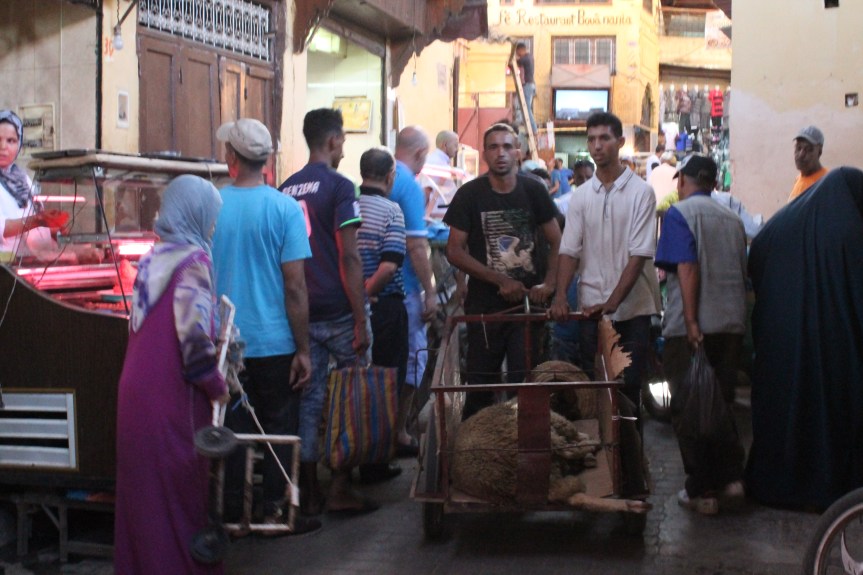
If that’s not a North African proverb, it should be. Some days instead of the one being budged, I want to be the one budging. Let them see how it feels for once.

But I know that’s a selfish attitude. So the question lingers: How exactly do I cope in such a pushy culture?

For example, standing in line at a shop today, the owner served the 5 pushy people behind me before he fetched what I asked for. Then I stood with my money on the counter while he served the next 10 pushy people behind me.

It wasn’t until I said, “Take this, sir!” that he turned to me and apologized. I wasn’t even tempted to give him the customary, “No problem.” My inflamed temper wanted to clear the crowd at the counter with a giant push and then hurl my unpurchased items at the shop owner. I could even envision myself stomping out, bellowing that I would never return.

How should I have acted? Really, the question is: How should I act? This isn’t a one time occurrence but a constant cultural barrier for me. In my 9 months here, I have met few truly courteous strangers; most courtesy turns out to be greediness in disguise.

This is one of the only things in this culture of which I cannot even glimpse a bright side. So, practically speaking, what should I do? Hang around a shop until the owner notices and takes pity on me? Disobey God’s command to love others as myself and begin pushing like everyone else?

Well, maybe my first step is to stop gritting my teeth when people infringe on my right to be served before them.

I will be with you

I’m not worthy to walk in the way God has called me. Tonight I begged for a confirmation, selfishly desiring a dream or a voice from heaven telling me that the gifts He has given me are perfect for the task.

Instead, in the midst of my tears, He reminded me of Moses’ calling. The conversation between God and Moses in Exodus 3 went like this:

“Come, I will send you.”
“Who am I, God?”
“I will be with you.”

There is no affirmation of self-worth; just the power of God in me.


Photo by Jonathan Cooper on Unsplash