
Interviewing Carmen

As I was reflecting on different aspects of North African culture, I realized it would be refreshing to get someone else’s perspective. So I talked with Carmen, a fellow foreigner, who lives in my city. (Keep in mind that her answers are paraphrased because I could not type fast enough to keep up with her thoughts.)

What do you like most about the culture?

I love the modesty. They have so much style and yet they’re so modest. Especially coming from Western culture. Although it may not be a true heart modesty, it’s physical modesty and that is nice.

Another thing I like is that people here talk about honoring God, and they’re just more open to talking about God in general. I went to a wedding in North America and there was no mention of God anywhere! It makes me wonder if God has a great plan for the children of Ishmael to have a greater voice for Him in the future; they’re already used to talking about Him.

What things about the culture makes you smile?

The colors of the traditional dress. They remind me of jewels. I went to a festival where everyone had on their best clothing and they looked like a flock of butterflies.

Do you find that people are friendly or easy to get to know?

I’ve found in our neighborhood that people are a bit harder. There is a foreigner barrier. They are hospitable but they have a limit. At the school where I teach English, that barrier is gone. They know that I’m the teacher and they are the parents instead of a foreigner and local.

Thinking long-term, what are some things about the culture that you will enjoy?

The coolest thing about being here long term is the chance to learn the language to make friends with people who don’t speak your mother tongue and don’t share your worldview. But when you get beyond that, you can share even bigger things; it becomes natural. Long term relationships are an investment and a privilege. I look forward to developing deep friendships with people from this culture. One of my best friends ever was an illiterate, subsistence farmer. I look forward to developing more of those kinds of relationships.

What are some things you might get tired of?

Not seeing what you most hope for. And if you work in the school system, lack of administrative support.

Why should someone visit North Africa?

To pray. There is such potential here in a culture that already acknowledges God. Will the Lord raise up a voice in this culture? Spirituality is respected here, not old-fashioned.  Whereas in the past, the West has been reaching out to the East, but will the Lord flip that and have the East reach out to the West?
We wear a Name

When I was in school, I met an atheist who was planning to work in the Arab world. He said that he was undecided about whether or not to reveal his beliefs. “I think it would be better to say I’m a Christian because even if they don’t like Christians, at least they would think I believe in God.” He didn’t mind branding himself with the Christian label; it meant nothing to him.

Before I moved to North Africa, people warned me that many North Africans have a misconception of Christianity. Is it any wonder? Long ago, “Christianity” was a name used to fight wars. In recent years, many presume to understand Christianity from a blend of European Catholicism, Hollywood, and tourists in scant clothing.
This is a big generalization, I realize; however, I run up against this big generalization frequently. Like the time that my friend told me what Christians believe because she had taken a religions class at the local university. Both she and others have treated me as if I don’t belong in the Christian box. In their opinion, some of the things I do or don’t do are too respectable to be Christian.

What have we done?

In Romans, Paul comes down pretty hard on God’s people for the same offense: “The name of God is blasphemed among the Gentiles because of you” (2:24). They weren’t practicing what they were preaching. As God’s chosen people they weren’t living up to the name they carried.

As a Christian, I bear the name of Christ. Instead of providing an excuse for others to blaspheme Him, I acknowledge that I need His power to live out this privilege.

My November guests

In November, three guests traversed the Atlantic to visit me: my mom, my brother, and my friend. Some of our adventures included:

  • Finding each other at the airport… and managing to convince security that I was not a risk
  • Traipsing around the city as each phone place we had been directed to directed us to someone else
  • Arguing with taxi drivers who were even more stubborn than I
  • Tasting the old medina, literally and figuratively
  • Posing for awkward pictures
  • Sampling camel burgers and a salad that tasted “like donkeys”
  • Wiggling cooked snails out of their shells with wooden toothpicks…and sampling them too
  • Long talks
  • Laughing until we cried
  • Visiting my friends for tea, dinner, or just to say “hi”
  • Tasting uncured olives that pickled our mouths
  • Eating most of our meals standing around in the kitchen
  • Souvenir shopping in the rain
  • Souvenir shopping in the rain again
  • A long train ride in the rain
  • Walking along the bay in the rain
  • Two nights of cold showers
  • Spending a night snuggled in the musty hotel blankets
  • Staying in a concrete hotel room which reverberated with the early morning call to prayer and reading of the Qur’an
  • Crossing the Strait of Gibraltar by ferry only to find that the rain in Spain does not stay mainly on the plain!
  • A long bus ride around many many roundabouts…in the rain
  • A bus break-down which seemed to temporarily mend itself
  • A few days in Spain with friends, church, a birthday party,  an open air market, olives, churros, pastries, cocido, and tapas
  • Goodbyes

I’m a good person

“You’re the perfect Muslim.”

“Huh?”

“Yah, except that you’re not a Muslim.” My friend began to list the ways in which I fulfilled the religious requirements: “You pray. You don’t lie or cheat. You dress modestly…”

She wasn’t talking about my heart; she was talking about my actions. And she wasn’t the first person to praise me for things I do right.

When I hear continual praises of my good deeds, it is easy to internally echo what I’m hearing. “Yes, I am pretty good. I pray. I don’t lie or cheat…”

Essentially, it is easy to forget this: if not motivated by my love for God, my good deeds mean nothing. The blackness of my heart only blackens as I bow to the idol of man’s praise.

I protested to my friend’s assessment of my character. However, she insisted that my heart is inherently good and that is why I do good things.

People will continue to praise me because they like to believe that I am being good on my own. They like to think that being “perfect” is humanly achievable. But when they walk away from an encounter with me, I want them to be praising God, not me.

Learning to listen

I was yawning between pages of War and Peace. The train’s rumble of metal on metal was soothing after three hours.

As we had moved from city to city, passengers had changed so often that they became a blur of faceless humanity. Across the compartment, someone took a seat facing me, another faceless being. I yawned again.

But then I smelled him. Cigarette smoke. I tried not to wrinkle my nose as I looked at him. Our eyes locked. He blinked, and I looked away.

Him.

What?!

When I had started the trip, I had spent time in prayer. God,  I want to listen to Your voice today. Several times, women had sat down next to me, but most had avoided eye contact. All I had given or received was a smile or maybe a greeting. But now it was a man. I didn’t talk to men unless I had a reason.

Remember the woman at the well? Who talked to her? Was it a man or a woman?

But I can’t talk to him. And my Arabic is horrid. Besides, I will only get myself into trouble… Fine. Okay, but You have to make Your timing really clear.

More than an hour later, he stood up–was he leaving? No, he took the empty seat next to me. I continued to skim through a dry chapter of War and Peace.

Now? But what if I heard You wrong?

Then he stood again. “Can you save my seat for me?” he asked in perfect English.

Wait, he speaks English? 

It was only a few minutes before he drifted back to his reserved seat, bringing along a cloud of cigarette smoke. This time I did wrinkle my nose. “You’re killing yourself, you know?”

He turned to me. “Do you believe in destiny?” His voice was low and gentle.

A subconscious understanding of where the conversation was headed triggered words that I didn’t hear until they had sprung from my lips: “Are you a fatalist?”

From there, our conversation careened down a different path than he had intended. But it was exactly the path that God had intended.

I doubt I will ever see him again. But it really doesn’t matter. What matters is that I am learning to listen to God’s voice.

Experiencing Eid Kbir

I could write a lot of things about this important holiday, but this post isn’t meant to be informational or theological. It’s is simply a snapshot of what my last couple of days have looked like. Granted, I decided not to display gruesome images of animal slaughter (thus limiting my photo options).

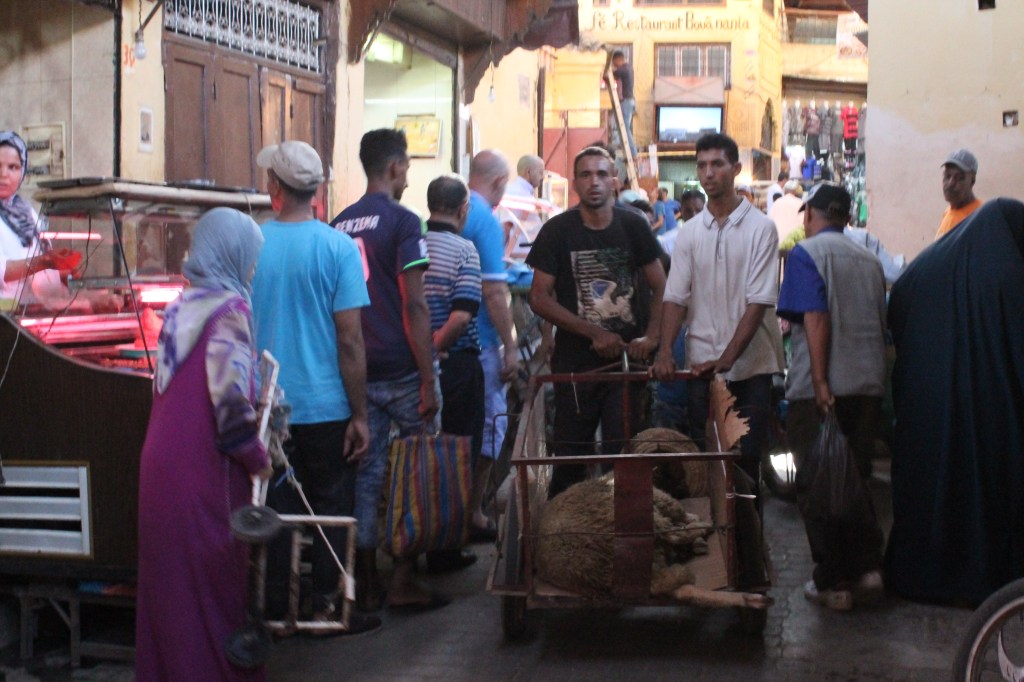
The first couple of photos are from the days before Eid. The city began to fill with the bleating of sheep and shops sold the necessities for the special day. Some shops even closed as their owners traveled. This is the country’s biggest holiday of the year.

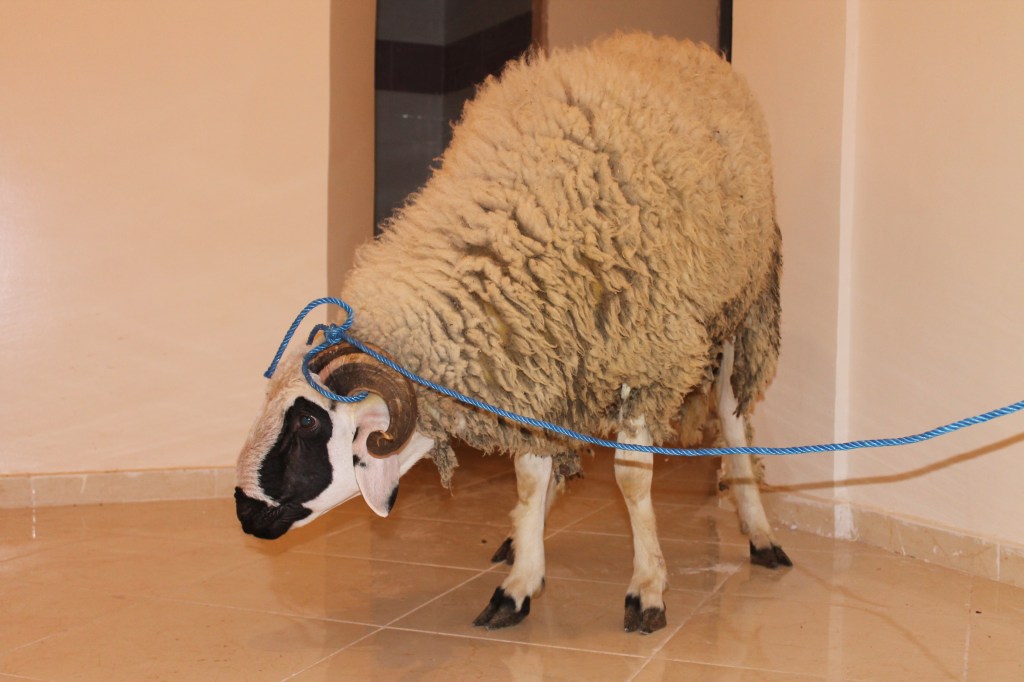
Then, I had the chance to experience the celebration firsthand. I guess the first sign that Eid was upon us was when the neighbors moved a cow and then a sheep into their courtyard below my window. Soon the sheep’s bleating was only one of many others ricocheting off the concrete walls.

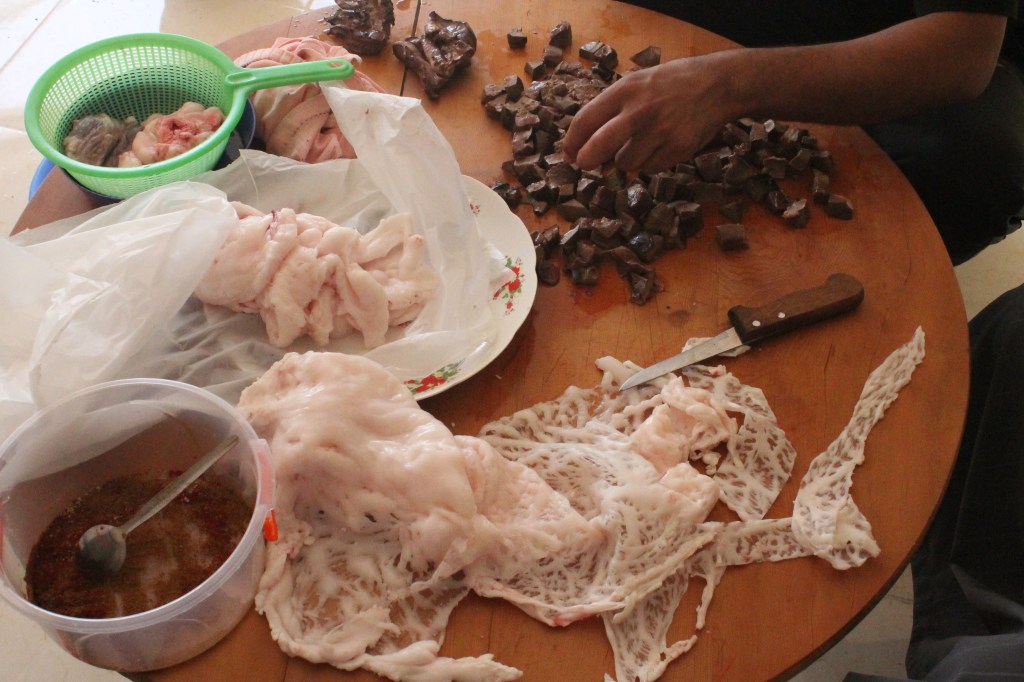
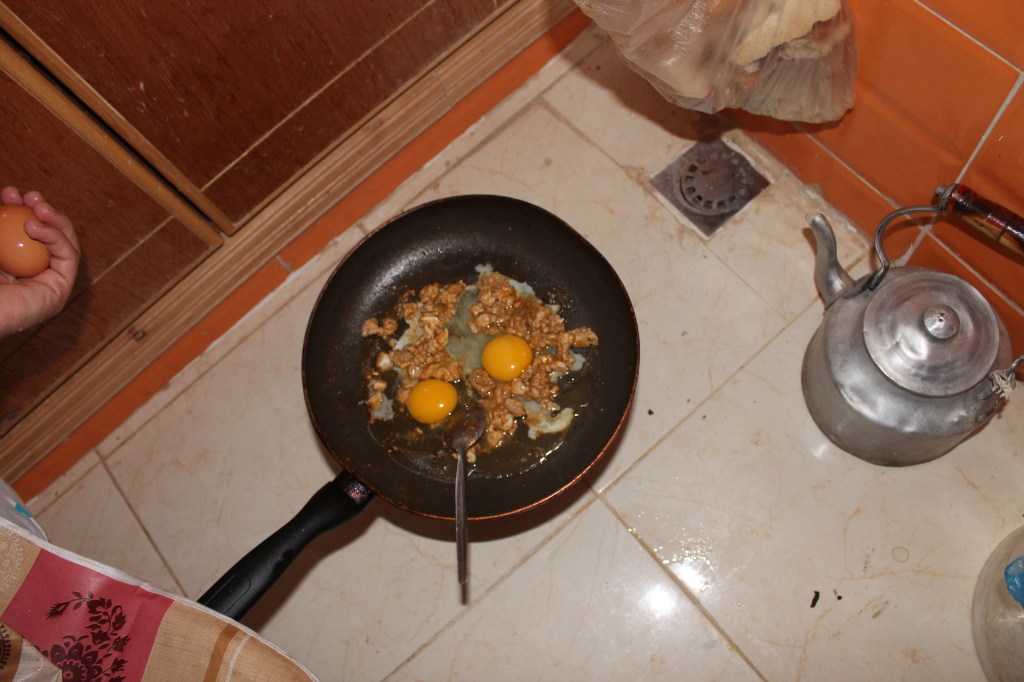
On Sunday evening, I joined my friend and her family for the Monday celebration. My head is spinning with the lifetime I feel like I lived in those two days. To my credit, I tasted a bit of everything that was served. The first meal of liver and heart kebabs with a side of spleen wasn’t too bad. But by evening, I admit that my mind refused to go over matter with the stomach and lungs dish. And what was worse was getting up in the morning to a breakfast of the head and feet. At least, now that I’m on the other side of it, I can look back and smile. I think my sampling of meat dishes until this point has been too tame!

bags and piles of charcoal in marketplace
Many little stands and shops sold charcoal to fill the thousands of grills around the city.
busy old city street and man hauling sheep in cart
One way of carrying your sheep home
sheep tied with blue rope
chopped liver and strips of fat on wooden table
Preparing for grilled liver and heart kebabs, also known as بولفاف
chopped brain and eggs in frying pan
Brain and eggs for breakfast, anyone?
loaves of fresh round bread
And of course, fresh bread with all of this!

Ramadan blues

“Am I hungry or just bored?” I muse as I peer into the refrigerator.

Summer has set in where the nights rarely descend with a breath of cool air. It is warm all of the time. And what is worse is that I feel trapped inside. And what is even worse is that my roommate chose this month to travel to Germany, another friend left forever, one classmate is in the UK and another classmate is in Spain. I am trapped with myself.

I make plans here and there, but the reality is that any plans are contingent upon the time of day. The hours that are too hot are off limits because street robbers might prey on the few people who are out. The hours right before the breaking of fast are even worse; there are hardly any people or cars to be seen and a fog of silence enshrouds the street.

Even if I do go out, most stores would be closed anyway. And the cafés and restaurants definitely are.

Why didn’t I just go home for part of the summer? Never mind the long journey or the money. Maybe that would have cured some of my recent homesickness.

I am tired of studying on my own, reviewing, practicing, listening, jotting down notes. I am tired of the food in my fridge. I am tired of sleeping.

For a melancholy, boredom breeds self-pity. At least it does in this melancholy. The light at the end of the tunnel is fading. Ramadan will NEVER end! Instead of thinking how hard it would be to fast for thirty days, I think about how unfair it is to plan my life around those who are fasting.

Selfishness. Yes, it all comes down to a perspective saturated in selfishness. Time to go count my blessings.


Photo by Erik Mclean on Unsplash