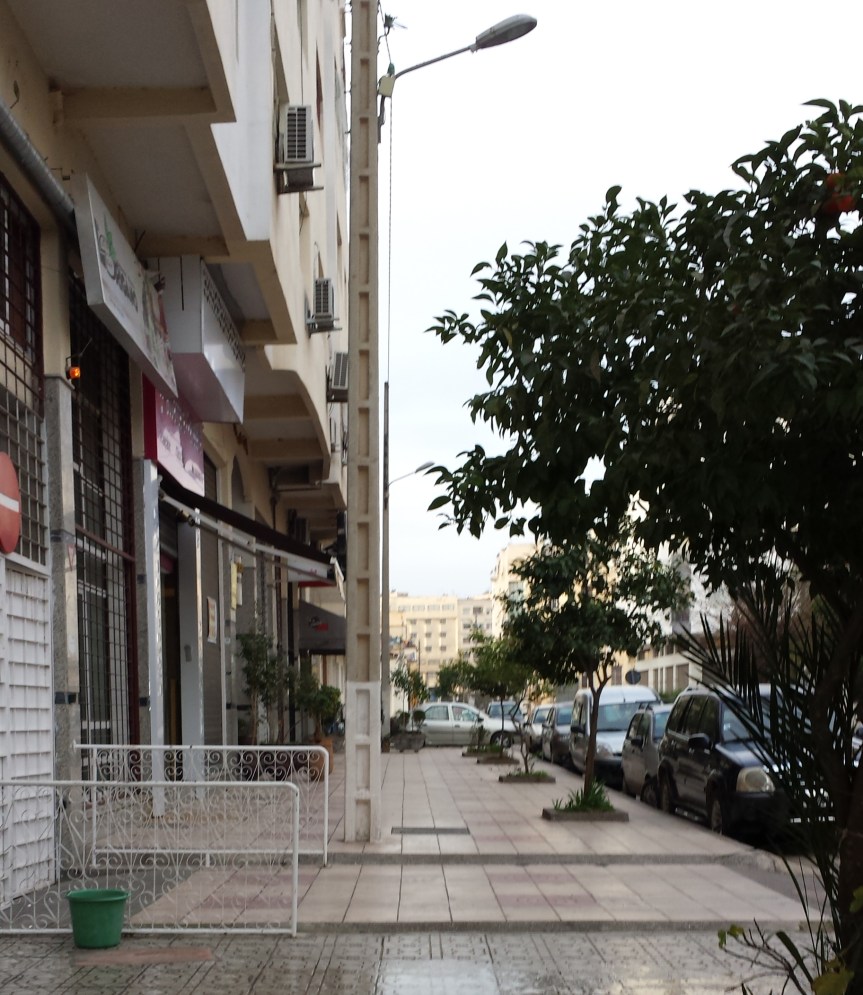


A Good Friday stroll

The Good Friday streets were quieter than normal. I plodded along, bracing myself against the wind.

When I was young—not more than ten—I overheard a conversation between my mom and her friend. The friend claimed that it always rained on Good Friday, even if it was just a little. Mom was politely dubious, but the statement impressed itself upon my impressionable mind. Did it really? Was God reminding us of the death of Jesus through a sky full of tears?

However, since this friend had revealed the fact after Good Friday, I had to wait an entire year to see if the statement were true. By then, I had forgotten about it. And I forgot the next year and the next until more than twenty years later, I still had never noted whether or not the rain dutifully came on Good Friday. Would it come to every part of the world if it indeed came at all? Would it come to Spain?

To be my age and wondering these things made me question my sanity. Why would I believe something that had neither Biblical nor meteorological basis?

I continued to walk, lost in rambling thoughts. My morning plans had been changed at the last minute, making me wish I had stayed in bed longer. But since I was up, I thought I might as well go for a stroll. My relaxed pace allowed a stooped, old man to zip around me. As he passed, I wondered what his story was.

Today the world was worth noticing: young voices pouring out of open cafés, elderly men congregating on park benches, a boy with a soccer ball. What did Easter mean to these people?

I wandered into my favorite café. “Coffee with milk?” The server asked before I had selected my chair.

“Thank you.” I smiled and pulled out my Kindle. I read, inhaling a fair amount of secondhand smoke and sipping my coffee from the sweet rim of my mug—I hadn’t used sugar and tried not to think too hard why the rim tasted sweet.

“One euro, guapa.” The server made change for my ten euro bill.

“Have a good Easter.” I smiled at her.

But would she? In Spain, the climax of Holy Week is the passion of Christ. That part of the holiday is celebrated and reenacted until resurrection Sunday is almost lost. Like their Jesus, did these people also keep their faith eternally nailed to the cross? Did they believe in victorious faith? Victorious life?

A dog trotted along a crosswalk, confident he owned the street. His owner followed a few paces behind.

The North African store was one of the only stores open on Good Friday. It bustled with limp produce, loud Arabic, and bodies that were busy making room for themselves in the small shop.

I dropped a euro on the floor as I paid for a few too-ripe tomatoes. The clerk gently smiled at my clumsiness. And then he switched from Spanish to Arabic to bid me farewell.

I greeted the mother of a lesser-known acquaintance and we walked home together in the powerful wind.

“I have laundry on our roof,” I told her as a gale threatened to carry us off like Mary Poppinses.

She had also hung her morning laundry on the roof, so at her street corner we said hasty goodbyes and rushed to rescue our scattered clothing.

It was afternoon when I opened my laptop to write an email. Outside my bedroom window, the clouds lowered over the mountains while the sky and the sea simultaneously turned gray. Then from somewhere came enough drops of rain to make me wonder, against all logic, if Mom’s friend had been right after all.


Photo by Anant Jain on Unsplash

Tips for surviving Spain- Part 1

Thinking of moving to southern Spain? Or even just visiting? Here are some helpful tips that my roommate helped me compile:

  1. Learn Spanish (I might as well start with the obvious).
  2. Carry your own shopping bags with you, recycle, conserve water, etc. Europe tends to be greener than America.
  3. Weigh your produce when you go shopping… or you’ll get to the counter without prices and the cashier might roll her eyes.
  4. Bring cash. Not every store accepts credit and/or debit cards. And many stores want small change, not large bills.
  5. Don’t read dates backwards. Dates are written by day/month/year rather than month/day/year. Don’t show up for an appointment on January 2 that was set for February 1.
  6. Read schedules by the 24-hour clock. Otherwise, you might expect a train at 6 p.m. that actually went at 6 a.m.
  7. Allow more time to complete tasks. The Spanish are fairly efficient… most of the time. But don’t treat the shopping world like a Wal-Mart. Shops tend to be more specialized and it takes longer to get everything you need (but it’s more fun!). And don’t expect buses to arrive on time… or arrive at all if it’s a holiday.
  8. Relax a bit. The average schedule runs about two hours later than the American schedule: shops open at 9 or 10. Lunch is at 2 or 3 p.m.
  9. Don’t try to shop between 2 and 5 p.m. In fact, don’t even bother going outside unless you’re looking for some quality solitude. And in the summer, you might burn to a crisp if you’re out in the hot sun between 1-6 p.m.
  10. Watch your step. At least in southern Spain, many people have little yippy dogs that leave behind deposits on the sidewalk.
  11. Realize that when it’s dark outside, it is NOT time to go to bed; the party is just beginning.
  12. Eat meat. Most Spaniards are unapologetically carnivorous. They especially love pork. (Be prepared to see the jamón serrano everywhere.) Some restaurant billboards would send animal rights activists into a tizzy.
  13. Don’t expect to find chicken in restaurants unless the restaurant name specifies chicken. Most menus are laden with pork and seafood options.
  14. Get used to eating bread, bread, bread. Fortunately, the Spaniards are excellent bread makers.
  15. And learn to love olives while you’re at it. Don’t worry; Spanish olives are amazing.

To be continued as we continue learning…

A day of Midwestern culture

One day last week, I started out the day with a friend and dusty chaff in a soybean field. It was a lovely way to celebrate my favorite season: the dry plains that stretch into the horizon, the banter of voices over the radios, the roar of machinery, the swirling haze of dust every time the combine approaches. There is something about growing up on a farm that makes the joy of the countryside stick in your blood.

But in the afternoon, I drove to the city to shop. Within minutes, I had exchanged the hazy corn and bean fields for the asphalt and concrete of the glaring city. And I loved it, as I always do. Right down to the traffic (as long as I’m not in a hurry).

After inhaling the exotic spices in the Asian Market, I had fun browsing up and down the aisles of Wal-Mart with a short list and a lot of time. Of course, I did this in a Wal-Mart that is sometimes referred to as “ghetto-mart.” But it’s my favorite Wal-Mart because one can escape the SUV, soccer-mom rush that usually accompanies Wal-Mart trips closer to home.

After crossing a few things off of my list, I paid and exited the store. The cart man met me in the doorway, gave me a bright look, and said cheerily, “Goodbye, Saint! Have a nice day. Praise the Lord!” And I smiled all of the way out to my car.

In fact, my heart was still warm even after 30 minutes of wandering around on obscure backstreets that inevitably turned into dead ends. (I had left the directions to my friend’s orchestra concert on my nightstand.) I told myself not to despair of ever hearing her play the violin and stopped at Arby’s for directions (and roast beef and curly fries, if you must know). I chatted with the helpful cashier and then tried not to spill the oozing Arby’s sauce on my shirt as I embarked on the remainder of my journey.

The free concert was lovely, but there was a catch: it was in an assisted living facility and I was the only person in the audience under 50 (or maybe 70). But I didn’t care because I had a great view. Plus, I didn’t feel out of place tapping my feet or humming my way along through “The Sound of Music”, “Chicago”, and “Phantom of the Opera.”

Culture shock in my own country

A few ways I’ve been shocked by my own culture in the last months:

  • Other kinds of foreign language. I approached some people in Aldi, excited that they were speaking another language… only to discover it was a butchered version of my mother tongue.
  • The politeness of complete strangers, even if they’re not trying to sell you something!
  • Efficiency.
  • The constant busyness. Without lifting a finger to plan, one can manage to walk into a new week with a full schedule.
  • The availability of, well, everything. If I can’t find it on a garage sale, I’ll pick it up at Wal-Mart or simply order it from Amazon.
  • The quietness. No noisy neighbors at night.
  • Menu prices. They’ve already made my eyes pop out more than once.
  • Not needing to carry tp with me everywhere I go.
  • The evasion of temperature extremes. Cold? No problem! Turn on the heat! Hot? Easy peasy. Turn on the air conditioning!

Little by little, I’m acclimating to my own culture… A journey that will probably continue until I leave it again.


Photo by Anna Sullivan on Unsplash

Do you want to know the apricot tree?- Part 3

The uneven cobblestone streets wound down into the old medina. It was my last big shopping trip before I left the country. I wasn’t going to rush. Not many people were out today- was it a holiday? Who cared?

I had already bought a neat little set of tea glasses and stopped to chat with the rug seller who invited me into his shop whenever I strolled by. Then I paused in front of a shop to look for a piece of jewelry someone had asked me to look for. Earrings with a ship anchors on them.

“Can I help you?” The idle shopkeeper was suddenly at attention.

“Yes, do you have… do you have… Do you have earrings with-” How in the world was I going to describe an anchor?

“Yes! Here are the earrings! I have this kind, and this kind-” His hands flew as he pointed out his worthy merchandise. “Do you want camels? I have camel earrings!”

“No. I want… I want earrings with something from a ship. Something they throw into the water.”

He covered his confusion by pointing out more undesired sets.

Then I spotted a keychain with a ship anchor. “There! I want earrings with this! What is this?”

He shrugged and grinned. “Something from a ship that they throw into the water.”

I rolled my eyes, but he urged me into his shop to look at other things. After a quick glance around, I was ready to go.

But he had spotted the set of tea glasses sticking out of the cloth bag I had draped over my arm. “Are those colored?”

“No. They’re just normal.”

Uninvited, he pulled them out of my bag. Carefully, he opened the box and seeing the set of shining but very normal glasses, he said reverently, “They’re nice.”

I agreed as I took the box back from him.

He was still staring at the box as I replaced it my shopping bag. “How much did you pay for them?”

The moment I had been waiting for had sneaked up and caught me unaware. Almost. But not quite.

“Do you want to know the apricot tree and who planted her?” I didn’t say the words loudly; I was too preoccupied with saying them correctly. But they hit their mark.

The storekeeper took a step backward before bursting into hearty laughter. It was several moments before he was able to respond. “You are not a foreigner. You are a North African! You speak North African!”

Do you want to know the apricot tree?- Part 1

Just a quick trip to the store and I would be back in a jiffy. Humming, I pranced down the flights of stairs and onto the street that baked in the warm March sun.

“Peace be upon you,” I greeted the storekeeper.

“And upon you.”

A woman was in front of me at the counter. She turned to me with an intrusive stare. “Is she English?” she addressed the storekeeper.

“No, I’m American.” I answered for myself and then looked away to avoid further questions.

Some North African women could smell evasion. They went around, rooting out people who dared to hide anything from them. Her eyebrows lifted. “You speak Arabic?”

“Yes. I live here.”

“How much do you pay for rent?”

Really? All I need is two eggs. I bit back a smart reply that would probably be effective. It would also probably be rude. So I cleared my throat and tried to dance around the question. “I live with two other girls.”

The storekeeper was smirking. I could feel it more than I saw it. But despite our months of trust-building and extraordinary civility, he refused to come to my rescue. Then again, maybe I had rescued him.

The woman hung on like an un-oiled tick. “But how much do you pay?”

Exsparated, I gave her an amount.

She gasped. “What? All of you pay that together?”

A gusty sigh escaped before I could stop it. “Noooo. Each of us pays that amount.” I had yet to acquire the linguistic ability to defend myself and my private information around women like her.

“Oh.” She glanced at the ceiling as she did some quick math. “That’s not very much.”

Glad you think so. Now, could you please finish?

When she had vanished, carrying with her the essence of satisfied control, I stepped up the counter, deflated. “Eggs.”

“How many?” The store keeper was still smirking.

“Just two.”

Grace and migrating tissues

I had spent a significant part of my evening in the living room chair with a box of tissues close at hand. It was my very own pity party. No one else was invited. The piles of bank statements, resident visa forms, tax papers, and junk mail were the life of my party.

I felt like I had been making lists all day. Lists of things that had to be done. Lists of phone numbers to call. Lists of people I should visit. Grocery lists. Arabic verb lists. And this list goes on…

Not only that, but the thoughts rolling around in my head hadn’t yet been categorized on any list. Is this what “normal” looked like in America? Had I simply forgotten? Or had I completely lost my ability to handle stress? Or was it just the paperwork I couldn’t handle?

That’s why I merited a pity party. So I moped and felt considerably worse afterwards. A pity party hangover. Finally, I was able to motivate myself to go to bed. And guess what? I had a wonderful night of sleep!

Not that I deserved it. Nope. If I would have been God, I would have made me toss and turn restlessly all night to learn my lesson for worrying about all of the “tomorrows” of my future. Instead, He showed me grace and I woke up ready to face the new day instead of cowering under the covers.

I chipped away at one of my lists, accomplishing what I could and leaving the rest unwept, unhonored, and unsung. And that afternoon, I was ready when a friend arrived in unexpected tears. She didn’t need to explain. We simply moved the tissues from beside my chair to where she was seated on the couch. And I made some tea.

God knows that we don’t always learn lessons best through justice. Sometimes what we need is grace.

Some things I miss/ Things I don’t (so far)

Things I miss:

  • Friends
  • Making friends quickly
  • A respect for morals rather than a disdain of them
  • Bringing God into everyday conversation without people thinking you are overly pious
  • Easy and cheap transportation
  • Inexpensive produce
  • Going out to eat on a whim because of inexpensive menu prices
  • Bargaining for prices
  • Warm and constant hospitality
  • Crossing the street without a crosswalk… and not feeling guilty
  • People looking excited when you speak to them in their language
  • People watching out for you

Things I don’t miss:

  • The class system and discrimination
  • Being addressed in French
  • Being treated as a trophy friend
  • Being treated as better than others
  • The façade of open-mindedness
  • A monotonous cuisine
  • Bread
  • Catcalls
  • Being targeted by people asking for things because you are a foreigner
  • People budging
  • People asking invasive questions

Transitioning with olives

All I wanted to do was buy olives. It was the perfect idea to reward myself with a short walk to the store between secretarial tasks. The weather was full of gentle Mediterranean breezes and I loved walking. Then why was I suddenly anxious?

What should I wear? Some of my clothes were stored in boxes. Others were stashed in suitcases, ready to make the final leg of the journey to the States. Somehow the outfit I had on no longer matched. The shades of blue were all wrong.

“Trish,” I reasoned with myself. “This outfit was perfectly fine before.” But not now. Not in Europe. Not in public. I changed and then changed back when the second option felt even worse.

How do I say olive in Spanish? Olive? No, that’s French. Zitun? That’s Arabic. Why can’t I remember my Spanish anymore? Should I take my own bag or do stores give out plastic bags? I can’t remember. What were they doing the last time I was here? Where did I even put my shopping bags?

Why is this so hard?

I didn’t want to take that short walk anymore. Every decision looked big. Nothing was familiar. I battled my anxiety all the way to the store. I felt everyone’s eyes on me. Am I even walking down the right street? Why is that car stopping for me? Thank you, sir! No, don’t wave at him; you’ll look even more like a stupid foreigner. You’re in Europe now.

Transition. Have I exaggerated my trip to the store? Yes. But the exaggeration was in reality, not in what I just wrote. It sounds ridiculous to say that I almost panicked at the thought of buying olives. But transition is hard because nothing is familiar. Everything requires extra thought and effort. No matter how insignificant, every decision feels big.

I am not the only one who feels the pressure of transition. Maybe everyone else I know can confidently buy olives, but there are different responses to transition. And there are different types of transition. Do you know of someone whose spouse has passed away? Someone who has lost a dear friendship? Someone who has moved to a different community?

Maybe it’s you. Maybe you’re feeling a bit like me right now, or worse. Whether it is you or someone else, give that person time to grieve and transition. Remember that we are not alone. There are others who understand… especially the “man of sorrows” who was “acquainted with grief” (Is. 53:3).

Djellaba shopping

We were supposed to be going djellaba shopping. Aisha had volunteered to help me when she found out I wanted to buy a traditional dress. I had agreed to meet her at her house, knowing well what would happen.

I was right. After an hour or so, when lunch was cleaned up and everyone was dressed, we moseyed out to a shop that happened to be closed. So we spent another half hour sitting on her mother’s couch and chatting over cups of thick coffee as someone dozed under a wool blanket across the room.

We entered a tiny shop that sold mostly pajamas. They did have a few djellabas, however. The tailor made me try them on and was disheartened when they all ended before my wrists and above my ankles.

So he took my measurements and told me to pick out a fabric. Aisha negotiated the price alone. When we walked away, she squealed. “That is the local price. You would not get a price like that. If I wasn’t with you, people would take advantage of you.” I didn’t doubt it.

She still had my money in her pocket and waving the scrap of fabric the tailor had snipped off for us, she insisted that we find a headscarf and traditional shoes to match my new outfit.

In that neighborhood there was such a camaraderie of poverty- a people that hovered just above the grime of life, but hovered together. Still, admonitions came to “hold your sack in front of you, not behind you!” Indeed, a lady in front of us paused when she realized that she no longer had her wallet.

But I was so watched that I couldn’t imagine how anyone could have stolen anything from me without someone else noticing. People swarmed around us, bumped into us, gawked at us.

A shopkeeper motioned to me while addressing Aisha. “Is she a Muslim?”
“No.”
“Not yet.” He eyed me. “Why aren’t you a Muslim?”
Taken off-guard, I straightened. “Why do I need to be?”
“She prays!” Aisha inserted, intent on protecting my religious freedom.
“Who is she?”
“My sister.”
“You’re short and she’s tall. How can you be sisters?”
I cleared my throat. “She is like our mother and I am like our father.”
Then Aisha and I giggled together, and the shopkeeper gave an irritated but irrepressible grin.

Another lady stopped us and Aisha proudly told her that I was getting a djellaba made by a local tailor.
“Is she a Muslim?”
“No.”
“Does she pray?”
“Yes.”
“Does she fast?”
“Yes, she fasts.”
“Well then, what does it matter what she is?”

I spoke up then, but the lady was more interested in the fact that I was speaking her dialect than in what I had to say. And she walked away, still convinced that my good deeds gave me a good shot at paradise.

The sundown prayer call sounded. Aisha kissed me goodbye and tucked me into a taxi, even while insisting that I stay for tea.

I stared out the window at the sunset on the way home, pensive and full. It was one of those days that I would like to store in my pocket and pull out when I get lonesome for these people.