His pleasure in forgiveness

I always assumed that God forgave sinners because He had to. Not grudgingly necessarily, but because He needed to uphold His end of the bargain. Jesus, the sinless, took our sin and our shame, and God chose to look on Him and forgive us.

But recently I read the phrase “God’s pleasure in forgiveness.” It made me stop and wonder: Does God really take pleasure in forgiving us?

Can He really be pleased to erase our shame when justice demands that we remain alienated from Him forever?

I am beginning to grasp a level of God’s grace that goes beyond fulfilling an obligation or “just doing His job.” He wants us to be restored to a right relationship with Him. If He didn’t, He would not have provided a Way.

Jesus stands with arms outstretched, beckoning us to step into His perfection. 

And I continue to wonder: God finds pleasure in forgiving us. But how much pleasure do we find in repentance?

One minute too late

One minute too late. I watched the bus roaring away, atypically on time. 

Where could I have gained that missing minute? Not talking so long with the receptionist? Running down the street? J-walking? Not stopping to greet the kebab owner? Dashing out of the phone repair shop without the normal pleasantries when I found out the owner spoke English? I had known my time was limited, but…

But as the bus roared away, suddenly I was excited. Right there, surrounded by empty benches, I felt a thrill go through me.

I had missed the bus by a hair. Maybe God had orchestrated this for a reason. What else could He have in mind? 

I looked around me, expecting to see that one person that God would nudge me to talk to. But there was no one. Slowly, I meandered out of the station, determined to put myself in the way of what God was up to.

I ended up sitting at an outdoor table of a café, sipping a drink and watching the world pass by. A world that took no notice that I was waiting to be used by God. 

When the hour was up, I made my way back to the bus station and endured an uneventful ride home. I stared out the window. “God, why did you let me miss the bus? Why didn’t you send anyone for me to talk to? God, did you really redeem that time or not?”

How will I ever know? But does it even matter? God may have been up to something. Or maybe all He was up to was showing me that He doesn’t need to give me an account of what He’s up to.


Photo credit: M.L.K.

Only God can redeem a broken life

Her tearless story was like too many stories I’ve heard. Another rocky marriage. And she barely in her twenties. She refused to tell her mother because it would make her worry. 

We munched on market olives, tossing the pits into the ravine over our shoulders. 

She shrugged. “What can I do? All marriages are like this.” 

“But they don’t have to be!” I protested. 

She agreed to let me pray for her. And we talked about making the first step to be the change.

I didn’t pretend to have the solution. “Only God can change hearts.”

“North Africans have black hearts!”

“Why? When you’re supposed to be good Muslims? Why do you say that Christians are the ones who do good and Muslims have black hearts?”

She was shaking her head. “I don’t know. I don’t know.” Some things just needed to be accepted. 

In the end, she went her way and I went mine. It ached to know that our lives had touched and she still walked away broken. But I am helpless to heal, to fix, or to fill. Her broken life is in God’s hands, awaiting joyful redemption. 

Neither do I condemn you

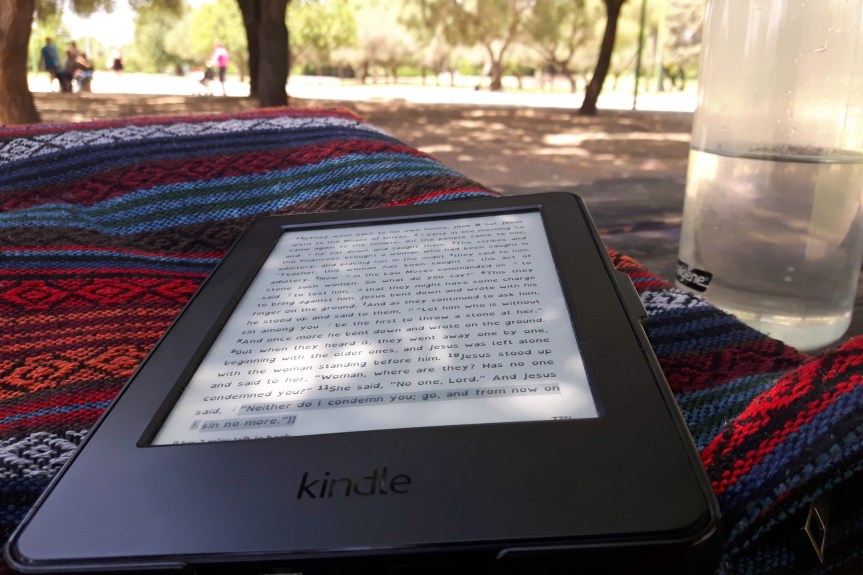
Whenever I read the story of the woman caught in adultery, I get caught up in Jesus’ brilliant suggestion for the one without sin to cast the first stone (Jn. 8:7).

Today was different. When I read the story this time, I saw His mercy.

Jesus did not condemn the sinful woman. “Neither do I condemn you; go, and from now on sin no more” (Jn. 8:11).

The One qualified to condemn did not. Instead, He freed her not only from shame and condemnation but also from the power of the sin in her life. “So if the Son sets you free, you will be free indeed” (Jn. 8:36).

What freedom that must have brought to a self-condemning heart!

And that’s the same freedom that should be evident in my own life and sometimes isn’t. I ignore Jesus’ words, believing that my own self-condemnation is greater than His promise. That His blood wasn’t worth the price of my sin.

That’s it, isn’t it? Unbelief masked as ongoing remorse.

Am I “free indeed”? Do I believe that there is truly “no condemnation for those who are in Christ Jesus” (Rom. 8:1)?

When will summer come?

One of these days summer will come. I’m not talking about the heat; I’m talking about the time. Summer is the season I have been holding out for in the crazy March, April, May, saying, “During summer, I will finally get to this or that.” I had a list of goals: learn how to sew better, develop materials for an English curriculum, refresh my Arabic, houseclean, and other noble goals like that.

It’s July, but I’m still waiting, thinking that summer and its abundance of time must begin soon.

In the meantime, life is full. Full of time with friends. Visits. Meeting new babies, both here and via WhatsApp. Appointments. Meetings. And even a chance to be a witness for my friend’s paperwork-only wedding at the mosque.

Maybe I need to redefine “summer.” Instead of labeling it as “extra time,” I should just label it as “life.” “Life” is a more realistic expectation anyway.

Life and smelly summer laundry.

Go ahead and hurt

Not acknowledging your own pain in light of someone else’s worse pain does not cultivate a heart of gratitude.

Last fall, I was hurting, but I noticed that there was always someone hurting more than I was. So I began to bury my pain inside, believing that my struggle was not valid compared to what others were going through.

I did a lot of people a disservice. Had I acknowledged that pain to the Lord and sought healing, I could have been part of the healing process of others. Instead, my own hurts handicapped me because I sunk them deeper and deeper into myself. On the surface, my pain gave way to resentment. It made it almost impossible to respond to others in need.

I stopped seeking out a place to share my pain because it wasn’t supposed to be real anyway. And I reminded myself over and over that I had so much to be grateful for. 

What was I doing? I was comparing myself to others and saw them as more needy and thus more worthy of care and attention. And my hurts…what hurts? I don’t have any hurts!

When we compare ourselves to others, it can cultivate faux gratitude. “This relationship may be broken but at least I have a solid roof over my head, unlike those war torn refugees.”

Real gratitude comes after we acknowledge our pain and still find God bigger. And still find Him good.

Have you ever read the Psalms? The psalmists don’t pretend that everything is okay. Instead, they often pour out their hearts in startling honesty. But then they rest in God’s goodness, His faithfulness, and His love. They see their pain in light of God’s bigness and they are grateful.

I’m not sharing this piece of my journey with you because it’s pretty (it’s not) or because it’s eloquent (it is only notes jotted down on my phone); I’m sharing this because maybe you are here at this point with me where you feel like your pain isn’t worth God’s time of day, or anyone else’s, for that matter.

We can keep believing that if we would like, but life is so much richer when we seek  healing. What does healing look like? I’m not an expert yet, but I know that sometimes it looks like confession, sometimes like forgiveness, and sometimes, it’s just acknowledging that the pain is real.

None of those options mean we magically stop feeling the hurt, but that we relinquish control of it and its control on us. And without the “at-least-I-don’t” comparisons that tell us we should be grateful, we find that we have tasted God’s goodness and we are truly grateful.

Signs of summer

It is starting to smell like summer outside. At street level, it’s sun-baked tile and rotting garbage. The air feels closer somehow and every scent is intensified. Even the nothing smells stronger.

Cars roar by with music pulsating through open windows. I even get a “howareyou?” from a car that stops as I cross the street.

Fireworks pop off and on all day long. I have long since stopped trying to see them. A sea breeze billows the curtain in the window. It feels almost fresh and cool when it’s not carrying the sun. In the distance, is the sleepy, tranquil sea.

Along with the first signs of summer comes Ramadan. It’s now week two. Ready or not, it’s here to stay. And I’m answering a lot of “Do you fast?” questions and trying not to eat or drink while I’m with friends. But I sampled an olive at the market the other day and didn’t remember until I was tossing away the pit that I was right beside the North African produce stand. (However, those were some of the best olives I have found yet and I don’t regret that I walked away with a container of them swimming in their brine.)

I am trying to convince myself that it’s too early to pull out the window fan. My summer wardrobe is already hanging in my closet. If I get out the fans, there will be no cooling technique to pull out of my pocket when the real heat comes. It’s only May, after all.

Lose your life for my sake: Remembering Grandpa

What does it mean to lose my life for Christ’s sake?

I was sitting on a park bench, feeling the warm sun just under the gentle breeze of a perfect day.

Florence, Italy. My sister, my friend, and I had been planning this trip for months. Flights, buses, trains, shuttles, airbnbs, tourist sites.

But there in the park, I was thinking about losing life. Because while we were still in Madrid, Grandpa had passed from this world to the next.

“Dad, should we cancel our trip?” I would not have been able to travel back for the funeral anyway, but being on a belated 30th birthday trip while my family mourned…

“Absolutely do not cancel your trip!”

So here I sat in Florence, pondering Matthew 10 on the day of Grandpa’s visitation. Have I found life by losing it? This familiar passage wasn’t making sense anymore.

The late cappuccino (we had defied the culture by sipping our cappuccino after 11 a.m.) was still taking effect. Just over the mesh-lined fence, tennis players swung rackets at a yellow ball. I could barely see them, but I heard them. Grunt. Thwack. Grunt. Thwack. “Out!”

Am I worthy of Christ? Do I love Him more than family? Have I taken up my cross?

In Italy—in a world so different from the one I grew up in—it was hard to understand that Grandpa was gone. But I let my mind drift through memories.

Hours and hours of reading “Burn-stin Bear” books and “Dead-Eye Dick.” Patiently teaching us grandchildren (his “coochtie boochties”) to play 42. “Honda” rides. Issuing drivers’ licenses for the golf cart. Constantly wanting to tape record his little grandchildren singing songs. Sketching maps that directed us past where this or that “used to be” as if we had been born in his generation. Chanting “Cumbine coorn and cumbine be-eans,” as we pulled ourselves up to sit with him in the combine. Giving us “bubble gums” from the door pocket of his F-150, the one that had the automatic window buttons in little blue and red bubbles that I would run my fingers over while I waited for my gum.

Letting Grandpa serve you something from the shop was always exciting because it was fascinating to watch him prepare something from his stash of snacks. (Did you know you can make hot chocolate from microwaving chocolate milk? Or a “roastin’ ear” by microwaving an ear of sweet corn wrapped in a wet paper towel?) Sunday night at Grandpa and Grandma’s typically included helping Grandpa get the ice cream out of the “shed” and hiding a pickle or an olive under the heaping scoops in Dad’s ice cream bowl.

And then Grandpa began to get older and frail. Some of his stories came out confused. His tall body began to shrink. His blue eyes got watery. But those watery eyes always brightened when he talked about his grandchildren and great-grandchildren.

When I told him goodbye last summer, I wondered if he would remember that I was going back to Spain.

Grandpa had dozed off while Grandma and I were chatting. “Touch his shoulder,” Grandma said.

I touched his shoulder and his blue eyes opened. Instead of watery, his eyes were clear as they stared up at me wordlessly.

“I’m going to go Grandpa. And I wanted to tell you goodbye.”

The clear, blue eyes continued to stare for several long moments. Had he heard me?

And then, “Kiss on the cheek!” So he remembered that my goodbye was longer than a “see you later.” I leaned over to hug him, kiss his cheek, and let him kiss mine.

My voice was still cheerful as I said, “If I don’t see you here again, I’ll see you in a much better place!”

He smiled. I cried. He was silent as I hugged him again.

That goodbye felt like a closed chapter in my life. It was one that I mourned, not only that day but also when Grandma passed away in November. And now again while sitting on that park bench, trying to register the reality of Grandpa’s death.

Death is real. It’s ugly. It hurts.

But what does it mean to lose my life for Christ’s sake? My mingling thoughts that late Florence morning brought me here: It isn’t until you die that the greatest potential for life is set before you.