
A morning of sounds

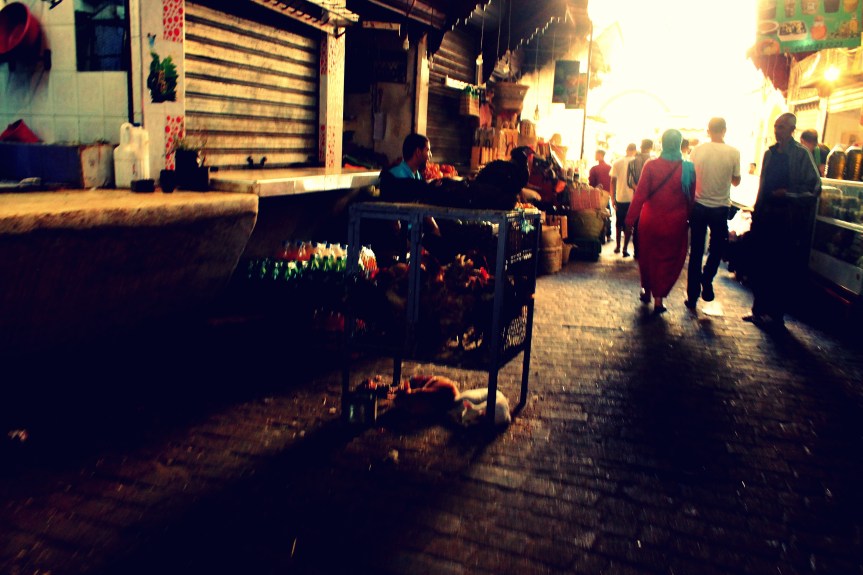
What does my typical North African morning sound like?

  • Mourning doves cooing outside of my window and a lonely rooster penned in someone’s courtyard
  • Slated shades being pulled up from various apartments
  • Water running, the electric kettle steaming, my own munching and slurping
  • A few mumbled “Good morning”s and “Have a good day”s
  • The bang of the door as I pull it shut behind me
  • Clomp, clomp, clomping down two stories of steps and the banging the apartment building door
  • The murmur of passing cars from a perpendicular street
  • A few snatches of conversation between school children and university students
  • A cat meowing as it digs through leftover garbage
  • “Bonjour!… Bonjour! Hola! Hello?”
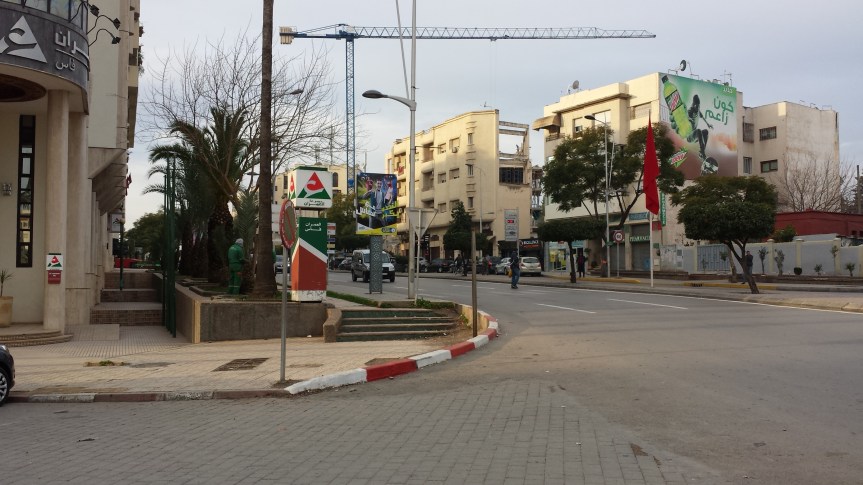
  • Horns honking around a busy intersection as other cars and pedestrians assume the right-of-way
  • Motorcycles, buses, trucks, cars, bicycles weaving in and out of each other—the screech of brakes and more horns and perhaps some yelling
  • A jackhammer of busy men working on the street
  • “سلام”
  • The scratching of a stalk broom on a sidewalk
  • The buzz of the Arabic school’s call button and consequently the opening of three heavy doors
  • “صباح الخير. لا باس؟”  “لا باس الحمد لله.”
  • The sharp sound of chairs on a bare floor and the rumble of moving wooden tables as we all pile in and settle down for a long Arabic session
Irritating?

Being immersed in a new culture reveals that some cultural customs are bad, some are neutrally different, and some are good… sometimes better than they are in our own culture.

Quite honestly, something in this culture grates on my nerves. It doesn’t happen every day, but when it does, I find it inexpressibly irritating.

As I walk along the street,  I meet passersby who look like they lead normal North African lives. Then without warning, one of these normal-looking people veers in my direction and holds out their hand for money. It’s as if seeing me, a foreigner, makes them remember they are not satisfied with their normal lives.

Irritating? Quite. I am a victim of racial profiling.

Well, today as I walked to school, I began to rethink this irritation of mine. What if, instead of looking at me and recognizing their lack of money, they looked at me and recognized their lack of something much greater, Someone much greater? What if, by seeing me (not as a foreigner, but as a friend), they realize that they are not satisfied to live a normal life?

And when that happens, will I be ready or will I be irritated to share what I have?

Ode to Marriage

The rain is banging against the tarp, filling the concrete house with a dull roar. Just the sound of it causes my bones to shiver. I promised myself a cup of coffee as long as I diligently planned the week’s English lessons. Then I opened a blank document and forgot my promise.

There is something about having a sheet of white on my screen that makes my fingers want fill it up with random thoughts. This time my random thoughts are about marriage.

What do I know about marriage? Very little since I’ve been single for nearly 30 years. Yet, being in a culture that points to marriage as necessary for one’s spiritual journey makes me contemplate this more than I would were I still in the States.

In one perspective, life begins at marriage. The unspoken idea is that one cannot be happy unless they have a significant other.

Then there is the perspective that life ends at marriage. Think about how countless movies and books end with a couple finally realizing that they are right for each other. Why do the books and movies end there?

And then, even more real to me in this culture is the perspective that once a woman is married, she becomes her husband’s servant and is bound to her home. Her only joy after marriage is having children.

At times, I’m envious of married couples who step into this new world together and get to experience things as a unit rather as individuals.

To me, that’s one of the most beautiful things of marriage: companionship. I told my classmate my thoughts and she looked at her husband and smiled: “Yes, that’s true. But once you’re married, you don’t DO as much!”

I suppose there’s a flip-side to everything. That’s why I won’t stress out about my marital status. The preparation for anything is in seeking God’s face.

These are my disconnected, rainy day thoughts.

Who are these people really?

Do you ever look at someone and marvel that they are just as real to themselves as you are to yourself? Sometimes that thought startles me; perhaps I subconsciously believe that I am the only real person in the world, or at least the only person with real thoughts and desires.

But sometimes I look at someone and realize that to them, they are “me” just like I am “me” to myself.

Sometimes, I wonder about their past. What happened that the shriveled lady in the worn burqa sits on the same corner to beg day after day? Why does that man call out inappropriate comments to women as they walk by? Why does this well-dressed father spend more time in cafés and on the street than at home with his family?

Often, people are merely splotches strewn upon the canvas of my momentary perception of life. Other times, I realize that the Artist painted them there for a reason. Those are the times that I look around, aghast: Who are these people really?

I’m a failure

Recently, a friend prayed for me: “God, let her learn what you’re teaching her through what she considers failure.”

“Failure” is a word I bump up against often. Too often for my poor, wounded pride. Although I’ve learned this lesson dozens of times, it still hasn’t traversed the head-to-heart channel.

I want to be the best. The best foreign Arabic speaker in North Africa. The English teacher that inspires others to change the world. In short, I want people to reflect on my life and call me accomplished.

That’s one of the reasons I’m here. Not because I’m excelling but because I’m not excelling. God set me up for what I consider failure. He sees that deep down in the dank crevices of my heart, I believe the lie that it’s about me and what I accomplish. So when I’m struggling to survive instead of excelling, I label it “failure” and try to soothe my pride in other ways.

But at the end of the day:

“It is good for me that I was afflicted, that I might learn your statutes.”

Ps. 119:71

Maybe this time the lesson will reach my heart.

Bread and soap operas

What do bread and soap operas have in common? Perhaps nothing. Yet recently, I’ve been beginning to wonder if there indeed is some sort of correlation.

Imagine bread for every meal—breakfast, lunch, afternoon coffee time, and dinner—and soap operas, not between those meals, mind you, but before during and after those meals.

Lest you become concerned that I have just wasted a week of my life by living with a local family, rest assured that not all of my energy was spent in anticipating the next show.

More than spicing my limited vocabulary, the week marinated me in the flavor of the culture. What do their homes look like? What do they eat? What do they do during the day? How do they use a bathroom without an American toilet? How does a typical family function (or dysfunction)?

Overall, the week was culturally awakening. Now the North Africans I pass on the street aren’t just people–they belong to a home and a family…and maybe I’ve just sampled a slice of their typical day.

Having said that, I still might be able to tell you the time of day according to what soap opera is on.

The Arabic screenplay

The more I study Arabic, the more I feel like the language is a screenplay and I am simply an actress who doesn’t know my lines. When tossed onto the stage of real life, I am lost, babbling my way through awkward situations.

“In the name of God, start eating.”

“Your greeting is welcome!” Oops. Or worse: “Goodbye!”

“Thank you” in response to polite comments is effective in both English and Spanish, and I don’t see why Arabic should be any exception.

“Send greetings to your family!” “Thank you!” (But not in Arabic.)

“Here. Wash your hands.” “Thank you!” (But not in Arabic.)

Somehow, one must learn and say beautifully trite phrases after anything. The problem for language learners is which phrases to say when. Saying “Praise God!” after someone sneezes is not acceptable.

Often when comments are made, I don’t even open my mouth, harnessed by the fear of reciting the wrong line.


Photo by Kyle Head on Unsplash

A day of smells

What does a typical day in North Africa smell like? Well, this is my day in smells:

  • the cold of the morning outside of my blankets
  • the bathroom: a strange mingling of soap, wet, and a scent that creeps up the drain overnight
  • the sweet of a clean kitchen until I open the refrigerator and catch a whiff of leftovers with a hint of aged dairy
  • outside the front door, there is a deeper cold smell mixed with the trash that cats have been sorting through during the night
  • and speaking of cats, their odor lingers despite their absence–not overwhelming, just there
  • walking past several men’s cafes guarantees a pair of lungs full of cigarette smoke
  • exhaust fumes from cars, taxis, and buses
  • the smell of used taxi seats partially covered by an air freshener and the cold
  • trash, fumes, and the sweet citrus of the orange trees on the walk from the taxi to school
  • the faint smell of gas from the lounge heater
  • wood smoke seeping out of a nearby house
  • food cooking in the cafes mixed with the ever-present cigarette smoke and the scattered trash
  • rotting fruit rolling along the sidewalk, kicked and trodden upon by passersby
  • garlic and chicken for lunch and consequently garlic on my breath after lunch
  • exhaust fumes and the sharp stench of urine on my walk to the park
  • the lovely freshness in the sweet acres of green and water: herbs, damp dirt, falling leaves
  • drifting in the open taxi window on my way to teach English is cigarette smoke, meat cooking on open grills, smell of humanity, and exhaust fumes
  • the pungent scent left over on the school desks of my classroom: what I imagine to be from unwashed hands
  • dry erase markers
  • mixed scents emanating from my junior high students: perfume, body odor, energy
  • and as the darkness falls, so does the cold, again suppressing the daytime scents
  • but there is still a damp that hovers in the air
  • and there is still the soap scent lingering on my sweatshirt as I cuddle up to study Arabic before bed

Photo by Brian Jimenez on Unsplash

The Noisemaker

Somewhere along our street lives a tiny man, perhaps no taller than my shoulder. I can’t say for sure because I’ve never seen him. He sleeps during the day and when the neighborhood goes to sleep, he steps out of his musty little house and begins his work.

See, although I have no proof, I do have ears. Every night I go to sleep, and every night the Noisemaker awakens me.

One night he walked up and down the street making a noise like a hoarse donkey’s bray. The dogs at every house barked furiously as he came and went, back and forth, back and forth. I lay in my bed, stricken with fear because the noise sounded like what I imagined a lion’s hiss to sound like. Now, I’m not even sure that lions hiss, but that wasn’t a factor I considered in my sleep-deprived state.

Just last night, the Noisemaker borrowed a keyboard and put it on the chorus setting. He played three notes and pause, three notes and pause. At least that’s what it sounded like: carolers outside the door starting and restarting their song. AhAHah, ahAHah. This time I wasn’t afraid because I knew it was just the Noisemaker.

Sometimes he comes in pattering feet up and down the hallway. Sometimes he pretends to be the wind and bang the poles that fasten the courtyard tarp.

And I’m sure he must smile as he snuggles up in his bed about the time the rest of the world struggles to get out of theirs. And he dreams of creative noises to make when the city once again goes to sleep.

What I want to know is: does he get paid?

Making sentences

After 9 days of studying Arabic, we learned formulaic sentences today. I discovered I was capable of following a pattern… and making mistakes.

I plodded through the Arabic script, plugging in my information at the end of each sentence: “My last name is…”, “My country is…” The sentences ticked by, miraculously without authoritative interruption to correct my pronunciation. I gathered speed. “My city is…” And like a sentence-making machine, I burst out: “My wife is…” and then paused. I really didn’t know who my wife was. Hmm.

I wasn’t the only one making mistakes. My classmate smilingly informed us that she was a “teacher” of Arabic instead of a “student.”

We giggled at ourselves. But the fact we were making mistakes meant that we were producing the language (or at least some form thereof).

Language learning is tedious. I confess I think it unfair for an adult to struggle for speech and still be patronized by teachers. There must be a better way. But meanwhile, I’ll keep working.

The Arabic school director told me, “This will give you more sympathy for your English students.”

He’s right. I didn’t even laugh when a 15-year-old boy stood up and told the class that he was a “housewife.”