Aisha- part 4

She lost her job. Just when things had been going well. Just when little by little she had been saving up to furnish the tiny salon. She had talked of buying an oven. She had talked of the circumcision party she wanted to hold for her son in April. Now that was gone. There were no more dreams because there was no more money.

Her husband was working a little, she explained, but she never saw the money.

“It goes for cigarettes and coffee with his friends at the coffee shop.”
“Praise God he doesn’t use your money for that!” I reminded her. But I still hurt for her.

Eventually she found work two days a week. Enough to survive, but not enough to live.

It seemed that every time I entered her home, there was a storm brewing between mother and daughter. Today was no exception.

When I had reached Aisha’s house, things were calm. We sat in the salon, talking and watching Bollywood. God’s grace bridged the language deficit. We talked about life, about marriage, about her children, about her job hunt.

Her daughter, Soukaina, disappeared to be with her friends. A long time later, Aisha hollered across the rooftops of that tiny, sunken neighborhood: “Soukaina! Soukaina!” Soukaina emerged from her friend’s house and soon thereafter two young men followed.

To a mother with no education, a girl’s purity and family honor are the only things worth living for. There is no other option. And with her husband generally absent, Aisha is the guardian of her daughter and, essentially, the family honor.

I just wanted to hide. I had already had an encounter on the street with a man who left my blood boiling in his wake. And upon arrival to Aisha’s neighborhood, I had an argument with the taxi driver whether or not it was safe for me to walk the ½ block from the taxi stand to Aisha’s house. I didn’t want to get involved in anything else, for goodness’ sake!

Aisha offered me a way out: to go with her to buy sweets for the afternoon tea.

But God said, “Stay here with Soukaina.”

So I stayed and listened to the 16-year-old, heart-broken side of the story. Then I touched her hot and teary face and wondered what kind of life lay ahead of this girl. What opportunities did she have? What opportunities would she have?

My own heart felt achy for the women of the family, even as we sipped syrupy tea and I made boats, airplanes, and trains out of each bite of cookie for Aisha’s 2-year-old son.

Aisha walked me to the taxis, telling me again and again how “dear” I am to the family.

I responded with the appropriate reciprocal response, but I really meant it. Aisha will always be dear to me. As we turned out of the neighborhood, the evening sky came into view with bright pinks and oranges. It was so breathtaking I started to cry from the bittersweet mingling of Aisha’s pain and God’s faithfulness.


Khadija

When we sat down on that bench along the boulevard, weary from hauling our backpacks around all day, my roommate and I didn’t imagine that the elderly lady who sat down next to us would become anything more than the elderly lady who sat down next to us.

But I smiled and said, “Peace be upon you.”

“And upon you.”

“Are you from here?”

It didn’t take long to find out that she was proud of her Berber heritage. Her opinionated brusqueness appealed to me. There were no fluffy, flattering words. No acting like we were movie stars. Just an invitation to tea the next day.

At tea, she spoke clearly and explained the words I didn’t understand. She understood that I was from a different culture and a different religion without treating me as if I were ignorant. And the way that she told stories inspired me to one day be like her.

In the months that followed, she told more stories, including part of her own story… a disappointing trail of heartache with oases of happiness. Whether I visited her with my roommate or alone, I always felt at rest. She didn’t pressure me to stay when I needed to go, or pressure me to eat when I was full. It was like she welcomed the relationship with no expectations. And she liked me for being me and not what I could do for her or who I might one day become.

One day, we went to visit her when she was ill. But she didn’t answer her door. After knocking and calling, I was concerned. Was she in the hospital? Was she too ill to come to the door?

We knocked on the neighbor’s door and were welcomed into the life of the next door family. They fed us, helped me with my homework, and chatted with that same element of acceptance. They were, in short, delightful. And Khadija was fine after all; just late with running errands.

She invited my family for tea when they visited North Africa. She admired pictures of my nephew and showed me her grandchildren. Her broken family had broken her heart. But after quickly wiping away her tears, she seemed content with the good people in her life. And her yearly pilgrimage to Mecca gave her an element of peace that she was doing what was right.

During one of my visits, I was sipping tea with her and the lady next door when Khadija switched the TV channel to sumo wrestling. I was repulsed until I realized I was living one of those moments that I would never be able to relive. How many times would I recline on the sofa, sipping sweet mint tea, and watching sumo wrestling with two 70-year-old ladies?

That was the same visit that she brought me a traditional robe to put on over my clothes. When she left to start the coffee, the neighbor lady patted my arm, “Now you are really her daughter. She is treating you like a daughter.”

Embarrassment in an airport

Some embarrassing moments haunt you all of your life and make you groan whenever you remember them. Other moments are so embarrassing at the time that they are not easily forgotten; yet, their memory makes you giggle instead of groan. Why? Maybe because we can relive the humor without reliving the embarrassment.

For example, recently I had a embarrassing moment that was completely mortifying for about 20 minutes before I started giggling. Why so short? Well, it happened in another city in an airport with people I am 99% sure I will never see again.

My friend and I took a trip to the desert for the holidays. We had a lot of luggage due to the fact that we had to haul bedding and towels with us (“a lot” perhaps being relative to someone who usually travels with a backpack). Therefore, when our train arrived at the small airport, we decided to take turns using the restroom. I went first and my friend waited at the bottom of the stairs with our suitcases.

Although I had never used the upstairs restrooms at this airport before, I followed the signs. But there appeared to only be one option. At least, there was a “WC” sign with a little man beside it. But where was the women’s? I looked farther down the hallway, but there was nothing close by. I was ready to continue on my way when a woman appeared in the restroom doorway.

Startled, I asked, “Is this for women?”

She gave an affirmative response. And spotting another woman behind her in the restroom, I shrugged off my hesitation and entered. But at some point, behind that closed stall door, I realized that I was no longer hearing women’s voices, but men’s.

I admit that I wasn’t initially embarrassed and just tried to decide whether to hang out indefinitely in the stall or make my entrance into the male-dominated room. But I couldn’t hang out in the restroom forever. I would miss my flight!

So I emerged. I kept my head down as I walked to the sink to wash my hands. Therefore, I don’t know how the men reacted to my presence. I assume it wasn’t favorably. After all, we were still in a culture where gender distinctions are clearly defined. But they didn’t say a word to me. Maybe they didn’t know how to confront the foreigner who was pretending to be oblivious.

Actually, it was the cleaning lady passing by the open door that hollered inside, “Madame! Madame!” When she had my attention, she continued in French, pointing to the little man symbol next to the WC sign.

Feeling the need to justify  myself (human nature, I suppose), I protested that someone had told me it was for ladies. But the delay only prolonged my presence in the room of unsettled men. Finally, I gathered my wits enough to apologize and scurry down the stairs to where my friend awaited me.

“Don’t go to the first restroom!” I admonished her wisely. And she vanished up the stairs while I waited with the heap of luggage. But as I waited, I realized I was standing by the doorway of the only restroom exit.

And there I stood, incapable of desertion for the sake of our luggage as one by one the men emerged from the restroom and came down the stairs to find me blushing on the bottom platform.

Every nation, tribe, and tongue

When I heard that a nearby university was hosting a Christmas carol festival, I didn’t need any other motivation to jump in a taxi and go. After all, North Africa isn’t the easiest place to celebrate Christmas. There are no Salvation Army bell ringers, no Christmas flyers or billboards announcing unbeatable sales, no Christmas lights, no store aisles filled with Christmas candy, hardly any Christmas shopping at all.

You may write off those things as obnoxious, an assault to your everyday life. But for me, those little things help remind me of God’s greatest Gift to mankind. This year I don’t have those reminders, and it’s hard to fully enjoy the season.

But now, in this university auditorium, I could overlook the giant poster of the country’s king on the wall and remember the coming of another King.

There were beautiful classic carols, contemporary carols, worship songs, gospel songs, touches of opera, and Bible readings. Children and adults took turns on stage, representing the evangelical churches of the country.

Some songs filled the auditorium with life, eliciting applause and cheers. In the wake of one particularly lively group, a Spanish monk walked up to the podium and read the Christmas story. The irony of the moment was stifled by the beauty of it.

Is this what heaven will be like?

After this I looked, and behold, a great multitude that no one could number, from every nation, from all tribes and peoples and languages, standing before the throne and before the Lamb, clothed in white robes, with palm branches in their hands, and crying out with a loud voice, “Salvation belongs to our God who sits on the throne, and to the Lamb!”

(Rev. 7:9-10)

Worship isn’t uniformity, but it is unifying. The variation of style, genre, and the mix of at least eleven languages was remarkable…but inconsequential. We were there to celebrate the birth of the Savior. 

My November guests

In November, three guests traversed the Atlantic to visit me: my mom, my brother, and my friend. Some of our adventures included:

  • Finding each other at the airport… and managing to convince security that I was not a risk
  • Traipsing around the city as each phone place we had been directed to directed us to someone else
  • Arguing with taxi drivers who were even more stubborn than I
  • Tasting the old medina, literally and figuratively
  • Posing for awkward pictures
  • Sampling camel burgers and a salad that tasted “like donkeys”
  • Wiggling cooked snails out of their shells with wooden toothpicks…and sampling them too
  • Long talks
  • Laughing until we cried
  • Visiting my friends for tea, dinner, or just to say “hi”
  • Tasting uncured olives that pickled our mouths
  • Eating most of our meals standing around in the kitchen
  • Souvenir shopping in the rain
  • Souvenir shopping in the rain again
  • A long train ride in the rain
  • Walking along the bay in the rain
  • Two nights of cold showers
  • Spending a night snuggled in the musty hotel blankets
  • Staying in a concrete hotel room which reverberated with the early morning call to prayer and reading of the Qur’an
  • Crossing the Strait of Gibraltar by ferry only to find that the rain in Spain does not stay mainly on the plain!
  • A long bus ride around many many roundabouts…in the rain
  • A bus break-down which seemed to temporarily mend itself
  • A few days in Spain with friends, church, a birthday party,  an open air market, olives, churros, pastries, cocido, and tapas
  • Goodbyes

Who do I laugh at?

The sun came and went as ominous clouds marched across the sky. I shivered and wondered why I hadn’t checked the weather before I had walked to the park to study. Winter was coming; that was certain.

On the other side of the bubbling fountain of the garden plaza, a man was stretched out on a bench in front of the bamboo forest. I had seen him there before. He wore several layers of clothing all with that grimy, unwashed tinge. He was a perfect picture of a North African homeless. But he didn’t bother anyone. Even when he awoke, stood up, and stumbled to another part of the garden.Beside me, just on the other side of the fig tree, were two boys pretending to be men. They smoked cigarettes, played music, and took selfies.

But when the homeless man got up and walked away, the boys gawked at him. Then they whispered something to each other and snickered.

I was angry. If the man had bothered them, I could have understood the sentiment to mock him. But as it was, the man had done nothing to deserve anything less than their respect. And yet they laughed at him. How dare they!

While I was still high on my judgment throne, God asked me, “Who do you laugh at?”

Me? Laugh at someone?

How many times have I amused myself at the expense of another? In short, who do I look at and tell myself I am better than they? Maybe it’s not the homeless man. But it could be the boys smoking cigarettes. And really, does that make my pride any less hideous than theirs?

The wedding I didn’t attend

I didn’t attend a wedding. That statement, of course, depends on one’s definition of “wedding”, I suppose. I did attend one or two ceremonies during the six day celebration, but the ceremonies were so low-key that I didn’t even see the bride. That’s why I say I didn’t attend because how can one attend a wedding without seeing who the wedding was for?

What I did experience, however, was enough to send my cultural senses spinning. Colorful clothing, drums and horns, dancing, green and rolling countryside, bread baking in an outside oven, a restless night curled up foot-to-foot with a stranger who kept stealing my blanket, mint tea and sweets to accompany the luscious wedding feast…

But I wasn’t only observing; I was being observed. My status as the only foreigner at this countryside wedding earned me plenty of stares, questions, and giggling girls developing heroine crushes on the uncomfortable-looking foreigner in the green dress.

After only 29 hours away from home, I returned feeling both culturally enriched and overwhelmed.

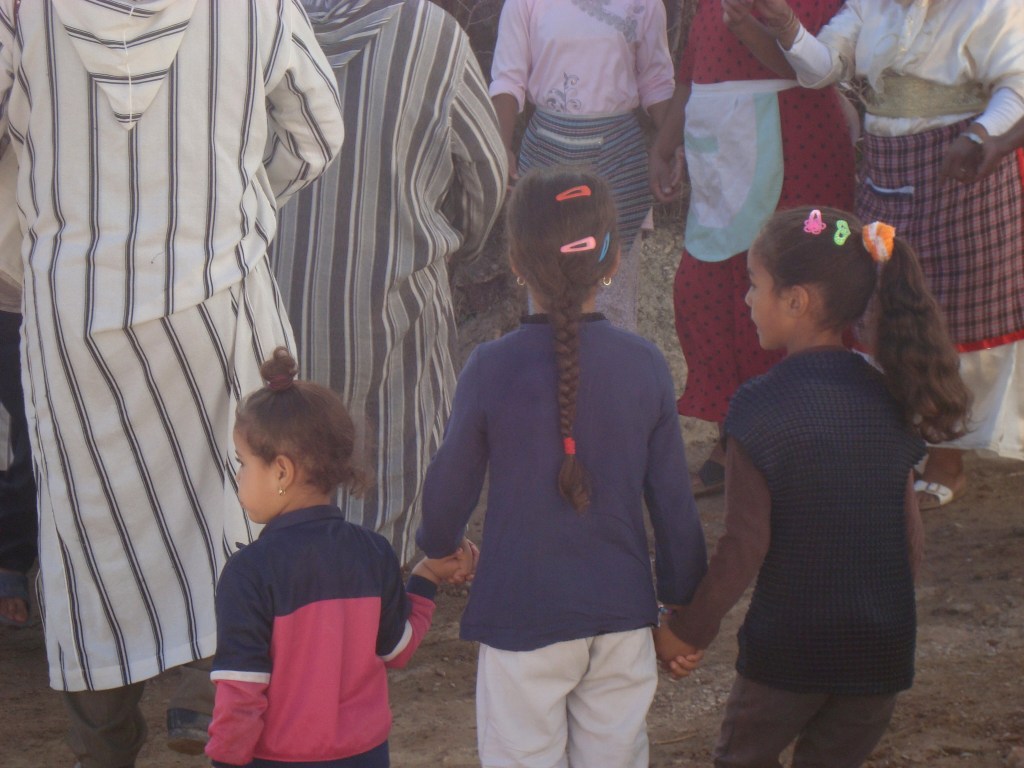
little girls holding hands next to adults in robes
people dancing
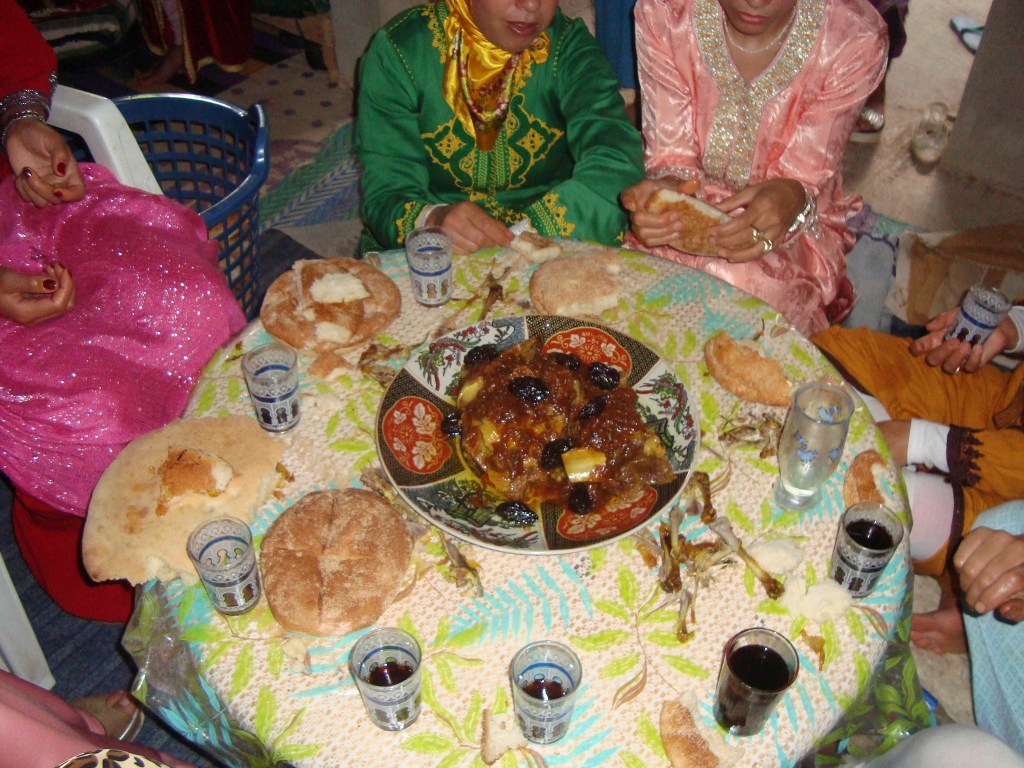
beef and prune tagine in center of table

Redeemed opportunities

Where do missed opportunities go? Are they gone forever or does God redeem them by giving us new opportunities?

Here in North Africa, where living intentionally should be as easy as breathing, I still miss opportunities. Why? Well, I’m busy; there is always language to study, classes to teach, emails to write, friends to visit, etc.

But those excuses aren’t good enough. Try telling a little boy that preparing lunch is more important than his soul. Maybe that’s not exactly what I said, but it is most likely what I communicated.

I was in the middle of a bad day when he followed me home from the store. People had been raining expectations down on me and I was exhausted although the day was only half finished. So when he jumped up and followed me, I rolled my eyes.

He only wanted one coin, he said. But to me, he was just one more beggar with just one more fabulous fable to accompany the outstretched palm. I tried to be pleasant, but my smile faded with his persistence. “Enough!” I said as he fell in step with me. “Be quiet!” I said. He didn’t. He followed me to my doorstep and only stopped when I closed the door behind me.

I had just started putting groceries away when my conscience awakened. What if I was the only person in that boy’s life who could have shared truth with him?

It took an hour or so before I was ready to face him again and apologize for my heartlessness. But when I went outside, he wasn’t there. Nor was he in front of the store. He had vanished.

So had my opportunity.

But my question is this: Has God redeemed my mistake by giving me another opportunity? Could it be having tea with that lonely widow? Or maybe taking time for a girl whose insecurity manifests itself in bullying?

God is a God of redemption. Because He has redeemed me, I know He is capable of redeeming my missed opportunities.


This post was first published on https://lucindajmiller.com

Learning to listen

I was yawning between pages of War and Peace. The train’s rumble of metal on metal was soothing after three hours.

As we had moved from city to city, passengers had changed so often that they became a blur of faceless humanity. Across the compartment, someone took a seat facing me, another faceless being. I yawned again.

But then I smelled him. Cigarette smoke. I tried not to wrinkle my nose as I looked at him. Our eyes locked. He blinked, and I looked away.

Him.

What?!

When I had started the trip, I had spent time in prayer. God,  I want to listen to Your voice today. Several times, women had sat down next to me, but most had avoided eye contact. All I had given or received was a smile or maybe a greeting. But now it was a man. I didn’t talk to men unless I had a reason.

Remember the woman at the well? Who talked to her? Was it a man or a woman?

But I can’t talk to him. And my Arabic is horrid. Besides, I will only get myself into trouble… Fine. Okay, but You have to make Your timing really clear.

More than an hour later, he stood up–was he leaving? No, he took the empty seat next to me. I continued to skim through a dry chapter of War and Peace.

Now? But what if I heard You wrong?

Then he stood again. “Can you save my seat for me?” he asked in perfect English.

Wait, he speaks English? 

It was only a few minutes before he drifted back to his reserved seat, bringing along a cloud of cigarette smoke. This time I did wrinkle my nose. “You’re killing yourself, you know?”

He turned to me. “Do you believe in destiny?” His voice was low and gentle.

A subconscious understanding of where the conversation was headed triggered words that I didn’t hear until they had sprung from my lips: “Are you a fatalist?”

From there, our conversation careened down a different path than he had intended. But it was exactly the path that God had intended.

I doubt I will ever see him again. But it really doesn’t matter. What matters is that I am learning to listen to God’s voice.

Experiencing Eid Kbir

I could write a lot of things about this important holiday, but this post isn’t meant to be informational or theological. It’s is simply a snapshot of what my last couple of days have looked like. Granted, I decided not to display gruesome images of animal slaughter (thus limiting my photo options).

The first couple of photos are from the days before Eid. The city began to fill with the bleating of sheep and shops sold the necessities for the special day. Some shops even closed as their owners traveled. This is the country’s biggest holiday of the year.

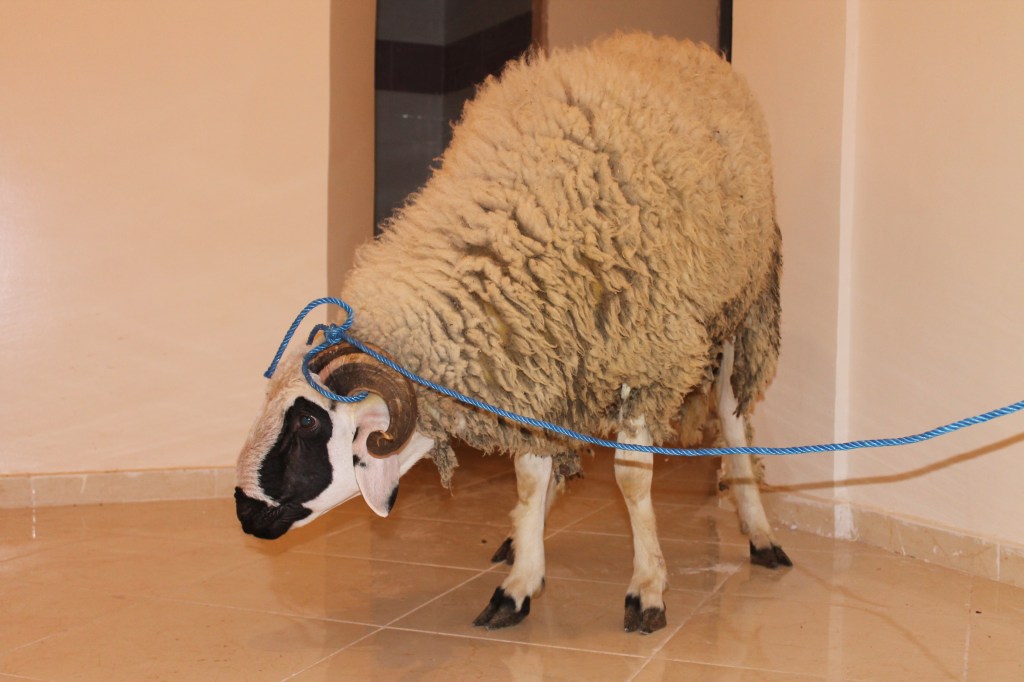
Then, I had the chance to experience the celebration firsthand. I guess the first sign that Eid was upon us was when the neighbors moved a cow and then a sheep into their courtyard below my window. Soon the sheep’s bleating was only one of many others ricocheting off the concrete walls.

On Sunday evening, I joined my friend and her family for the Monday celebration. My head is spinning with the lifetime I feel like I lived in those two days. To my credit, I tasted a bit of everything that was served. The first meal of liver and heart kebabs with a side of spleen wasn’t too bad. But by evening, I admit that my mind refused to go over matter with the stomach and lungs dish. And what was worse was getting up in the morning to a breakfast of the head and feet. At least, now that I’m on the other side of it, I can look back and smile. I think my sampling of meat dishes until this point has been too tame!

bags and piles of charcoal in marketplace
Many little stands and shops sold charcoal to fill the thousands of grills around the city.
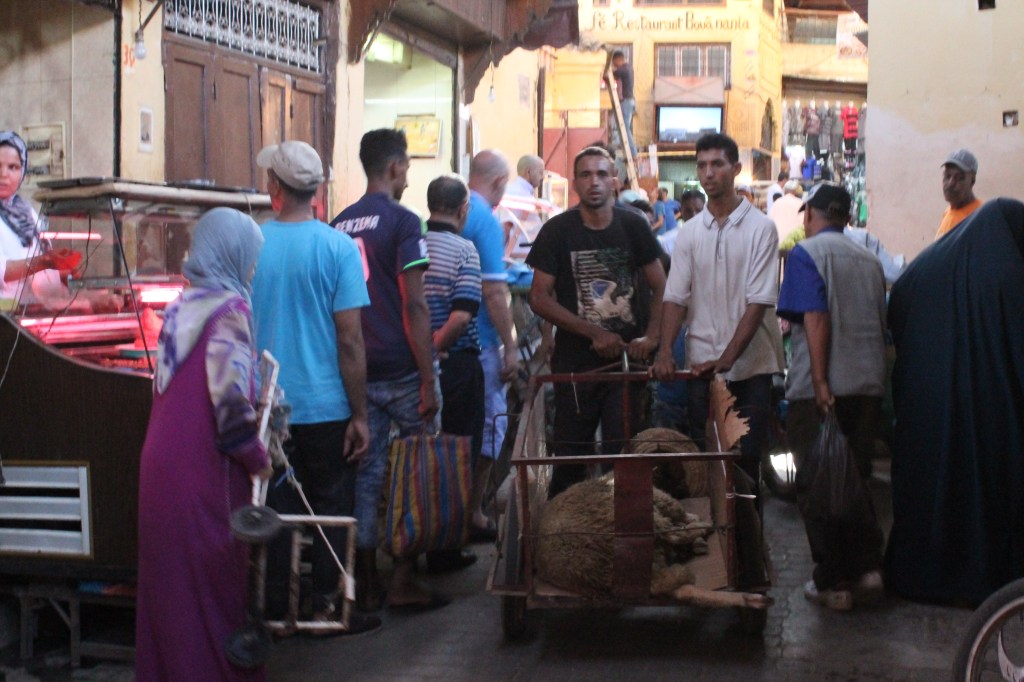
busy old city street and man hauling sheep in cart
One way of carrying your sheep home
sheep tied with blue rope
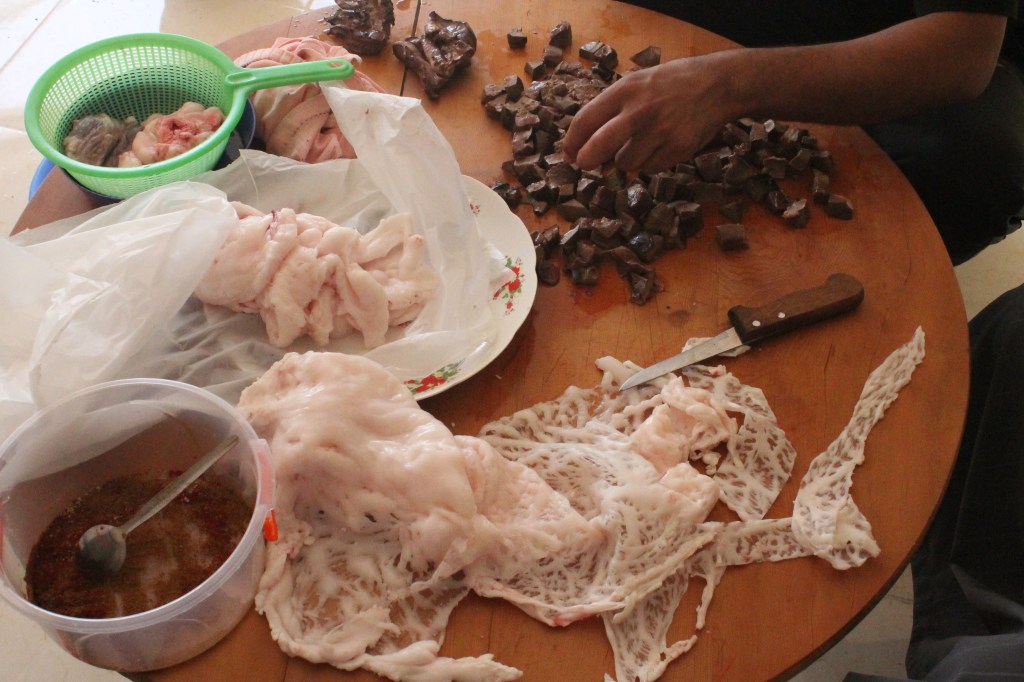
chopped liver and strips of fat on wooden table
Preparing for grilled liver and heart kebabs, also known as بولفاف
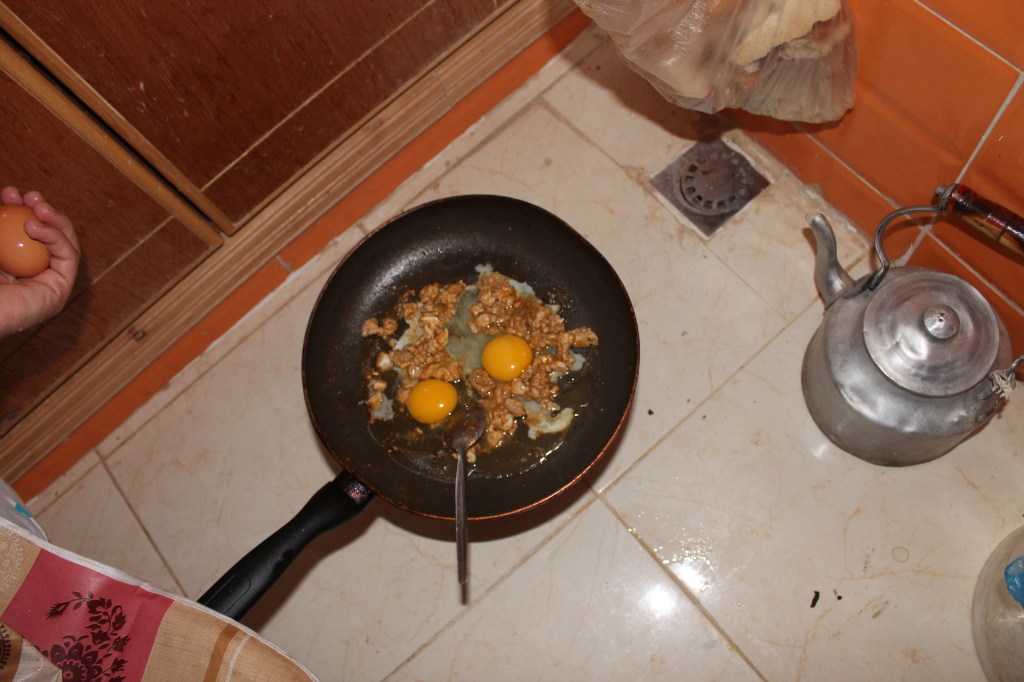
chopped brain and eggs in frying pan
Brain and eggs for breakfast, anyone?
loaves of fresh round bread
And of course, fresh bread with all of this!