Transitioning with olives

All I wanted to do was buy olives. It was the perfect idea to reward myself with a short walk to the store between secretarial tasks. The weather was full of gentle Mediterranean breezes and I loved walking. Then why was I suddenly anxious?

What should I wear? Some of my clothes were stored in boxes. Others were stashed in suitcases, ready to make the final leg of the journey to the States. Somehow the outfit I had on no longer matched. The shades of blue were all wrong.

“Trish,” I reasoned with myself. “This outfit was perfectly fine before.” But not now. Not in Europe. Not in public. I changed and then changed back when the second option felt even worse.

How do I say olive in Spanish? Olive? No, that’s French. Zitun? That’s Arabic. Why can’t I remember my Spanish anymore? Should I take my own bag or do stores give out plastic bags? I can’t remember. What were they doing the last time I was here? Where did I even put my shopping bags?

Why is this so hard?

I didn’t want to take that short walk anymore. Every decision looked big. Nothing was familiar. I battled my anxiety all the way to the store. I felt everyone’s eyes on me. Am I even walking down the right street? Why is that car stopping for me? Thank you, sir! No, don’t wave at him; you’ll look even more like a stupid foreigner. You’re in Europe now.

Transition. Have I exaggerated my trip to the store? Yes. But the exaggeration was in reality, not in what I just wrote. It sounds ridiculous to say that I almost panicked at the thought of buying olives. But transition is hard because nothing is familiar. Everything requires extra thought and effort. No matter how insignificant, every decision feels big.

I am not the only one who feels the pressure of transition. Maybe everyone else I know can confidently buy olives, but there are different responses to transition. And there are different types of transition. Do you know of someone whose spouse has passed away? Someone who has lost a dear friendship? Someone who has moved to a different community?

Maybe it’s you. Maybe you’re feeling a bit like me right now, or worse. Whether it is you or someone else, give that person time to grieve and transition. Remember that we are not alone. There are others who understand… especially the “man of sorrows” who was “acquainted with grief” (Is. 53:3).

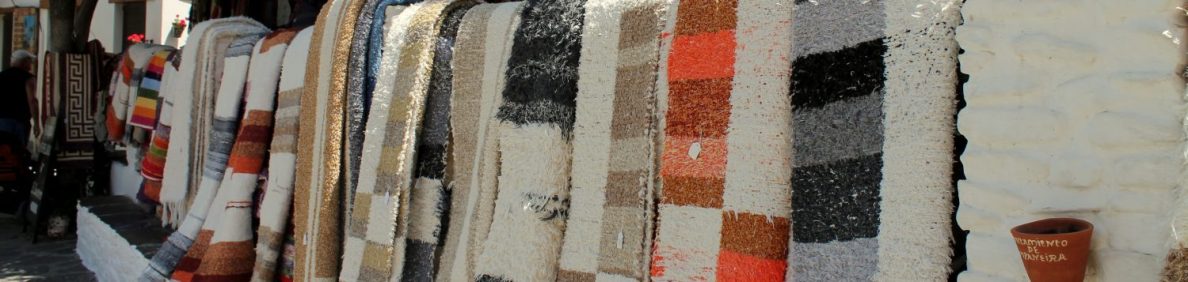
Djellaba shopping

We were supposed to be going djellaba shopping. Aisha had volunteered to help me when she found out I wanted to buy a traditional dress. I had agreed to meet her at her house, knowing well what would happen.

I was right. After an hour or so, when lunch was cleaned up and everyone was dressed, we moseyed out to a shop that happened to be closed. So we spent another half hour sitting on her mother’s couch and chatting over cups of thick coffee as someone dozed under a wool blanket across the room.

We entered a tiny shop that sold mostly pajamas. They did have a few djellabas, however. The tailor made me try them on and was disheartened when they all ended before my wrists and above my ankles.

So he took my measurements and told me to pick out a fabric. Aisha negotiated the price alone. When we walked away, she squealed. “That is the local price. You would not get a price like that. If I wasn’t with you, people would take advantage of you.” I didn’t doubt it.

She still had my money in her pocket and waving the scrap of fabric the tailor had snipped off for us, she insisted that we find a headscarf and traditional shoes to match my new outfit.

In that neighborhood there was such a camaraderie of poverty- a people that hovered just above the grime of life, but hovered together. Still, admonitions came to “hold your sack in front of you, not behind you!” Indeed, a lady in front of us paused when she realized that she no longer had her wallet.

But I was so watched that I couldn’t imagine how anyone could have stolen anything from me without someone else noticing. People swarmed around us, bumped into us, gawked at us.

A shopkeeper motioned to me while addressing Aisha. “Is she a Muslim?”
“No.”
“Not yet.” He eyed me. “Why aren’t you a Muslim?”
Taken off-guard, I straightened. “Why do I need to be?”
“She prays!” Aisha inserted, intent on protecting my religious freedom.
“Who is she?”
“My sister.”
“You’re short and she’s tall. How can you be sisters?”
I cleared my throat. “She is like our mother and I am like our father.”
Then Aisha and I giggled together, and the shopkeeper gave an irritated but irrepressible grin.

Another lady stopped us and Aisha proudly told her that I was getting a djellaba made by a local tailor.
“Is she a Muslim?”
“No.”
“Does she pray?”
“Yes.”
“Does she fast?”
“Yes, she fasts.”
“Well then, what does it matter what she is?”

I spoke up then, but the lady was more interested in the fact that I was speaking her dialect than in what I had to say. And she walked away, still convinced that my good deeds gave me a good shot at paradise.

The sundown prayer call sounded. Aisha kissed me goodbye and tucked me into a taxi, even while insisting that I stay for tea.

I stared out the window at the sunset on the way home, pensive and full. It was one of those days that I would like to store in my pocket and pull out when I get lonesome for these people.

Aisha- part 4

She lost her job. Just when things had been going well. Just when little by little she had been saving up to furnish the tiny salon. She had talked of buying an oven. She had talked of the circumcision party she wanted to hold for her son in April. Now that was gone. There were no more dreams because there was no more money.

Her husband was working a little, she explained, but she never saw the money.

“It goes for cigarettes and coffee with his friends at the coffee shop.”
“Praise God he doesn’t use your money for that!” I reminded her. But I still hurt for her.

Eventually she found work two days a week. Enough to survive, but not enough to live.

It seemed that every time I entered her home, there was a storm brewing between mother and daughter. Today was no exception.

When I had reached Aisha’s house, things were calm. We sat in the salon, talking and watching Bollywood. God’s grace bridged the language deficit. We talked about life, about marriage, about her children, about her job hunt.

Her daughter, Soukaina, disappeared to be with her friends. A long time later, Aisha hollered across the rooftops of that tiny, sunken neighborhood: “Soukaina! Soukaina!” Soukaina emerged from her friend’s house and soon thereafter two young men followed.

To a mother with no education, a girl’s purity and family honor are the only things worth living for. There is no other option. And with her husband generally absent, Aisha is the guardian of her daughter and, essentially, the family honor.

I just wanted to hide. I had already had an encounter on the street with a man who left my blood boiling in his wake. And upon arrival to Aisha’s neighborhood, I had an argument with the taxi driver whether or not it was safe for me to walk the ½ block from the taxi stand to Aisha’s house. I didn’t want to get involved in anything else, for goodness’ sake!

Aisha offered me a way out: to go with her to buy sweets for the afternoon tea.

But God said, “Stay here with Soukaina.”

So I stayed and listened to the 16-year-old, heart-broken side of the story. Then I touched her hot and teary face and wondered what kind of life lay ahead of this girl. What opportunities did she have? What opportunities would she have?

My own heart felt achy for the women of the family, even as we sipped syrupy tea and I made boats, airplanes, and trains out of each bite of cookie for Aisha’s 2-year-old son.

Aisha walked me to the taxis, telling me again and again how “dear” I am to the family.

I responded with the appropriate reciprocal response, but I really meant it. Aisha will always be dear to me. As we turned out of the neighborhood, the evening sky came into view with bright pinks and oranges. It was so breathtaking I started to cry from the bittersweet mingling of Aisha’s pain and God’s faithfulness.

Learning to listen

I was yawning between pages of War and Peace. The train’s rumble of metal on metal was soothing after three hours.

As we had moved from city to city, passengers had changed so often that they became a blur of faceless humanity. Across the compartment, someone took a seat facing me, another faceless being. I yawned again.

But then I smelled him. Cigarette smoke. I tried not to wrinkle my nose as I looked at him. Our eyes locked. He blinked, and I looked away.

Him.

What?!

When I had started the trip, I had spent time in prayer. God,  I want to listen to Your voice today. Several times, women had sat down next to me, but most had avoided eye contact. All I had given or received was a smile or maybe a greeting. But now it was a man. I didn’t talk to men unless I had a reason.

Remember the woman at the well? Who talked to her? Was it a man or a woman?

But I can’t talk to him. And my Arabic is horrid. Besides, I will only get myself into trouble… Fine. Okay, but You have to make Your timing really clear.

More than an hour later, he stood up–was he leaving? No, he took the empty seat next to me. I continued to skim through a dry chapter of War and Peace.

Now? But what if I heard You wrong?

Then he stood again. “Can you save my seat for me?” he asked in perfect English.

Wait, he speaks English? 

It was only a few minutes before he drifted back to his reserved seat, bringing along a cloud of cigarette smoke. This time I did wrinkle my nose. “You’re killing yourself, you know?”

He turned to me. “Do you believe in destiny?” His voice was low and gentle.

A subconscious understanding of where the conversation was headed triggered words that I didn’t hear until they had sprung from my lips: “Are you a fatalist?”

From there, our conversation careened down a different path than he had intended. But it was exactly the path that God had intended.

I doubt I will ever see him again. But it really doesn’t matter. What matters is that I am learning to listen to God’s voice.

Adventure on Hardware Alley

My motive was to not look lost. I fingered the plastic washer in my pocket as I turned down “hardware alley,” a street lined almost exclusively with hardware stores. Lest you question the logic of this arrangement, note that most of the stores specialize in certain areas such as light fixtures, mirrors, tile, etc. And often, they don’t overlap merchandise. For example, only one or two stores carry little items like screws, nails, and washers.

Which was exactly my problem. I had yet to ascertain which stores I needed to visit and I felt out of place tromping from store to store on a street operated and patronized mostly by men. My task was to find metal washers to replace the plastic ones that had come with our new toilet seat. Ideally, the metal would grip the porcelain and keep the seat from sliding around.

When I whipped out my plastic washer for the first store owner, he pointed to the store next door. The store next door did indeed have washers.

“What do you want them for?” the owner asked.

I was embarrassed to admit that I was trying to fix a toilet seat. After all, this man was from a culture where Western toilets were the exception rather than the norm. So I offered a blank smile and pretended not to understand his question. Sometimes being a foreigner is helpful. Then again, being a foreigner was what got me into the situation in the first place.

The man eventually dug out two metal washers. They were small, but they were the only size he had. He suggested I keep looking for bigger ones and if I couldn’t find any, to try out the ones he had given me. When I pulled out my wallet, he said, “No problem” and ushered me out of his store.

I stopped at a third store where the man shook his head and told me to try another store.

“Where?” I realized how ridiculous the question was as I asked it. My directional comprehension still had much room for improvement. I prepared to nod and smile despite the fact that I wouldn’t understand.

And I didn’t understand everything, but I understood that the store he recommended was somewhere in relation to a nearby bank. So I meandered around, trying to look purposeful rather than lost.

Eventually, I made an educated guess and entered a store that was overcome with men. (One of my friends refers to such places as “the valley of the shadow of men.”)

I sidled up to the counter. “Do you have something like this…” I plunked the metal washer from the second store owner on the counter. “But bigger. Like this one…” Another plunk as I set the larger plastic washer beside the tiny metal one. “But not plastic.”

The owner didn’t give me any smart remarks or pick-up lines. He didn’t even give me a strange look. He just asked how many I wanted and fetched me precisely what I was looking for.

I fought the urge to cast a smug look around to see if anyone was astonished by my smooth purchase on hardware alley.

Of bargaining

“It’s camel leather!”

“Really?”

I probably wasn’t the first ignorant foreigner to fall for that trick. But unlike most foreigners, I had a friend beside me who revealed the claim as rubbish. Camels are too valuable to be able to sell cheap street merchandise made of their hides.

I narrowed my eyes at the shopkeeper. “You lied to me! Shame on you!”

He sheepishly tried to make amends, but his customer was no longer interested.

Living in North Africa requires me to be functional at bartering with shopkeepers and street vendors. If no price is listed on an item, I must accept an exorbitant price or hone my bargaining skills.

Often, a shopkeeper will take me aside and lower his voice: “For everyone else, it is 150, but for you it is 130.”  As if he doesn’t tell every customer the same thing. At times, shopkeepers add phrases like: “…because you have North African friends” or “because you live here.” If the price still seems unreasonably high, I add, “And I’m a student. Do I get a student discount?”

Once, as I was bartering in Arabic, a shopkeeper told me “You are not a tourist. You are a North African!” Given the context, I took that as a compliment.

Using Arabic helps those selling realize that I am intentional about what I am buying. It also clues them in that I might know reasonable prices. After speaking to a restaurant owner in Arabic, he listed a fair price for a meal and I accepted. But when I asked to see a menu, he had none to give me; the only menus were “tourist” menus!

I may bargain for a while, but when I know my last price and I say my last price, it is my last price. It is what the item is worth to me and if I can’t buy it for that, I don’t want it. Sometimes the shopkeepers drop their prices to meet mine, sometimes they don’t. Sometimes, I am walking away when they call me back. Perhaps it’s the threat that others will get my business when I say, “No thank you. I will keep looking at other shops.”

Bargaining used to terrify me. Now, after seven months, I have accepted this piece of the culture. Until I finish language study in another seven months, I might be enjoying myself.

Quiet corner=buried treasure

Have you ever stumbled across a place that you were subconsciously looking for? It takes a bit for you to catch your breath as your heart smiles: “Yes!”

It might be as trivial as a little café, buried in a North African old city where few tourists trod. Except us. A friend and I were wandering down one narrow cobblestone street after another. We walked right past the café the first time, not because we didn’t notice it, but because the owner spotted us and began to holler that we were welcome. We darted down another street to avoid him. But that street was a dead end and eventually we had to turn around.

Hot and tired, we were easy victims when we passed by the café the second time and the owner called out his menu just in case we changed our minds. Then he said the magic words: “We have orange juice!”

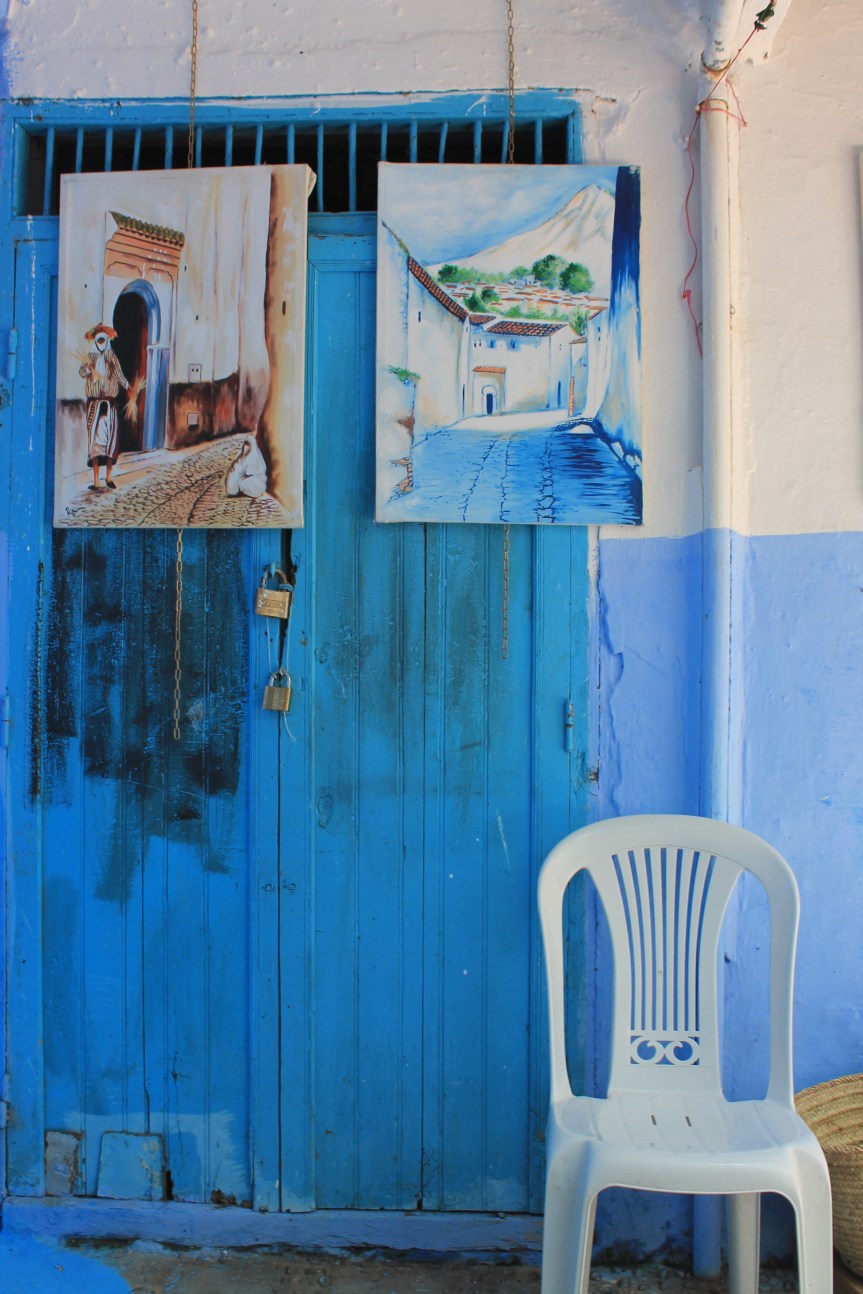
We sat on white plastic chairs and admired the blue art hanging from metal chains on the blue walls. The reed table runner covered the rusty metal table and smelled like fresh hay. Sitting felt wonderful. The shade felt wonderful. We pulled off our sunglasses and mopped the sweat from our foreheads.

The juicer was whirring inside a makeshift hut, the café’s kitchen. A moment later, we heard slurping and a satisfied, “Ahhh!” Apparently our juice had met the café owner’s approval.

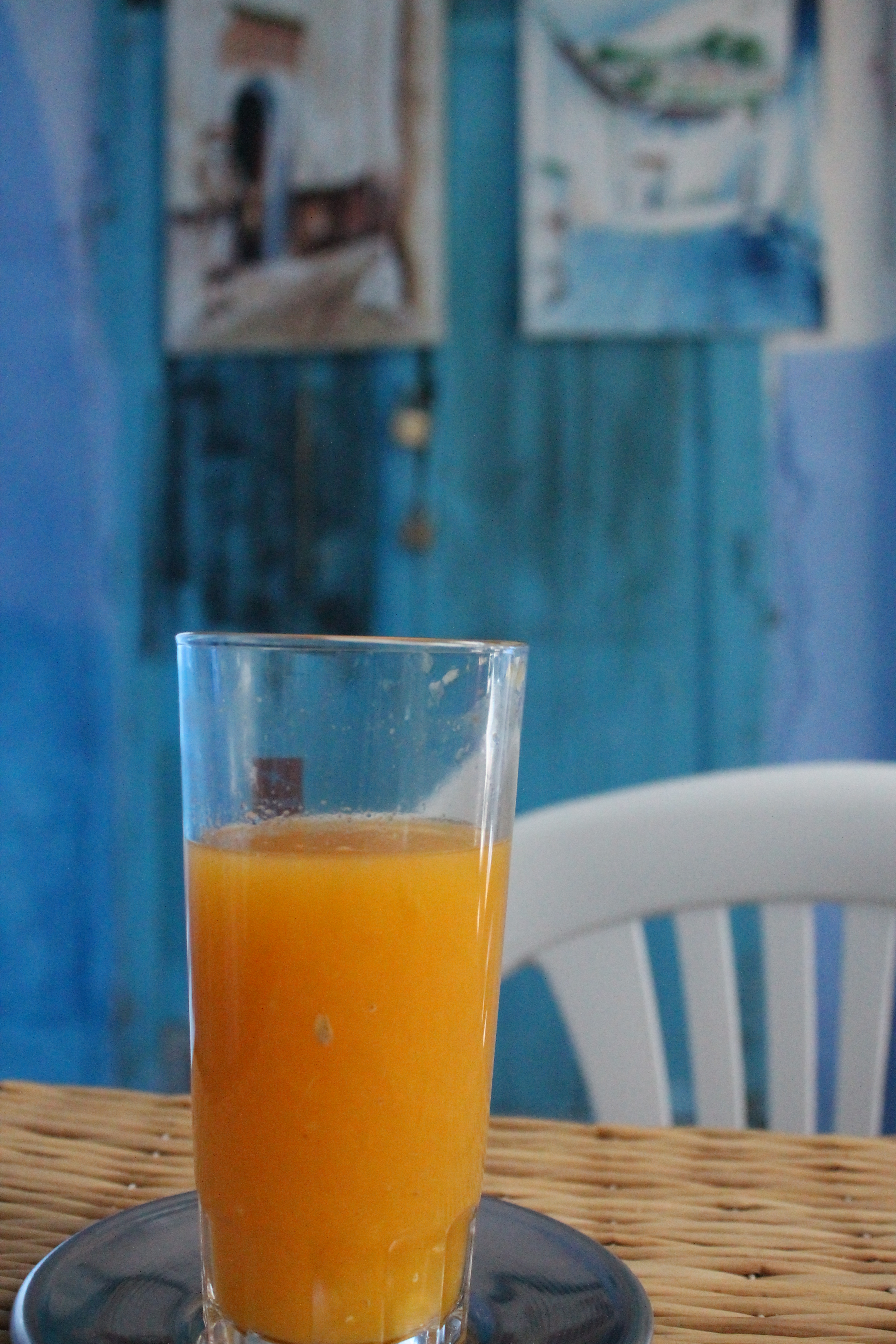
He brought out tall glasses on little metal plates. “My name is Rashid.”His sunny smile brightened when we tried to speak Arabic. But he left us alone until we were finished enjoying the shade and every last drop of our fresh orange juice.

glass of orange juice on wicker table next to blue wall

Aisha- part 2

Aisha was waiting for me on my way to school the next day. And the next. And every morning that I had the early hour of class. Because of her, I began to recognize the network of house workers who met regularly to chat on the way to their respective jobs.

Although I was glad for the chance to practice conversational Arabic, I still was unsure of what she wanted from me.

The day she had invited me to stay at her house grew closer. Because of my apprehension, I managed to whittle the overnight adventure down to a day trip. On the Friday before, we rehearsed what would take place on Sunday: I would meet her at the same place under the berry tree across from the bus stop at 11:00 a.m.

I don’t think she believed I would follow through with the plan. She tried calling me five times while I was in church. And when I finally answered, I was on my way to the meeting place.

“I’m coming!”

She spewed a string of sentences I couldn’t understand, but what I assumed to be a reason that she was behind schedule.

“Okay. Okay. No problem. Okay.”

And I waited under the berry tree until a taxi pulled up and honked. Aisha was in the backseat, bouncing in her excitement. She grabbed me in a warm embrace before I had the chance to close the door behind me. And she talked, one rapid sentence after another, often missing the fact that I didn’t understand.

The taxi wound through the new city, behind the old city, and up up up on a hill. There was no containing Aisha’s joy as she led me out of the taxi and into her world.

It was the first bite of a day full of exquisite North African hospitality.

Aisha- part 1

We had seen each other before. Most mornings I passed her by on my way to school. She and a friend would sit on a concrete bench under a tree. Noting the consistency of our timing and location, I greeted the women regularly. But I never slowed enough to make conversation.

Until the day I needed help with my homework. Both ladies were startled when I plopped down beside them and asked them to help me. With no context for this encounter, they were full of questions: Was I a student? Where was I studying? What kind of Arabic was I studying? What was my name?

The conversation was labored, but I finished the assignment and arrived at class, breathless and only a few minutes late.

A few days later, I was striding to school with my normal stoic street face when a lady in my peripheral became animated and shouted to get my attention.

Another beggar, I surmised, and turned to greet her without reaching for my change purse. But then I recognized her face, although she wasn’t in her usual place under the tree.

As we greeted each other in somewhat reserved familiarity, I studied her for the first time. She wore old clothes and the kind of shoes that most women only wore to the public bath house. Her face was enveloped in the odor of her breath, which I smelled as I embraced her. She was a tiny woman, not built for the hard work that life required of her.

Who was this woman? And what did she want from me? She insisted on walking with me on my way to school; she said she worked as a maid at a house nearby.

Her speech was complimented with gestures. “You—come—my house—to sleep.” She isolated her words with the intention of helping me understand. “Do you understand?”

I did understand, but said only, “God willing” which was neither a commitment nor a refusal.

Before we parted ways, she asked for my phone number. That evening she called me and together we weathered my first phone call in Arabic. We exchanged greetings and a few other bits of information among the numerous confessions of “I’m sorry; I don’t understand.”

She told me she would wait for me the next day on my way to school.

A morning of sounds

What does my typical North African morning sound like?

  • Mourning doves cooing outside of my window and a lonely rooster penned in someone’s courtyard
  • Slated shades being pulled up from various apartments
  • Water running, the electric kettle steaming, my own munching and slurping
  • A few mumbled “Good morning”s and “Have a good day”s
  • The bang of the door as I pull it shut behind me
  • Clomp, clomp, clomping down two stories of steps and the banging the apartment building door
  • The murmur of passing cars from a perpendicular street
  • A few snatches of conversation between school children and university students
  • A cat meowing as it digs through leftover garbage
  • “Bonjour!… Bonjour! Hola! Hello?”
  • Horns honking around a busy intersection as other cars and pedestrians assume the right-of-way
  • Motorcycles, buses, trucks, cars, bicycles weaving in and out of each other—the screech of brakes and more horns and perhaps some yelling
  • A jackhammer of busy men working on the street
  • “سلام”
  • The scratching of a stalk broom on a sidewalk
  • The buzz of the Arabic school’s call button and consequently the opening of three heavy doors
  • “صباح الخير. لا باس؟”  “لا باس الحمد لله.”
  • The sharp sound of chairs on a bare floor and the rumble of moving wooden tables as we all pile in and settle down for a long Arabic session