Was it worth it?

“Was my time in Spain worth it?” This question has crossed my mind a hundred times since I started winding down my life here. Was all of the time, energy, and finances invested worth the results I see? Or rather, the lack of results? Were they worth the years of being far from the people I love best in the world? Far from my own culture and community?

Lord willing, I plan to move back to the States in just over 2 weeks. My emotions are everywhere, leaking out in goodbye tears with a friend or bouncing in sheer giddiness as I remember that I don’t have to face upcoming life transitions alone anymore.

But was my time worth it?

I came across a quote from Elisabeth Elliott that I had jotted down long ago: “[People] cannot be hustled into the kingdom of God. And it is well to remember Christ’s own descriptions of that kingdom–leaven and seed, things that work slowly and out of sight. We long for visible evidence of our effectiveness and when it is not forthcoming, we are tempted to conclude that our efforts never had anything to do with the kingdom.” (From Made for the Journey by Elisabeth Elliott)

Exactly. I have coached myself not to dwell on the question of whether or not my time in Spain was worthwhile. After all, God works in ways we can’t see and I don’t have to understand the whys of His calling. Like Elisabeth Elliott said, God’s work is often slow and hidden.

When I shared my thoughts with J,  he suggested a new perspective, one he had gleaned from an article he had read. In his unimposing way of communicating truth, he suggested that rather than asking myself, “Was the sacrifice worth it?” it’s better to remind myself: “He is worth it.”

My personal fulfillment takes a backseat to God’s glory. 

This doesn’t mean I can’t evaluate my work and make adjustments. Neither does it mean I cannot grieve my losses or my lack of perceived success. But staying stuck in my questioning grief reveals a lack of divine perspective because neither sacrifice nor success can define the worth of a kingdom endeavor. 

A life spent for God is worth it, no matter what.

Deeper sorrow, deeper joy

I know how to hide my feelings from myself. I’ve had practice telling those miniature white lies about how I don’t mind or that I’m unconditionally happy and galloping through life without unwanted feelings lassoing me.

My body gives me a jolt now and then: a wrinkled forehead glimpsed in the mirror, indigestion, weight loss, fatigue. But look on the bright side, I think. I don’t really feel that stressed, weary, cranky, or conflicted. I am living the ideal life. Who in their right mind wouldn’t want to be me right now?

What I don’t remember is that shutting down my “negative” feelings also shuts down my capacity to deeply feel joy.

Earlier this month, I realized that wedding planning all day on my day of rest was not a sustainable pattern. So on my next day off, I forced myself to rest, really rest. I wrote “read” on my to-do list and that was all. As evening came, I transitioned into watching Call the Midwife. Two episodes later, I shut down my computer and cried. It was as if feeling vicariously for almost 2 hours helped to release my store of pent-up feelings.

This is where I want to be: feeling. Even if sometimes it means feeling an aching loneliness or feeling downright scared at what looms ahead. When I open my heart to feel, I experience the richness of the ups and downs of a life fully-lived. Because joy is right there too, every bit as deep… deeper even, but I can’t notice it when I’m only skimming along the top of life.

This season of life is filled with lasts and goodbyes as I prepare to leave Spain in 3 1/2 weeks. “Another last,” said my teammate when we dropped off my final guests. My guests and I had had a marvelous time, exploring and talking, processing and laughing. Their leaving set me into motion, clearing out my house and closing up my life here. It aches, but not all aches are bad.

I’m also filled with energy as I think about trading this life for several months with family and friends in my home community. And then there’s the dizzying delight of marrying J in three short months.

God meant the sorrows and joys of this season to be felt rather than ignored. So today, I choose to stay in this vibrant sense of being alive.

A life of perpetual humiliation

I just finished reading Anthony Doerr’s Four Seasons in Rome. Someone discarded it, and I picked it up, curious. This isn’t a book recommendation unless you happen to know that you like Anthony Doerr, but Doerr’s descriptions of life on the outside of a culture cut me wide open. I didn’t know there were words for these “in but not of” feelings.

Apartness and perpetual humiliation are part of daily life for those living overseas. Sometimes we talk about it too much. Often we don’t even acknowledge it but let our frustration become part of the existing barrier, like a thick moss growing over a wall we’re trying to ignore.

We are outsiders, always outsiders, chipping at the barrier that stands between us. And there are successes! Moments when a chunk of the wall falls away and we glimpse the other side…only to find razor wire. 

“To be a nonfluent foreigner is to pass through one gate only to find yourself outside two more,” writes Doerr (p. 46). “We are humbled over and over–humility hangs over our heads like a sledgehammer… Oh, you think you’ve been here long enough to barter at the street markets? Guess what, you just spent €8 on three plastic clothes hangers” (p. 76).

After nine months in Rome, Doerr walks into a grocery store and makes an order without messing up a single syllable. “What happens?” he writes. “I get my groceries. No streamers drop from the ceiling, no strobe lights start flashing. The grocer doesn’t reach across the counter and take my face in her hands and kiss me on the forehead.” Instead, the grocer asks about his boys and speaks so quickly he can’t keep up. “…I miss 80 percent of it and sheepishly, stepping down from my throne of fluency, have to ask, ‘I’m sorry, more slowly, please?’” (p. 168)

For some, eventually the barriers do not loom so large or feel so insurmountable. But for many? “I know nothing… I never made it through the gates between myself and the Italians. I cannot claim to have become, in even the smallest manner, Roman” (p. 201).

True. Despite my efforts to integrate into the culture around me, my North American worldview remains mostly intact, placing me decidedly on the outside. 

But if we let it, doesn’t living on the outside help us accept who we are? After all, like it or not, we cannot cease being a part of something. Not being a part of the culture we’re living in is because we’re part of another, or even several. Being on the outside can help us identify our own “inside.”

Apartness and perpetual humiliation are hard, but they are also opportunities to learn and grow.* And we need these opportunities to understand ourselves.

So I will try to be grateful. Even as my neighbor gives me a list of what is wrong with my couscous. Next time, it will be better. I can promise.


Doerr, Anthony. Four Seasons in Rome. Scribner, 2007. 

*Thank you, J, for your positive spin on life to remind me to keep on growing!

Utilizing distractions

The last few weeks have both drained and filled me in ways I’m not even sure I can explain. Oddly enough, one of the things that helped me cope with overwhelming emotions was reading a chapter book to my oldest nieces and nephews, sending a chapter or two each day via voice message. My family is full of avid readers and listeners, which makes the escape of a good story enjoyable for all of us. 

Did I just use the word “escape”?

I used to think distractions were an emotionally weak way to deal with an issue. I still think that they can be just that. But they can also give time to let emotions settle. A well-timed distraction can keep us from panicking, growing numb, or tuning out. A distraction contains the issue–good or bad–for a time until we’ve worked up the strength to deal with it. 

Even when I manage to relinquish my preoccupation to the Lord, I still find it helpful to distract myself so I don’t snatch it back from His capable hands. You might find me organizing my pantry while listening to an audio book or praying aloud. Or deciding an across-town shopping trip must be done today, on foot, at tip-top speed. Or making a detailed and utterly useless list.

At some point, the issue must be addressed–the change faced, the sorrow grieved–and distractions must come to an end. We cannot heap distraction upon distraction and expect positive results.

Today as I was leafing through an old Bible study book, I saw that I had written an “escape plan,” practical steps to exchange my burdens for the yoke of Christ. “Stop. Praise. Pray. Distract. Share.” My goal had been to post these steps somewhere, but the idea got lost in the shuffle of life. Until today.

I guess I needed the reminder that distractions, useful as they are, are a means to an end and not the end themselves.

Little 2015 “poems”

In 2015, I challenged myself to a one thing every month. One month, the challenge was to write a poem a day. The challenge was that: a challenge and most of my “poems” turned into tiny definitions using the same rhythm: 8/6/7. 

I found them a few months ago while I was looking through my old journals and decided to pull out several to share with you. They’re not artistic, but they’re fun. And maybe I’ll inspire you to write your own! If you do, share them in the comments section below.

Flowers
Sweet thoughts shrouded in timely death:
Bliss to those remembered;
Tear drops to those forgotten.

TV
Exclusive members only, but
Please show brain parking pass.
Night is full of undreamed dreams.

Music
The heart’s expression put to dance.
Tones that beckon listeners.
Message in a bottle, found.

Music 2
Listening to another’s heart
In catchy rhyme and rhythm
And wishing you’d thought of that.

Blank Pages
Rolling stretches of nothingness
Packed into neat, white squares:
Deserts in languished places.

Clocks
Ever-present competitors
Daring life to vanish
Before we decide to dance.

Childhood Memories
Poignant traveling of the mind
That pinches can’t awake:
Bitter, sweet, and bittersweet.

Death
A monster posed to frustrate life;
Yet, mingled with heaven
Will strangely bring relief.

Heartbreak
Initial tears have disappeared;
Descends the selfish numb—
It’s only I who suffers!

Books
For a stolen moment letting
Reality fade and
Becoming who you are not.

Trust
Relinquishing every control
To one you believe in
Though sometimes you feel equipped.

Photo by Zaini Izzuddin on Unsplash

Bricks and churros

Meeting her was like being handed an armload of bricks. Surprising, heavy, and requiring concentration to keep the bricks from tumbling everywhere. She was sturdy and strong. Like she was giving the world the finger, and the world was cowering. And yet… and yet, her inner chaos spilled over on everyone she touched. 

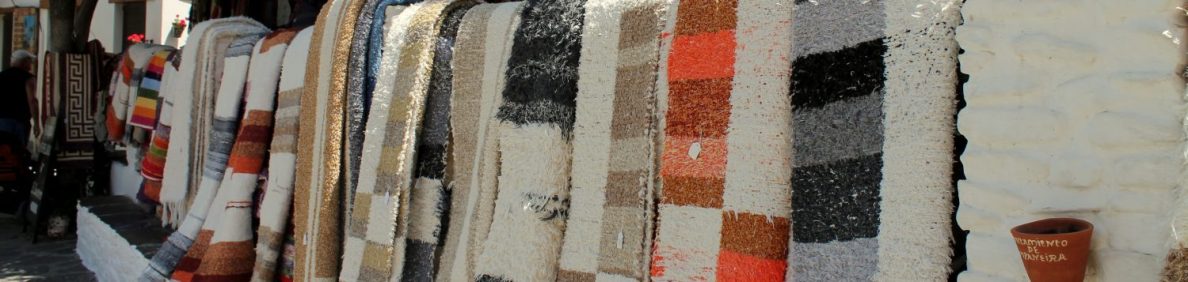
I had noticed her for years, only ever at the market. She was eye-catching: tall, broad, non-conformist, and always purposefully raiding booths at the traveling market. 

Then one day, we crossed paths. Literally. And she stopped me. “Who are you?” she asked with bright eyes. 

She was thrilled with my stumbling Arabic, my height (we stood eye-to-eye), and my nationality. We exchanged numbers and parted ways. I walked home, a little dazed by my ability to attract strong women who longed to take me under their wing. How many times had this happened before?

She and I messaged back and forth for a couple of weeks. She had a situation costing her a lot of time and energy. “Pray for me,” she said. 

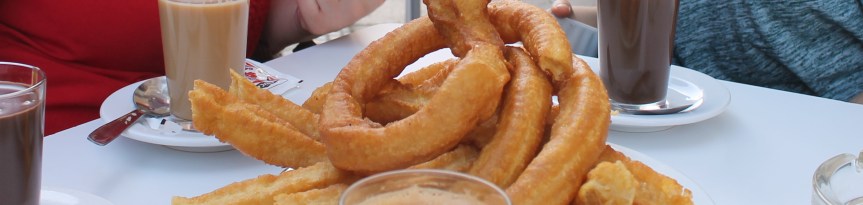
Last week, I messaged her. “Are you going to the market? Can we meet for churros?”

I found her at the market, rooting through piles of merchandise, somehow sniffing out deals I had already walked by once. 

When she reached out to hug me, body odor clogged my throat and I tried not to breathe. It wasn’t her, but her clothes, I thought. She might not have access to a washer. “SHE’S AMERICAN!” she blared at the market vendor in a voice as big as she was.

She insisted on paying for the churros. “It’s all the same.” She waved me off as I fought back. We found a table and she started talking. Loudly. As she told me her problems, neighboring tables shot us glances. 

I was hyper-aware of the intrusive volume as I munched on churros and wiped my fingertips on the gray churro wrap, but it took most of my concentration to follow her story. I felt like I was juggling those bricks now, trying to keep all of my senses from screaming at me while I focused on her words. There were a lot of them. Both senses and words.

When she told me why her marriage had crumbled, she shrugged. “We get along fine now. But you know, we were too young to know how to solve our problems.” Another shrug. Another middle finger to the world of pain.

An airborne brick was about to land on my foot. What should I say? Was she anything but “fine”? Even with all of the pain she had just detailed? Had anyone in her life ever let her be anything but “fine”?

I pressed my greasy fingers against the paper again, admiring the pristine fingerprints I left behind, dark against the pale gray. My fingerprints. Beautiful. Special.

And the woman sitting beside me left her own greasy fingerprints on everything she touched. Also beautiful. Also special.

“Was it hard to relate to his family?” I asked finally.

And when I looked up from our fingerprinted churro paper, my breath caught. This “load of bricks” in front of me was dabbing her eyes. She wasn’t crying. Not quite. But I had touched something still raw. I sat quietly, ignoring the cooling churros. Ignoring the eavesdroppers around us. She didn’t say more, and I didn’t pry. Our friendship was too new for that. 

But I walked home with this God-given reminder that I had just had greasy churros with God’s image bearer, His beautiful creation. Her wounds and scars would never be able to disguise that.

Repetition at the sea

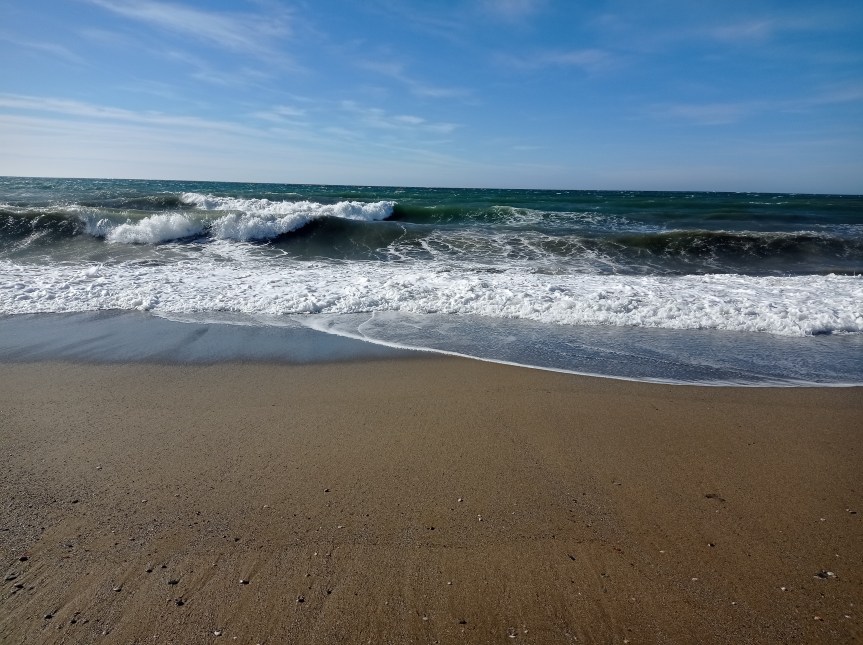
My favorite part of the beach is feeling the immenseness of God while seeing the careful details of His creation–a tiny shell, a delicate strip of seaweed. And all of the while, the waves rhythmically pummel the grainy shore. 

In his book Orthodoxy, G. K. Chesterton writes that maybe God is like a child in the way He enjoys the repetition of His creation. It’s not that He is stuck in a rut or that He even has a factory that stamps the same design on daisy after daisy. Instead, He delights in the repetition of His creation like a child, “[exulting] in monotony.” “For we have sinned and grown old,” writes Chesterton, “and our Father is younger than we.”

I think about this as I pick smooth pieces of broken shells out of the sand around my towel. The sea creeps closer. Then the wind picks up and I turn my back to it and watch people walking their dogs along the walking path. On top of the mountains swelling beyond the port, are caps of brilliant snow.  

The roar of look-alike waves settles something so deep in me that tears prickle behind my eyes.

Just that week, darkness had threatened with a roar, but the roar of a starving lion rather than a roar of majestic waves. And for a few awful moments I had felt its breath on my neck, breath that smelled of despair. 

Will the lion come back? My heart races to even consider it. Please no, God. Not again. But, if I’m honest, there are tired days I want to let myself be consumed, as if stopping the struggle could bring relief. 

I pack my things–my damp towel, the handful of broken shells, and my sunglasses. As I walk to the bus stop, the salt from the ocean spray still clings to my lips. I lick them. And then I lick them again. The salt remains. I smile, imagining that I smell like the sea.

My heart has quieted. Perhaps it was in the faithfulness of the Father’s repetitive creation. Or the delightful majesty of ocean and mountains. Perhaps. But even in the bitter wind, His Presence is here.

Pride and apathy

True love drives away laziness, that’s what a young friend learned in philosophy class. It drives away apathy too.

Then why do I grow apathetic to the woundedness that surrounds me?

Overwhelmed, that’s what I am. Overwhelmed by the dissonance of compassion and my own limits. I am one person with moderate abilities and stamina. I cannot be a superhero no matter how hard I try. My tiny contribution of self-sacrifice will not change the world.

And so I begin to seal off my heart, and what began as love is reduced to apathy.

Or was it even love to begin with?

When I fill my schedule to the brim with world-changing activities, what is my motive? Can it be love? It might be, but, if I’m honest, my motive to change the world often starts and ends with pride. And it’s a pride that turns apathetic when I refuse to be humbled by remembering my limits.

There always will be busy seasons in our lives, some longer than others, but a sustained frantic pace, even under the pretense of love is not truly loving.

Love isn’t defined by the absence of laziness or apathy. The real meaning isn’t found in the absence of something. It’s not even found in the presence of something like hard work or compassion. It is ultimately found in the Presence of Someone.

When I realize that I am not the one who must save the world, I am freed. The burden to be the savior rolls away. Finally, I can stop panicking over my limits in light of all the work that needs to be done. I am finally free to love well.

I can sit with someone who needs to cry. I can make cupcakes for a team event. I can read a captivating book. I can agree to tutor another student. I can have a friendly chat with my neighbor from the patio. I can probe deeper into the heart of a young woman who isn’t sure who she wants to be just yet. And I can do all of this, recognizing that I am just a small piece in what is happening, and, praise the Lord, I get the joy of being a piece.

I am a created being, created with limits. And that is very good. Why? Because the work does not begin and end with me but with the One who is limitless.


For an excellent resource on human limits, I recommend You’re Only Human by Kelly M. Kapic.

I wish I knew you

Maybe you think I don’t notice that bruise on half your face. You light the room with a smile and a dignified calm.

But I wish I could grab him by the throat and not let go until I know that he will never touch you again.

Except with love.

But how can I know unless you tell me? And how can you tell me unless you trust me? And how can you trust me when you just met me and he calls your phone and you need to go before we even know each other?

We say goodbye with an embrace, two kisses, and a few besides.

Then I stand and watch you walk away, wishing I knew the you behind that sparkling smile. 

And that black eye.


Photo by mostafa meraji on Unsplash

Mural: Please like and subscribe

As I mentioned a few months ago, I collected photos of murals as I prayer walked Mytown this spring.

Some of the murals were funny. Some were really odd. But then there were those that made me stop and wonder: What was the artist trying to say?

As I share some of the murals with you. You can wonder with me or leave an interpretation in the comments below.