The lighter side of language learning

I have no history with the other foreigners I have met here in North Africa: no previous inside jokes, no awkward memories of growing up together, etc.

Yet, because we are here together, we have begun to share something that I cannot share with people from home: the joy of mixing our common languages. And the beautiful thing is that we understand each other.

My class is known as the class that laughs a lot. My classmates and I are often drawing parallels from Arabic to English. There are verbs that in their conjugated forms sound like “guilty” and “dirty”, and nouns that sounds like “slave” and “smelly.” So we utilize them as their false English cognate, so much that our teachers have begun to do the same.

We also like directly translating from Arabic. In Arabic, many verbs are a slight variation of their nouns. “Do you want to coffee with me and have coffee at the coffee?”or “The chicken eggs eggs.”

And then there are times when we make up our own words completely such as tacking an English ending onto an Arabic verb or even using both Arabic and English constructions on the same root word.

For example, in Arabic the passive voice is typically the normal verb preceded by a “t” sound. And, as you know, the regular past tense verb in English ends in “ed”.

One day, as a friend and I were walking down the street, a guy from a passing vehicle hollered, “Bonjour!”

We giggled. “We’ve just been tbonjoured.”

Of bargaining

“It’s camel leather!”

“Really?”

I probably wasn’t the first ignorant foreigner to fall for that trick. But unlike most foreigners, I had a friend beside me who revealed the claim as rubbish. Camels are too valuable to be able to sell cheap street merchandise made of their hides.

I narrowed my eyes at the shopkeeper. “You lied to me! Shame on you!”

He sheepishly tried to make amends, but his customer was no longer interested.

Living in North Africa requires me to be functional at bartering with shopkeepers and street vendors. If no price is listed on an item, I must accept an exorbitant price or hone my bargaining skills.

Often, a shopkeeper will take me aside and lower his voice: “For everyone else, it is 150, but for you it is 130.”  As if he doesn’t tell every customer the same thing. At times, shopkeepers add phrases like: “…because you have North African friends” or “because you live here.” If the price still seems unreasonably high, I add, “And I’m a student. Do I get a student discount?”

Once, as I was bartering in Arabic, a shopkeeper told me “You are not a tourist. You are a North African!” Given the context, I took that as a compliment.

Using Arabic helps those selling realize that I am intentional about what I am buying. It also clues them in that I might know reasonable prices. After speaking to a restaurant owner in Arabic, he listed a fair price for a meal and I accepted. But when I asked to see a menu, he had none to give me; the only menus were “tourist” menus!

I may bargain for a while, but when I know my last price and I say my last price, it is my last price. It is what the item is worth to me and if I can’t buy it for that, I don’t want it. Sometimes the shopkeepers drop their prices to meet mine, sometimes they don’t. Sometimes, I am walking away when they call me back. Perhaps it’s the threat that others will get my business when I say, “No thank you. I will keep looking at other shops.”

Bargaining used to terrify me. Now, after seven months, I have accepted this piece of the culture. Until I finish language study in another seven months, I might be enjoying myself.

Hot

I have spent most of my summers in humid Illinois, a few in Mexico, and last summer in Phoenix, Arizona. Yet, every time spring yields to an overpowering summer, the heat catches me off guard.

Sure there are ways to survive even without air conditioning. Here in North Africa, spray bottles, fans, popsicles,  and cold water bottles come to mind.

The sun hovers directly above the city and beats its rays into the vast stretches of concrete and tile. Don’t picture me lounging on lush green grass under a generous shade tree. If I reclined on the ground, I would probably fry like an egg. And most of the shade comes when the sun dips behind the concrete buildings.

I have little energy. Staying hydrated is a chore. Headaches are routine. Sometimes I’m even sick to my stomach.

Yet, this miserable heat brings out the camaraderie that wouldn’t be here if the weather were perfect. After the sun goes down, people unite on the streets, visiting, shopping, or just watching the world go by. The carefree atmosphere comes from the underlying sensation of “Whew! We survived another day together!”

WhatamIdoinghere

WhatamIdoinghere
And whatwasIthinking
To expose myself to rejection
And the stinging unknown.
WhatamIdoinghere
And whatwasIthinking
To make myself vulnerable
To a broken world,
Tasting its pain and distress
Hearing the cry of the oppressed.
WhatamIdoinghere
And whatwasIthinking
To let my soul experience
The piercing emotion that comes
From living a full life,
Allowing my will to battle strife,
Petitioning for souls at heaven’s door,
And understanding love more than before
WhatamIdoinghere?

Judging the radical

There is someone I regularly pass judgment upon. I try not to. But he has a way of deflating my perceived piety because whenever I am around him, I feel myself judging him. He just doesn’t fit into my spiritual box.

Nearly every time I see him, God teaches me the same lesson: “Stop judging, my child.” And I am convicted once again.

Spirituality isn’t confined to what I think it should look like. And when I’m not so busy being full of myself and how I am doing spirituality perfectly, then I see how God displays His attributes differently in different people. So how can I put His personality in a box?

And I think of the people in the Bible who more focused on God than on themselves. They had to do some pretty radical things: leading an entire people group out of slavery, taking messages of judgment to God’s people, marrying a prostitute, living a wild desert life, and giving up normality to have a child out of wedlock…a child conceived by the Holy Spirit.

So how can I say that I know what a relationship with God looks like for every person? He doesn’t give us all of the same callings or the same gifts. And I am thankful that not everyone is as closed-minded as I am about following God radically.

Quiet corner=buried treasure

Have you ever stumbled across a place that you were subconsciously looking for? It takes a bit for you to catch your breath as your heart smiles: “Yes!”

It might be as trivial as a little café, buried in a North African old city where few tourists trod. Except us. A friend and I were wandering down one narrow cobblestone street after another. We walked right past the café the first time, not because we didn’t notice it, but because the owner spotted us and began to holler that we were welcome. We darted down another street to avoid him. But that street was a dead end and eventually we had to turn around.

Hot and tired, we were easy victims when we passed by the café the second time and the owner called out his menu just in case we changed our minds. Then he said the magic words: “We have orange juice!”

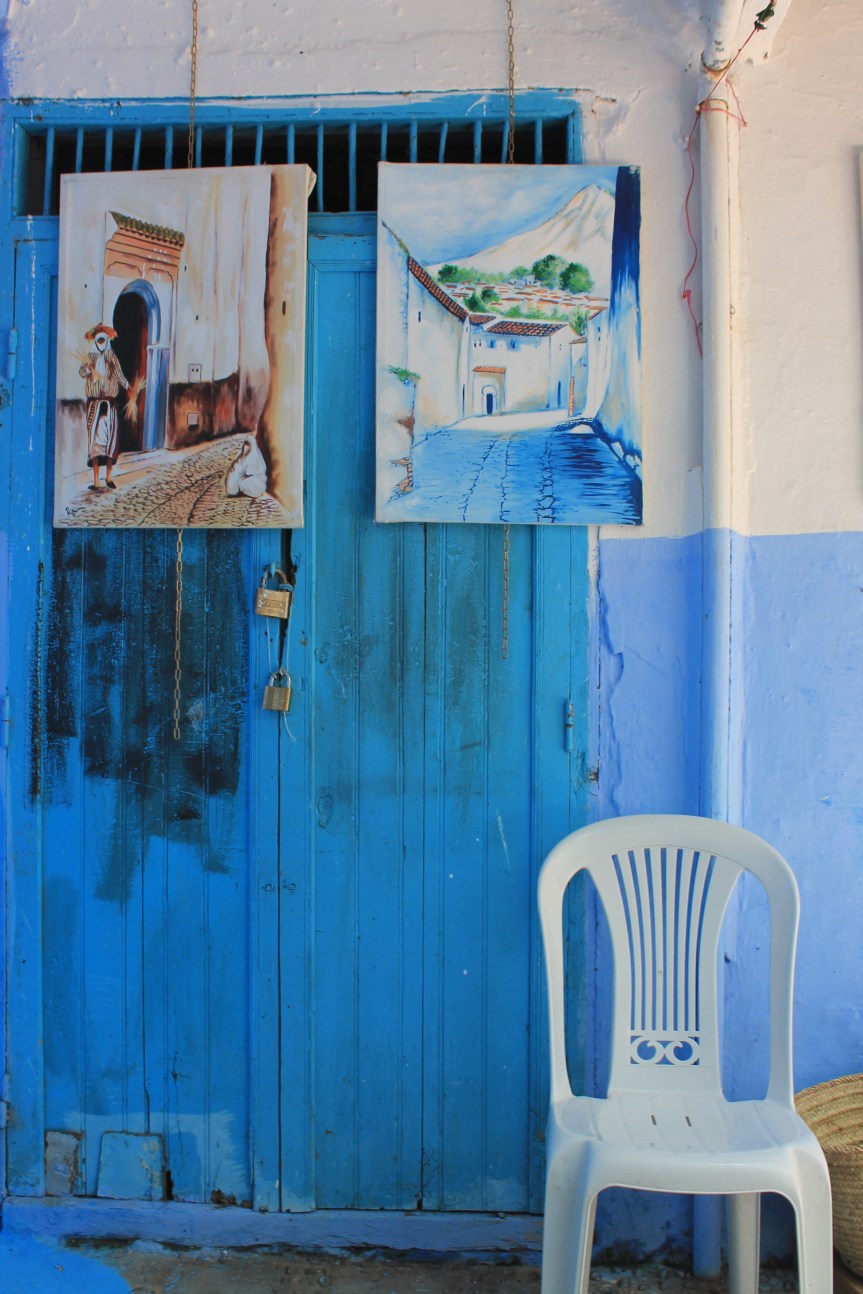
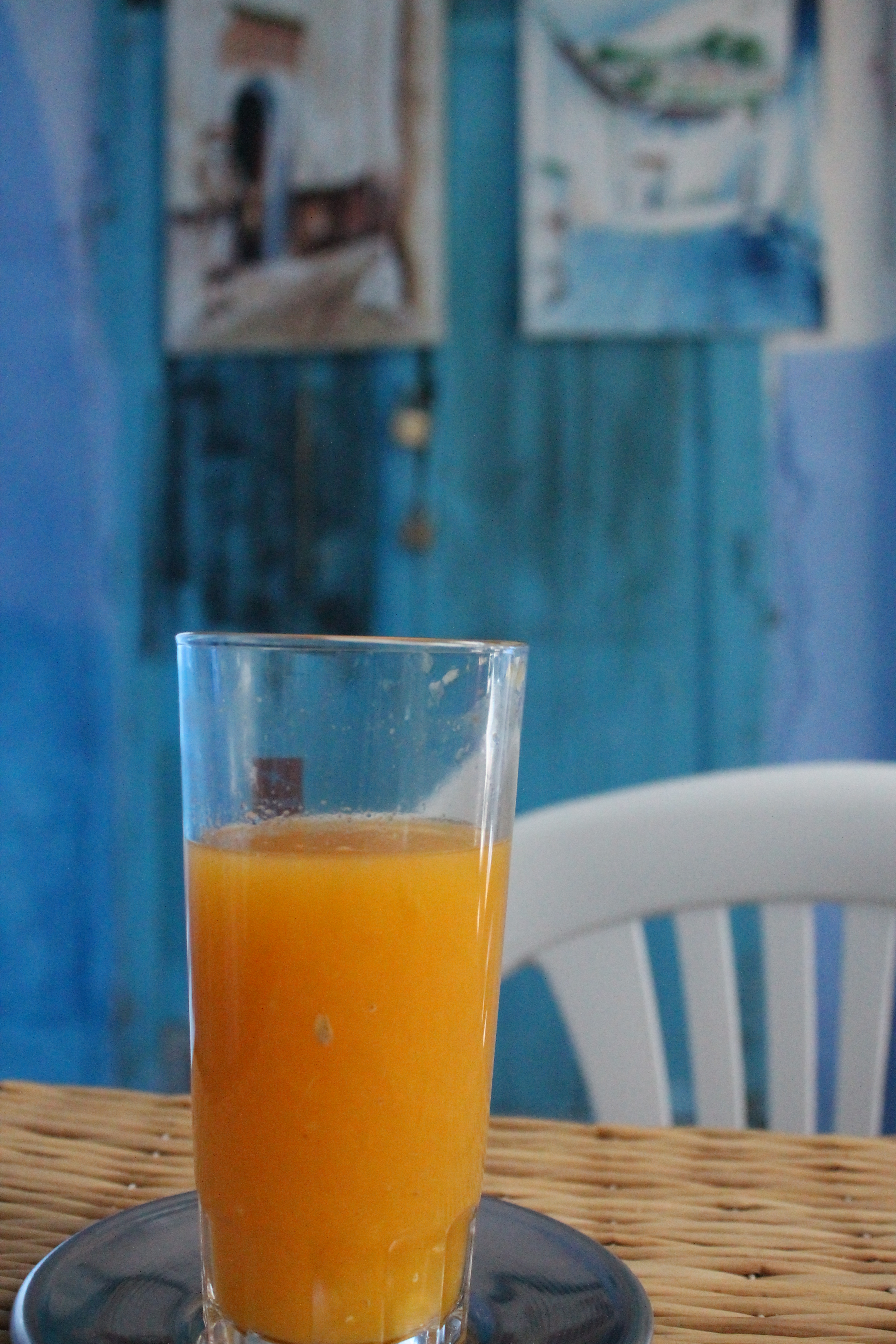
We sat on white plastic chairs and admired the blue art hanging from metal chains on the blue walls. The reed table runner covered the rusty metal table and smelled like fresh hay. Sitting felt wonderful. The shade felt wonderful. We pulled off our sunglasses and mopped the sweat from our foreheads.

The juicer was whirring inside a makeshift hut, the café’s kitchen. A moment later, we heard slurping and a satisfied, “Ahhh!” Apparently our juice had met the café owner’s approval.

He brought out tall glasses on little metal plates. “My name is Rashid.”His sunny smile brightened when we tried to speak Arabic. But he left us alone until we were finished enjoying the shade and every last drop of our fresh orange juice.

glass of orange juice on wicker table next to blue wall

The belt slinger

Sitting in the shade of a damp sheet strung across two clotheslines hadn’t been too bad. But now out on the street, I had to stop pretending it wasn’t hot. The concrete tossed the day’s heat into my face as we walked down narrow streets of the tall apartment buildings in Aisha’s neighborhood.

It was the day of Eid, the celebration at the end of Ramadan. As the sun considered setting, people started to appear on the streets, freshly scrubbed and in new clothes. Time for the party!

Aisha had explained that all of the children would be out on the streets in their new clothes, playing, dancing, and laughing. We were on our way to witness this delightful street party now.

But we were only approaching Aisha’s mother’s apartment when we encountered a slight glitch in our plans: apparently, Aisha’s nephew had whacked a neighbor girl with his belt. The girl’s mother approached the few family members lingering outside of Aisha’s mother’s apartment. She was furious as she displayed the belt’s point of contact with her daughter’s face.

Along with the others, I peered at the unbruised, unbroken skin, trying to ascertain the validity of the crime. Her inflammatory remarks didn’t set well with the boy’s family. An instant wall of excuses met her accusations: this wasn’t the boy’s problem, but her daughter’s problem, the family told her.

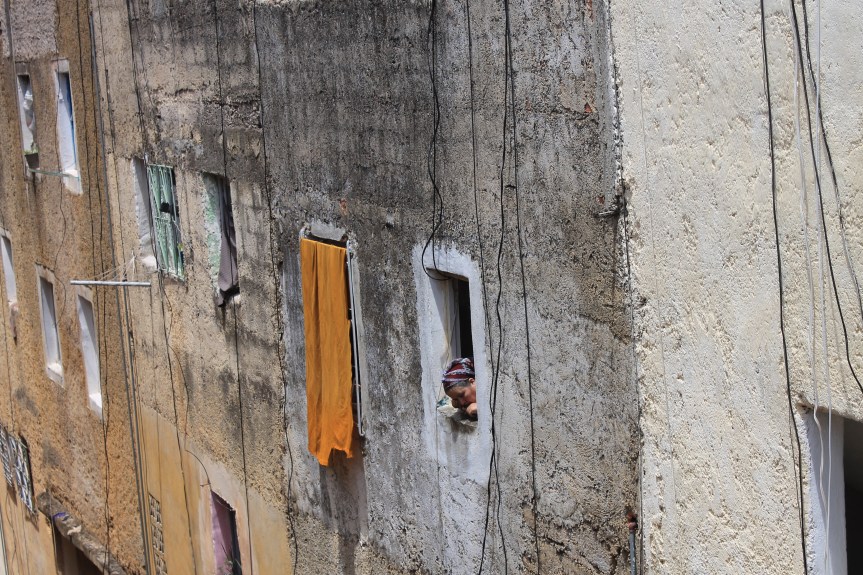
The little girl’s shaky sobs were lost as the confrontation exploded. Hollering escalated, echoing up and down the street. Neighbors rushed to the scene to offer unwanted advice and intercession. Others stood in the background to observe. Above us, others leaned out of windows to watch the drama unfold on the street below. A bit of pushing began, but tapered off quickly as friends dragged the more aggressive ones away. There was little effort to control any display of temper.

I was the only foreigner, the only one who didn’t quite culturally grasp what was happening. I leaned awkwardly against the doors of a closed shop to watch, fighting my own instincts to intervene.

The original crime had been so trivial. Why the big fight in the middle of the street?

Meanwhile, the little belt slinging offender was running around slaying other children with his belt, unhindered and unnoticed altogether… except by me!

Ramadan blues

“Am I hungry or just bored?” I muse as I peer into the refrigerator.

Summer has set in where the nights rarely descend with a breath of cool air. It is warm all of the time. And what is worse is that I feel trapped inside. And what is even worse is that my roommate chose this month to travel to Germany, another friend left forever, one classmate is in the UK and another classmate is in Spain. I am trapped with myself.

I make plans here and there, but the reality is that any plans are contingent upon the time of day. The hours that are too hot are off limits because street robbers might prey on the few people who are out. The hours right before the breaking of fast are even worse; there are hardly any people or cars to be seen and a fog of silence enshrouds the street.

Even if I do go out, most stores would be closed anyway. And the cafés and restaurants definitely are.

Why didn’t I just go home for part of the summer? Never mind the long journey or the money. Maybe that would have cured some of my recent homesickness.

I am tired of studying on my own, reviewing, practicing, listening, jotting down notes. I am tired of the food in my fridge. I am tired of sleeping.

For a melancholy, boredom breeds self-pity. At least it does in this melancholy. The light at the end of the tunnel is fading. Ramadan will NEVER end! Instead of thinking how hard it would be to fast for thirty days, I think about how unfair it is to plan my life around those who are fasting.

Selfishness. Yes, it all comes down to a perspective saturated in selfishness. Time to go count my blessings.


Photo by Erik Mclean on Unsplash

The pattern of practical loving

Sometimes I don’t know what the practical side of love is supposed to look like. And by the practical side of love, I’m referring to loving those in need. Is it really even “supposed to” look like anything, as if it were a consistent pattern? 

This is on my mind because today on my way to the store, I saw the same beggar that I always see on the way to the store. As usual, she sat on the sidewalk, her swollen feet outstretched for passersby to take pity on her condition.

I smiled and greeted her. Her face lit with an almost-toothless grin. She cackled a greeting in return and asked how I was. She wasn’t expecting anything more from me than what I gave.

So what did she really want? Was it the couple of coins I could have dropped into her hand? Was it the groceries I could have bought for her? Or did she really just want eye-contact: to be treated like a normal person, to be loved instead of patronized by a stranger?

When I walked back out of the store, I had nothing for her except another smile. And she was ready with that same brilliant grin. What I had given her was all she wanted from me today.

Perhaps the only consistent “pattern” in practical loving the fact that one is loving.

“You shall love the Lord your God with all your heart and with all your soul and with all your mind. This is the great and first commandment. And a second is like it: You shall love your neighbor as yourself. On these two commandments depend all the Law and the Prophets.”

Matt. 22:37-40

Good windows make good neighbors

Robert Frost once wrote a poem about good fences making good neighbors. But what if there are no fences, only windows that overlook walls of windows from neighboring apartments? Do good windows make good neighbors too?

Through the windows, I can sample the lives of my neighbors. Without really knowing them or even really knowing exactly what apartment they live in, I know certain things.

For example, a man sneezes about 9:00 every evening. It’s not just a sneeze, but a SNEEZE. Actually, it is a series of sneezes that gives me an estimate of the time not unlike the call to prayer. And since the Ramadan time change, the sneezes have been coming at 8 p.m.

There is an unpleasant child in a lower level apartment, whose screams are punctuated by the parents’ roars of disapproval.

I can smell what neighbors are cooking, at times even identifying individual spices. And there is often the clattering of women washing dishes or the hissing of a pressure cooker.

In a tiny courtyard below, some neighbors play soccer with friends. When there are five or six of them, I don’t know how they manage to fit, let alone play a game. Their shouting in African French echoes all over our mini community.

Parties on the roof until the wee hours of the morning mean that talking and laughter float through our windows with the cool night breeze.

One evening, a little boy appeared in his window wearing only a T-shirt and his underwear. Silently, he climbed up in the window sill and measured the window with a tape measure. Then he climbed back down.

See, good windows must make good neighbors… or at least provide daily entertainment.