A life of perpetual humiliation

I just finished reading Anthony Doerr’s Four Seasons in Rome. Someone discarded it, and I picked it up, curious. This isn’t a book recommendation unless you happen to know that you like Anthony Doerr, but Doerr’s descriptions of life on the outside of a culture cut me wide open. I didn’t know there were words for these “in but not of” feelings.

Apartness and perpetual humiliation are part of daily life for those living overseas. Sometimes we talk about it too much. Often we don’t even acknowledge it but let our frustration become part of the existing barrier, like a thick moss growing over a wall we’re trying to ignore.

We are outsiders, always outsiders, chipping at the barrier that stands between us. And there are successes! Moments when a chunk of the wall falls away and we glimpse the other side…only to find razor wire. 

“To be a nonfluent foreigner is to pass through one gate only to find yourself outside two more,” writes Doerr (p. 46). “We are humbled over and over–humility hangs over our heads like a sledgehammer… Oh, you think you’ve been here long enough to barter at the street markets? Guess what, you just spent €8 on three plastic clothes hangers” (p. 76).

After nine months in Rome, Doerr walks into a grocery store and makes an order without messing up a single syllable. “What happens?” he writes. “I get my groceries. No streamers drop from the ceiling, no strobe lights start flashing. The grocer doesn’t reach across the counter and take my face in her hands and kiss me on the forehead.” Instead, the grocer asks about his boys and speaks so quickly he can’t keep up. “…I miss 80 percent of it and sheepishly, stepping down from my throne of fluency, have to ask, ‘I’m sorry, more slowly, please?’” (p. 168)

For some, eventually the barriers do not loom so large or feel so insurmountable. But for many? “I know nothing… I never made it through the gates between myself and the Italians. I cannot claim to have become, in even the smallest manner, Roman” (p. 201).

True. Despite my efforts to integrate into the culture around me, my North American worldview remains mostly intact, placing me decidedly on the outside. 

But if we let it, doesn’t living on the outside help us accept who we are? After all, like it or not, we cannot cease being a part of something. Not being a part of the culture we’re living in is because we’re part of another, or even several. Being on the outside can help us identify our own “inside.”

Apartness and perpetual humiliation are hard, but they are also opportunities to learn and grow.* And we need these opportunities to understand ourselves.

So I will try to be grateful. Even as my neighbor gives me a list of what is wrong with my couscous. Next time, it will be better. I can promise.


Doerr, Anthony. Four Seasons in Rome. Scribner, 2007. 

*Thank you, J, for your positive spin on life to remind me to keep on growing!

And can it be…?

It’s my responsibility to choose the songs for our Sunday sunrise service. The Easter Sunday selection often falls on me, I think, or maybe it’s just a reflection of how many years I’ve been in Spain to have the selection fall on me (or a reflection of my age and coinciding inability to remember).

There is an overwhelming number of songs to choose from. The traditional hymns that make the male voices boom, “Up. From. The grave. He. Arose!” to some of the newer songs that encompass Jesus’ life and passion. I only get to choose a few, but that doesn’t stop me from snooping through other people’s Spotify playlists.

What are some of your favorites? And why?

One of mine (one of many) is “And Can It Be, That I Should Gain?” by Charles Wesley (1738). The lyrics are powerful, the music beautiful (especially with an organ!). The hymn starts with questions, evoking shame and guilt.

And can it be that I should gain
An interest in the Savior's blood?
Died He for me, who caused His pain?
For me, who Him to death pursued?

The hymn goes on to share the mystery and grit of the Savior’s death followed by the hymn writer’s own testimony of freedom and life from the living “Christ my own.” Yet, through the entire song, we are pulled back to the refrain:

Amazing love! how can it be
That Thou, my God, should die for me?

A reminder of our helplessness before God without Jesus’ death and resurrection for “Adam’s helpless race.” A reason to celebrate Resurrection Day with gratitude.


Photo by Henrique Jacob on Unsplash

A stray in Andalusia

I hefted my bag onto the closest seat as the bus lurched forward, nearly carrying the rest of me and mine down the aisle. But I caught the seat handle just in time and wrestled off my backpack.

It was one of those four seater sections of the bus where two passengers faced another two passengers. The kind of seat I typically avoid because I dislike riding backwards and letting my knees protrude into someone else’s territory. But today, the bus was full and at a quick glance, it didn’t seem like there were many other options. 

The woman across from me, knees against mine, watched me curiously. I smiled and decided, given the close quarters, not to mention that I was still getting over the flu. I was trying to subtly clear the cough in my throat when her questions began, each in thick Andalusian. “Where are you from? Where do you live? What’s your name?”

Every time I replied, she broadcasted my answer over her shoulder to an elderly gentleman sitting a row back. He watched me with delight, his eyes peering between the clouds of white which were his head and chin.

“Where do you live in Mytown?”

“Close to Central Market.”

“SHE LIVES CLOSE TO CENTRAL MARKET.”

“Oh, Central Market!”

This was how the interrogation went as I bounced along backwards, feeling both annoyed and amused that everyone on the bus now had access to my personal data. She began to preface questions with my name, dragging my attention away from the window where I was pretending that I had forgotten she was there. I kept my answers to the point, swallowing back the coughing fit that kept swelling in my airway.

“How long have you lived here?”

“Six years.”

“SHE HAS LIVED HERE SIX YEARS.”

“Ah! Six years.”

Andalusians, pleasant as they are, have a way of reducing me to the feeling that I’ve just stepped off the plane. They pick me up like a stray. Under their burning curiosity, I get tongue-tied. Getting tongue-tied leads to falling behind in the conversation. Falling behind is a blow to my confidence, which in turn, makes me appear ignorant and lost. That’s when I try to preserve my fizzling dignity by looking for an escape.

Fast forward to not many days after my backwards bus ride to find a friend and me face to face with three abrupt police officers. This time, curiosity was backed by the authority of the uniform.

“What are you doing here?”

Suddenly, I felt as if I were wandering into territory that was not mine for the wandering. I was three and half blocks from home and I felt like they had found me lost.

“Where are you from? Holland? Russia?”

I had never been stopped by police officers before. I don’t even have a speeding ticket to my name (although, I can’t say I’ve never deserved one). A few questions in, I realized they didn’t believe we had done anything wrong, but they were curious who we were and why we were in this particular neighborhood. Their method was protection by intimidation. Not very effective, but very Andalusian.

Once again, the stray puppy was held up for examination and then sent home. Literally this time.

“Go home. You’ll get robbed here.” As if I didn’t live three and a half blocks away. As if I hadn’t been living three and a half blocks away for three years.

Sometimes, I just want to make a list of all of the things I’ve experienced and survived in life and hand it to the next person who tries to protect my presumed naivete. My list may not be long, but I’m guessing it’s longer than a stray puppy’s.

I wish I knew you

Maybe you think I don’t notice that bruise on half your face. You light the room with a smile and a dignified calm.

But I wish I could grab him by the throat and not let go until I know that he will never touch you again.

Except with love.

But how can I know unless you tell me? And how can you tell me unless you trust me? And how can you trust me when you just met me and he calls your phone and you need to go before we even know each other?

We say goodbye with an embrace, two kisses, and a few besides.

Then I stand and watch you walk away, wishing I knew the you behind that sparkling smile. 

And that black eye.


Photo by mostafa meraji on Unsplash

Aging alone

Back when I was teaching, we took a field trip to The Museum of Science and Industry in Chicago. There were these cool machines with cameras that would age a photo depending on life choices. Are you a smoker? Do you spend a lot of time in the sun? And so on went the questions.

One of my junior highers got me to pose for the camera. My mistake was not taking over the controls afterwards. Having already gone through the process once, he knew all of the answers to age my photo as much as possible. He ignored my protests as the screen spun out an image of a worn out old lady who eerily resembled me.

Thanks, kid.

I remember that photo sometimes when I find a new gray hair or a neck wrinkle or an age spot I never noticed before. The realization that one is aging is hard for many people; however, as a single, I wonder if aging alone is different. Not harder, but different.

As a single, there is no togetherness in disintegration. It’s just a party of one who watches the body in the mirror stoop and droop a little more each year. A party of one who gets pitied as she grays because there go her chances to snag a husband and, if she doesn’t have children, she can’t even attribute the grays to the honorable occupation of child-rearing.

His eyelids sag and he gets an extra roll of fat at his waistline.

There is no together giggling at age creeping over two bodies become one. It is just her facing irreversible doom as she watches those creeping spider veins.

There is no one to notice that mole on his back slowly changing colors. No one to miss that tooth except him.

Those freckles that once were becoming are overcome by age spots and they’ve scattered farther than she ever imagined. Her body is no longer what it used to be. And sometimes she’s glad she doesn’t have to share it.

I read through 1 Peter recently, about beauty being internal rather than external. Because remember, these bodies were not made to last forever. Whether one is aging together or aging alone, that truth is comforting.

Now it’s your turn. I’d love to hear other perspectives. What has it been like for you to age alone, man or woman, single or widowed? Or what has it been like for you to age beside someone else? Maybe you’ve had both experiences. What are some things you’ve learned over the years?

Telemarketers and tempers

I lost my temper. Telemarketers had been calling at least twice a day for weeks, making me jump, startling me from whatever I was doing to dig my phone out of my bag in the middle of the store or turn off my bluetooth speaker. They called from various numbers but they always played the same music when I answered. Because of my pending residency, I didn’t have the luxury of not answering calls from unknown numbers. Initially, I told them I wasn’t interested in their internet offer, and then mostly just ignored them. But one day I lost my temper.

“Look, who are you with? Stop calling me! I’m tired of you calling me! Do you understand me?” My rush of emotion garbled my Spanish.

“No, I don’t understand.”

“Who are you with?” I demanded again.

She hesitated split second, thrown off-script. “I’m calling for María…” Liar.

“I’m not María and I have had this number for three years!”

“I’m sorry for bothering you.”

After I cooled down, I began to wonder if this poor lady had received the brunt of my anger at a Spanish demographic. Not at Spanish culture as a whole–more often than not, I view the culture as a welcome Western break from North African culture–but at a certain bossy attitude I bump into. In America, the current lingo has something to do with the name “Karen” (which I believe is an injustice to the name since no Karens I know act like the memes). It’s the women who believe it is their duty to uphold every law they can get their hands on. And they enforce invisible laws too. 

“You can’t sit there! We’re supposed to keep a distance of 2 meters!” The bossy voice at my ear caused me to jump.

And the familiar dread rose. “No?” The last I had heard was that we were allowed to sit side by side on the bus. Had regulations changed again?

The man behind the sharp voice piped up: “Yes, we’re allowed to sit with a partner.” His tone was just as blessedly bossy.

“No, we’re supposed to keep a distance of 2 meters!” she bugled. 

I closed my eyes. As if anyone on the bus could sit 2 meters apart. Then again, I sure wouldn’t mind having more than 2 meters separating me from that voice. They fought it out, those two equally matched enemies while I sat, staring forward, trying to talk myself out of venomous irritation.

Sometimes I deserve a reprimand as I cut a corner here or there. Most of us probably do. After a sharp comment at the post office after I violated a hyper-enforced regulation (Note: no getting a number to wait outside while “Karen” is on duty), I obediently returned outside and pondered what in the world made me so angry about that attitude. Spanish culture is abrasive, yes, especially for thin-skinned Americans, but this went deeper than hurt feelings.

Then I found it: shame. It was shame. Every time someone barked at me, whether or not it was to enforce a covid regulation (or an imagined one!), they reinforced my sense of incompetence in their culture. And deeper still, they contributed to a deep-seated fear that I did not nor would I ever belong. 

That fear is what bubbled to the angry surface with the unsuspecting telemarketer. The solution? Probably a cocktail of growing a few more layers of skin as long as I am a “stranger and pilgrim” while simultaneously rooting myself deeper in the One I belong to.

I’m still working on that, but in the meantime, I’m learning that shouting at telemarketers probably doesn’t solve anything. Although, they haven’t called me since that day…

Made in God’s image: thoughts on sexual harassment- Part 1

I hesitate to approach this topic because I have so much to learn. Yet, my silence isn’t much use to anyone. So, I’m lunging forward, hoping that victims of sexual harassment will grasp the power of knowing that harassment cannot touch their intrinsic worth. 

MADE IN GOD’S IMAGE

“So God created man in his own image, in the image of God he created him; male and female he created them… And God saw everything that he had made, and behold, it was very good.” (Gen. 1:27&31a)

God made man and woman–He made you— in His image. And He called you “very good.” Although “very good” included the human body, God wasn’t just talking about the shape of your nose or how pleasing your figure might be.

At a deeper level, God’s image on your being–the rational, moral, and spiritual–is what gives you beauty and worth. You are “very good” because you were created in God’s image. It’s integral; you cannot be separated from it.

But you can choose not to believe it. 

When someone’s value as an image bearer is undercut, there is pain. It’s the sort of pain that no amount of “I must have done something to deserve this” can take away. We can bury it, but we can’t really hide it. And after a while, we start to believe that we are no longer worthy of God’s image. 

Today, the discussion focuses on sexual abuse, a much more intricate and painful topic. But sometimes in our haste to address the big issues, we skim over the lingering pain of those who have been harassed but not abused. 

“Harassment is normal,” we think. Indeed, we have normalized harassment to the degree that we don’t bother addressing it. Even as a victim, this was my approach… until recently. 

IS SEXUAL HARASSMENT OKAY?

Harassment is common, not normal, and the more we normalize it, the more we give the message that it’s acceptable to harass and to be harassed. 

During my first experience with harassment, I thought I was overreacting because everyone else ignored it. So, after a few fumbled attempts at addressing it, I accepted it as par for the course in my work environment. 

Only recently have I been able to say, “This is not okay.” Why not? Because someone is trying to cheapen the image of God in me. God’s image is being objectified for the sake of someone’s pleasure or lust for power.

Clearly, harassment isn’t something we should dwell on; but, until we find healing, we will dwell on it, like it or not. By “dwell,” I don’t mean in conscious thought only; much of our “dwelling” can happen in the subconscious realm. My first incident was set aside and rarely thought of. Yet, inside of me there was a simultaneous shrinking from and hunger for the positive attention of men. 

MY EXPERIENCE

I didn’t know how much my first experience with sexual harassment had affected me until another incident occurred. Suddenly, I was dealing with the emotional aftermath of two incidents instead of one. 

But the emotions didn’t come from the incidents themselves as much as from the shame that wound its way through the memories. 

  • It is my fault. Someone implied that I had been too friendly, too familiar. 
  • I have to get over it. It wasn’t a big deal. Nobody else thought I was worth standing up for. Nobody seemed to think he should get into trouble. I tried to ignore it, but week after week of the same issue left my defenses ragged. (Sometimes I felt like I could just give in.)
  • Maybe I haven’t forgiven. Surely, if I just forgave, all of the pain and shame would vanish. 

Along with sexual harassment, there is often a sense of pleasure that comes with being noticed and desirable. That sense of pleasure is God-given (read Song of Solomon!), but in cases of sexual harassment, it typically serves to deepen the shame. We think to be a “real” victim, we must never feel anything except disgust. 

Sexual harassment attacks a vulnerable spot; therefore calling the pain to light also calls our vulnerability to light. So we hide behind masks of disgust, anger, or indifference, to name a few.

The offender is not the only victimizer. Many of us have also experienced a level of rejection from those looking on. “Get over it,” is a common sentiment from those who acknowledge what happened but don’t believe in the emotional aftermath. And there are always people who are skeptical, downplay the incident, or even defend the offender. 

Regardless of how others respond to your experience, it still happened. 

Next week, I’ll share a few ways to respond during and after an incident. In the meantime, I would be glad to hear your advice and wisdom as well. 🙂 See you next time. 


Photo by Shoeib Abolhassani on Unsplash

We esteemed Him not

“He is despised and rejected of men; a man of sorrows, and acquainted with grief: and we hid as it were our faces from him; he was despised, and we esteemed him not.”

Isaiah 53:3

We esteemed Him not.

This phrase has stuck with me this Easter season. I prefer to focus on Jesus’ victory over sin and death. Christ is risen! But this declaration that we esteemed Him not

What does it mean? As I dug deeper, I noticed that this rejection is passive rather than active–apathetic rather than hateful.

At least hatred acknowledges a person or a deed. Apathy goes beyond; apathy doesn’t even care.

Apathy. For our bleeding Savior. Barnes’ says, “…he was regarded as cut off from man…that he was the most abject and vile of mortals in the estimation of others; so vile as not to be deemed worthy of the treatment due to the lowest of men.”

“He is despised and rejected of men; a man of sorrows, and acquainted with grief: and we hid as it were our faces from him; he was despised, and we esteemed him not.”

Isaiah 53:3

This verse speaks in first person plural of the Jewish nation, but I, for one, can see myself in the “we.”

I am so focused on my risen Lord that I don’t esteem my dying Lord. I grow apathetic to the suffering God on the cross, bearing the weight of sin and shame of mankind. My sin and my shame. 

Esteem Him this Easter season. Esteem the dying God and worship the living One.


Photo by Henrique Jacob on Unsplash

His pleasure in forgiveness

I always assumed that God forgave sinners because He had to. Not grudgingly necessarily, but because He needed to uphold His end of the bargain. Jesus, the sinless, took our sin and our shame, and God chose to look on Him and forgive us.

But recently I read the phrase “God’s pleasure in forgiveness.” It made me stop and wonder: Does God really take pleasure in forgiving us?

Can He really be pleased to erase our shame when justice demands that we remain alienated from Him forever?

I am beginning to grasp a level of God’s grace that goes beyond fulfilling an obligation or “just doing His job.” He wants us to be restored to a right relationship with Him. If He didn’t, He would not have provided a Way.

Jesus stands with arms outstretched, beckoning us to step into His perfection. 

And I continue to wonder: God finds pleasure in forgiving us. But how much pleasure do we find in repentance?

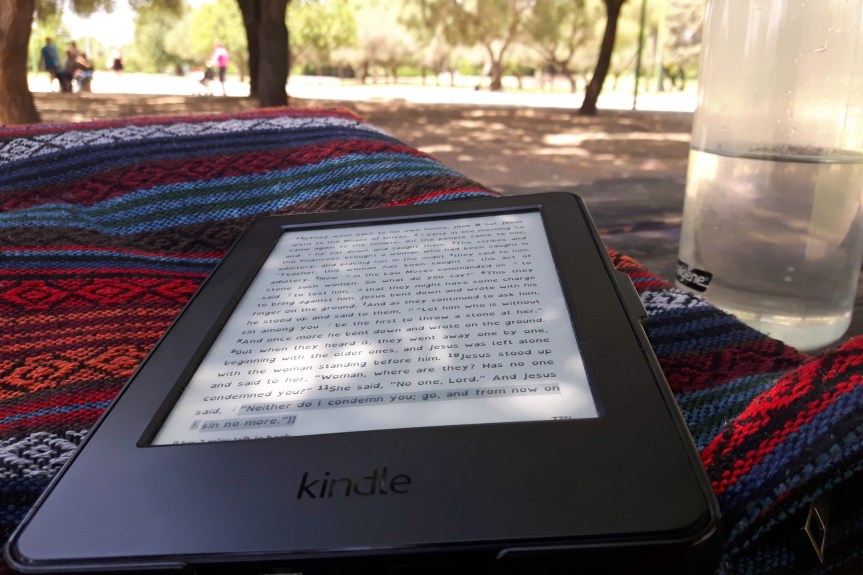
Neither do I condemn you

Whenever I read the story of the woman caught in adultery, I get caught up in Jesus’ brilliant suggestion for the one without sin to cast the first stone (Jn. 8:7).

Today was different. When I read the story this time, I saw His mercy.

Jesus did not condemn the sinful woman. “Neither do I condemn you; go, and from now on sin no more” (Jn. 8:11).

The One qualified to condemn did not. Instead, He freed her not only from shame and condemnation but also from the power of the sin in her life. “So if the Son sets you free, you will be free indeed” (Jn. 8:36).

What freedom that must have brought to a self-condemning heart!

And that’s the same freedom that should be evident in my own life and sometimes isn’t. I ignore Jesus’ words, believing that my own self-condemnation is greater than His promise. That His blood wasn’t worth the price of my sin.

That’s it, isn’t it? Unbelief masked as ongoing remorse.

Am I “free indeed”? Do I believe that there is truly “no condemnation for those who are in Christ Jesus” (Rom. 8:1)?