Part five: Friends and ferries

Click to read: Part one: A palace and a hostel, Part two: A stolen sandwich and art, Part three: Relationship advice and edible puzzles, and Part four: Tanneries and street food


My friend was waiting when our bus pulled into one of the country’s eastern-most cities. Back at the house, we joined her husband and a bubbling lasagna and caught up over supper.

When the guys left to check into J’s downtown hotel, J took my phone–the one with functioning data–in case he needed help getting back in the morning. As he left, I worried aloud. My fears were unreasonable, I knew, with his being a seasoned traveler, but he was blazing a new territory all alone. He told me that I was nervous so he wouldn’t have to be. 

As soon as they had gone, my friend and I got down to the heart-to-heart girl talk we’d been waiting for.😀

The next morning, her husband got up early to make the German version of cinnamon rolls, or “cinnamon snails.” After breakfast, we parted ways–the men for a hike, the women shopping. My friend and I moseyed through a shaded market area and even had the privilege of witnessing a fight involving a shattered shop display and two irate shopkeepers. We also meandered through the city and finally found an unoccupied shady spot in the park.

The only thing I bought was a notebook for writing letters. I figured J would approve since most of the letters would likely arrive to his mailbox.
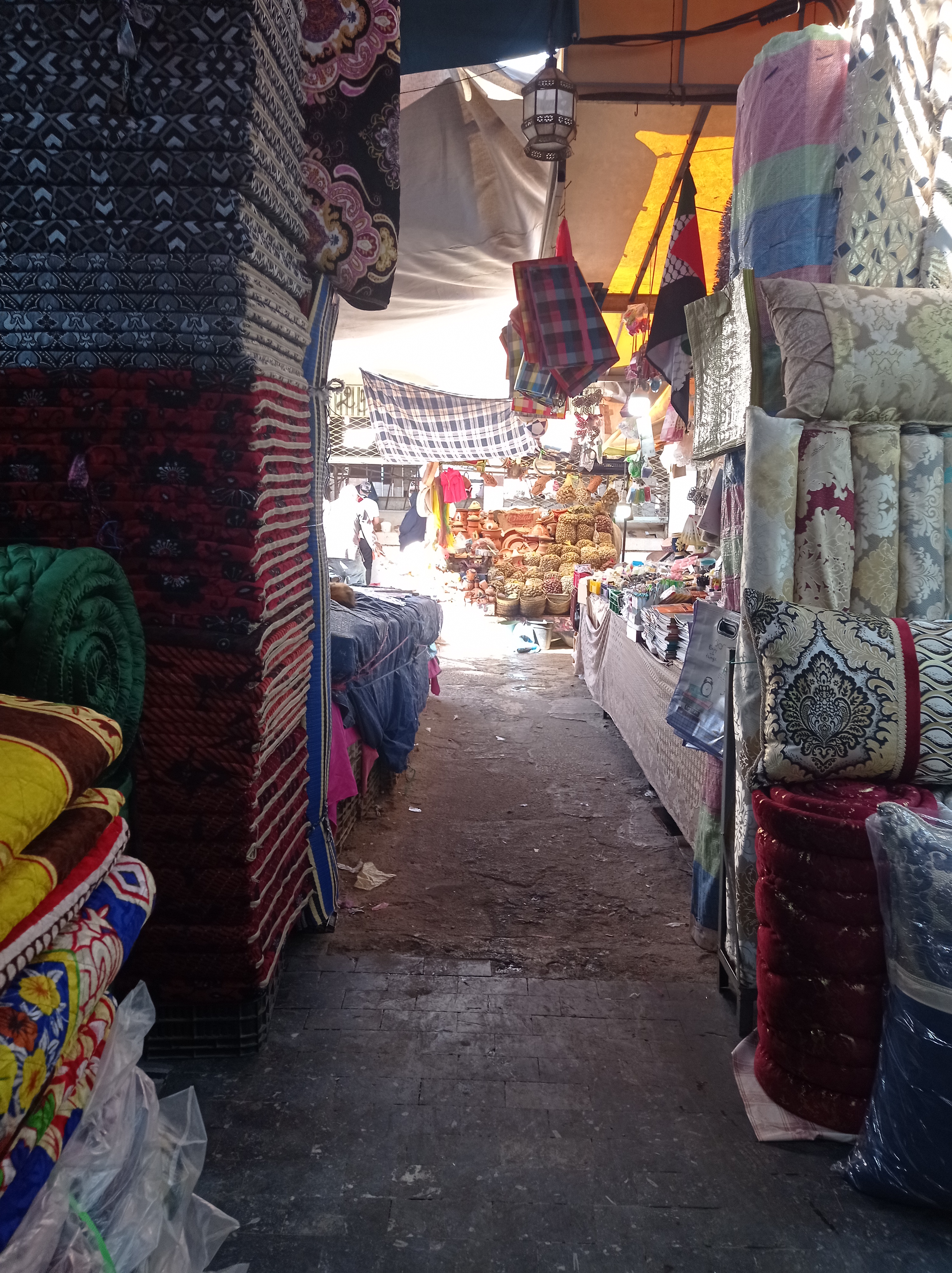
Market wares

We met the men for lunch in a family restaurant with comfortable chairs. We lingered over the mouth-watering salads, reluctant to move on, even after the main course arrived. Our main course, tride au poulet, was chicken slathered in some sort of sweet sauce and covered with thin sheets of pastry dough. It was delicious, but far too sweet for either J or me. We made a valiant effort, but still couldn’t finish the dish.

bread and small dishes of various salads
tride au poulet

After an afternoon rest, we walked to a local park–a dot of refreshing green in the midst of vast brown. We picked up a few foods on our way home for a light supper. I may or may not have eaten more than my share of the maaqoudas (potato-based fritters) because I forgot how much I loved them.

The next morning, we said our goodbyes after breakfast. It had been a short but worthwhile visit. As we waited in line for a taxi to take us to the border city, I was unpleasantly surprised to see that our taxi would be an old Mercedes rather than a newer taxi where everyone was entitled to their own seat. The driver ordered J and me to sit together in the front seat. I attempted to be a good sport, but I could already picture us emerging from the taxi hours later with crooked spines and headaches. J perched himself on the center console and somehow managed to give me the majority of the front seat without interfering with the driver’s shifting. He even dozed off up there!

Our border crossing was smooth, thanks to our blue passports. From the border, we walked to the port and boarded our waiting ferry. We had the perfect amount of time, despite the fact that we had forgotten to calculate the hour time jump once we crossed the border. The ride was 6½ hours, so we had plenty of time both to rest and explore. We did both, but spent most of the time on the upper passenger deck. There, the wind was chilly and the sun bright. As we talked, we stared at the water, mesmerized by the swirling foam the ferry left behind. We even saw dolphins for a few magical minutes.

ferry on open sea

Soon, darkness was falling. Our ferry pulled into the Almería port and we disembarked into the familiar night air. After only five days in North Africa, Spain was downright homey.
Part four: Tanneries and street food

Click to read: Part one: A palace and a hostel, Part two: A stolen sandwich and art, and Part three: Relationship advice and edible puzzles


I had never used the BlaBlaCar app before. Surely a carpooling app couldn’t be as pain-free as it looked. But it was! J and I arrived at the Málaga Costa del Sol airport in plenty of time. We checked in and zipped through security and border control before parking ourselves just inside of the international gate area to people-watch.

We were some of the last passengers to board our flight. Why rush to constrain yourself to a seat that’s already reserved for you? Our 15 euro flight got us to North Africa safely. After we landed, J and I stayed in our seats rather than smashing ourselves against the other passengers in the aisle. We didn’t even stand up, necks bent at unnatural angles under the overhead bins. (Why do we do this?!)

A man who had been watching us announced to the other passengers: “These are the most intelligent people on here! They waited to get on the plane until the last and they are waiting to get off the plane too!”

As we waited in the customs line, I couldn’t wait and asked J, “What do you think of North Africa so far?” Wisely, he returned that he wasn’t sure if his first impressions were accurate and that he’d rather wait to give them.

We stepped out of the airport and were spat into North African culture where overly helpful taxi drivers swarmed. After hemming and hawing, we agreed to a ride for 150 dirham, 50 dirham less than the initial asking price.

Once we had been deposited in our friends’ neighborhood, I asked the neighborhood guard where the Americans lived. He pointed me to a black gate and told me how many stories up. Americans in that part of the world don’t have much anonymity, and that is what I had been counting on. 

We joined the family, catching up on life, hanging out with the children, and feasting on a giant stir-fry for supper. 

The next day was our day to tour the city. It was my chance to show J the world that had been mine for 16 months. We passed my old language school and I recalled the hours I had spent exhausting my sweat and tears while learning Arabic. We dropped by my old neighborhood too, even popping in at the little store around the corner to say hello and buy a Snicker bar just because. (We also forgot about that Snicker bar until it became a squished pile in the bottom of our warm and sweaty backpack.) 

From there, we snagged a taxi to the old city. I could already feel myself shriveling into a prune. The weather was hotter than I had expected and much drier than either of us were used to. We couldn’t keep up with our water intake. 

We descended into the heart of the old city to the renowned tanneries, avoiding anyone who was too helpful. In fact, over the course of the day we managed to disappoint a lot of hopeful shopkeepers, browsing rather than buying. At the tanneries, we stood at the lookout and peered down on all of the action. There was so much to watch at once. J shooed away an over-eager tour guide, preferring to figure things out on his own.

colorful tannery vats

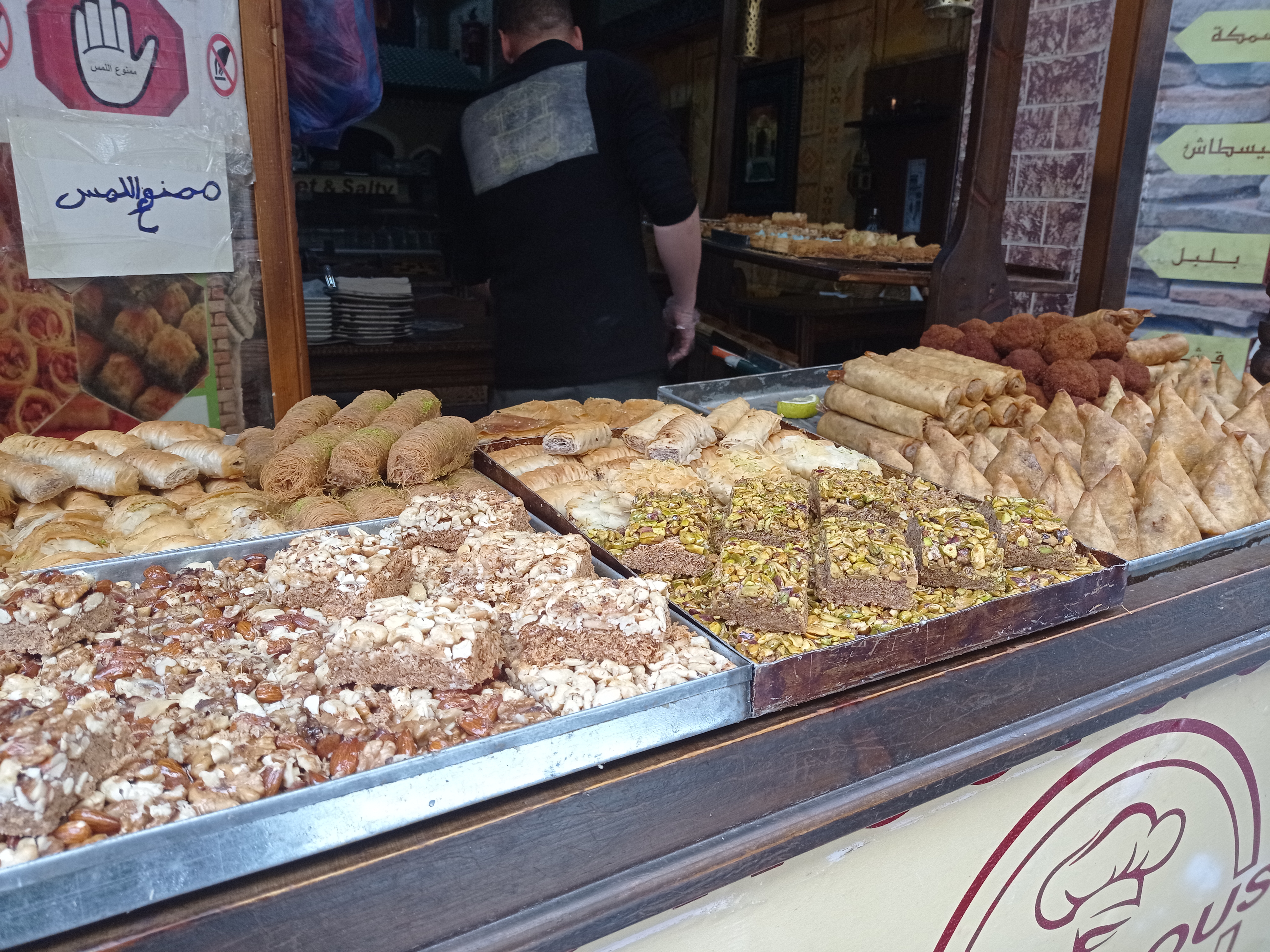
We hunted for a hole-in-the-wall restaurant, but the only one I remembered wasn’t serving lunch yet. So we bought street food instead: neems (fried spring rolls), briouats (a triangular, chicken filled pastry), kalinte (chickpea flan) sprinkled with cumin and red pepper, and olives with lemon and parsley. 

We looked for a place to eat our collection, and finally found a sunny spot along the ledge of a fence. But first on our menu was activated charcoal. Three pills before and three after a meal. With street food on a warm day, I got pretty bossy about following the instructions. We took our time, munching and tossing olive pits at the trunk of a scrawny tree in the sidewalk. Even there in that scorching African sunbeam, our repast was delicious.

street food cart

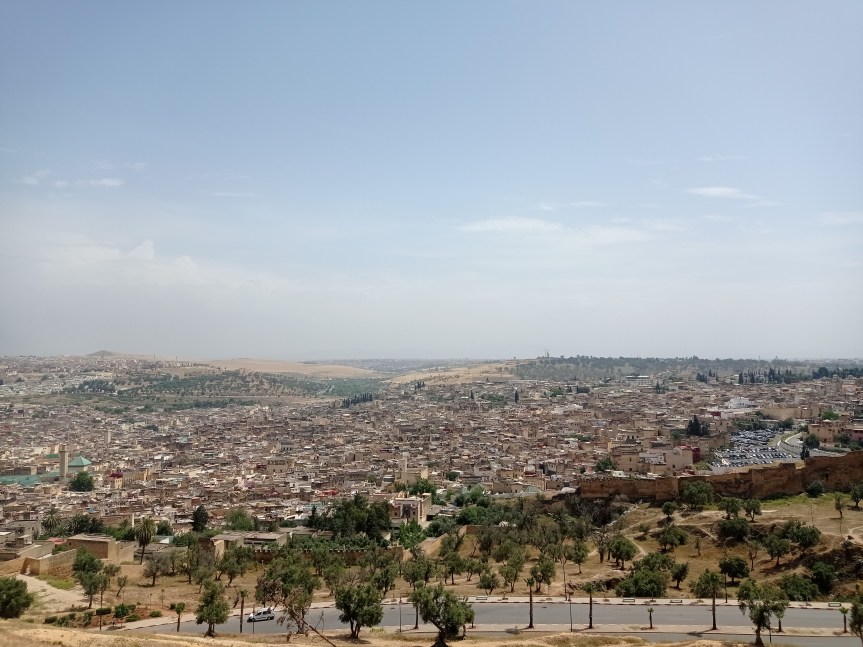
From my time of living in the city, I had fond memories of climbing up the side of a hill to a set of ancient tombs that overlooked the city. But how to get there? We stopped to ask directions. The shopkeeper gave us some of his life story for free as well as detailed directions, which I promptly forgot by trying to retain everything he said. No matter. We still had Google maps and what was left of my memory. We wound our way up the hill, admired the tombs and the view and then parked ourselves in the shade until my fantasy about a tall glass of fresh-squeezed orange juice overpowered the lure of a shady spot. 

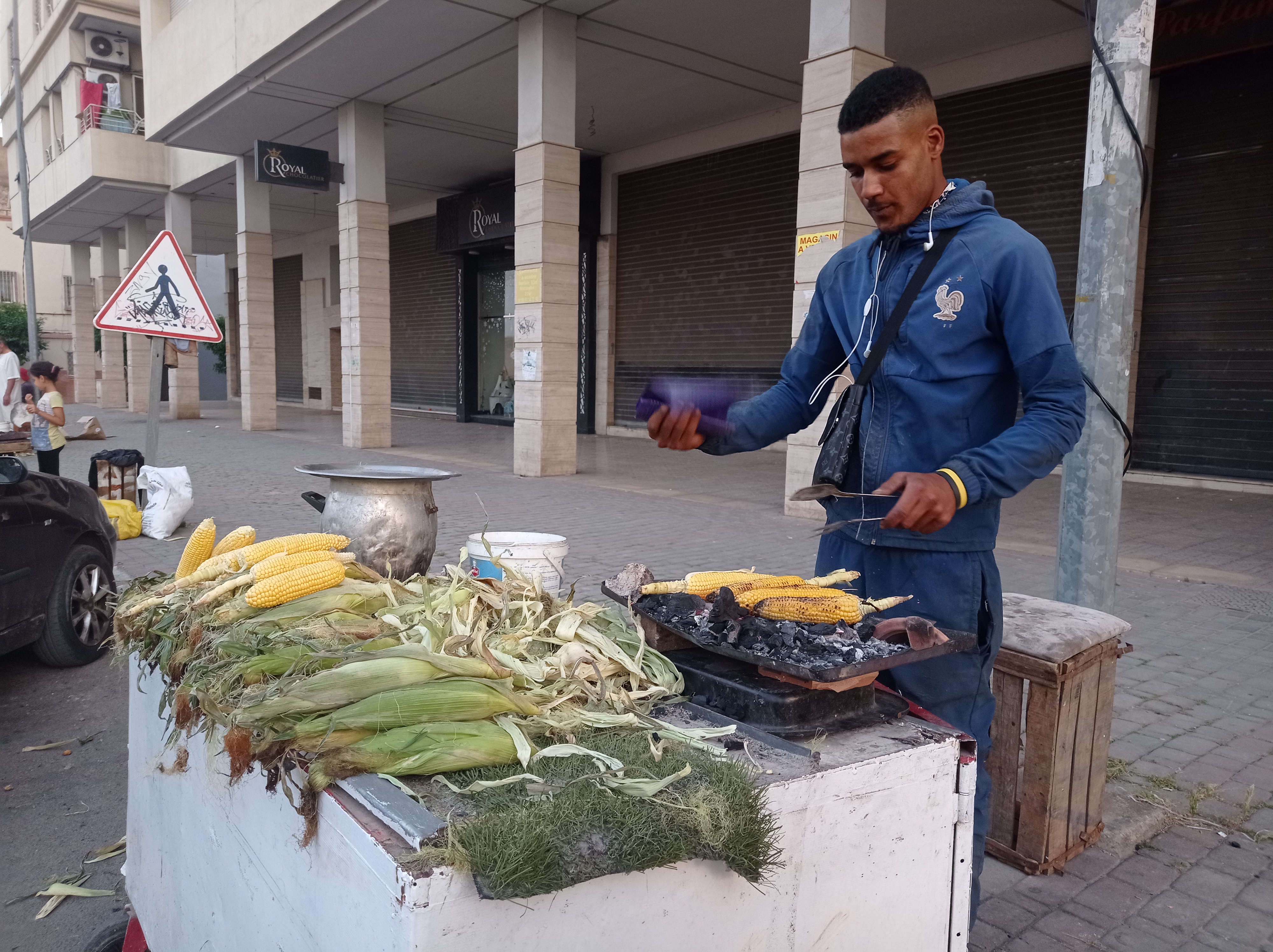
We spent a chunk of the afternoon perched on a restaurant’s third story, sipping orange juice, eating tagine, and watching people swirling in and out of the city gate below. Once we had cooled off, we meandered back to our friends’ house, with one last stop to buy an ear of roasted street corn.

Street corn vendor

The next morning, we envisioned ourselves arriving at the international church on time. Instead, with all of the careful packing that went into the morning–the gifts for a friend’s family, the trusty charcoal, and the Imodium, just in case–I managed to forget my wallet. My wallet which held our only local currency.

“I’m sorry. We don’t have money,” I told the taxi driver. “Take us back to the house.” Obligingly, he made a loop at the next roundabout and waited outside while I dashed up the flights of stairs to retrieve my wallet. Any dreams of arriving at church on time were crushed. 

Although the fellowship had changed since I had been there last, it was still charged with a buzzing energy of brothers and sisters in Christ uniting after a long week. After the service, I was able to reconnect with a few acquaintances before we were on our way to visit Chaimae and her family.

I was surprised by how Chaimae’s family remained unchanged. Throughout the day, most of the family dropped by, delighted to meet J and practice their English. They fed us breakfast and then fed us several courses of lunch a few hours later. That afternoon, J got a very long look into North African culture.

North African breakfast spread

Our time in the city was drawing to a close. The next morning we breakfasted on eggs and khlea, a cured beef that tastes like a barn. I hung out in the egg section, but J preferred the barny beef. The guy has an inexcusably tolerant palate. 

As we left the city, I looked out the bus window, wondering if I was saying goodbye forever. I felt nostalgic but realized I no longer had a lingering sense of belonging.

Some ups and downs of language learning

We approached what we hoped was the bus stop, our suitcases rattling along behind and a disgruntled (and tipsy) beggar peering after us. Since disembarking the ferry, we were well aware that we were in foreign territory once again. “Toto, I’ve a feeling we’re not in Spain anymore!”

“Peace be upon you. Do taxis stop here?” I threw the question out to a group of brightly dressed ladies waiting in a spot of shade.

“The taxis are over there, in the port,” one lady spoke up.

“No, I mean the taxis that you pay by place. Those other taxis are too expensive.”

Back and forth we went until suddenly she started giggling. “I’m speaking with you in Arabic! You’re a foreigner and I’m speaking with you in Arabic!”

Back in Spain, I apparently used just enough of a greeting but not enough filler conversation for a new customer to ask me if I was North African.

I thanked her and laughed because it always amuses me that someone with my complexion could ever be mistaken for a North African.

With wide eyes, she backed away from me, exclaiming, “Tbarakallah!” (God be praised!)
And it’s always refreshing to hear someone say, “You talk like us!” even when I obviously don’t. It makes the weekly log of Arabic study look less intimidating somehow.

Don’t get me wrong. There are also the less-proud moments.

Like when, after an English class, I was zoning out over a bowl of harira, letting the conversation swirl around me. Suddenly, my friend turned to me. “Isn’t that right?”

I swallowed that spoonful of soup and looked back at her blankly. Right? What was I expected to agree to? I groped for context–a word or a phrase, but I found only a blank slate. Oh, boy.

Yet, in the same conversation, a woman who had designated herself as my Arabic teacher told me I was dangerous. Why? Apparently, I understood more than I let on. (At least when I wasn’t zoning out over my soup.)

There are also times that a friend will sigh and look weary while trying to understand what I am saying. Times when I talk in the wrong language, or simply switch back and forth between Arabic and Spanish without realizing it. Times when a joke or a witty quip falls flat because it was funny in my mind but not my mouth.

Occasionally, just to be annoying, I speak only in Arabic to a new shop owner. I don’t look North African, but neither do I look very Spanish. I’ve had owners eye me but keep speaking Arabic simply because they weren’t sure if they could switch to Spanish.

But my local shop owner got me back by playing my game with me. In fact, he didn’t let on that he spoke a decent amount of English for two whole years! In the meantime, he was able to eavesdrop on conversations I had with visiting friends. Today, we still talk mostly Arabic and he occasionally gives me language lessons while he bags up my groceries.

Overall, like I wrote last time, language learning is a journey, an act of worship. With its ups and downs, it’s bound to be a bumpy, but meaningful ride. 🙂

When in North Africa- Part 1

Last year, a fellow immigrant in Spain asked me to visit her when she went back to her country for the summer. I didn’t. 

But this year I did. My roommate and I navigated buses, taxis, and even a pre-Eid ferry that made us stand in line for hours to get a simple passport stamp. 

Just as our final taxi approached the place where we would meet my friend, we lunged over a pothole and I dumped my water bottle on myself. I was so soggy that when I got up, leftover water pooled in the leather seat. 

From the backseat, I reached my suitcase and managed a swift and subtle change while the other passengers remained in blessed oblivion. 

My friend, her husband, and her mother were waiting at the taxi stand. 

“Gather yourselves.” My friend called her sister as we approached the sprawling countryside house that would be our home for the week.

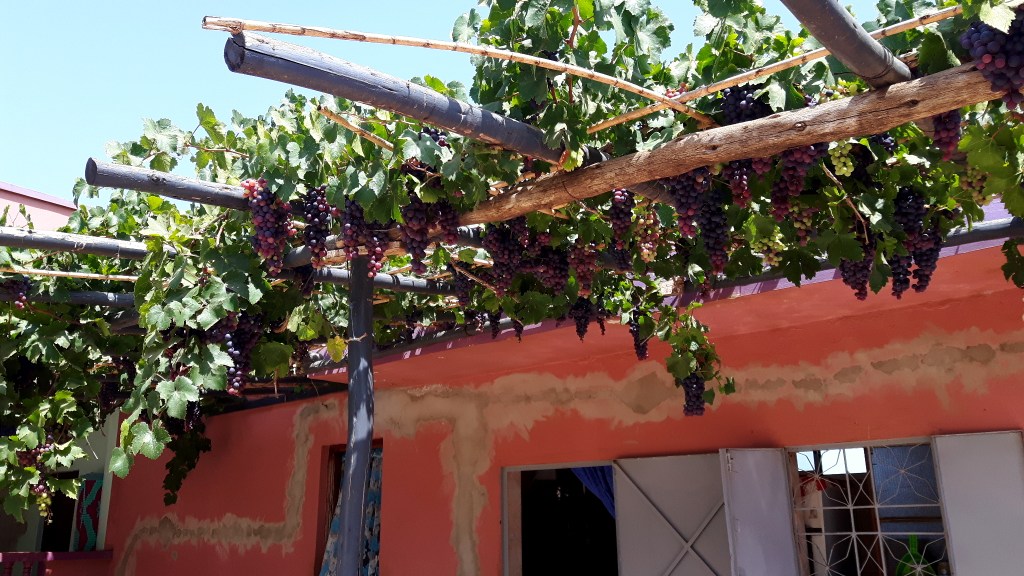
grape arbor above salmon colored house
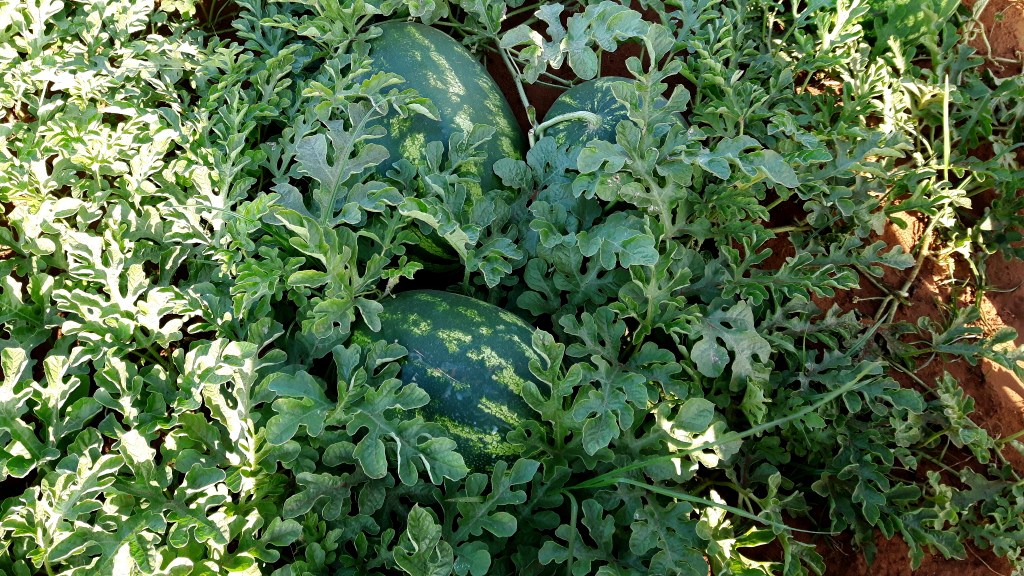
large watermelons hiding in vines

My roommate and I had long since resigned ourselves to the possibility of a public sleeping area, a dirty squatty, and bucket showers. Instead, we were shown into a salon the size of our entire apartment. And the bathroom was bigger than my bedroom at home. Outside the kitchen door was a grape arbor heavy with weaving vine and plump grape clusters. 

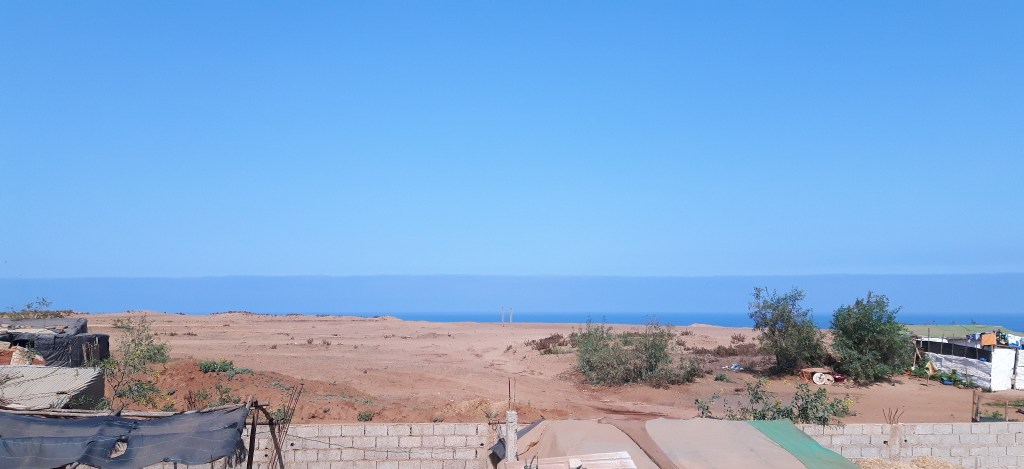
The house was surrounded on three sides by peanut and melon crops. The fourth side led down a steep hill to the ruggedly beautiful beach. Rolling land of green fields tuned my farm girl soul. I stood on the roof and drank in the fresh air. 

landscape of beach and the atlantic

“The air is still new,” my friend pointed to the chilly sea.

We began to meet the family. The house was alive with adult children and a handful of grandchildren. Most of the family resided within the walls of the family home. But there seemed space enough. Faces began to blur as the night wore on and we grew sleepier.

Our hosts spread a table with tea and all of its accompaniments. When we had filled to the brim, someone asked when we wanted dinner. Given that it was 11 p.m., we sat with widened eyes until I worked up the polite courage to ask, “What time do you usually eat?”

My friend laughed. “We don’t usually eat another meal,” she admitted and laughed again when we noticeably relaxed. 

They sent us to bed, still chuckling about the ominous beef and prune tagine.

Bargaining and boxing class: North Africa part 4

In December, I spent most of a week in North Africa, visiting friends. My intention is to give you a glimpse of my trip. Please forgive me for omitting certain details and for changing names in order to protect my friends.

“Can I have your phone number?” The taxi driver didn’t waste much time.

When I explained why that wasn’t possible, he asked if I was a Muslim.

“No. I follow Jesus the Messiah.”

He pondered this through several streets of traffic. As he pulled up to the curb to drop me off, he spoke again, “You should read the Qur’an.”

I sighed. “I do read the Qur’an. You should read the Bible.”

He frowned and shook his head at me in the rearview mirror as I handed him the fare.

In light of his suggestion, my own suggestion had been logical. But apparently only to me. “Why not? Are you scared?” I punctuated my challenge with a cheerful goodbye and a hasty exit.

This morning was my morning to go shopping in the old city. The sights and smells of the old city had remained unchanged for centuries and had certainly not changed in the year and a half of my absence. There is a forever skirmish between fragrant and repulsive: baking bread, roasting chicken, urine, a blend of fresh spices, rotting fruit, soaps and perfumes, trash.

Rather than the narrow cobblestone streets accommodating their pedestrians, tourists and residents alike pressed in close to accommodate the streets.

“Where have you been?” several vendors called to me as I bustled along. Did they– could they?!— really remember me?

To my disappointment, I had forgotten how to bargain. No longer was it a matter of easy banter and good deals; it felt exhausting and cheap. Fortunately, shopping didn’t take long since I could only buy what would fit in my backpack between my clothes.

I caught a taxi to my friend’s neighborhood only to find that Khadija and her neighbor, Fusia, were out studying. They would be back soon, said Khadija’s niece. I sat in the salon, watching TV and wondering how my two eighty-year-old friends were doing in their studies.

Suddenly, the door opened and everyone piled into the apartment. There were hugs and greetings that came so fast that I could only repeat “Praise God” and laugh. Someone made tea. Another ran out to buy cookies. We talked and watched a Turkish soap opera until dark.

“I’ll walk with you,” Fusia said. She held my hand and led me along the street. “We’re going to go see my grandson. He will be sad if he doesn’t see you.”

What I didn’t realize was that her grandson’s boxing class did not allow interruptions. Two women screened everyone who entered, and one looked like she could flatten anyone who crossed her. I was making plans for a polite retreat when Fusia asked if her friend all of the way from Spain could just greet dear little Ali.

“Of course! Come with me!”

And so I interrupted the boxing class, a whole room full of gawking children and their annoyed instructor. Ali ran over to kiss me. His cheeks were pink. Mine may have been too.

Only after that, I was allowed to get a taxi and return home.

Words were more than just words: North Africa part 3

In December, I spent most of a week in North Africa, visiting friends. My intention is to give you a glimpse of my trip. Please forgive me for omitting certain details and for changing names in order to protect my friends.

Chaimae’s hug was long and tight, trying to make up for the year and a half of missed embraces. Her mother gave me the same hug. They led me into the salon, not the fancy one for guests, but the family salon that doubled as a bedroom. I wasn’t a guest; I was still family.

“Did you eat lunch?”

Chaimae fried fish and reheated chicken and potatoes already in a pot. We ate, talked about our families, and showed pictures from our time apart. Both mother and daughter were amazed that I remembered Arabic, or at least a semblance of it.

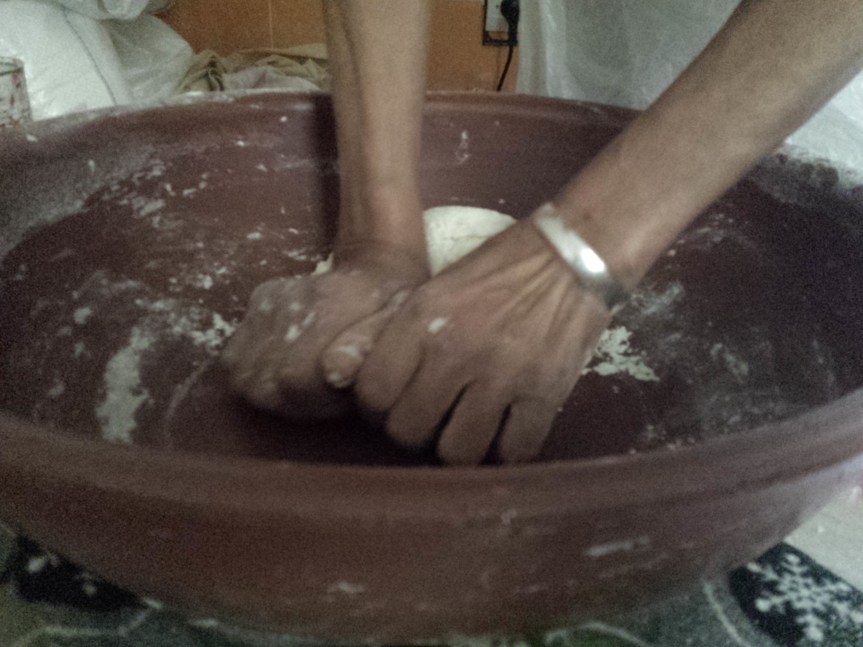
After the bread was patted into round loaves, Chaimae and I went for a stroll around the neighborhood. By the time we returned, the older brothers had arrived for afternoon tea.

It was after sipping cups of syrupy tea and eating mounds of oily bread that one of the brothers wiped his hands on the community napkin, leaned back against the couch, and pinned me with probing eyes. “Who is Jesus to you?”

I was ready.

The entire family listened as I shared. I listened as they shared. The conversation grew thick and loud. My face turned hot in animation. But their faces were hot too.

We discussed our differences and how our separate paths could not both be the path of God. Yet, beneath our disagreement was a profound respect for one another. We had known each other long enough now that words were more than just words; our words were what we had seen each other living and breathing.

And our words were as different as our lives.

Tea time blurred into dinner and more food appeared on the table, but no one seemed interested in another round of feasting.

My Arabic was worn out. So was the rest of me. When family members started to trickle out the door, I slipped into the kitchen to wash dishes. Chaimae made beds on the floor. She gave me a couch pillow so high that my neck immediately began to ache. I waited until the light was out to quietly set it aside.

Partway through the night, the light switched on.

“Chaimae! Chaimae! Wake up! Trish isn’t on her pillow!” They tucked the pillow under my kinked neck, and Chaimae’s mother tucked more blankets around me.

“It’s good that I slept in the room with you,” she told me after my interrupted night of sleep. “To take care of you.”

I smiled, hoping my expression reflected more of the endearment and less of the suffocation I was feeling.

After breakfast, they sent me to the taxi with enough tears to let me know I would be missed.

How do I love her?: North Africa part 2

In December, I spent most of a week in North Africa, visiting friends. My intention is to give you a glimpse of my trip. Please forgive me for omitting certain details and for changing names in order to protect my friends.

I woke up early. If I had known all that the day held, I may have tried harder to fall back asleep.

“Do you have a friend to meet you at the taxi stand?”

It was the normal question taxi drivers asked whenever they took me to Aisha’s neighborhood. And I was a bit nervous about locating the house without wandering up and down the streets of this particular neighborhood.

“Do you want me to walk you to the door?”

Then I saw it. The taxi driver had pulled ahead far enough that I could see the doorway from the taxi stand. “That’s it!” At least I was 90% sure.

At the top of those countless concrete stairs, I found the family at home, bursting with a warm welcome.

But all was not well.

The tension I had felt in their home more than a year ago had only increased. Sporadic and often violent discipline left the children confused, angry, and out of control.

Aisha invited me to sit on the naked couches. She had washed the covers for my visit, she said. She shook her head and clicked her tongue. Someone had slipped over the roof and stolen them off of the line as they dried in the sunshine.

As Aisha cooked (she refused my help, which was fortunate since her kitchen can only fit one person at a time), I slipped out to the rooftop to pray and to watch the world from the 6th story. The neighborhood was a moving I Spy book: a man leans over a roof parapet with a paint roller on a stick, turning dingy white to barn red. He calls to the men on the roof below to move their things so he doesn’t drip paint on them. His daughter swings on the clothesline behind him, laughing in delight as the wire stretches wider and wider. Boys play cards on the street below. Across the way, a woman gathers laundry. Just next door, a teenage girl drapes a blanket over the parapet, stops to watch the world, and spots me doing the same. I am fascinated by the movement—a symphony of together-life, sometimes harmonious, sometimes not.

More family came for a lunch of fried fish. And then we went for a walk. Rivers of mud flowed through the dirty market, splattering our shoes as motorcycles roared by. We came to an open area of crab grass, where families sat on blankets and pieces of cardboard and peeled mandarins while the children ran wild.

Aisha and I peeled mandarins together and had the first meaningful conversation of the day. But something in her expression and words spoke of stale panic.

The explosion came a little later, on our way home. Slaps, a bruised eye, and suddenly wood pieces hurled through the air as mother and daughter screamed at each other. Onlookers interceded, patching the family’s distress with layers of shame.

In the taxi on the way home, I hugged my backpack that now smelled like leftover cigarette smoke. “God, help this family!” I prayed until the words felt worn out. But God knew the layers in those words. How could I– a long-distance friend– initiate the healing of a crushed and bleeding family?

A few days later, we met for a final goodbye, just Aisha and I. We talked about her daughter. After listening to stories of behavior problems and irresponsibility, I begged Aisha to love her daughter.

“How do I love her?” she asked.

How does she show unconditional love when she may have never known it? How can she pass on what has never been passed on to her?

As we parted ways, I tried to scrape together my broken heart and wished I could scrape together hers too.

Some things I miss/ Things I don’t (so far)

Things I miss:

  • Friends
  • Making friends quickly
  • A respect for morals rather than a disdain of them
  • Bringing God into everyday conversation without people thinking you are overly pious
  • Easy and cheap transportation
  • Inexpensive produce
  • Going out to eat on a whim because of inexpensive menu prices
  • Bargaining for prices
  • Warm and constant hospitality
  • Crossing the street without a crosswalk… and not feeling guilty
  • People looking excited when you speak to them in their language
  • People watching out for you

Things I don’t miss:

  • The class system and discrimination
  • Being addressed in French
  • Being treated as a trophy friend
  • Being treated as better than others
  • The façade of open-mindedness
  • A monotonous cuisine
  • Bread
  • Catcalls
  • Being targeted by people asking for things because you are a foreigner
  • People budging
  • People asking invasive questions

Djellaba shopping

We were supposed to be going djellaba shopping. Aisha had volunteered to help me when she found out I wanted to buy a traditional dress. I had agreed to meet her at her house, knowing well what would happen.

I was right. After an hour or so, when lunch was cleaned up and everyone was dressed, we moseyed out to a shop that happened to be closed. So we spent another half hour sitting on her mother’s couch and chatting over cups of thick coffee as someone dozed under a wool blanket across the room.

We entered a tiny shop that sold mostly pajamas. They did have a few djellabas, however. The tailor made me try them on and was disheartened when they all ended before my wrists and above my ankles.

So he took my measurements and told me to pick out a fabric. Aisha negotiated the price alone. When we walked away, she squealed. “That is the local price. You would not get a price like that. If I wasn’t with you, people would take advantage of you.” I didn’t doubt it.

She still had my money in her pocket and waving the scrap of fabric the tailor had snipped off for us, she insisted that we find a headscarf and traditional shoes to match my new outfit.

In that neighborhood there was such a camaraderie of poverty- a people that hovered just above the grime of life, but hovered together. Still, admonitions came to “hold your sack in front of you, not behind you!” Indeed, a lady in front of us paused when she realized that she no longer had her wallet.

But I was so watched that I couldn’t imagine how anyone could have stolen anything from me without someone else noticing. People swarmed around us, bumped into us, gawked at us.

A shopkeeper motioned to me while addressing Aisha. “Is she a Muslim?”
“No.”
“Not yet.” He eyed me. “Why aren’t you a Muslim?”
Taken off-guard, I straightened. “Why do I need to be?”
“She prays!” Aisha inserted, intent on protecting my religious freedom.
“Who is she?”
“My sister.”
“You’re short and she’s tall. How can you be sisters?”
I cleared my throat. “She is like our mother and I am like our father.”
Then Aisha and I giggled together, and the shopkeeper gave an irritated but irrepressible grin.

Another lady stopped us and Aisha proudly told her that I was getting a djellaba made by a local tailor.
“Is she a Muslim?”
“No.”
“Does she pray?”
“Yes.”
“Does she fast?”
“Yes, she fasts.”
“Well then, what does it matter what she is?”

I spoke up then, but the lady was more interested in the fact that I was speaking her dialect than in what I had to say. And she walked away, still convinced that my good deeds gave me a good shot at paradise.

The sundown prayer call sounded. Aisha kissed me goodbye and tucked me into a taxi, even while insisting that I stay for tea.

I stared out the window at the sunset on the way home, pensive and full. It was one of those days that I would like to store in my pocket and pull out when I get lonesome for these people.

Living memories

People
Are living memories of all you’ve
Seen, heard, smelled, tasted, and felt
With them.
You wake up one morning
And find you married
The reality you love.
And before you go
You must have that
Last walk to school
Last taxi ride
Last cup of tea.
Then you close the door behind you,
Taking only lifeless photos
And stale words in worn journals.