
Redeemed opportunities

Where do missed opportunities go? Are they gone forever or does God redeem them by giving us new opportunities?

Here in North Africa, where living intentionally should be as easy as breathing, I still miss opportunities. Why? Well, I’m busy; there is always language to study, classes to teach, emails to write, friends to visit, etc.

But those excuses aren’t good enough. Try telling a little boy that preparing lunch is more important than his soul. Maybe that’s not exactly what I said, but it is most likely what I communicated.

I was in the middle of a bad day when he followed me home from the store. People had been raining expectations down on me and I was exhausted although the day was only half finished. So when he jumped up and followed me, I rolled my eyes.

He only wanted one coin, he said. But to me, he was just one more beggar with just one more fabulous fable to accompany the outstretched palm. I tried to be pleasant, but my smile faded with his persistence. “Enough!” I said as he fell in step with me. “Be quiet!” I said. He didn’t. He followed me to my doorstep and only stopped when I closed the door behind me.

I had just started putting groceries away when my conscience awakened. What if I was the only person in that boy’s life who could have shared truth with him?

It took an hour or so before I was ready to face him again and apologize for my heartlessness. But when I went outside, he wasn’t there. Nor was he in front of the store. He had vanished.

So had my opportunity.

But my question is this: Has God redeemed my mistake by giving me another opportunity? Could it be having tea with that lonely widow? Or maybe taking time for a girl whose insecurity manifests itself in bullying?

God is a God of redemption. Because He has redeemed me, I know He is capable of redeeming my missed opportunities.


This post was first published on https://lucindajmiller.com
Blessed are they that budge

Blessed are they that budge for they shall be first in line.

If that’s not a North African proverb, it should be. Some days instead of the one being budged, I want to be the one budging. Let them see how it feels for once.

But I know that’s a selfish attitude. So the question lingers: How exactly do I cope in such a pushy culture?

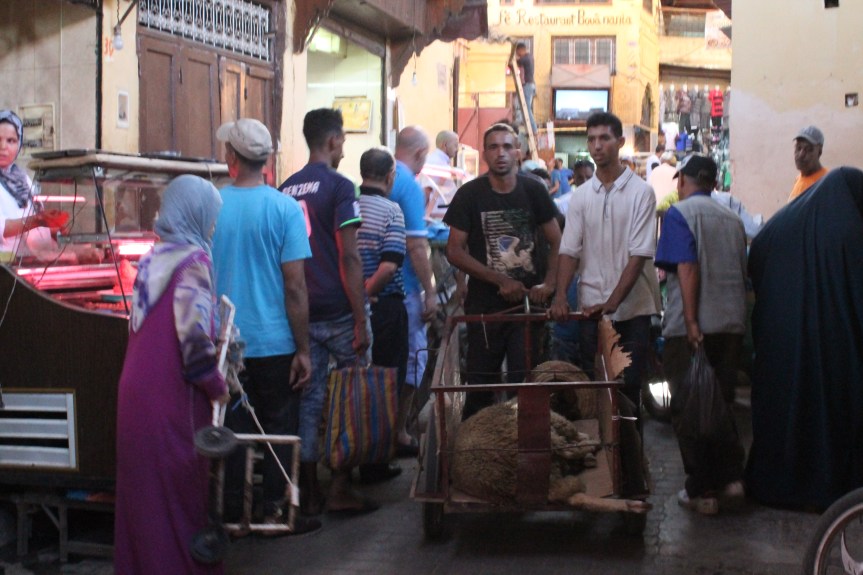
For example, standing in line at a shop today, the owner served the 5 pushy people behind me before he fetched what I asked for. Then I stood with my money on the counter while he served the next 10 pushy people behind me.

It wasn’t until I said, “Take this, sir!” that he turned to me and apologized. I wasn’t even tempted to give him the customary, “No problem.” My inflamed temper wanted to clear the crowd at the counter with a giant push and then hurl my unpurchased items at the shop owner. I could even envision myself stomping out, bellowing that I would never return.

How should I have acted? Really, the question is: How should I act? This isn’t a one time occurrence but a constant cultural barrier for me. In my 9 months here, I have met few truly courteous strangers; most courtesy turns out to be greediness in disguise.

This is one of the only things in this culture of which I cannot even glimpse a bright side. So, practically speaking, what should I do? Hang around a shop until the owner notices and takes pity on me? Disobey God’s command to love others as myself and begin pushing like everyone else?

Well, maybe my first step is to stop gritting my teeth when people infringe on my right to be served before them.

Too many hours on a train

I find that when I am forced to be inactive for a length of time, I begin to wonder things I normally don’t take time to think about.

Such as:

Is it only those with rushed, complicated lives that can appreciate the simple? Can those who are simple truly appreciate their simplicity when they’ve never experienced anything different? So then, can simplicity only be fully appreciated by those who don’t have it? And can the complicated life ever go back to being simple or does it always carry its baggage of experience with it? Can the process of losing simplicity ever be reversed? In short, can one both know and appreciate their own simplicity?

We are dust

Do you ever get tired of living by the expectations of the culture around you? I do. Expectations can be healthy, a type of accountability. In a way, expectations are what people give you when they can’t or chose not to give you rules.

Living in a different culture gives me two sets of cultural expectations to abide by. Suddenly, besides the way that I have been raised to behave, I am given a new set of standards from a very different culture. Sometimes I am stranded when the cultures clash: Is it better to be evasive and deceptive or offend someone by being truthful? Either way, someone is unhappy.

In short, I forget to focus on God’s expectations, which might mean disappointing both cultures. 

But are God’s expectations attainable? He was the one who placed me in this cultural conflict in the first place, so wouldn’t His expectations be the hardest to meet of all? And He does expect a lot:

“And we all, with unveiled face, beholding the glory of the Lord, are being transformed into the same image from one degree of glory to another.”

2 Cor. 3:18

His expectation is that we become more like the Son, more challenging than any cultural demand!

But He also remembers something that cultures forget: we are dust. Living to please cultural expectations would drain every drop of our resources, and like Solomon’s leech (Prov. 30:15), the culture(s) would still cry for more.

But God sees our limitations and coordinates them with His great expectation:

“As a father shows compassion to his children,
so the Lord shows compassion to those who fear him.
For he knows our frame; he remembers that we are dust.”

Ps. 103:13-14

He doesn’t forget our frailty; he knows what it is like to be a human. His expectation for us doesn’t change, but as we learn, His grace abounds.

Picky eater

“Picky eeeeeater!”

I heard that phrase a lot as a child, mostly from older siblings. As I grew up, I learned to like more foods, as most children do. But living here in North Africa, I have come to a deeper understanding of “picky eater.” North Africans are the pickiest eaters I have encountered in my limited international experience.

Why? Well, that’s the question I have been asking myself since I arrived.

In my opinion, most of the answer can be found in the pride the people have for their own cuisine. On my last trip home from Spain, I sat beside two men on the plane–one from North Africa and another from South America. This was the conversation:

South American: Is the food here good?
North African: It is the best in the world!

They hadn’t asked my opinion, so I sat, pondering the unmasked pride of the North African. Granted, the food here is good; I love it. But I also know that there are other flavors out there besides cumin, olive, dried fruit, lemon, and garlic. And how many other cuisines had this particular North African tasted?

In fact, how many ethnic restaurants does my city have? The few scattered here and there have to be sniffed out by a detective. Unless the three fast food restaurants count as American. There is also a pasta place in the mall. Italian, I suppose?

But the other restaurants seem to have exactly the same menu. It’s like the few things they do, they do well…but they remain few. And that’s all the people have ever known. So anything foreign is unwelcome because, of course, it could never measure up anyway!

When I make food for local friends, I select recipes with care. Something North African would not suit because as a foreigner, I wouldn’t prepare it correctly. Therefore, I must try something American but with the prominent North African flavors.

But once, a friend came to visit me unexpectedly. Although hesitant, I offered her some of the stir-fry I had just made. She tasted it and has been talking about that “salad” ever since, hoping to replicate it in her own kitchen.

That gives me hope that with more globalization will come more exposure to various cuisines and hence fewer picky eaters in North Africa!

Unashamed of our offerings

A few weeks ago, a friend read us the story of the woman and the copper coins (Mark. 12:41-44). As we sat around the room listening to the story, we saw the Teacher and His disciples watching the procession of people drop their dutiful percentages into the offering box.

And in the middle of the clanking coins of the proud and wealthy, we saw a poor widow approach the box and drop in her two small copper coins.

I had always pictured the widow creeping up and hiding her flushed face as she dropped in her offering. But if she was trying to hide, she would have done a better job than to let the disciples see the value and count the number of coins that had dropped in.

Maybe she wasn’t embarrassed at all. Despite the wealth and the substantial giving of the others, she was unashamed to bring her offering to God. And why should she be ashamed? She gave God 100%; she gave “all that she had to live on” (Mark 12:44).

I want to offer my life like she offered her two copper coins.

We miracles that don’t look like miracles

Not long ago, someone told me, “Every story is beautiful.” “Of course!” I probably responded. All stories were beautiful, but some stories were fascinating: dreams and visions, persecution, bold statements of faith, etc. Those were the stories that captivated me. They still do.

But that someone was right by putting all stories on the same level. Because, as he went on to say, “God loves you just as much as He loves anyone else.” Right. Of course, but–

But it’s true. My redemption story is just as miraculous and beautiful even though I haven’t “stopped the mouths of lions, quenched the power of fire, escaped the edge of the sword” (Heb. 11:33-34). In fact, many of the people who are in the Hebrews “Hall of Faith” lived lives of simple obedience rather than lives of excitement.

Those exciting stories are still fascinating. However, my challenge this week is to thank God for the redemption stories of the “normal” people around me.

Whether exciting or not, our stories are miraculous.

Life is too much

This morning I woke up early but chose not to get out of bed. The fan’s consistent hum soothed me as my mind wandered over the past week… and then the coming week.

As I lay there, suddenly I was terrified by the sensation that life was too much for me. I couldn’t face it. I couldn’t overcome the obstacles in my course.

The panicky taste lingered as all of my challenges and problems heaped up in front of me and dared me to climb. I only wanted to run away. Until I remembered that greater is He that is in me than he that is in the world (1 Jn. 4:4).

The lighter side of language learning

I have no history with the other foreigners I have met here in North Africa: no previous inside jokes, no awkward memories of growing up together, etc.

Yet, because we are here together, we have begun to share something that I cannot share with people from home: the joy of mixing our common languages. And the beautiful thing is that we understand each other.

My class is known as the class that laughs a lot. My classmates and I are often drawing parallels from Arabic to English. There are verbs that in their conjugated forms sound like “guilty” and “dirty”, and nouns that sounds like “slave” and “smelly.” So we utilize them as their false English cognate, so much that our teachers have begun to do the same.

We also like directly translating from Arabic. In Arabic, many verbs are a slight variation of their nouns. “Do you want to coffee with me and have coffee at the coffee?”or “The chicken eggs eggs.”

And then there are times when we make up our own words completely such as tacking an English ending onto an Arabic verb or even using both Arabic and English constructions on the same root word.

For example, in Arabic the passive voice is typically the normal verb preceded by a “t” sound. And, as you know, the regular past tense verb in English ends in “ed”.

One day, as a friend and I were walking down the street, a guy from a passing vehicle hollered, “Bonjour!”

We giggled. “We’ve just been tbonjoured.”

Hot

I have spent most of my summers in humid Illinois, a few in Mexico, and last summer in Phoenix, Arizona. Yet, every time spring yields to an overpowering summer, the heat catches me off guard.

Sure there are ways to survive even without air conditioning. Here in North Africa, spray bottles, fans, popsicles,  and cold water bottles come to mind.

The sun hovers directly above the city and beats its rays into the vast stretches of concrete and tile. Don’t picture me lounging on lush green grass under a generous shade tree. If I reclined on the ground, I would probably fry like an egg. And most of the shade comes when the sun dips behind the concrete buildings.

I have little energy. Staying hydrated is a chore. Headaches are routine. Sometimes I’m even sick to my stomach.

Yet, this miserable heat brings out the camaraderie that wouldn’t be here if the weather were perfect. After the sun goes down, people unite on the streets, visiting, shopping, or just watching the world go by. The carefree atmosphere comes from the underlying sensation of “Whew! We survived another day together!”