A life of perpetual humiliation

I just finished reading Anthony Doerr’s Four Seasons in Rome. Someone discarded it, and I picked it up, curious. This isn’t a book recommendation unless you happen to know that you like Anthony Doerr, but Doerr’s descriptions of life on the outside of a culture cut me wide open. I didn’t know there were words for these “in but not of” feelings.

Apartness and perpetual humiliation are part of daily life for those living overseas. Sometimes we talk about it too much. Often we don’t even acknowledge it but let our frustration become part of the existing barrier, like a thick moss growing over a wall we’re trying to ignore.

We are outsiders, always outsiders, chipping at the barrier that stands between us. And there are successes! Moments when a chunk of the wall falls away and we glimpse the other side…only to find razor wire. 

“To be a nonfluent foreigner is to pass through one gate only to find yourself outside two more,” writes Doerr (p. 46). “We are humbled over and over–humility hangs over our heads like a sledgehammer… Oh, you think you’ve been here long enough to barter at the street markets? Guess what, you just spent €8 on three plastic clothes hangers” (p. 76).

After nine months in Rome, Doerr walks into a grocery store and makes an order without messing up a single syllable. “What happens?” he writes. “I get my groceries. No streamers drop from the ceiling, no strobe lights start flashing. The grocer doesn’t reach across the counter and take my face in her hands and kiss me on the forehead.” Instead, the grocer asks about his boys and speaks so quickly he can’t keep up. “…I miss 80 percent of it and sheepishly, stepping down from my throne of fluency, have to ask, ‘I’m sorry, more slowly, please?’” (p. 168)

For some, eventually the barriers do not loom so large or feel so insurmountable. But for many? “I know nothing… I never made it through the gates between myself and the Italians. I cannot claim to have become, in even the smallest manner, Roman” (p. 201).

True. Despite my efforts to integrate into the culture around me, my North American worldview remains mostly intact, placing me decidedly on the outside. 

But if we let it, doesn’t living on the outside help us accept who we are? After all, like it or not, we cannot cease being a part of something. Not being a part of the culture we’re living in is because we’re part of another, or even several. Being on the outside can help us identify our own “inside.”

Apartness and perpetual humiliation are hard, but they are also opportunities to learn and grow.* And we need these opportunities to understand ourselves.

So I will try to be grateful. Even as my neighbor gives me a list of what is wrong with my couscous. Next time, it will be better. I can promise.


Doerr, Anthony. Four Seasons in Rome. Scribner, 2007. 

*Thank you, J, for your positive spin on life to remind me to keep on growing!

Part four: Tanneries and street food

Click to read: Part one: A palace and a hostel, Part two: A stolen sandwich and art, and Part three: Relationship advice and edible puzzles


I had never used the BlaBlaCar app before. Surely a carpooling app couldn’t be as pain-free as it looked. But it was! J and I arrived at the Málaga Costa del Sol airport in plenty of time. We checked in and zipped through security and border control before parking ourselves just inside of the international gate area to people-watch.

We were some of the last passengers to board our flight. Why rush to constrain yourself to a seat that’s already reserved for you? Our 15 euro flight got us to North Africa safely. After we landed, J and I stayed in our seats rather than smashing ourselves against the other passengers in the aisle. We didn’t even stand up, necks bent at unnatural angles under the overhead bins. (Why do we do this?!)

A man who had been watching us announced to the other passengers: “These are the most intelligent people on here! They waited to get on the plane until the last and they are waiting to get off the plane too!”

As we waited in the customs line, I couldn’t wait and asked J, “What do you think of North Africa so far?” Wisely, he returned that he wasn’t sure if his first impressions were accurate and that he’d rather wait to give them.

We stepped out of the airport and were spat into North African culture where overly helpful taxi drivers swarmed. After hemming and hawing, we agreed to a ride for 150 dirham, 50 dirham less than the initial asking price.

Once we had been deposited in our friends’ neighborhood, I asked the neighborhood guard where the Americans lived. He pointed me to a black gate and told me how many stories up. Americans in that part of the world don’t have much anonymity, and that is what I had been counting on. 

We joined the family, catching up on life, hanging out with the children, and feasting on a giant stir-fry for supper. 

The next day was our day to tour the city. It was my chance to show J the world that had been mine for 16 months. We passed my old language school and I recalled the hours I had spent exhausting my sweat and tears while learning Arabic. We dropped by my old neighborhood too, even popping in at the little store around the corner to say hello and buy a Snicker bar just because. (We also forgot about that Snicker bar until it became a squished pile in the bottom of our warm and sweaty backpack.) 

From there, we snagged a taxi to the old city. I could already feel myself shriveling into a prune. The weather was hotter than I had expected and much drier than either of us were used to. We couldn’t keep up with our water intake. 

We descended into the heart of the old city to the renowned tanneries, avoiding anyone who was too helpful. In fact, over the course of the day we managed to disappoint a lot of hopeful shopkeepers, browsing rather than buying. At the tanneries, we stood at the lookout and peered down on all of the action. There was so much to watch at once. J shooed away an over-eager tour guide, preferring to figure things out on his own.

colorful tannery vats

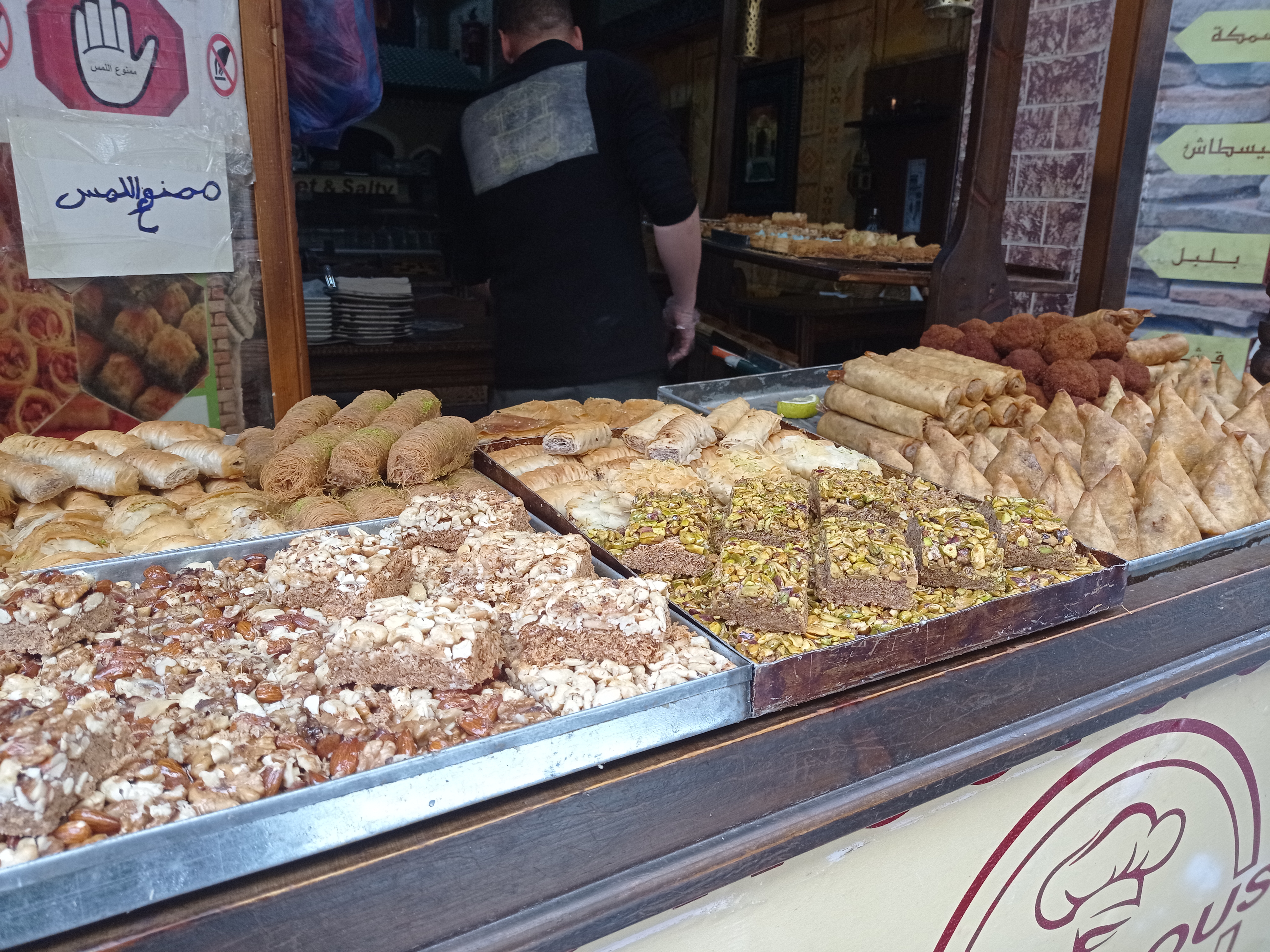
We hunted for a hole-in-the-wall restaurant, but the only one I remembered wasn’t serving lunch yet. So we bought street food instead: neems (fried spring rolls), briouats (a triangular, chicken filled pastry), kalinte (chickpea flan) sprinkled with cumin and red pepper, and olives with lemon and parsley. 

We looked for a place to eat our collection, and finally found a sunny spot along the ledge of a fence. But first on our menu was activated charcoal. Three pills before and three after a meal. With street food on a warm day, I got pretty bossy about following the instructions. We took our time, munching and tossing olive pits at the trunk of a scrawny tree in the sidewalk. Even there in that scorching African sunbeam, our repast was delicious.

street food cart

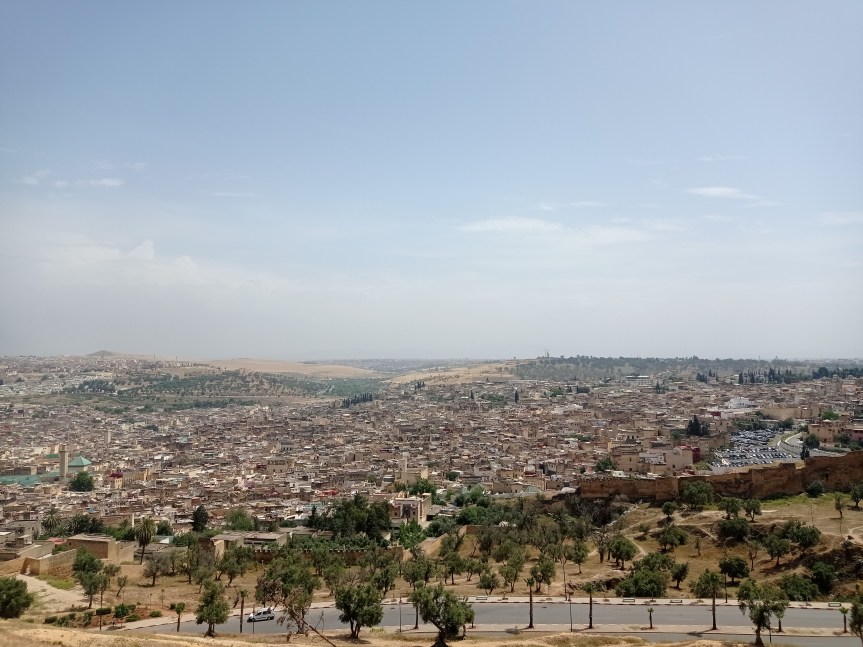
From my time of living in the city, I had fond memories of climbing up the side of a hill to a set of ancient tombs that overlooked the city. But how to get there? We stopped to ask directions. The shopkeeper gave us some of his life story for free as well as detailed directions, which I promptly forgot by trying to retain everything he said. No matter. We still had Google maps and what was left of my memory. We wound our way up the hill, admired the tombs and the view and then parked ourselves in the shade until my fantasy about a tall glass of fresh-squeezed orange juice overpowered the lure of a shady spot. 

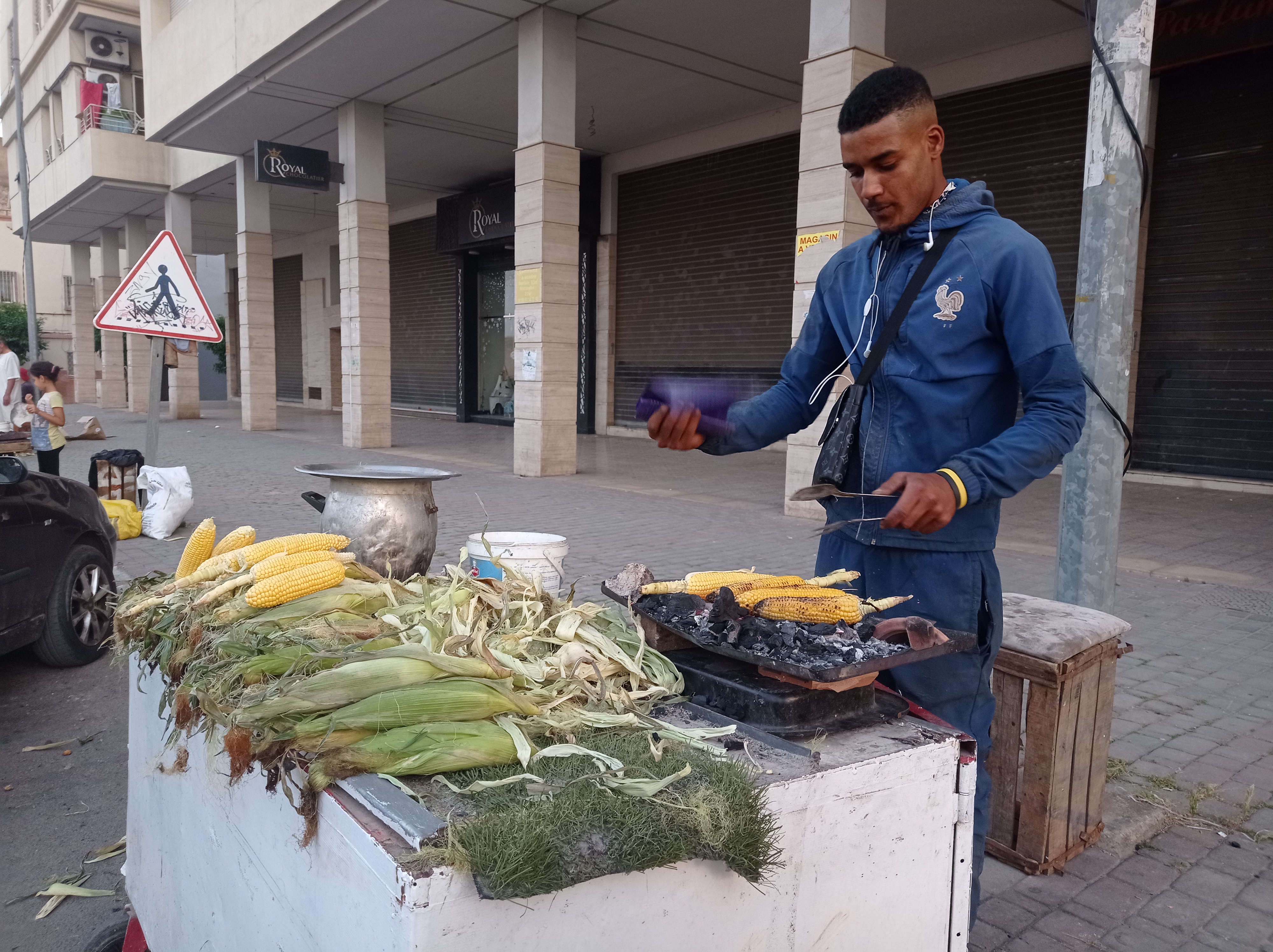
We spent a chunk of the afternoon perched on a restaurant’s third story, sipping orange juice, eating tagine, and watching people swirling in and out of the city gate below. Once we had cooled off, we meandered back to our friends’ house, with one last stop to buy an ear of roasted street corn.

Street corn vendor

The next morning, we envisioned ourselves arriving at the international church on time. Instead, with all of the careful packing that went into the morning–the gifts for a friend’s family, the trusty charcoal, and the Imodium, just in case–I managed to forget my wallet. My wallet which held our only local currency.

“I’m sorry. We don’t have money,” I told the taxi driver. “Take us back to the house.” Obligingly, he made a loop at the next roundabout and waited outside while I dashed up the flights of stairs to retrieve my wallet. Any dreams of arriving at church on time were crushed. 

Although the fellowship had changed since I had been there last, it was still charged with a buzzing energy of brothers and sisters in Christ uniting after a long week. After the service, I was able to reconnect with a few acquaintances before we were on our way to visit Chaimae and her family.

I was surprised by how Chaimae’s family remained unchanged. Throughout the day, most of the family dropped by, delighted to meet J and practice their English. They fed us breakfast and then fed us several courses of lunch a few hours later. That afternoon, J got a very long look into North African culture.

North African breakfast spread

Our time in the city was drawing to a close. The next morning we breakfasted on eggs and khlea, a cured beef that tastes like a barn. I hung out in the egg section, but J preferred the barny beef. The guy has an inexcusably tolerant palate. 

As we left the city, I looked out the bus window, wondering if I was saying goodbye forever. I felt nostalgic but realized I no longer had a lingering sense of belonging.

Limiting choices and such

When I sit down to write, I like to have a plan. Today I have none. I have a mental list of undeveloped ideas that I haven’t had time to think through. Not yet. So welcome to my stream of consciousness, which has no theme nor plot nor point.

Summer is coming. The forecast says that May is supposed to cool off partway through, but so far we’re careening towards a hot and dry summer. It makes me glad to miss it. I’m booked now: my bus ticket, my Airbnb, my flights, my airport pick-up. Everything is arranged for physically arriving Stateside come July.

The trip is planned. It’s everything else that worries me.

I don’t enjoy closing down a house for three months, especially when I have an inkling that a host of other townies would be delighted to change the locks and move into my house while I’m gone. (Yes, yes. This does happen. And regularly.) The landlady says she’ll drop in every now and then to check on things, and it’s her house, so I guess I’ll let that inkling evaporate. But cleaning out the fridge and freezer and purging the cupboard of anything inclined to hatch moths or rot… Sigh. My down-the-hall neighbor volunteered to babysit my plants. “Don’t worry if they die,” I told her. They lead a fairly risky life with me anyway.

I’d like to buy some new clothes and maybe sew too so I don’t return to my passport country looking like a tramp. The other day, my neighbor boy was delighted to find the shoe rack I recently tucked behind an inner door. “Shoes!” he cried, exposing the rack to his mother and me. Shoes indeed. All two pairs of them. Well, three if you count my walking shoes which can only be differentiated from my “good” shoes by how worn the soles are. Oh, and my good shoes have a smudge of yellow paint from when I slipped on a freshly painted curb. It wasn’t until my neighbor boy exposed my shoes neatly lined on the rack that I realized how slim my pickings have become. So I promptly ordered a pair of sandals.

But the truth is that I like limiting my choices. When my days are filled to the brim with choices, it’s nice to have an area I don’t have to consider at length. Sneakers or flats?

Then again, I also run the risk of looking like a tramp.

I make myself a weekly menu too. Beans on Mondays and Tuesdays. Fish on Wednesdays, etc. Of course, I am forever changing my recipes and portions–the fun part for me. And there are those days when I could happily devour everything in my refrigerator because I can’t stop being hungry. But always sticking to a plan isn’t much fun anyway.

Do you limit your choices in certain areas of your life? If so, which areas? Do you find it repressive or helpful?

I think I should sign off now. I’m realizing that the only reason I wrote this much is because I’m dragging my feet about the next items on my to-do list. So until the next time, when I can hopefully provide writing with a bit more substance (but don’t hold your breath).


Note: I have a new pair of sneakers waiting for me in the States. They *cough* may be exactly the same shoe that I already have two pairs of, but at least they’re a different color this time!

Also note: The purple striped wallpaper was not even close to being my idea. If you want to discuss limited choices further, we can talk about moving into a furnished apartment with a very involved landlady. 🙂

A snow day and yodelers

For context, read part 1 and part 2 before reading this.

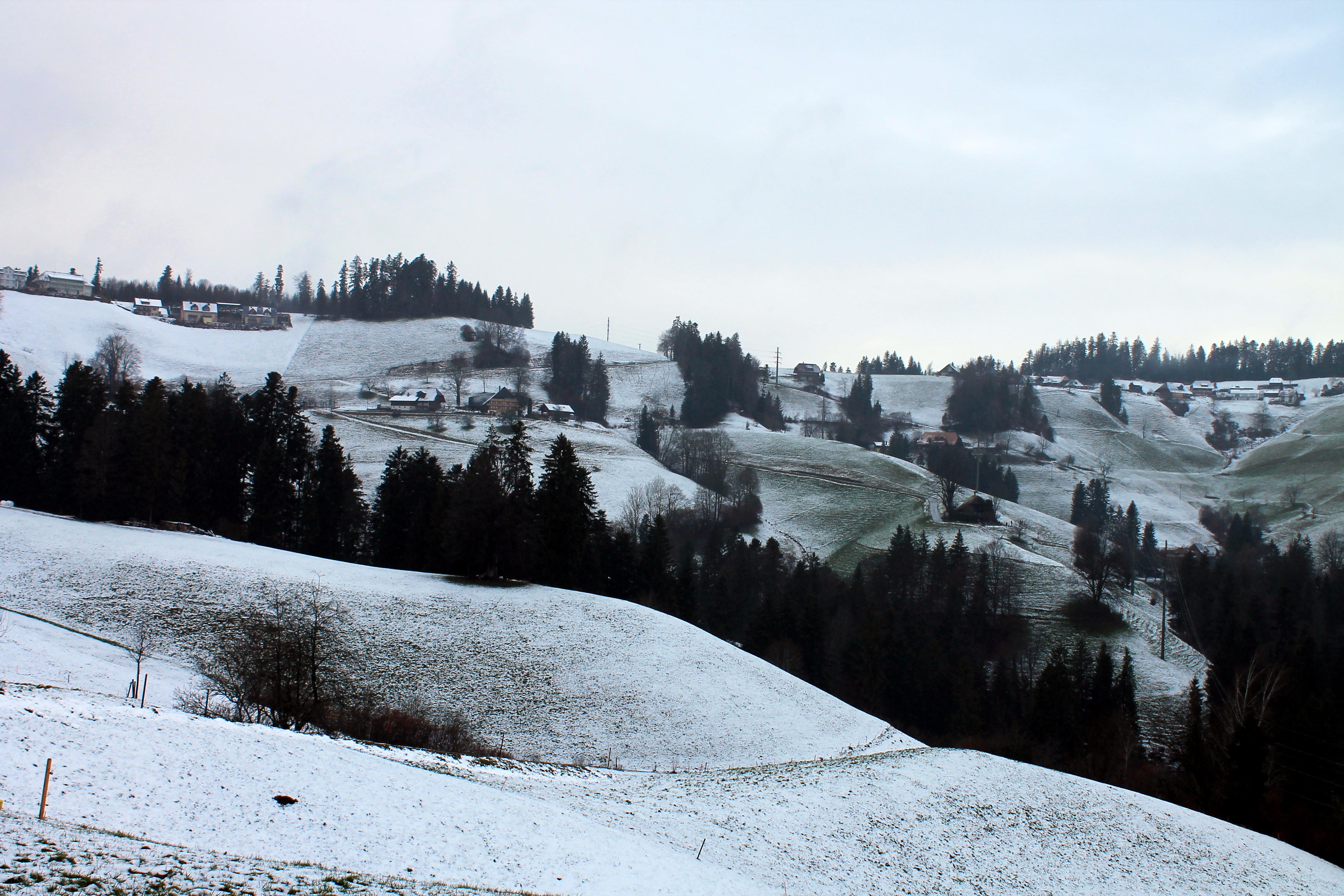
Snowy hills

Saturday morning, we awoke to a white world. The green hills of yesterday were white today. We had a few minutes of fretting about being stuck in our hairpin curve neighborhood until spring, but we soon settled in for the joy of a wet snow day. We did laundry, put puzzles together (although the puzzles were decidedly not for adults), and made spaghetti and garlic bread.

It was this day that we hunted high and low for trash bags, and, after perusing the Airbnb folder, discovered that we would have to pay for a second trash bag and corresponding disposal! Nonsense! I stood on the trash. I think my brother-in-law did too. And later, Dad pressed it down even more. Hopefully, the bag of now-bricks did not put out our hostess’ back when she stooped to pick it up.

Now that I’m done discussing trash and our remarkably uneventful Saturday, I might as well mention that one fantastic thing that we did: a yodeler concert!

Yodeler group on stage

My former roommate had found a concert about 15 minutes from our place. And by the time evening rolled around, the roads were clear. We wandered into the concert hall, feeling very much like we were wandering into a Central Illinois gathering. Again, it was both delightful and disconcerting how much we physically fit in. We relied on Mom’s high school German and my German pronunciation of my own name to claim our reserved tickets (which, as it turns out, I still mispronounced my name so I might as well have just used the English version). Several people wanted to talk to us, but our blank smiles deterred them.

We sipped Rivella and ate the little chocolates at our places. The atmosphere was friendly and relaxed. People chatted until the lights suddenly dimmed. I checked my phone. It was 8:00 p.m. on the dot.

By the first song, we had already settled back to enjoy the evening. The music was exactly what Dad had spent years of hours watching on YouTube. His dreamy expression made the rest of us warm and happy too. The mixture of traditional music groups was delightful. My nephew was the only baby present (this might tell you the age bracket of the audience), and he did pretty good, considering the concert started at his bedtime.

During intermission, a man came around and tried to talk to us. When we apologized, he backed away and said something about “American!” Word had got around.

Trachselwald Castle

On Sunday, we went out for one last scenic drive. The snow was mostly gone, and the landscape was green again. We wound through the countryside and eventually found our way to Trachselwald Castle, where Anabaptists were once held as prisoners. We didn’t think we could get into the exhibit, but decided to enjoy the outside anyway. Then, my nervy brother-in-law pushed open the unlocked door and we wandered inside the damp, cold tower. It was an unexpected peek into our history, and the unexpected part made it that much more meaningful.

That evening, my former roommate brought over her fiancé to get my vote of approval (that was my idea). We had a delightful evening of talking and praying together. And in the end, he got my approval. 🙂

After they left, we realized we were pretty low on food. In our effort to “work it out just right,” we had underestimated our appetites. My brother-in-law and nephew polished off the tube of mayonnaise… plain. With a side of butter… plain.

The next morning, after a few hiccups–such as not filling up the rental van with fuel and my nephew promptly wetting through all of his layers just after Mommy checked in the carry-on–we were on our way to Spain!

Not having been able to reserve an exit row, Dad passive-aggressively manipulated circumstances by stretching his legs into the aisle until the stewardess took note and moved all 6’6″ of him to a roomier seat. It was a rough flight. My nephew cried for a good part of it while my sister and brother-in-law felt like “those” parents. There was enough turbulence that my sister and I wore matching pale green faces.

At our layover in Madrid, we had the perfect amount of time, which we squandered by making various and sundry trips to the food bar only to end up with stuffy sandwiches and a tasteless salad… and an almost missed flight. We made a wild dash when my brother-in-law saw on the screen that our flight was boarding.

“We are about to close the gate,” the attendant told us. And we frantically collected our people and things. But after that trauma, our flight was uneventful. And then we were home–at least I was home.

But I will have to write about that another day.

Bricks and churros

Meeting her was like being handed an armload of bricks. Surprising, heavy, and requiring concentration to keep the bricks from tumbling everywhere. She was sturdy and strong. Like she was giving the world the finger, and the world was cowering. And yet… and yet, her inner chaos spilled over on everyone she touched. 

I had noticed her for years, only ever at the market. She was eye-catching: tall, broad, non-conformist, and always purposefully raiding booths at the traveling market. 

Then one day, we crossed paths. Literally. And she stopped me. “Who are you?” she asked with bright eyes. 

She was thrilled with my stumbling Arabic, my height (we stood eye-to-eye), and my nationality. We exchanged numbers and parted ways. I walked home, a little dazed by my ability to attract strong women who longed to take me under their wing. How many times had this happened before?

She and I messaged back and forth for a couple of weeks. She had a situation costing her a lot of time and energy. “Pray for me,” she said. 

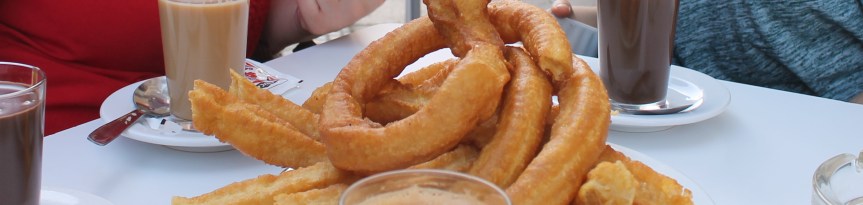
Last week, I messaged her. “Are you going to the market? Can we meet for churros?”

I found her at the market, rooting through piles of merchandise, somehow sniffing out deals I had already walked by once. 

When she reached out to hug me, body odor clogged my throat and I tried not to breathe. It wasn’t her, but her clothes, I thought. She might not have access to a washer. “SHE’S AMERICAN!” she blared at the market vendor in a voice as big as she was.

She insisted on paying for the churros. “It’s all the same.” She waved me off as I fought back. We found a table and she started talking. Loudly. As she told me her problems, neighboring tables shot us glances. 

I was hyper-aware of the intrusive volume as I munched on churros and wiped my fingertips on the gray churro wrap, but it took most of my concentration to follow her story. I felt like I was juggling those bricks now, trying to keep all of my senses from screaming at me while I focused on her words. There were a lot of them. Both senses and words.

When she told me why her marriage had crumbled, she shrugged. “We get along fine now. But you know, we were too young to know how to solve our problems.” Another shrug. Another middle finger to the world of pain.

An airborne brick was about to land on my foot. What should I say? Was she anything but “fine”? Even with all of the pain she had just detailed? Had anyone in her life ever let her be anything but “fine”?

I pressed my greasy fingers against the paper again, admiring the pristine fingerprints I left behind, dark against the pale gray. My fingerprints. Beautiful. Special.

And the woman sitting beside me left her own greasy fingerprints on everything she touched. Also beautiful. Also special.

“Was it hard to relate to his family?” I asked finally.

And when I looked up from our fingerprinted churro paper, my breath caught. This “load of bricks” in front of me was dabbing her eyes. She wasn’t crying. Not quite. But I had touched something still raw. I sat quietly, ignoring the cooling churros. Ignoring the eavesdroppers around us. She didn’t say more, and I didn’t pry. Our friendship was too new for that. 

But I walked home with this God-given reminder that I had just had greasy churros with God’s image bearer, His beautiful creation. Her wounds and scars would never be able to disguise that.

A time to weep, and a time to laugh: Residency renewal

It’s that time again.

A friend told me it seems like I’m always renewing my residency. I agree. 

But this time was supposed to be easy. I waited for my appointment, full of confidence. Of course, my confidence may have been due in part to the fact that the immigrants in front of me had their dubious paperwork shoved into crumpled plastic page protectors. I, on the other hand, had my blue passport carefully tucked behind a stack of crisp, typed forms, neat photos still in their protective sleeve, and an appropriate receipt matched with a tax form. Bring it on.

But it was I who slinked defeated from the office, ready to throw my hands in the air and tell Spain, “FINE! I’m DONE being legal! So there!” 

I was able to stifle that impulse. And I’m not done being legal, of course. But it did take several hours of rigorous cleaning and a listening ear or two before I was inclined to persevere. 

Which, in turn, led me to a management office. And then a second management office. And finally, per directions, to a right hand turn by a children’s shoe store and down an alley to a hole-in-the-wall lawyer’s office which mercifully listed “immigration” on the plaque beside the front door. 

I stepped into the dim office to find the waiting wall lined with sub-Saharans, North Africans, and Asians. Congratulating myself on finally being in the right place, I took a seat. 

The man at the front desk didn’t acknowledge me as he gave slow, clear instructions to a client. So I had time to look around. The attempt at decor was shuffled aside for the sake of productivity. Stacks of paperwork in wild piles. Artwork lost behind taped up notices or a whiteboard. A bookcase filled with untouched manuals and a silent essential oils diffuser.

It was a bit messy, but not dirty, I decided. And it held a slight odor of the people who were crushed inside. 

Five minutes later, when the clerk had finished, he turned to me. I explained my situation, finishing with: “Can you help me?”

He took my card. “Maria, we have an American here!” he chirped. I must have been the first. Actually, I almost assuredly was. North Americans are an endangered species in Mytown. And how many of the seven or eight of us would have stepped foot in this office?

Only the desperate ones.

The lawyer peered down at me from her desk. I shuffled my neat stacks of paperwork, aware of the dozens of eyes now trained on me from the waiting wall. 

The clerk made a copy of my card and asked some questions. But could they help me?

It turns out, they could, but it would take several more trips to the office. Several more surprised stares from the other clients as I joined their ranks. Several more long stretches of leaning against the waiting wall and studying the half-hidden artwork. 

Then on one visit, the clerk removed the whiteboard to let me study more than just the fringe of the painting. On another visit, I was witness to a fight that the clerk helped diffuse before it escalated to the point of no return. On another visit, I bumped into a family I knew which helped to pass the time. That same visit, I took advantage of the clerk’s warm, North African culture to negotiate the fee. And on that last visit, he handed me a neat stack of stamped papers tucked in a plastic page protector. Success.

That was only step one. I will have to return. Being a legal immigrant is not for the faint of heart, no matter where you are in the world. But I’m full of confidence again. Bring it on.

Conglomeration of life

Below is a conglomeration of life I either noticed or experienced in recent weeks. The thoughts are scattered and unpolished (like everything else on my blog, except maybe just a bit more). But I hope you enjoy a peek into life here.


“Hola, American.” A sub-Saharan man said the words almost under his breath as we passed on the street.

I didn’t think much about it until I was a few steps beyond him. How did he know I was American? Someone must have told him.

Due to the abundance of Russian immigrants and the lack of North American ones, my community assumes I’m Russian. In fact, when I started Spanish class, my Russian classmate told me that she’s seen me around and always thought I was a Russian.

Last night in class, she worked on forming a sentence with the imperfect subjunctive: “Trish has a face as if she were Russian.” After various corrections and alterations, we all were very familiar with the idea that Trish looks Russian.


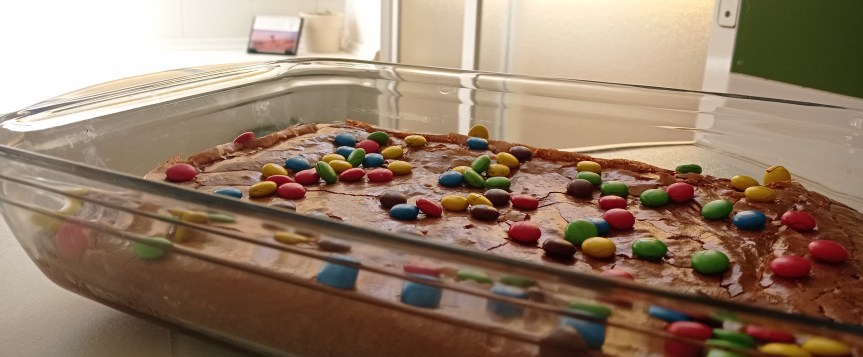
“I thought to myself: I hope she makes brownies. And you did!” My student pulled the brownie plate closer to her and grinned at me with shining eyes. And she didn’t protest when I sent the leftovers home with her after class.


Little arms thrown wide with delight in overhead bubbles.


Four neighbors were on the front stoop when I stepped out the front door of the apartment building.

“Are you having a meeting?” I asked with a laugh.

No, two were just out for a smoke and had collected the others coming in or out the door. Like me.

“Sit down here. Join us.” Demanded the middle-aged man from the second floor. We hadn’t seen each other for a while so maybe he thought he needed the latest scoop on my life.
Not really wanting to wedge myself between two people with lit cigarettes, I stood back just enough to enjoy the breeze that waltzed down the street.

“You don’t smoke, do you?” The second floor neighbor asked.

“No.”

“Do you drink?”

“Not that either.”

“What about the other thing?”

Was this a morality test? I hesitated, not knowing for sure what he meant. “Marijuana?” I asked hopefully. “No, not that either.”

“No. Making love.” He tinged a bit with this. I suppose you could say I had forced him to say it.

The lady on the other side of the stoop eyed me. “It’s not worth it. Men are too complicated.”

“You say men are too complicated!” He was indignant. “It’s the women who are too complicated.”

It was a good time to leave. So I made a light, overgeneralized comment. They laughed. I told them goodbye and continued on my way.


I had almost reached the language school when I noticed a woman was getting out of her car. She was a bleached blonde with dark eye makeup. The combination made her seem sad somehow. Behind her was a mural of a woman with streaking mascara.

Two sad ladies on the corner, almost like a piece of visual poetry, I thought, and continued walking.

I was in the middle of the crosswalk when muffins, donuts, and bread came skidding across the road toward me. I hesitated mid-stride. Was I hallucinating, my subconscious pulling up cravings for foods I rarely ate?

But no. A delivery van’s door had slid open as the van bumbled through the roundabout. The goodies inside had tumbled onto the street with enough momentum to shoot them in my direction.

I helped gather the packages littered across the roundabout and toss them into crates. The poetic sad lady from the corner helped too.

“Gracias!” the man told Sad Lady. “Chokran!” he told me.

I paused and looked down. Sometimes when I wear a dress, people ignore my fair coloring and assume I’m North African. Not that it matters, I suppose. Russian. North African.

Why not?


I trailed Sad Lady into the language school–who knew she was going there too?!–and when I couldn’t get my questions answered at the front desk as I had hoped, I began to chat with her.

She was planning to test for English; I for Spanish. “Let’s meet for coffee to practice!” she said and we exchanged phone numbers.


The next evening, my neighbor and I were only a couple of blocks from home when we saw the drunkest person I have ever seen in Spain. He stumbled out of a salón de juegos and clambered on his bike. Both he and the bike splattered onto the sidewalk. He gave an unintelligible monologue at high decibels but appeared relatively undamaged.

Just a block later, a man bumped into my neighbor. “I’m sorry! I was looking over there while I was walking and didn’t see you!” he said while his arm gave an exaggerated swing in the direction of the park.

“No problem,” my neighbor said graciously. “It happens.”

“I’m sorry. I’m not a racist. And I’m not a thief. You have to be careful on the street. Hold your bag like this!” He tugged the strap of his man purse. Then he clasped his hands together, and gave a wobbly bow in mid-stride and began the same speech again.

And again.

And so we continued several blocks with his cycle of effervescent apologies and wobbly bowing.

My neighbor and I finally stopped at a store to let him get ahead of us.

“Well,” I sighed. “We’re only a few blocks from home. What else is going to happen? Should we go back?”


Hopscotch boxes drawn all of the way to 85, progressively lopsided from weary little hands.


I fell out of bed the other morning. I was freshly awake and rolled over, only to realize that during the night, I had perched myself on the edge of the bed. Fortunately, I caught myself with flailing limbs before I made a resounding boom on the downstairs neighbors’ ceiling.

Who needs caffeine? There’s nothing quite like tumbling out of bed for a delightful adrenaline rush.


A friend cried when I brought her a gift. We sat on the floor together just inside her front door while she fingered every item in the gift bag with grateful tears. Someone cared.


The safety of Grandma’s hand holding fast.


A house with crumbs and sticky that remind me that someone has honored me with their presence in my home.

Mi casa es tu casa

My neighbor’s hands were slick with oily meloui dough when the doorbell rang. “Could you get that?”

I opened the door and gave a cheerful “Salam walekum!” The young mother greeted me but backed away with popping eyes and an apology. 

“No, no, no, you came to the right door.” I grinned. “Welcome.” I had dropped by to play with my neighbor’s little boy. Soon I had three little people to play with and a mother who stood beaming over me, incredulous that I was there on the floor stringing monkeys from the doorknob and reading about 1-2-3 with Winnie the Pooh. The new little girls wanted laptime too.

Amid the chaos of the younger generation, I heard snippets of the visitor’s story, a story that didn’t match her sparkling eyes. Then we ate meloui, tiny cooling pieces at a time. I ate mine, trying not to sprinkle crumbs on the smooth little pigtail bobbing just below my chin.

“This is such a great day,” my neighbor sang as she shuffled us around the table in order to reach the fridge. “My friend came and my neighbor!” She smiled and began sorting through last week’s cilantro. 

If I hadn’t known, I would not have guessed that her son had been sick, refusing to eat and wailing day and night for several days straight. In desperation, his parents had hauled him to the ER where he got the medication he needed. 

Low on sleep on top of a distorted schedule, would I have been cheerful to have my house overflowing with people?

You could argue that hospitality is required in Islam and therefore, whether or not they feel it, North Africans are hospitable. True. But most North Africans are not just hospitable because they’re required to be; it’s less of a conscious choice and more of an integral part of life.

Another night, my neighbor, her friend, and I walked to the park. There, we joined up with several other women. Our bench seated three and squished four. We were seven.

Had we been American, we would have chatted briefly and then half of us would have moved to a nearby bench to sit. However, North Africans value relationships much more than they value comfort… and relationships require time spent together. So three of us stood or chased renegade children while four sat hip to hip. Every now and then, someone wedged themselves out of the line-up and gave another the chance to sit for a while.

I came home from that outing, over-stimulated and linguistically exhausted. The sound of my key turning in the lock was absolutely musical. I am American and I value both personal space and comfort. I will probably always value those two things. Those values and solid relationships aren’t mutually exclusive when others prioritize the same values.

But what about when they don’t?

I’m still pondering what it means to be an introvert in my line of work–What does that look like practically? (Maybe someday I’ll be brave enough to explore this on my blog.) But I will say this: even in my exhaustion, I also rejoice in the beauty of a culture that decidedly values relationships and community, even at the expense of individual preference.

Proud to be an American?- Part 1

Living overseas among various nationalities exposed me to some of American stereotypes. Some of the stereotypes made me wonder whether or not I’m proud to be an American after all.

Never in my life had I felt so boxed in by American culture, so labeled. Sometimes people told me that I wasn’t like “that,” insinuating that “that” was the essence of American error.

Want to hear what other people think of Americans? Well, here are a few things…

We are impulsive.
We make quick decisions without weighing the pros and cons or how our decisions affect other people. This probably has a lot to do with personality, but there is a trend in favor of this stereotype. Why? Is it because we’re used to having things easy? Do we always give ourselves the option to give up when things get harder than we had anticipated?

We are loud.
This is another stereotype that depends on personality. I did notice a trend with Americans overseas. We were usually the loud ones, laughing, talking, unafraid that the everyone within shouting distance knew our business.

We are scared to be real.
We hold surface conversations and act like our lives are going smoothly. (Personally, I think this trend is starting to change with a generation that values authenticity.)

We are violent. (And everyone owns a gun.)
Hmm. Well? Look at the video games we have access to, even children. Look at Hollywood. We might freak out at nudity (reinforcing another stereotype), but without flinching, we watch people’s heads being blown off. There’s a lot more behind this idea, but I’ll let you unpack this one for yourself.

Stay tuned for Part 2!


Photo by Donovan Reeves on Unsplash

Culture shock in my own country

A few ways I’ve been shocked by my own culture in the last months:

  • Other kinds of foreign language. I approached some people in Aldi, excited that they were speaking another language… only to discover it was a butchered version of my mother tongue.
  • The politeness of complete strangers, even if they’re not trying to sell you something!
  • Efficiency.
  • The constant busyness. Without lifting a finger to plan, one can manage to walk into a new week with a full schedule.
  • The availability of, well, everything. If I can’t find it on a garage sale, I’ll pick it up at Wal-Mart or simply order it from Amazon.
  • The quietness. No noisy neighbors at night.
  • Menu prices. They’ve already made my eyes pop out more than once.
  • Not needing to carry tp with me everywhere I go.
  • The evasion of temperature extremes. Cold? No problem! Turn on the heat! Hot? Easy peasy. Turn on the air conditioning!

Little by little, I’m acclimating to my own culture… A journey that will probably continue until I leave it again.


Photo by Anna Sullivan on Unsplash