Oh, the people you meet

A short two-day trip to a land not so far away yielded a wealth of interactions and acquaintances that made it hard to leave. Oh, the people you meet!

  • A fellow passenger in a grand taxi, who spoke to me only a few minutes before inviting my roommate and me to her niece’s evening wedding.
  • A lady passing by on the street who helped us pound on the locked riad door and stuck with us until the owner and his maid came back from the market.
  • The riad owner with a surprisingly Western perspective and his maid who loved engaging in deep conversation about cross-cultural marriage and religion. But just when I thought I was making an excellent point, the owner leaned back in his chair, grinned, and said that if he had met me 24 years ago, he would have married me. The maid, an adorable but hopeless romantic, kept returning to the cross-cultural marriage part of the conversation.
  • A young lady who seemed to know everyone in town and was delighted to take us around to her favorite places…and even fish out a party invitation for us (which we turned down). But before we parted, she took us to a crumbling café for evening tea above the sea. There, she told us about her life. At the end of her story she shrugged away any traces of self-pity, smiled, and said, “Well, what are we going to do? Praise God.”
  • An old gentleman who led me to a store to buy water, waited for me, and led me back. He escaped before I could thank him.
  • A taxi driver who took us to an ancient ruins sight and then meekly offered his phone number in case we couldn’t find a taxi back into town.
  • Our guide at the ruins who led us through the layers of sights on the hillside. But he stayed far ahead of us to not disturb our sight-seeing. And he topped off his hospitality by calling the taxi driver to return for us (thus saving me a phone call in Arabic).
  • Our guide at the music conservatory who didn’t seem to mind that class was in session as he banged around on a piano in the courtyard… and then tried to get us to show off as well. He made my heart swell in hollow pride when he mistook me for a local.
  • The owner of a souvenir shop who seemed sincere in his beliefs, but wanting to listen as much as explain.
  • A family on the train who knew how to enjoy each other and the people around them. What fun to be a part of their lives for that ride. And before they got off at their stop, the father found us seats with other women so we wouldn’t have to travel alone in our cabin.

Embarrassment in an airport

Some embarrassing moments haunt you all of your life and make you groan whenever you remember them. Other moments are so embarrassing at the time that they are not easily forgotten; yet, their memory makes you giggle instead of groan. Why? Maybe because we can relive the humor without reliving the embarrassment.

For example, recently I had a embarrassing moment that was completely mortifying for about 20 minutes before I started giggling. Why so short? Well, it happened in another city in an airport with people I am 99% sure I will never see again.

My friend and I took a trip to the desert for the holidays. We had a lot of luggage due to the fact that we had to haul bedding and towels with us (“a lot” perhaps being relative to someone who usually travels with a backpack). Therefore, when our train arrived at the small airport, we decided to take turns using the restroom. I went first and my friend waited at the bottom of the stairs with our suitcases.

Although I had never used the upstairs restrooms at this airport before, I followed the signs. But there appeared to only be one option. At least, there was a “WC” sign with a little man beside it. But where was the women’s? I looked farther down the hallway, but there was nothing close by. I was ready to continue on my way when a woman appeared in the restroom doorway.

Startled, I asked, “Is this for women?”

She gave an affirmative response. And spotting another woman behind her in the restroom, I shrugged off my hesitation and entered. But at some point, behind that closed stall door, I realized that I was no longer hearing women’s voices, but men’s.

I admit that I wasn’t initially embarrassed and just tried to decide whether to hang out indefinitely in the stall or make my entrance into the male-dominated room. But I couldn’t hang out in the restroom forever. I would miss my flight!

So I emerged. I kept my head down as I walked to the sink to wash my hands. Therefore, I don’t know how the men reacted to my presence. I assume it wasn’t favorably. After all, we were still in a culture where gender distinctions are clearly defined. But they didn’t say a word to me. Maybe they didn’t know how to confront the foreigner who was pretending to be oblivious.

Actually, it was the cleaning lady passing by the open door that hollered inside, “Madame! Madame!” When she had my attention, she continued in French, pointing to the little man symbol next to the WC sign.

Feeling the need to justify  myself (human nature, I suppose), I protested that someone had told me it was for ladies. But the delay only prolonged my presence in the room of unsettled men. Finally, I gathered my wits enough to apologize and scurry down the stairs to where my friend awaited me.

“Don’t go to the first restroom!” I admonished her wisely. And she vanished up the stairs while I waited with the heap of luggage. But as I waited, I realized I was standing by the doorway of the only restroom exit.

And there I stood, incapable of desertion for the sake of our luggage as one by one the men emerged from the restroom and came down the stairs to find me blushing on the bottom platform.

The wedding I didn’t attend

I didn’t attend a wedding. That statement, of course, depends on one’s definition of “wedding”, I suppose. I did attend one or two ceremonies during the six day celebration, but the ceremonies were so low-key that I didn’t even see the bride. That’s why I say I didn’t attend because how can one attend a wedding without seeing who the wedding was for?

What I did experience, however, was enough to send my cultural senses spinning. Colorful clothing, drums and horns, dancing, green and rolling countryside, bread baking in an outside oven, a restless night curled up foot-to-foot with a stranger who kept stealing my blanket, mint tea and sweets to accompany the luscious wedding feast…

But I wasn’t only observing; I was being observed. My status as the only foreigner at this countryside wedding earned me plenty of stares, questions, and giggling girls developing heroine crushes on the uncomfortable-looking foreigner in the green dress.

After only 29 hours away from home, I returned feeling both culturally enriched and overwhelmed.

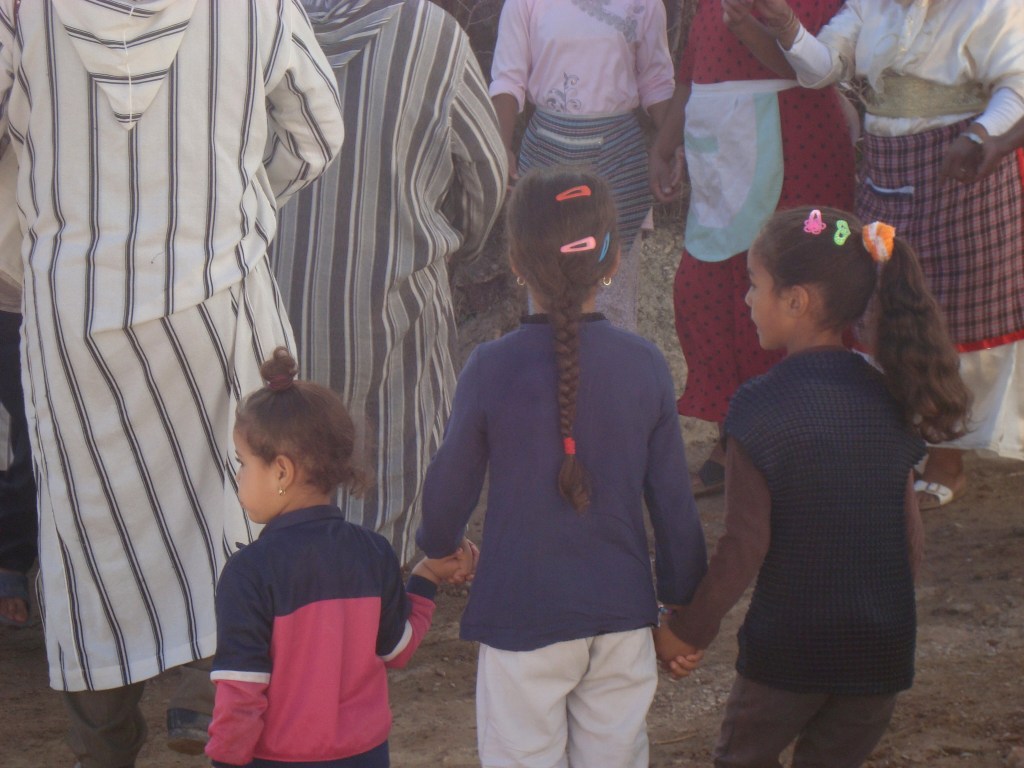
little girls holding hands next to adults in robes
people dancing
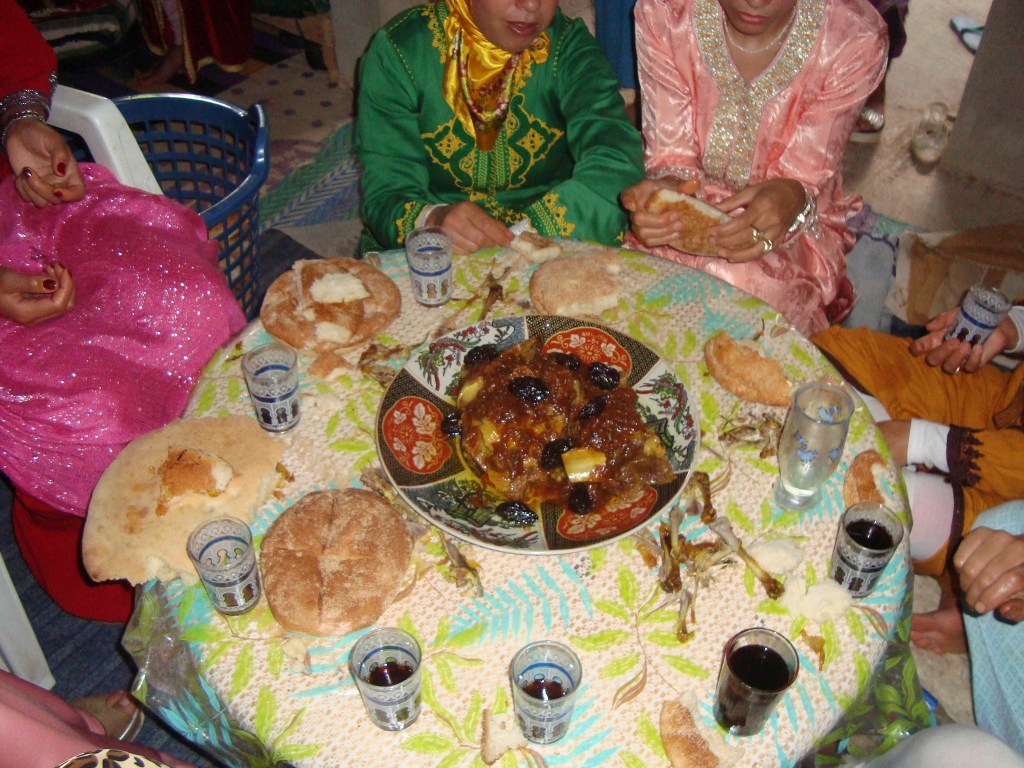
beef and prune tagine in center of table

Redeemed opportunities

Where do missed opportunities go? Are they gone forever or does God redeem them by giving us new opportunities?

Here in North Africa, where living intentionally should be as easy as breathing, I still miss opportunities. Why? Well, I’m busy; there is always language to study, classes to teach, emails to write, friends to visit, etc.

But those excuses aren’t good enough. Try telling a little boy that preparing lunch is more important than his soul. Maybe that’s not exactly what I said, but it is most likely what I communicated.

I was in the middle of a bad day when he followed me home from the store. People had been raining expectations down on me and I was exhausted although the day was only half finished. So when he jumped up and followed me, I rolled my eyes.

He only wanted one coin, he said. But to me, he was just one more beggar with just one more fabulous fable to accompany the outstretched palm. I tried to be pleasant, but my smile faded with his persistence. “Enough!” I said as he fell in step with me. “Be quiet!” I said. He didn’t. He followed me to my doorstep and only stopped when I closed the door behind me.

I had just started putting groceries away when my conscience awakened. What if I was the only person in that boy’s life who could have shared truth with him?

It took an hour or so before I was ready to face him again and apologize for my heartlessness. But when I went outside, he wasn’t there. Nor was he in front of the store. He had vanished.

So had my opportunity.

But my question is this: Has God redeemed my mistake by giving me another opportunity? Could it be having tea with that lonely widow? Or maybe taking time for a girl whose insecurity manifests itself in bullying?

God is a God of redemption. Because He has redeemed me, I know He is capable of redeeming my missed opportunities.


This post was first published on https://lucindajmiller.com

Blessed are they that budge

Blessed are they that budge for they shall be first in line.

If that’s not a North African proverb, it should be. Some days instead of the one being budged, I want to be the one budging. Let them see how it feels for once.

But I know that’s a selfish attitude. So the question lingers: How exactly do I cope in such a pushy culture?

For example, standing in line at a shop today, the owner served the 5 pushy people behind me before he fetched what I asked for. Then I stood with my money on the counter while he served the next 10 pushy people behind me.

It wasn’t until I said, “Take this, sir!” that he turned to me and apologized. I wasn’t even tempted to give him the customary, “No problem.” My inflamed temper wanted to clear the crowd at the counter with a giant push and then hurl my unpurchased items at the shop owner. I could even envision myself stomping out, bellowing that I would never return.

How should I have acted? Really, the question is: How should I act? This isn’t a one time occurrence but a constant cultural barrier for me. In my 9 months here, I have met few truly courteous strangers; most courtesy turns out to be greediness in disguise.

This is one of the only things in this culture of which I cannot even glimpse a bright side. So, practically speaking, what should I do? Hang around a shop until the owner notices and takes pity on me? Disobey God’s command to love others as myself and begin pushing like everyone else?

Well, maybe my first step is to stop gritting my teeth when people infringe on my right to be served before them.

We are dust

Do you ever get tired of living by the expectations of the culture around you? I do. Expectations can be healthy, a type of accountability. In a way, expectations are what people give you when they can’t or chose not to give you rules.

Living in a different culture gives me two sets of cultural expectations to abide by. Suddenly, besides the way that I have been raised to behave, I am given a new set of standards from a very different culture. Sometimes I am stranded when the cultures clash: Is it better to be evasive and deceptive or offend someone by being truthful? Either way, someone is unhappy.

In short, I forget to focus on God’s expectations, which might mean disappointing both cultures. 

But are God’s expectations attainable? He was the one who placed me in this cultural conflict in the first place, so wouldn’t His expectations be the hardest to meet of all? And He does expect a lot:

“And we all, with unveiled face, beholding the glory of the Lord, are being transformed into the same image from one degree of glory to another.”

2 Cor. 3:18

His expectation is that we become more like the Son, more challenging than any cultural demand!

But He also remembers something that cultures forget: we are dust. Living to please cultural expectations would drain every drop of our resources, and like Solomon’s leech (Prov. 30:15), the culture(s) would still cry for more.

But God sees our limitations and coordinates them with His great expectation:

“As a father shows compassion to his children,
so the Lord shows compassion to those who fear him.
For he knows our frame; he remembers that we are dust.”

Ps. 103:13-14

He doesn’t forget our frailty; he knows what it is like to be a human. His expectation for us doesn’t change, but as we learn, His grace abounds.

Experiencing Eid Kbir

I could write a lot of things about this important holiday, but this post isn’t meant to be informational or theological. It’s is simply a snapshot of what my last couple of days have looked like. Granted, I decided not to display gruesome images of animal slaughter (thus limiting my photo options).

The first couple of photos are from the days before Eid. The city began to fill with the bleating of sheep and shops sold the necessities for the special day. Some shops even closed as their owners traveled. This is the country’s biggest holiday of the year.

Then, I had the chance to experience the celebration firsthand. I guess the first sign that Eid was upon us was when the neighbors moved a cow and then a sheep into their courtyard below my window. Soon the sheep’s bleating was only one of many others ricocheting off the concrete walls.

On Sunday evening, I joined my friend and her family for the Monday celebration. My head is spinning with the lifetime I feel like I lived in those two days. To my credit, I tasted a bit of everything that was served. The first meal of liver and heart kebabs with a side of spleen wasn’t too bad. But by evening, I admit that my mind refused to go over matter with the stomach and lungs dish. And what was worse was getting up in the morning to a breakfast of the head and feet. At least, now that I’m on the other side of it, I can look back and smile. I think my sampling of meat dishes until this point has been too tame!

bags and piles of charcoal in marketplace
Many little stands and shops sold charcoal to fill the thousands of grills around the city.
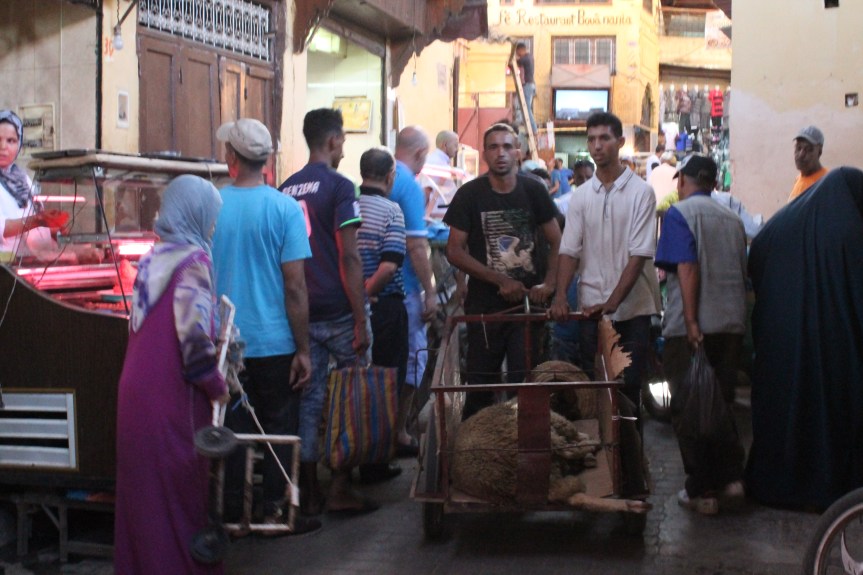
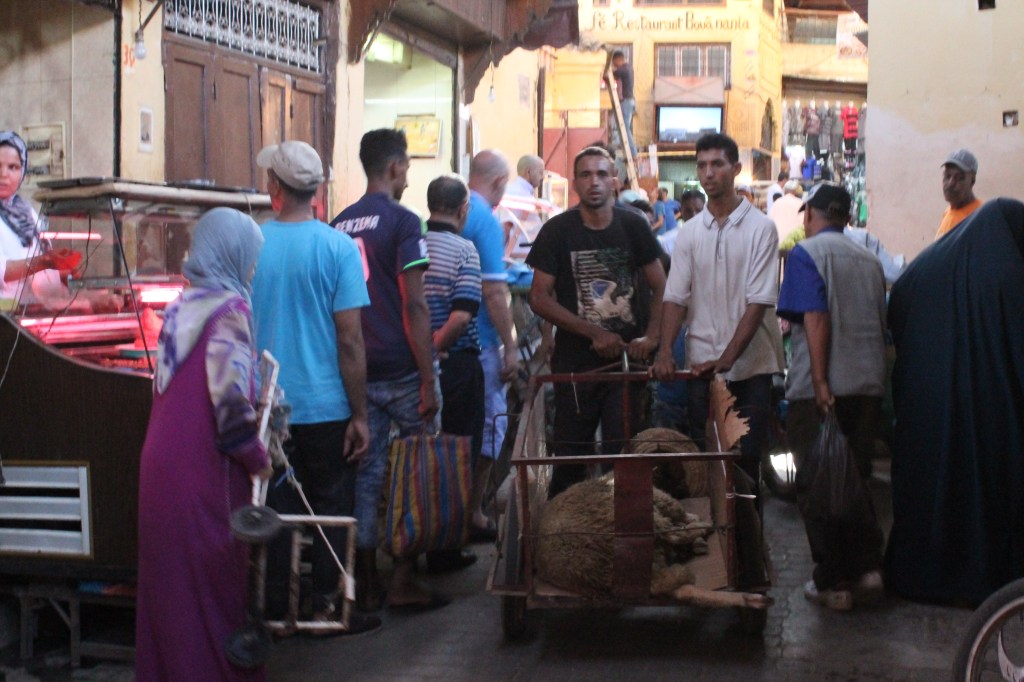
busy old city street and man hauling sheep in cart
One way of carrying your sheep home
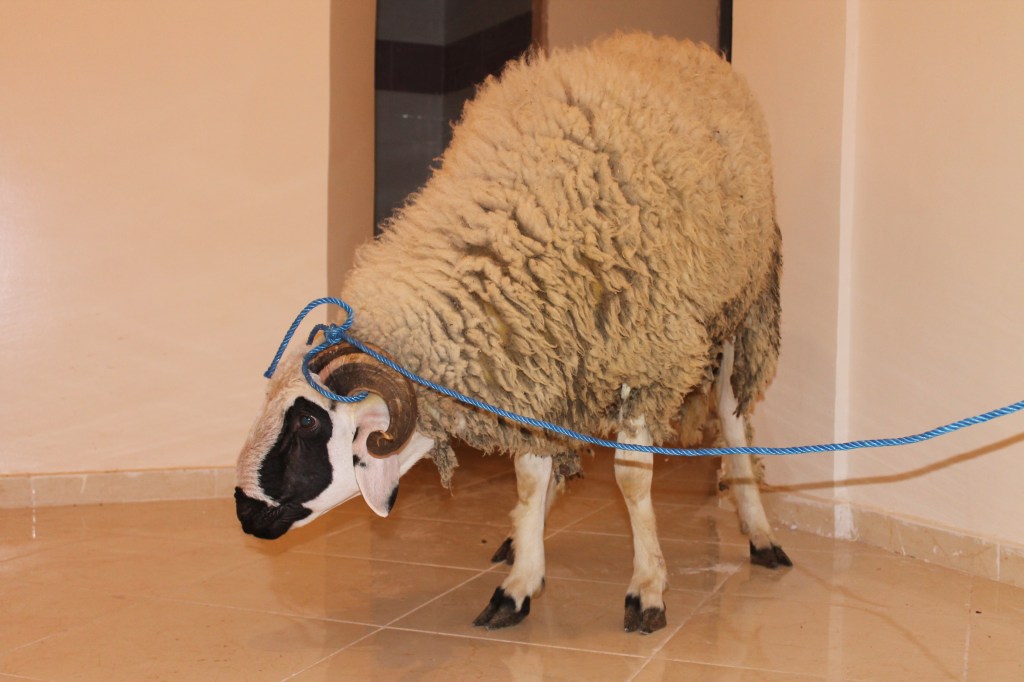
sheep tied with blue rope
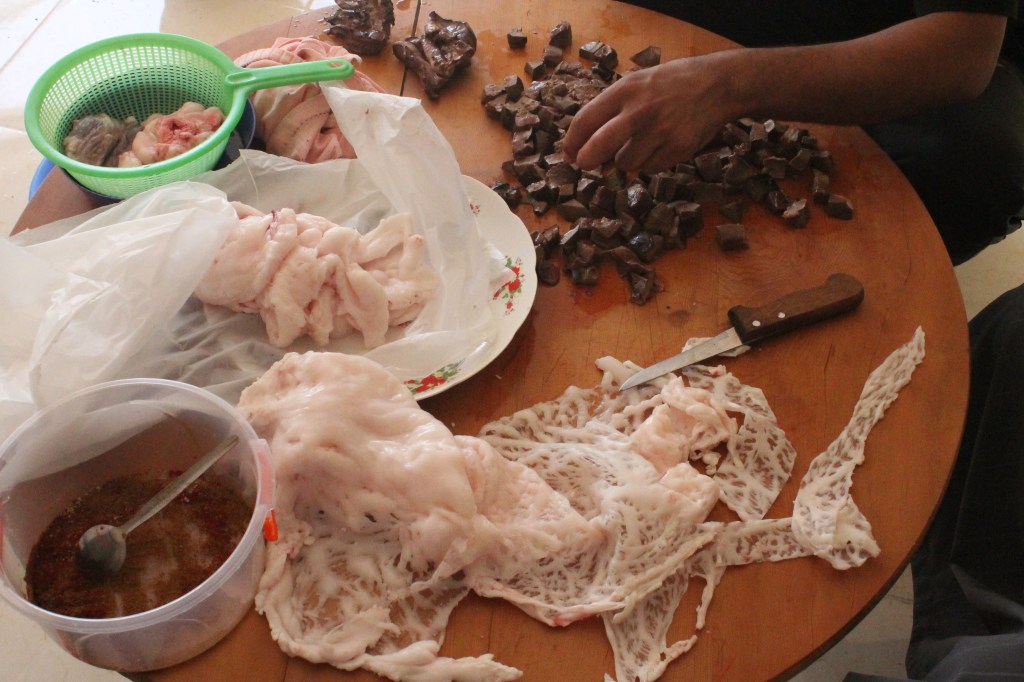
chopped liver and strips of fat on wooden table
Preparing for grilled liver and heart kebabs, also known as بولفاف
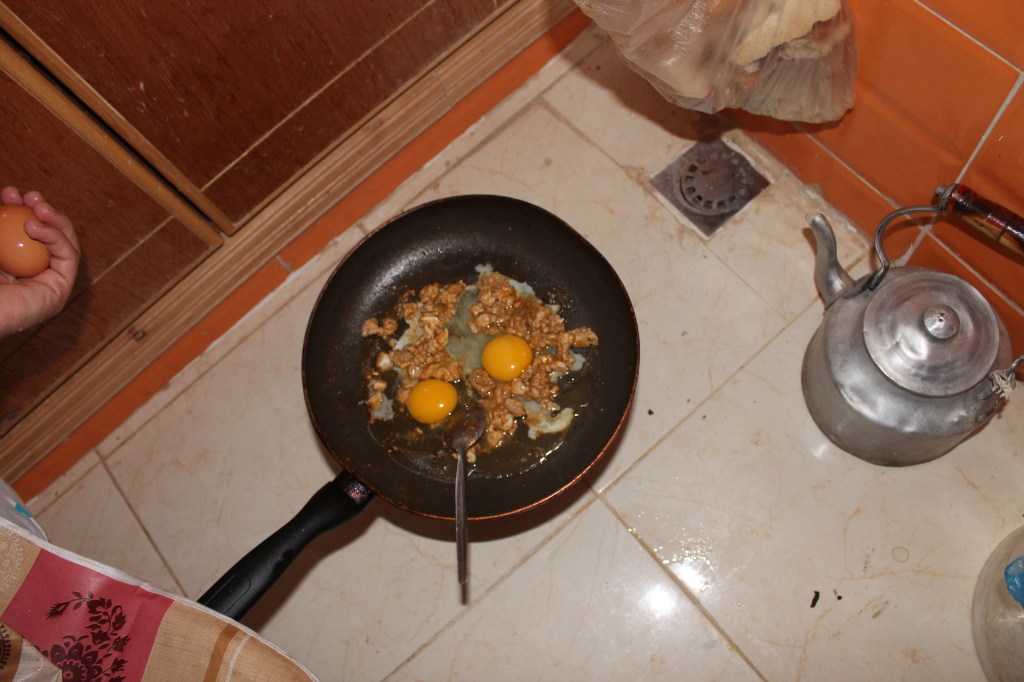
chopped brain and eggs in frying pan
Brain and eggs for breakfast, anyone?
loaves of fresh round bread
And of course, fresh bread with all of this!

The lighter side of language learning

I have no history with the other foreigners I have met here in North Africa: no previous inside jokes, no awkward memories of growing up together, etc.

Yet, because we are here together, we have begun to share something that I cannot share with people from home: the joy of mixing our common languages. And the beautiful thing is that we understand each other.

My class is known as the class that laughs a lot. My classmates and I are often drawing parallels from Arabic to English. There are verbs that in their conjugated forms sound like “guilty” and “dirty”, and nouns that sounds like “slave” and “smelly.” So we utilize them as their false English cognate, so much that our teachers have begun to do the same.

We also like directly translating from Arabic. In Arabic, many verbs are a slight variation of their nouns. “Do you want to coffee with me and have coffee at the coffee?”or “The chicken eggs eggs.”

And then there are times when we make up our own words completely such as tacking an English ending onto an Arabic verb or even using both Arabic and English constructions on the same root word.

For example, in Arabic the passive voice is typically the normal verb preceded by a “t” sound. And, as you know, the regular past tense verb in English ends in “ed”.

One day, as a friend and I were walking down the street, a guy from a passing vehicle hollered, “Bonjour!”

We giggled. “We’ve just been tbonjoured.”

Of bargaining

“It’s camel leather!”

“Really?”

I probably wasn’t the first ignorant foreigner to fall for that trick. But unlike most foreigners, I had a friend beside me who revealed the claim as rubbish. Camels are too valuable to be able to sell cheap street merchandise made of their hides.

I narrowed my eyes at the shopkeeper. “You lied to me! Shame on you!”

He sheepishly tried to make amends, but his customer was no longer interested.

Living in North Africa requires me to be functional at bartering with shopkeepers and street vendors. If no price is listed on an item, I must accept an exorbitant price or hone my bargaining skills.

Often, a shopkeeper will take me aside and lower his voice: “For everyone else, it is 150, but for you it is 130.”  As if he doesn’t tell every customer the same thing. At times, shopkeepers add phrases like: “…because you have North African friends” or “because you live here.” If the price still seems unreasonably high, I add, “And I’m a student. Do I get a student discount?”

Once, as I was bartering in Arabic, a shopkeeper told me “You are not a tourist. You are a North African!” Given the context, I took that as a compliment.

Using Arabic helps those selling realize that I am intentional about what I am buying. It also clues them in that I might know reasonable prices. After speaking to a restaurant owner in Arabic, he listed a fair price for a meal and I accepted. But when I asked to see a menu, he had none to give me; the only menus were “tourist” menus!

I may bargain for a while, but when I know my last price and I say my last price, it is my last price. It is what the item is worth to me and if I can’t buy it for that, I don’t want it. Sometimes the shopkeepers drop their prices to meet mine, sometimes they don’t. Sometimes, I am walking away when they call me back. Perhaps it’s the threat that others will get my business when I say, “No thank you. I will keep looking at other shops.”

Bargaining used to terrify me. Now, after seven months, I have accepted this piece of the culture. Until I finish language study in another seven months, I might be enjoying myself.

Quiet corner=buried treasure

Have you ever stumbled across a place that you were subconsciously looking for? It takes a bit for you to catch your breath as your heart smiles: “Yes!”

It might be as trivial as a little café, buried in a North African old city where few tourists trod. Except us. A friend and I were wandering down one narrow cobblestone street after another. We walked right past the café the first time, not because we didn’t notice it, but because the owner spotted us and began to holler that we were welcome. We darted down another street to avoid him. But that street was a dead end and eventually we had to turn around.

Hot and tired, we were easy victims when we passed by the café the second time and the owner called out his menu just in case we changed our minds. Then he said the magic words: “We have orange juice!”

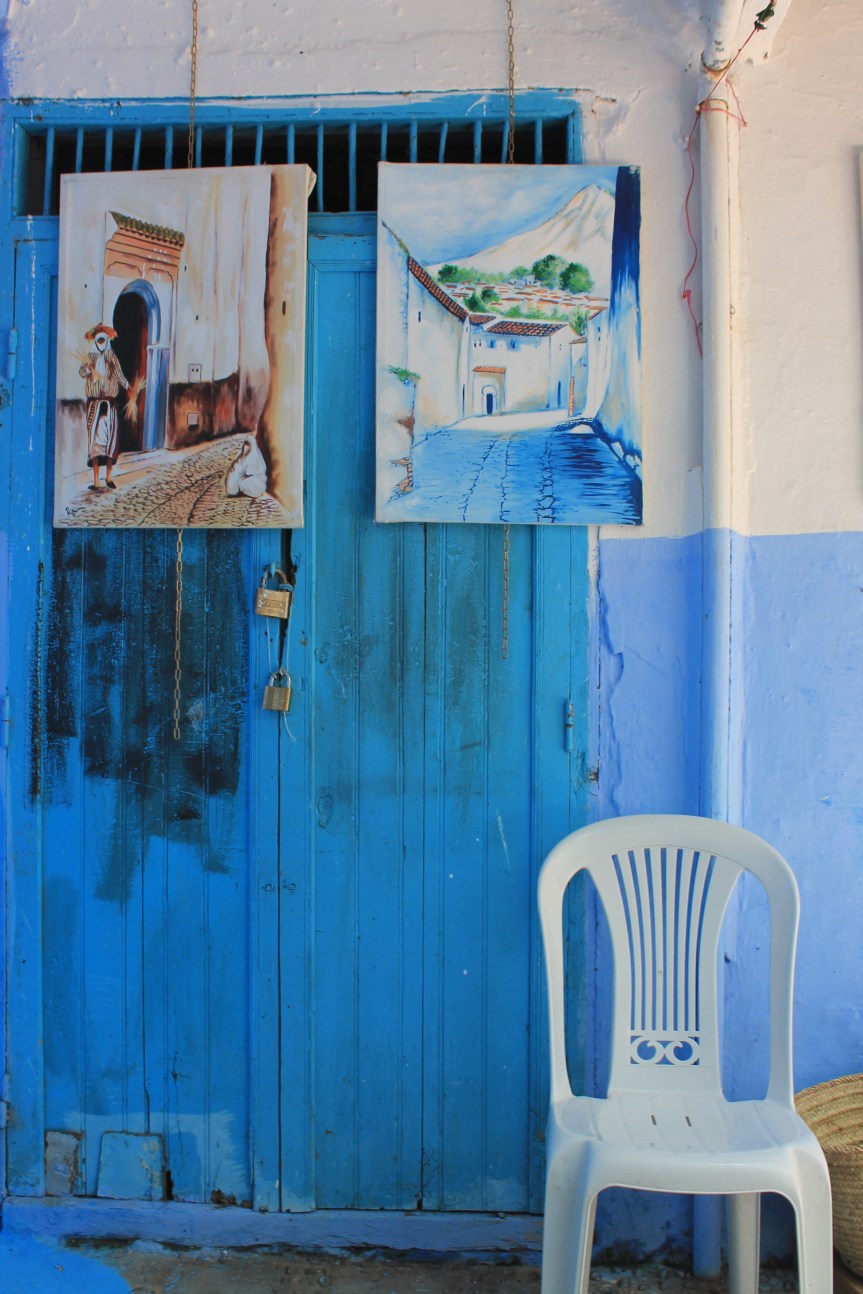
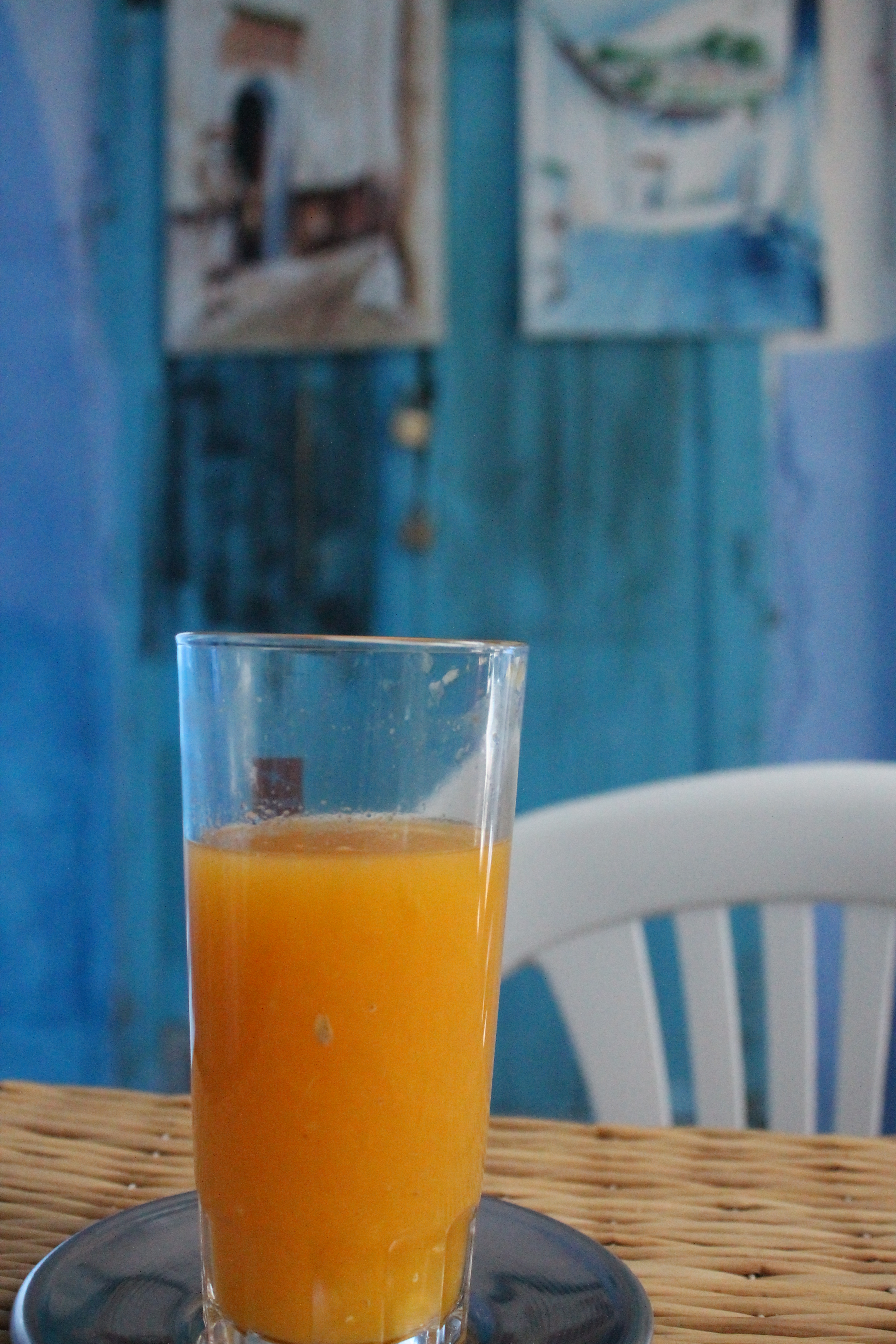
We sat on white plastic chairs and admired the blue art hanging from metal chains on the blue walls. The reed table runner covered the rusty metal table and smelled like fresh hay. Sitting felt wonderful. The shade felt wonderful. We pulled off our sunglasses and mopped the sweat from our foreheads.

The juicer was whirring inside a makeshift hut, the café’s kitchen. A moment later, we heard slurping and a satisfied, “Ahhh!” Apparently our juice had met the café owner’s approval.

He brought out tall glasses on little metal plates. “My name is Rashid.”His sunny smile brightened when we tried to speak Arabic. But he left us alone until we were finished enjoying the shade and every last drop of our fresh orange juice.

glass of orange juice on wicker table next to blue wall