
Was it worth it?

“Was my time in Spain worth it?” This question has crossed my mind a hundred times since I started winding down my life here. Was all of the time, energy, and finances invested worth the results I see? Or rather, the lack of results? Were they worth the years of being far from the people I love best in the world? Far from my own culture and community?

Lord willing, I plan to move back to the States in just over 2 weeks. My emotions are everywhere, leaking out in goodbye tears with a friend or bouncing in sheer giddiness as I remember that I don’t have to face upcoming life transitions alone anymore.

But was my time worth it?

I came across a quote from Elisabeth Elliott that I had jotted down long ago: “[People] cannot be hustled into the kingdom of God. And it is well to remember Christ’s own descriptions of that kingdom–leaven and seed, things that work slowly and out of sight. We long for visible evidence of our effectiveness and when it is not forthcoming, we are tempted to conclude that our efforts never had anything to do with the kingdom.” (From Made for the Journey by Elisabeth Elliott)

Exactly. I have coached myself not to dwell on the question of whether or not my time in Spain was worthwhile. After all, God works in ways we can’t see and I don’t have to understand the whys of His calling. Like Elisabeth Elliott said, God’s work is often slow and hidden.

When I shared my thoughts with J,  he suggested a new perspective, one he had gleaned from an article he had read. In his unimposing way of communicating truth, he suggested that rather than asking myself, “Was the sacrifice worth it?” it’s better to remind myself: “He is worth it.”

My personal fulfillment takes a backseat to God’s glory. 

This doesn’t mean I can’t evaluate my work and make adjustments. Neither does it mean I cannot grieve my losses or my lack of perceived success. But staying stuck in my questioning grief reveals a lack of divine perspective because neither sacrifice nor success can define the worth of a kingdom endeavor. 

A life spent for God is worth it, no matter what.

Deeper sorrow, deeper joy

I know how to hide my feelings from myself. I’ve had practice telling those miniature white lies about how I don’t mind or that I’m unconditionally happy and galloping through life without unwanted feelings lassoing me.

My body gives me a jolt now and then: a wrinkled forehead glimpsed in the mirror, indigestion, weight loss, fatigue. But look on the bright side, I think. I don’t really feel that stressed, weary, cranky, or conflicted. I am living the ideal life. Who in their right mind wouldn’t want to be me right now?

What I don’t remember is that shutting down my “negative” feelings also shuts down my capacity to deeply feel joy.

Earlier this month, I realized that wedding planning all day on my day of rest was not a sustainable pattern. So on my next day off, I forced myself to rest, really rest. I wrote “read” on my to-do list and that was all. As evening came, I transitioned into watching Call the Midwife. Two episodes later, I shut down my computer and cried. It was as if feeling vicariously for almost 2 hours helped to release my store of pent-up feelings.

This is where I want to be: feeling. Even if sometimes it means feeling an aching loneliness or feeling downright scared at what looms ahead. When I open my heart to feel, I experience the richness of the ups and downs of a life fully-lived. Because joy is right there too, every bit as deep… deeper even, but I can’t notice it when I’m only skimming along the top of life.

This season of life is filled with lasts and goodbyes as I prepare to leave Spain in 3 1/2 weeks. “Another last,” said my teammate when we dropped off my final guests. My guests and I had had a marvelous time, exploring and talking, processing and laughing. Their leaving set me into motion, clearing out my house and closing up my life here. It aches, but not all aches are bad.

I’m also filled with energy as I think about trading this life for several months with family and friends in my home community. And then there’s the dizzying delight of marrying J in three short months.

God meant the sorrows and joys of this season to be felt rather than ignored. So today, I choose to stay in this vibrant sense of being alive.

I’m doing terrible, terrible

Estoy fatal, fatal…” I’m doing terrible, terrible. That’s how an elderly neighbor typically greets me. 

Maybe I’ve lent an ear too many times. Or, for all I know, she dumps her health issues on everyone she comes in contact with. 

Being on the receiving end of her complaints isn’t much fun. It’s hard to listen to how the doctors can’t give her any answers, about her latest trip to the pharmacy, or how her legs refuse to work (although they mysteriously carried her several blocks from home). 

She never asks how I am or what I’m doing. I doubt she even knows my name. 

I help roll her walker down the ramp from the elevator, open the door, and stop for a “Oh, uh-huh, oh that’s too bad” chat on the street. I even take her cinnamon rolls at Christmas because I know she likes them. Still, I inwardly groan every time our paths cross.

Estoy fatal, fatal…

As much as I hate to admit this, I know that sometimes I sound just like my neighbor: “Why me? Why do I have to be the one to deal with this bumpy relationship/chronic illness/broken heart/smashed dream? I’m doing terrible, terrible…”

When life doesn’t feel fair, it can be an easy slide from lament to griping, from heartache to bitterness. Even with the Spirit of God dwelling in me. 

So it’s a good thing God sends my neighbor into my life every now and then to give a face to my inward grumblings and remind me to trust that God knows what He is doing. Then, as Jen Pollock Michel writes in her book In Good Time, I can receive life with gratitude and say, “Whatever you choose to give, Lord, I embrace” (p.99).


Pollock Michel, Jen. In Good Time: 8 Habits for Reimagining Productivity, Resisting Hurry, and Practicing Peace. Kindle ed., Baker Books, 2022.

A life of perpetual humiliation

I just finished reading Anthony Doerr’s Four Seasons in Rome. Someone discarded it, and I picked it up, curious. This isn’t a book recommendation unless you happen to know that you like Anthony Doerr, but Doerr’s descriptions of life on the outside of a culture cut me wide open. I didn’t know there were words for these “in but not of” feelings.

Apartness and perpetual humiliation are part of daily life for those living overseas. Sometimes we talk about it too much. Often we don’t even acknowledge it but let our frustration become part of the existing barrier, like a thick moss growing over a wall we’re trying to ignore.

We are outsiders, always outsiders, chipping at the barrier that stands between us. And there are successes! Moments when a chunk of the wall falls away and we glimpse the other side…only to find razor wire. 

“To be a nonfluent foreigner is to pass through one gate only to find yourself outside two more,” writes Doerr (p. 46). “We are humbled over and over–humility hangs over our heads like a sledgehammer… Oh, you think you’ve been here long enough to barter at the street markets? Guess what, you just spent €8 on three plastic clothes hangers” (p. 76).

After nine months in Rome, Doerr walks into a grocery store and makes an order without messing up a single syllable. “What happens?” he writes. “I get my groceries. No streamers drop from the ceiling, no strobe lights start flashing. The grocer doesn’t reach across the counter and take my face in her hands and kiss me on the forehead.” Instead, the grocer asks about his boys and speaks so quickly he can’t keep up. “…I miss 80 percent of it and sheepishly, stepping down from my throne of fluency, have to ask, ‘I’m sorry, more slowly, please?’” (p. 168)

For some, eventually the barriers do not loom so large or feel so insurmountable. But for many? “I know nothing… I never made it through the gates between myself and the Italians. I cannot claim to have become, in even the smallest manner, Roman” (p. 201).

True. Despite my efforts to integrate into the culture around me, my North American worldview remains mostly intact, placing me decidedly on the outside. 

But if we let it, doesn’t living on the outside help us accept who we are? After all, like it or not, we cannot cease being a part of something. Not being a part of the culture we’re living in is because we’re part of another, or even several. Being on the outside can help us identify our own “inside.”

Apartness and perpetual humiliation are hard, but they are also opportunities to learn and grow.* And we need these opportunities to understand ourselves.

So I will try to be grateful. Even as my neighbor gives me a list of what is wrong with my couscous. Next time, it will be better. I can promise.


Doerr, Anthony. Four Seasons in Rome. Scribner, 2007. 

*Thank you, J, for your positive spin on life to remind me to keep on growing!

Part three: Relationship advice and edible puzzles

Click to read: Part one: A palace and a hostel and Part two: A stolen sandwich and art


J and I spent almost a week in Mytown. He stepped into my life and met my people. Yes, I continued to feel the emotional dissonance of my meshing worlds, but assigning a name to the feeling seemed to rob it of its power. 

“Does he have money to take care of you?” 

My friends and neighbors invited themselves into the particulars of our relationship. They all had advice about where we should live, how soon we should get married and start a family, etc.– but they always expressed their approval of J in the end.

We found park benches to sit on and people-watch. We discussed things we hadn’t thought to discuss on the phone or through emails and messages. Sometimes we didn’t bother to do anything except “be” with each other. 

Two men on a park bench in a plaza

But that’s not all we did. We had British breakfast at the port. And on the beach, I collected broken shells while he went for a jog along the shoreline. A teammate borrowed J for morning bike rides, giving him the chance to burn off some of his morning energy before I even rolled out of bed. 

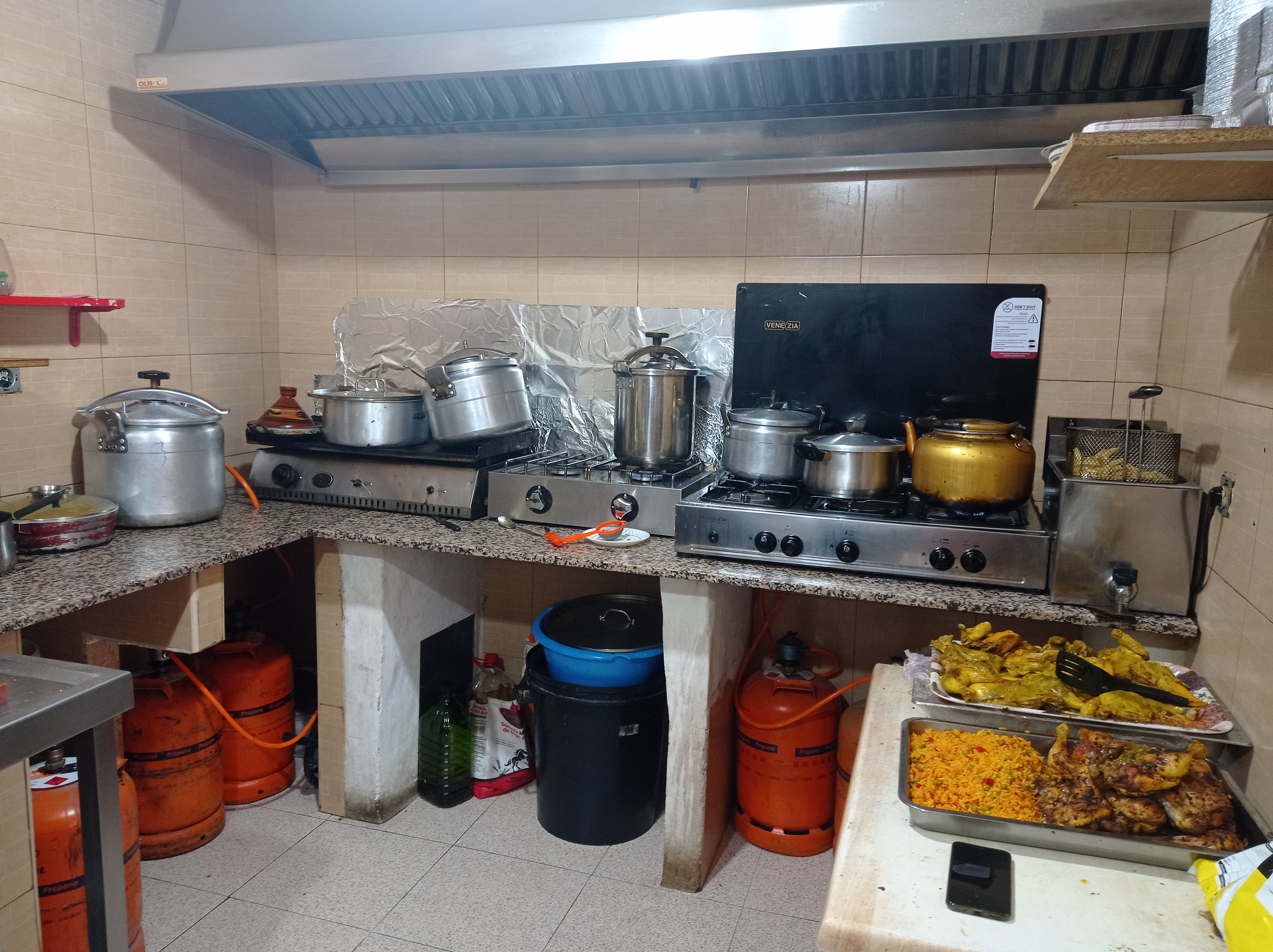
Late one morning, we bussed to a neighboring town’s restaurant where my friend cooks. She gave me a tour of the kitchen, lifting kettle lids and describing everything inside. She heaped our table full of food we hardly made a dent in: chicken with rice, lentils, beef and prune tagine, salads, fries, bread, vegetables, and tall glasses of orange juice. “I was so happy when you said you were coming that I cried,” she told me later. She expressed her appreciation for our visit by making sure that we were taken care of… right down to ordering our pirated taxi ride home.

Restaurant kitchen filled with prepared food

We delivered birthday gifts to my neighbor boys. We went to the market and bought a buffet of olives and other pickled delights. And J chatted with the various Chinese store owners around town. His Mandarin was typically met with surprise and guarded curiosity… or even an expletive.

We spent a warm afternoon volunteering with the Red Cross, entertaining a group of children while the village women studied basic Spanish. The director had brought puzzles for the children, but the puzzles were too advanced for their ages. One little boy leaned into an open puzzle box and scooped the pieces to his mouth, pretending to eat them: “Om! Om!” he said over and over again. The other children weren’t too concerned as long as his appetite didn’t extend to their puzzle. There were some wild moments, some tattle-tale stories, and a mini lesson on forgiveness. A volunteer from another district had brought virtual reality glasses which entertained a few adults and children at a time. 

Over the course of the week, we spent a lot of time at the center where J was staying, learning how to bump around in the same kitchen together while on task. J faithfully washed the dishes after our meals; I could probably count on one hand the number of dishes I washed when he was around. Our team met on Sunday and for a few other activities scattered throughout the week. 

In the evenings, J would walk me home. And in the mornings, he would usually meet me on my way to the center. In fact, there was rarely a time that I walked that three-minute walk entirely alone. A delighted smile to greet me on the street was one of those small things that made me miss him terribly when he was gone. 

And then, on Thursday evening, we finished our laundry, packed our backpacks, and attempted an early bedtime. The next morning, we left for North Africa. 

Utilizing distractions

The last few weeks have both drained and filled me in ways I’m not even sure I can explain. Oddly enough, one of the things that helped me cope with overwhelming emotions was reading a chapter book to my oldest nieces and nephews, sending a chapter or two each day via voice message. My family is full of avid readers and listeners, which makes the escape of a good story enjoyable for all of us. 

Did I just use the word “escape”?

I used to think distractions were an emotionally weak way to deal with an issue. I still think that they can be just that. But they can also give time to let emotions settle. A well-timed distraction can keep us from panicking, growing numb, or tuning out. A distraction contains the issue–good or bad–for a time until we’ve worked up the strength to deal with it. 

Even when I manage to relinquish my preoccupation to the Lord, I still find it helpful to distract myself so I don’t snatch it back from His capable hands. You might find me organizing my pantry while listening to an audio book or praying aloud. Or deciding an across-town shopping trip must be done today, on foot, at tip-top speed. Or making a detailed and utterly useless list.

At some point, the issue must be addressed–the change faced, the sorrow grieved–and distractions must come to an end. We cannot heap distraction upon distraction and expect positive results.

Today as I was leafing through an old Bible study book, I saw that I had written an “escape plan,” practical steps to exchange my burdens for the yoke of Christ. “Stop. Praise. Pray. Distract. Share.” My goal had been to post these steps somewhere, but the idea got lost in the shuffle of life. Until today.

I guess I needed the reminder that distractions, useful as they are, are a means to an end and not the end themselves.

What am I fit for?!

If you’ve ever given your heart to more than one place in this world, you’ll know what I’m talking about. 

I am in a culture that is not my own; yet, in a strange way, I feel like I belong. But I will never fully belong because this is not who I am. Paradoxically, returning to the place I most expect to belong is not as comfortable as it used to be. I’ve changed, adapted, conformed–or whatever you want to call it–to my new culture, and I can’t go back without wearing that change. 

One evening not long ago, I was on my way home when suddenly confusion washed over me. Where was I going? “If I were to go to the homiest home I can think of right now, where would I go?” I asked myself. My flat in Spain? My room at my parents’ house? Or any of the other places I’ve lived in my lifetime? 

The concept of “home” was foggy, like waking from a dream and expecting to be in one place but being thousands of miles away instead.

When I feel that sense of homelessness, I think of Eliza Doolittle in the musical My Fair Lady. As the result of a wager between two learned men, Eliza has been transformed from a street flower girl into a proper lady. But now the experiment is done, and she is turned loose. But to where? In one world, she can only ever be an imposter; in the other world, she has changed too much to go back and belong. “What am I fit for?!” she cries.

I feel that agony sometimes. I want the luxury of fully belonging to one home and one culture, of not being different or feeling misplaced. 

But this strange in-between space is also held in the hand of my loving Father. Today, that is enough. And tomorrow it will be too.

If I get lung cancer, it’s Spain’s fault

When I walk down the street, more often than not, I find myself walking behind someone with a smoldering cigarette. If I can’t speed around them, I try to get out of their wake but end up bumping into oncoming pedestrians.

Why does this happen so often, you ask? It’s not Murphy’s law, so don’t bother blaming it on him. Actually, it’s because so many Spaniards smoke.

One of the first things I noticed when I returned to Spain this fall was the smells. Cigarette smoke, cologne, cigarette smoke, body odor, cigarette smoke, car fumes, cigarette smoke–oh, and to break it up a little, weed. 

I was walking home from the market one morning when a middle-aged lady stopped me and asked for a light. I was curious; did I look like I smoked? Or was it an assumption given my geographical location?

Last week, a group of us huddled in a bus stop, trying to hide from the chilly breeze within the three protective walls. Without warning, two of the ladies lit up, forcing the rest of us to choose between the chill or the fumes. Rude? Well, I’m in Spain and this is how it’s done among the young, old, rich, poor, and everything in between.

Until I start carrying my own tank of purified air, I suppose I will continue inhaling secondary smoke. It’s life here, for better or for worse, and I’m the one who chose to live here. I’m just saying that if I get lung cancer someday, it’s probably Spain’s fault!

“Savor” to “survive” and back again

Last year, I succumbed to the pressure of choosing a word for the year. Many find this practice useful, helping them to reestablish their life’s purpose and set achievable goals and the like. I, however, have never found it particularly helpful, typically forgetting my chosen word by mid-February at the latest. 

But, like I said, last year I succumbed again. After sorting through a list of candidates, I selected “savor.” My choice came from a desperate attempt to hang on to the shreds that life was offering me. 

Ironically, I didn’t forget my word last year. But I watched as it morphed from “savor” to “survive.” That change stung because it didn’t even feel like a choice.

I survived the coming summer heat, physical exhaustion, the hours upon hours of traveling, coordination, public speaking, and the other things I don’t typically enjoy. I smiled as I networked and made new connections and friends and caught up with dear old friends. I was glad…but savor? No. I felt like I was clutching at the precious moments as they passed by.

So here I am at the beginning of a new year, analyzing the last one and seeing that, in its own way, last year was indeed something I could savor. The moments still slipped by too quickly, but their accumulation brought healing. That frantic juggling of a schedule allowed me to see a doctor and finally get some answers. Those times with friends squeezed into my trips and around my trips gave me the input and support I desperately needed. And the list goes on.

So I look back on 2023 and savor the memories because I am a little more mature, a little more like Jesus because of the stories of last year. 

That said, I think I’ll refrain from choosing a word for 2024; it’s too much pressure!

What about you? Have you chosen a word for this year?

My new winter coat

As I fingered my winter coat, I noticed the excellent quality of the fabric and stitching. The bus was bouncing through roundabouts; still, it was worth risking motion sickness to do a quick google search of the brand.

I wasn’t wrong. My coat was excellent quality.

But by now you’re probably wondering why I hadn’t figured this out before. After all, hadn’t I been the one to buy the coat in the first place? Well, yes, but I bought it in the same place I buy most of my clothing: a thrift shop. 

It was exactly what I wanted–just a bit long, sturdy, warm but not too warm for Spanish winters, a hood, pockets, and dark. And that hole in the pocket wouldn’t take more than 2 minutes to mend and that dog hair would wash out because, yes, it was even washable too. And who besides me would notice that scuff on the cuff?

Besides, I was past due to replace the $5 coat I had picked up at a second-hand market in North Africa seven years ago. So I bought this new coat for $12 plus tax and brought it back to Spain with me, where I was just discovering that Goodwill had offered quite a steal.

As we bounced along, I felt rather pleased with myself. And as other winter coats brushed past me, I felt even more pleased with myself. Doubtless, I had the nicest coat on board the bus. 

Yes, there was a rush of pride as I forgot how surprised I had just been to find myself the owner of something of quality. I mentally classified myself with the elite. My classy coat may not have been a luxury brand, but was subtly luxurious, nonetheless. I sat up straighter. 

And then I looked down at the skirt I was wearing and it occurred to me that it was pilling from overuse. And the sneakers poking out the bottom were smudged from all of the streets they had walked with me. Hmm. Was I the first to notice the incongruous quality of my clothing?

And then I wanted to laugh. Who cared? Who really cared? Let the world scratch their heads if they wanted to. I planned to enjoy both worlds even if I ended up looking like a walking thrift store.

At my stop, I hopped off the bus feeling like a million dollars.